
What is the Patent Box Scheme? A Comprehensive 2026 UK Guide

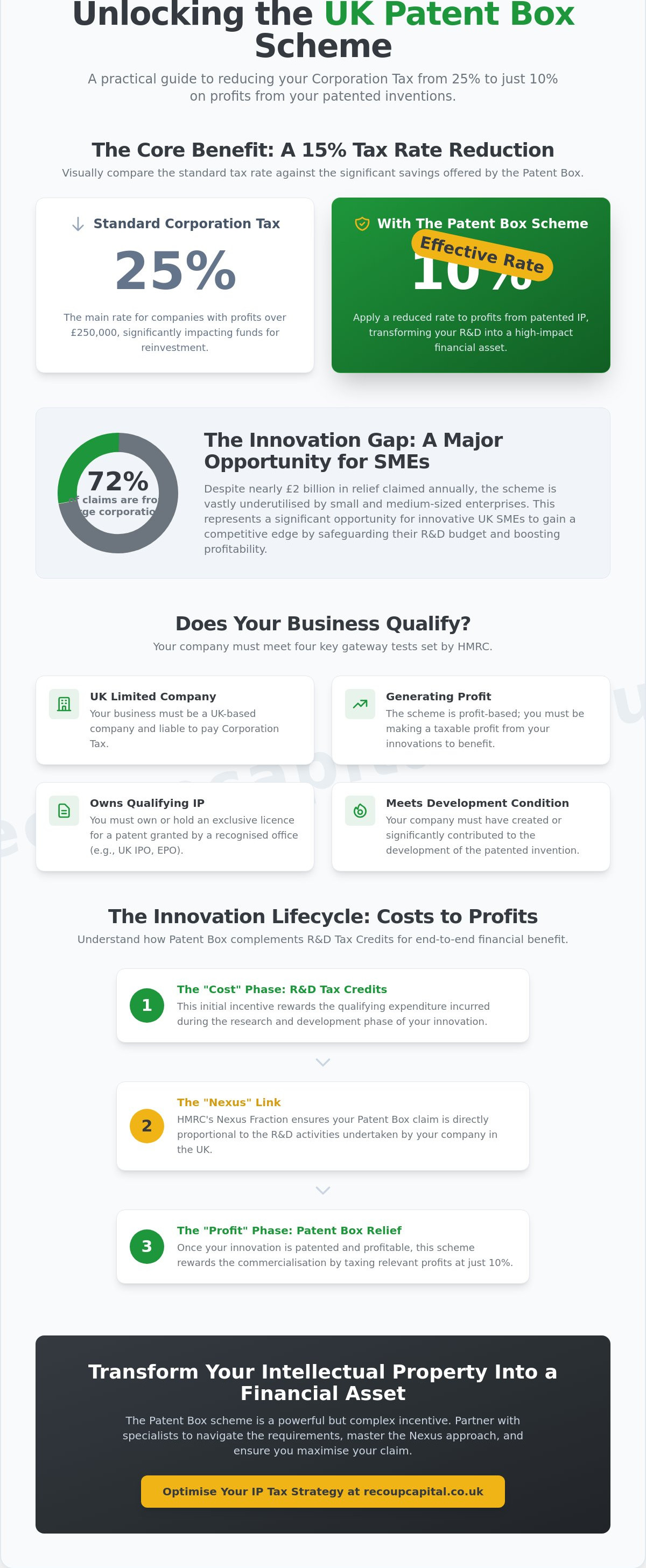
Despite nearly £2 billion in relief being claimed annually, a staggering 72% of companies currently using the Patent Box scheme are large corporations, leaving a significant innovation gap for UK SMEs. If your business is feeling the weight of the 25% Corporation Tax rate, you are likely asking what is the patent box scheme and how it can practically safeguard your R&D budget. This incentive is a powerful strategic tool that rewards British ingenuity by reducing the tax on profits derived from patented inventions to just 10%.
We recognise that watching a quarter of your profits disappear can be disheartening, particularly when those funds are vital for future growth. The complexity of HMRC's nexus approach and the transition to the Intellectual Property Office's new digital service often make the process feel intimidating. This guide promises to demystify the 10% tax mechanism, help you identify if your specific IP qualifies, and show you how to integrate this relief with R&D tax credits for maximum benefit. We will outline the essential steps to navigate the strict two-year election deadlines and turn your intellectual property into a high-impact financial asset.
Key Takeaways
- Reduce your effective Corporation Tax rate from 25% to just 10% on profits derived from your patented inventions.
- Understand what is the patent box scheme and whether your intellectual property granted by the UK IPO or EPO meets the latest eligibility requirements.
- Master the "Nexus approach" to ensure your previous R&D expenditure correctly fuels your current Patent Box tax relief.
- Identify Relevant Intellectual Property Income (RIPI) to accurately separate your patent-related earnings from standard commercial revenue.
- Learn how to integrate Patent Box claims with your R&D tax credits to transform innovation into a long-term strategic asset.
Understanding the Patent Box Scheme in 2026
In 2026, the UK's fiscal environment presents a clear divide between standard commercial activity and high-value innovation. For many directors, the primary question remains: what is the patent box scheme and why is it suddenly a boardroom priority? Simply put, the Patent Box is a government tax incentive designed to reward companies that choose to keep their intellectual property (IP) and its commercialisation within the UK. By offering a significantly reduced rate of Corporation Tax on profits derived from patented inventions, the scheme acts as a powerful anchor for British engineering and technology firms.
The core objective of the scheme hasn't changed since its introduction in 2013; it's about global competitiveness. The UK government wants to prevent "brain drain" where innovative ideas are developed here but commercialised elsewhere. For those seeking a broader historical context, Wikipedia's explanation of Patent Box details how these regimes have evolved across Europe to encourage domestic research and development. In 2026, this incentive is more relevant than ever, providing a stable foundation for businesses to scale their operations whilst maintaining their tax efficiency.
The 10% Corporation Tax Advantage
The most compelling reason to explore the scheme is the 15% tax saving gap. Whilst the main rate of Corporation Tax stands at 25% for companies with profits over £250,000, the Patent Box allows you to apply a reduced 10% rate to profits linked to your patents. This relief isn't a direct grant or a cash payment; instead, it's delivered as an additional deduction in your CT600 tax return. An effective rate is the actual percentage of tax paid on specific profits after all relevant adjustments and deductions have been applied. By lowering this rate, the scheme ensures that a larger portion of your commercial success stays within the business to fund the next generation of products.
Why Intellectual Property Incentives Matter Now
Since the major tax shifts in April 2023, the Patent Box has transitioned from a "nice to have" to a core strategic pillar. Whilst other tax reliefs have faced scrutiny or adjustment, the Patent Box remains a remarkably stable and predictable incentive. It rewards the "profit" phase of innovation, complementing the way R&D tax credits reward the "cost" phase. This stability allows for confident long-term planning. For a business in the manufacturing or life sciences sectors, these savings aren't just numbers on a balance sheet; they represent the capital required for new machinery, specialised talent, and further IP protection. It's about transforming your legal protections into strategic financial assets that drive sustainable growth.
Eligibility Criteria: Does Your Business Qualify?
Securing the benefits of the Patent Box requires more than just holding a certificate from a patent office. To understand what is the patent box scheme in a practical sense, you must first determine if your company meets the strict gateway tests set by HMRC. Primarily, your business must be a UK limited company liable for Corporation Tax. Crucially, the scheme is profit-based; you must be generating a taxable profit from the commercialisation of your intellectual property to see a reduction in your tax bill. If your innovation is still in the pre-revenue phase, you won't benefit immediately, but the groundwork you lay now is vital for future capital recovery.
Qualifying Intellectual Property (IP) Rights
The scheme isn't limited to standard mechanical patents. To qualify, your IP must be granted by the UK Intellectual Property Office (IPO), the European Patent Office (EPO), or specific EEA nations. This includes medicinal and botanic innovation rights, such as supplementary protection certificates and plant variety rights. Many directors worry about the time it takes for a patent to be granted, particularly with the transition to the "One IPO" digital service. It's reassuring to know that whilst you cannot claim the 10% rate whilst a patent is "pending," you can often backdate the relief once the patent is officially granted, provided you have elected into the scheme on time.
The Development Condition and Exclusive Licensing
HMRC's "Development Condition" is designed to ensure the relief supports genuine UK-led innovation. To satisfy this, your company must have performed "qualifying development" by creating or significantly improving the patented invention. It isn't enough to simply purchase a patent from a third party and collect the royalties. If your business is part of a larger group, you must also meet the "Active Ownership" requirement. This means you must perform a significant amount of management activity regarding the IP, such as deciding how it is used or protected, rather than being a passive holder of the rights.
For companies that don't own their patents outright, exclusive licensing provides a viable route to eligibility. However, the contract must be robust. To qualify, your licence must grant you rights to the exclusion of all other persons, including the patent owner, within at least one entire national territory. Taking the time to review your IP portfolio with a specialist can reveal whether your current structure meets these rigorous HMRC standards or if adjustments are needed to protect your future claims. This proactive approach ensures that your legal protections are correctly aligned with your tax strategy from the outset.
The Strategic Link Between Patent Box and R&D Tax Credits
Understanding what is the patent box scheme involves looking beyond a single tax line and seeing how it interacts with the broader innovation lifecycle. Whilst many businesses treat these incentives as separate silos, they are actually two sides of the same coin. R&D tax credits are designed to reward the "cost" of innovation by providing relief on the money you spend during the development phase. Conversely, the Patent Box rewards the "profit" generated once that innovation is commercialised. By aligning these two mechanisms, you create a powerful financial loop where the savings from one stage help fund the next breakthrough.
The timing of these claims is a critical component of your cash flow strategy. During the early, loss-making years of a project, R&D tax credits explained as a cash injection or tax reduction can be a lifeline. Once your patented product hits the market and begins generating taxable income, the Patent Box takes over to protect those profits at the 10% rate. These two schemes form a cradle-to-grave incentive that supports your business from the first prototype to global commercial success.
How R&D Expenditure Influences Patent Box Savings
The "Nexus" regime is the bridge between your development activity and your final tax saving. HMRC uses an R&D fraction to track how much of the innovation was actually performed by your company. If you conduct your research in-house, your fraction remains high, allowing you to claim the full benefit of the 10% rate. However, outsourcing R&D to connected parties or purchasing IP from elsewhere can dilute this fraction. This direct link ensures that the most significant rewards are reserved for companies that maintain a substantive presence and active development team within the UK.
Navigating the Nexus Fraction for Maximum Relief
Calculating the fraction involves a specific formula: (Qualifying R&D + Uplift) / Total IP Expenditure. HMRC allows a 30% "uplift" on your qualifying costs to provide some flexibility, but the underlying data must be robust. Meticulous record-keeping is your best defence; you need to track every pound of expenditure back to the specific patent it supports. Optimising your supply chain is equally vital. By carefully managing how you engage with subcontractors and group companies, you can protect your R&D fraction and ensure your Patent Box benefit remains as high as possible. This level of detail transforms a simple tax claim into a sophisticated piece of corporate finance that supports long-term reinvestment in British tech.
Calculating Your Benefit: From IP Profits to Tax Savings
While understanding what is the patent box scheme starts with the headline 10% rate, the true value is found in the precision of your calculations. HMRC requires a specific multi-stage process to isolate the profit attributable to your patents from your standard commercial earnings. This isn't just about your total turnover; it's about dissecting your income streams to identify what qualifies as Relevant Intellectual Property Income (RIPI). By isolating these figures, you can ensure that your tax relief is both maximised and fully compliant with the latest regulatory standards.
Identifying Relevant IP Profits (RIPI)
Identifying RIPI is the foundation of a successful claim. It encompasses several specific revenue types that must be tracked meticulously:
- Revenue from the sale of patented products or bespoke items that incorporate a patented component.
- Income generated through licence fees or royalties derived from your qualifying IP.
- Financial gains from the sale of the IP rights themselves or awards from patent infringement cases.
Once you've identified this income, you must deduct the specific costs associated with generating it to reach your "IP profit." This figure represents the raw benefit of your innovation before the final adjustments are applied.
After determining your IP profit, the next step involves applying the Nexus Fraction discussed in the previous section. This fraction adjusts your profit based on your proportion of in-house R&D expenditure. Finally, you elect into the scheme by making a formal notification in your CT600 tax return. This election is a binary choice; you're either in or out for that specific accounting period, and the decision must be made with a clear view of your long-term tax position.
Common Pitfalls in Patent Box Calculations
The calculation contains several mandatory deductions that often trip up the uninitiated. You must exclude a "routine return," which is essentially the profit HMRC assumes any business would make even without a patent. This is typically calculated as a 10% markup on certain costs. Additionally, if your brand carries significant value, you may need to deduct a "marketing asset return" to ensure the relief only applies to the technological innovation rather than your brand's market power.
Perhaps the most critical pitfall is the election deadline. You have exactly two years from the end of the accounting period in which the profits arose to elect into the scheme. If you miss this window, the opportunity for that period is lost. Given these complexities, many businesses choose to partner with a corporate finance specialist to ensure every deduction is accurate and every deadline is met. Professional oversight transforms a complex tax requirement into a streamlined strategic advantage for your business.
Partnering with Recoup Capital for IP Tax Optimisation
Moving from the theoretical understanding of what is the patent box scheme to a successful tax election requires a specialised execution strategy. At Recoup Capital, we act as a proactive guide through these regulatory landscapes, ensuring your innovation is rewarded without the administrative burden often associated with HMRC's nexus requirements. Our approach is rooted in transparency and results, focusing on identifying overlooked IP opportunities that standard accounting might miss. We don't just process paperwork; we reframe your financial returns as strategic assets that fuel your future growth and stability.
Our team understands the nuances of the 2026 tax environment, including the transition to the Intellectual Property Office's digital services. We handle the heavy lifting of data collection and technical justification, allowing your directors to focus on core operations. By maintaining a solid track record and a commitment to reliability, we transform complex regulatory procedures into an approachable opportunity for business expansion. This partnership-oriented style ensures that your claim is defended with institutional credibility whilst maintaining professional clarity throughout the process.
Our Integrated Approach to R&D and Patent Claims
Operating at the intersection of tax law and technical innovation, our team ensures your R&D tax credits and Patent Box claims work in perfect harmony. Managing both schemes through a single partner prevents data duplication and eliminates the risk of conflicting Nexus Fraction figures that can arise when different firms handle separate incentives. Our technical specialists work alongside chartered accountants to ensure every pound of qualifying expenditure is captured. This unified view ensures your corporate finance strategy fully accounts for the long-term value of your intellectual property, protecting your innovation from cradle to grave.
Why a Success-Based Model Protects Your Innovation
We believe in demonstrating value through results rather than delivering a traditional sales pitch. Our success-based fee model means there are no upfront costs; we only win when you successfully recover tax. This aligns our goals directly with your recovery and fosters a relationship-first approach built on mutual success. We manage the proactive HMRC liaison on your behalf, providing peace of mind and ensuring full compliance with the latest 2026 guidelines. Speak with a Recoup Capital specialist today to discover how a long-term collaboration can protect your innovation and maximise your business's capital utility.
Transforming Innovation into Strategic Capital
The Patent Box scheme is no longer just a tax incentive; it's a fundamental component of a modern UK business strategy. By reducing your Corporation Tax to 10% on qualifying profits, you're essentially creating a sustainable fund for future breakthroughs. You now understand what is the patent box scheme and how it integrates with your R&D efforts to protect the entire lifecycle of your innovation. Success depends on meticulous record-keeping and meeting strict election deadlines to ensure no capital is left behind.
Our team of chartered tax accountants and technical specialists provides national coverage across all innovation sectors, ensuring your claims are robust and fully compliant. We operate on a success-based fee structure, meaning our interests are perfectly aligned with your business growth and long-term success. We invite you to book a no-cost IP tax review with Recoup Capital to explore how we can turn your intellectual property into a high-impact financial asset. Your ingenuity has built the future; it's time to ensure your tax strategy reflects that achievement.
Frequently Asked Questions
Can I claim Patent Box relief if my patent is still pending?
You cannot apply the reduced 10% tax rate whilst your patent is in the "pending" stage. However, you can track and accumulate the potential relief during this period. Once the patent is officially granted by the UK IPO or EPO, you can backdate the claim for the profits earned during the pending period, provided you elected into the scheme for those years. This ensures that the time spent in the application queue doesn't result in lost tax savings.
Does the Patent Box scheme apply to software and AI inventions?
Software and AI inventions are eligible provided they meet the rigorous criteria for patentability. If your code solves a specific technical problem in a non-obvious way and results in a granted patent, the profits derived from that software qualify for the relief. This is a vital area for tech firms seeking to understand what is the patent box scheme and how it can protect digital innovation within the 2026 landscape.
How does the Patent Box work with the new Merged R&D Scheme?
The Patent Box continues to operate alongside the Merged R&D Scheme that was introduced in April 2024. Your qualifying R&D expenditure under this merged regime remains the foundation for your Nexus Fraction calculation. It's essential to maintain meticulous records of these costs, as they directly determine the proportion of your IP profits that can benefit from the 10% Corporation Tax rate.
Can small businesses benefit from Patent Box or is it just for large firms?
Small businesses can absolutely benefit from the scheme, even though large corporations currently account for the majority of claims. Any UK limited company with qualifying patents and taxable profits can elect to use the 10% rate. For an SME, the 15% saving compared to the 25% main rate is a significant strategic asset that can be reinvested into further research and development.
What happens if our patent is held by an overseas parent company?
A UK subsidiary can still claim relief if it holds an exclusive licence to use and commercialise the patent. To be eligible, the UK entity must meet the "Development Condition" by showing it played a significant role in creating or improving the invention. You'll also need to demonstrate "Active Ownership," meaning the UK team manages the IP rights rather than just holding them passively.
Is there a limit to how much tax relief we can claim through the scheme?
There is no fixed monetary cap on the total amount of tax relief a company can claim through the Patent Box. The benefit is limited only by the volume of your Relevant Intellectual Property Income and the strength of your Nexus Fraction. As your patented product sales grow, your tax savings scale proportionally, making it a highly effective tool for high-growth engineering and technology firms.
How long does it take to see the tax benefit after electing into the Patent Box?
You'll typically realise the financial benefit when you file your annual Corporation Tax return. Because the relief is delivered as a deduction that reduces your taxable profit, it results in a lower tax bill or a refund of tax already paid on account. This process usually concludes within nine months and one day of your accounting year-end, providing a predictable boost to your company's cash flow.
What documentation does HMRC require for a Patent Box claim?
HMRC requires a robust audit trail that connects your commercial profits directly to your qualifying patents. You'll need to provide a detailed breakdown of your Relevant Intellectual Property Income and evidence of the R&D expenditure used to calculate your Nexus Fraction. Maintaining clear documentation of what is the patent box scheme's impact on your specific product lines ensures your claim is processed smoothly and remains compliant with the latest regulations.