
What Accountants Need to Know About R&D Tax Credits in 2026: A Strategic Guide

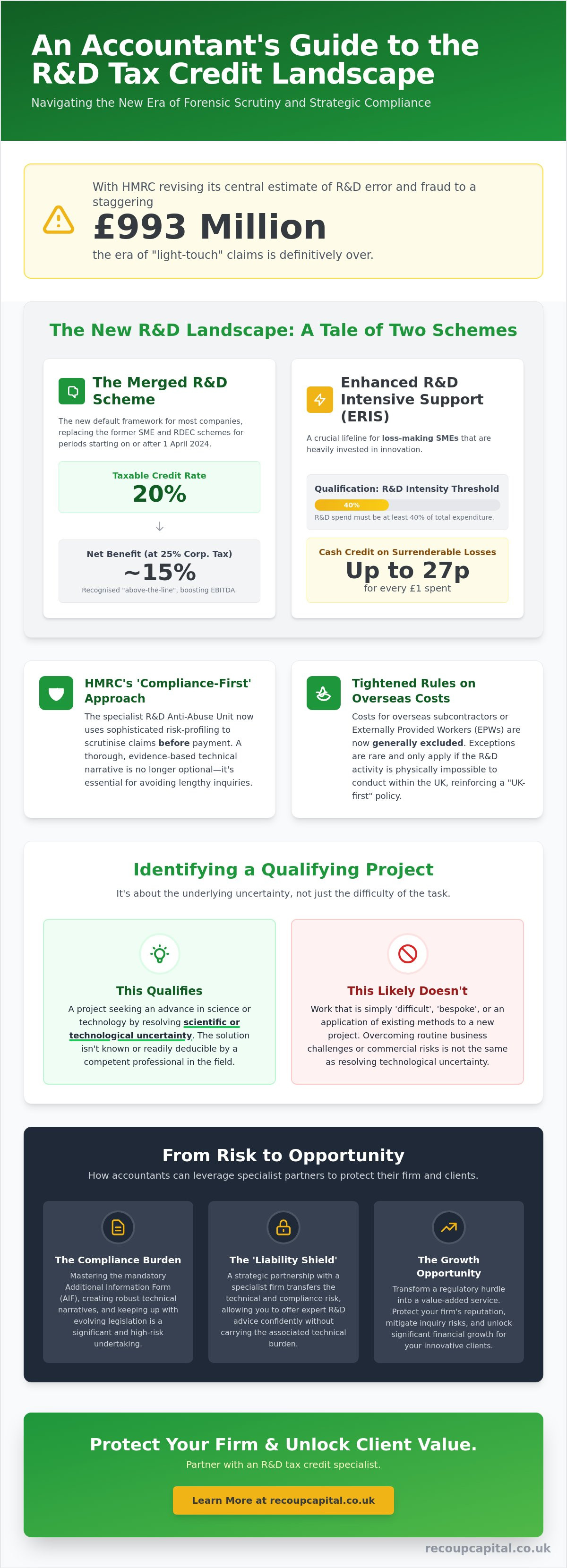
With HMRC revising its central estimate of R&D error and fraud to a staggering £993 million, the days of "light-touch" claims have been replaced by a new era of forensic scrutiny. You've likely noticed the shift; understanding what accountants need to know about R&D tax credits has moved from a seasonal task to a core strategic requirement. Navigating the mandatory Additional Information Form (AIF) and the nuances of the Merged R&D Scheme now feels like a high-stakes balancing act between client value and professional risk.
This guide provides a comprehensive briefing to help you maintain compliance whilst protecting your firm's reputation. We'll explore the 20% taxable credit rate, the 40% intensity threshold for Enhanced R&D Intensive Support (ERIS), and the tightening rules around overseas expenditure. By the end of this article, you'll have a clear framework for identifying qualifying innovation and a reliable partnership model that transforms regulatory hurdles into strategic growth opportunities for your clients. It's about moving beyond simple paperwork to provide the robust, evidence-based advice your clients expect in this evolving landscape.
Key Takeaways
- Grasp the mechanics of the Merged R&D Scheme and the updated 2026 rates for both profit-making companies and R&D-intensive loss-makers.
- Learn what accountants need to know about R&D tax credits to accurately identify qualifying projects by applying the latest DSIT definitions of technological uncertainty.
- Streamline your compliance process by mastering the mandatory Additional Information Form (AIF) requirements, ensuring all technical narratives and senior sign-offs are handled correctly.
- Mitigate the risk of HMRC inquiries and protect your firm's reputation by implementing a forensic approach to claim preparation.
- Discover how a strategic partnership with a specialist can provide a "liability shield," allowing your practice to offer expert R&D advice without the associated technical burden.
The 2026 R&D Landscape: Navigating the Merged Scheme and Compliance Standards
The UK's approach to innovation funding has reached a point of total consolidation. For accounting periods beginning on or after 1 April 2024, the distinction between the old SME and RDEC schemes has vanished for most. In its place stands the Merged R&D Scheme, a unified framework designed to streamline claims and reduce administrative friction. As the primary UK tax incentive for R&D, this system now provides a taxable credit of 20% on qualifying expenditure. For your clients paying the main rate of corporation tax at 25%, this equates to a net benefit of approximately 15%.
Understanding what accountants need to know about R&D tax credits in 2026 requires a firm grasp of this "above-the-line" credit model. Unlike the previous SME deduction, the credit is now recognised in the accounts as a form of income, which directly impacts a company’s EBITDA. This shift isn't just a technical change; it's a strategic reframing of R&D as a visible business asset rather than a hidden tax adjustment. For a detailed breakdown of these mechanics, you can refer to our guide on R&D tax credits explained.
Understanding the Merged Scheme vs. ERIS
Whilst the Merged Scheme is the default, the Enhanced R&D Intensive Support (ERIS) remains a vital carve-out for loss-making, research-heavy businesses. To qualify, a company's R&D expenditure must meet the 40% intensity threshold, meaning at least 40% of their total expenditure is dedicated to qualifying R&D. These intensive SMEs can still access a more generous 14.5% credit rate on surrenderable losses. This can result in a cash credit of up to 27p for every £1 spent, providing a crucial lifeline for startups and deep-tech firms that haven't yet reached profitability.
It's also essential to recognise the 2026 stance on overseas expenditure. HMRC has tightened the net significantly. Generally, costs for overseas subcontractors or externally provided workers are now excluded unless the R&D activity is physically impossible to perform within the UK. This "UK-first" policy aims to ensure that taxpayer-funded incentives drive domestic growth and employment.
The Shift in HMRC Compliance Philosophy
The days of HMRC acting as a passive processor of claims are over. The current environment is "compliance-first," driven by the R&D Anti-Abuse Unit. This specialist team uses sophisticated risk-profiling to identify anomalies before payments are issued. For general practice accountants, "Volume 2" of the HMRC R&D manual is no longer just a reference; it's essential reading. It contains the settled guidance on how HMRC interprets "scientific or technological uncertainty" in a post-reform world. If a claim doesn't align with these specific technical standards, it's increasingly likely to trigger a time-consuming enquiry.
div>Identifying Qualifying Activity: Moving Beyond the 'Lab Coat' Stereotype
One of the most critical things what accountants need to know about R&D tax credits in 2026 is that qualifying activity rarely involves a white lab coat. The Department for Science, Innovation and Technology (DSIT) defines R&D as a project that seeks an advance in science or technology through the resolution of scientific or technological uncertainty. This isn't just about creating a brand-new product; it often involves significantly improving an existing process or material. If your client is struggling to overcome a technical hurdle that a competent professional in their field couldn't solve with a simple Google search or standard industry manual, they're likely sitting on a qualifying claim.
The 2026 threshold for "Scientific or Technological Uncertainty" is high. It's no longer enough to be doing something "difficult" or "bespoke." You must be able to demonstrate that the outcome was not readily deducible. This distinction between Business as Usual (BAU) and a Qualifying Advance is where many claims fail under HMRC scrutiny. If you're unsure whether a client's specific project qualifies, exploring our process for claiming R&D tax credits can clarify the boundary between routine work and genuine innovation.
The 'Baseline' Test: Establishing the Starting Point
To secure a claim, you must document the "state of the art" in the specific industry at the time the project began. This baseline represents the publicly available knowledge and standard practice. If the solution was already "readily available" or could be found in existing technical literature, the project won't qualify as an advance. The ICAEW on R&D tax relief emphasises that the advance must be in the overall knowledge or capability in the field, not just the company's own internal knowledge. For a deeper dive into these criteria, our guide on R&D tax credits explained offers a structured breakdown of the technical requirements.
R&D in the Construction and Engineering Sectors
In construction and engineering, R&D often hides within bespoke structural solutions. When a firm develops a new method to stabilise a unique soil type or integrates sustainable materials in a way that hasn't been tested before, they're resolving technological uncertainties. There's also a significant overlap with land remediation relief, particularly when innovative biological or chemical processes are used to treat contaminated sites. Don't overlook "unsuccessful" projects; in the eyes of HMRC, a project that failed to reach its technical goal is often the strongest evidence that a genuine uncertainty existed. Documenting these failures is a proactive way to build a robust, enquiry-proof narrative for your clients.
The Administrative Burden: Mastering the Additional Information Form (AIF)
Since the mandate was first established, the Additional Information Form (AIF) has evolved into the absolute gatekeeper of the R&D regime. If you submit a CT600 containing an R&D claim without having filed the AIF via the HMRC portal first, the claim will be automatically rejected. This isn't just a procedural box-ticking exercise; it's a detailed disclosure that requires a named "Senior Officer" within the claimant company to sign off on the accuracy of the submission. This requirement ensures that the company's leadership takes direct responsibility for the technical narratives and financial figures provided.
Understanding what accountants need to know about R&D tax credits in 2026 involves recognising that HMRC now demands project-by-project granularity. Gone are the days of submitting a single, overarching report for the entire business. Each project must be broken down into its specific technical components. Relying on pre-populated templates or generic descriptions is a high-risk strategy that often triggers immediate enquiries. Inspectors are increasingly adept at identifying "boilerplate" language that fails to reflect the unique technical challenges of a specific business.
Technical Narrative Requirements: Quality over Quantity
HMRC inspectors focus their scrutiny on two specific areas: the "Uncertainty" and the "Resolution." To succeed, a narrative must clearly define the technological baseline and explain why the solution wasn't readily deducible to a competent professional. Quantifying the advance is now a baseline expectation. Rather than stating a process became "more efficient," your clients should specify that the project achieved a 12% reduction in energy consumption or a 20% increase in data throughput. For guidance on how modern documentation standards are changing, you may find our analysis on HMRC R&D Tax Claim Transparency and AI particularly useful.
Cost Allocation and Apportionment
Precision in cost attribution is paramount under the 2026 rules. Staff costs, including employer NICs and pension contributions, must be apportioned based on verifiable time spent on qualifying activity.
- Software and Cloud: Only claim for licences and cloud computing resources directly consumed during the R&D process.
- The "All-Inclusive" Trap: Avoid applying flat-rate percentages across entire departments. HMRC expects to see a reasoned methodology for how time and costs were divided.
- Subcontractor Justification: Ensure any qualifying subcontractor costs are clearly linked to the specific project narratives provided in the AIF.
Mitigating Risk: Protecting Your Practice and Clients from HMRC Inquiries
The rise of 'nudge letters' has fundamentally changed the risk profile for general practitioners. These communications from HMRC aren't formal inquiries; they serve as a tactical warning that a claim has been flagged for review. Knowing how to respond professionally is critical. A vital part of what accountants need to know about R&D tax credits in 2026 is the potential for 'reputational contagion'. When a non-compliant claim is submitted through your firm's agent code, it doesn't just put that specific client at risk. It can trigger a wider review of your entire portfolio, potentially impacting your standing with HMRC across other tax heads.
The 'R&D Claimant Professional Standards' now place a heavier burden on the accountant to perform a high-level 'sanity check' on a client's figures. You don't need to be a technical expert, but you should be able to identify red flags. For instance, if a client's R&D expenditure seems disproportionately high compared to their turnover or payroll without a clear technical justification, it warrants a deeper dive. Protecting your practice means ensuring that every claim you sign off on is supported by a robust, evidence-based narrative that aligns with current legislation.
The Anatomy of an HMRC R&D Inquiry in 2026
Common triggers for an inquiry often include high claim-to-turnover ratios and poor AIF narratives that lack technical depth. Once an inquiry begins, the administrative cost to your practice can be significant. HMRC's timeline for resolution has extended, often requiring multiple rounds of correspondence and technical interviews. Many 'no-win, no-fee' generalist consultants who promise quick returns often disappear the moment an inquiry starts, leaving the accountant to handle the fallout. This is why a forensic approach to the initial submission is the only way to safeguard your client's interests and your firm's time.
Professional Indemnity and the Duty of Care
It's worth assessing whether your Professional Indemnity (PI) insurance specifically covers technical R&D assessments. Many standard policies are designed for general tax work and may not provide adequate protection if a complex R&D claim is rejected due to technical inaccuracies. A 'specialist sign-off' can act as a vital safeguard, ensuring that the scientific and technological justifications meet the high bar set by HMRC. If you are concerned about the robustness of a pending claim, you can learn why claiming R&D tax credits with a specialist provides an essential layer of professional protection and shifts the technical liability away from your practice.
Strategic Collaboration: How Accountants Can Leverage Specialist Partners
The complexity of the 2026 landscape often means that a generalist's time is better spent on high-level strategy rather than technical forensic writing. This is where strategic collaboration becomes essential. A primary takeaway for what accountants need to know about R&D tax credits is the value of the "Liability Shield." When you partner with a specialist, the technical responsibility for the scientific narrative shifts. You retain your position as the trusted advisor, whilst we provide the sector-specific depth needed to satisfy the R&D Anti-Abuse Unit. This referral model ensures that your firm isn't exposed to the risks of a rejected claim while still delivering maximum value to your clients.
Spotting "hidden" R&D amongst your current clients is often easier than it sounds. It frequently hides in plain sight within manufacturing, software development, or engineering firms that view their innovation as "just part of the job." Our streamlined process begins with a brisk, no-cost assessment to determine eligibility before moving into full documentation. We handle the heavy lifting, ensuring the claim is submitted accurately alongside your existing corporation tax workflows. This proactive approach transforms a potentially intimidating regulatory procedure into an approachable opportunity for business growth.
The Benefits of a Specialist R&D Partner
Access to engineers and scientists who can translate complex projects into the specific language HMRC requires for AIF narratives is a game-changer. This ensures that every "uncertainty" and "resolution" is framed correctly. Because we operate on a success-based fee structure, our goals are perfectly aligned with your client’s interests. You can explore our full approach to claiming R&D tax credits to see how we maintain this high standard of compliance whilst securing the capital your clients deserve.
Integrating R&D into the Annual Compliance Cycle
Integrating R&D into the annual compliance cycle ensures that capital recovery is never an afterthought. We recommend timing the technical assessment to coincide with the preparation of year-end accounts. This allows you to present the resulting tax credit as a strategic asset for the client’s future growth rather than a simple refund. Choosing the right R&D tax credit specialists in the UK is about finding a partner who values long-term collaboration as much as technical precision, ensuring your professional reputation remains protected at every stage.
Securing Your Practice's Future in the New R&D Era
The 2026 landscape for R&D tax relief is no longer about volume; it's about the precision of the technical narrative and the robustness of the cost allocation. Moving away from generic templates and embracing the forensic requirements of the Merged Scheme is the only way to protect your firm's agent code and professional standing. This guide has detailed the essential pillars of what accountants need to know about R&D tax credits to move from defensive compliance to proactive innovation support.
By leveraging a specialist partnership, you can provide your clients with the technical depth they require without increasing your own professional indemnity risk. Our expert team of chartered tax accountants and technical specialists brings a proven track record in the construction and engineering sectors. We operate on a success-based fee model, ensuring there's zero risk for your clients and a focus on long-term collaboration.
Discover how Recoup Capital partners with accountants to deliver compliant R&D claims.
It's time to turn these regulatory hurdles into a clear path for business growth. We're here to help you navigate this transition and ensure your clients receive the strategic financial assets they've earned.
Frequently Asked Questions
Can an accountant submit an R&D claim without a specialist?
Yes, any qualified accountant can technically submit a claim. However, the 2026 compliance landscape makes this a high-stakes exercise. What accountants need to know about R&D tax credits is that the Additional Information Form (AIF) requires deep technical justifications that go beyond traditional tax work. Many firms choose to partner with specialists to ensure these narratives meet HMRC's forensic standards whilst shifting the technical liability away from their practice.
What is the deadline for submitting an R&D tax credit claim in 2026?
Companies can claim R&D tax relief up to two years after the end of the relevant accounting period. This window allows for retrospective claims, provided the project met the qualifying criteria at the time. It's vital to ensure the mandatory Additional Information Form is submitted before the Corporation Tax Return (CT600), as failing to follow this order will lead to an automatic rejection by HMRC.
How has the definition of R&D changed under the Merged Scheme?
The fundamental DSIT definition of seeking an advance in science or technology remains consistent. The biggest change under the Merged Scheme is the treatment of costs rather than the definition of activity. Specifically, there are now significant restrictions on overseas expenditure for subcontractors and externally provided workers. The focus has shifted heavily toward ensuring that the R&D activity is physically performed within the UK to qualify for the 20% credit.
What happens if HMRC rejects a client's R&D claim?
If HMRC rejects a claim, they'll typically issue a closure notice and may seek to recover any tax credit already paid. Beyond the financial loss to the client, there's a serious risk of professional penalties if the error is deemed "careless" or "deliberate." A rejected claim also creates reputational risk for your firm, as it can trigger a wider review of other claims submitted under your agent code.
Are software development costs still eligible for R&D tax relief in 2026?
Yes, software development remains a primary driver of R&D claims. In 2026, qualifying costs include not only staff time but also cloud computing and data licence fees directly used for the R&D project. It's important to apportion these costs accurately; you can't claim for general hosting or software used for routine business operations. Only the resources consumed during the resolution of technological uncertainty are eligible.
How do R&D tax credits interact with other reliefs like Capital Allowances?
R&D tax credits and Capital Allowances are complementary but distinct strategic tools. R&D relief covers revenue expenditure like staff wages and consumables, whereas Capital Allowances are claimed on capital assets like machinery or laboratory equipment. You can't "double-claim" for the same expenditure, so it's essential to categorise costs correctly between revenue and capital at the year-end to maximise the total recovery for your client.
Is the 'Senior Officer' sign-off on the AIF legally binding?
Yes, the Senior Officer sign-off is a formal declaration that the information provided in the AIF is true and accurate. This individual must be a named person within the claimant company, such as a director or the CFO. This requirement is a key part of HMRC's strategy to ensure company leadership takes direct responsibility for the technical narrative, making it harder to blame external consultants for non-compliant claims.
How much can a client expect to receive back under the Merged Scheme?
Most companies using the Merged Scheme in 2026 receive a taxable credit of 20% of their qualifying expenditure. For those paying the main rate of corporation tax, the net benefit is approximately 15%. However, loss-making SMEs that meet the 40% intensity threshold can access the ERIS scheme, which can result in a cash credit of up to 27p for every £1 spent. Knowing these rates is essential for what accountants need to know about R&D tax credits when forecasting client cash flow.