
DIY R&D Claim vs Using an Advisor: Navigating the 2026 UK Tax Landscape

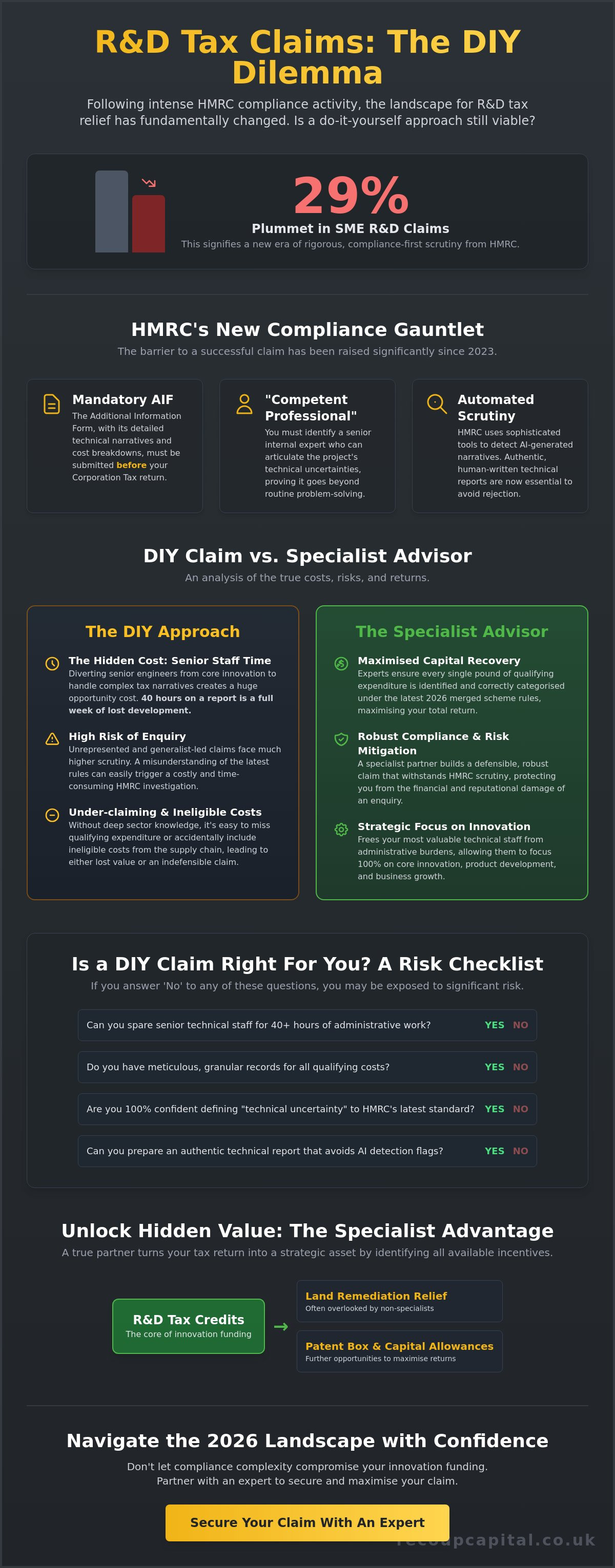
Did you know that SME R&D claims have plummeted by 29 per cent following a period of intense HMRC compliance activity? This isn't because British businesses have stopped innovating. It's because the regulatory bar has been raised to a height that makes the DIY R&D claim vs using an advisor debate more critical than ever before. You might be questioning whether the cost of a specialist is justified when your internal team understands your projects best.
It's a common dilemma. You want to maximise your capital recovery without inviting the stress of a formal enquiry or draining your internal resources. We understand the pressure to keep costs low whilst ensuring every pound of qualifying expenditure is captured under the 2026 merged scheme rules. This guide explores whether a self-managed approach or a specialist advisor offers the best ROI and security for your claim.
We'll examine the complexities of the mandatory Additional Information Form, the strict six-month notification deadlines, and how a strategic partnership can transform a daunting compliance task into a powerful tool for business growth. By the end, you'll have the clarity needed to navigate the 2026 landscape with total confidence.
Key Takeaways
- Learn how the 2026 shift to a compliance-first regime has transformed the technical requirements for every R&D narrative.
- Uncover the hidden financial impact of diverting your senior engineers from core innovation to handle complex administrative tasks.
- Weigh the pros and cons of a DIY R&D claim vs using an advisor to ensure you are maximising your total capital recovery.
- Apply a practical risk assessment framework to determine if your internal record-keeping can withstand the rigours of modern HMRC scrutiny.
- Explore how a specialist partner identifies often-overlooked incentives like Land Remediation Relief to turn your tax return into a strategic asset.
The 2026 R&D Tax Landscape: Why the DIY Approach Has Changed
The era of R&D tax relief being treated as a "soft" incentive is officially over. Following a period of intense HMRC scrutiny, SME claims fell by 29 per cent as the Revenue transitioned to a rigorous, compliance-first regime. This shift has fundamentally altered the DIY R&D claim vs using an advisor calculation for UK limited companies. What used to be a straightforward addition to a tax return is now a high-stakes technical submission that requires meticulous documentation.
Since the introduction of the mandatory Additional Information Form (AIF) in August 2023, the barrier to entry has risen significantly. You can't submit a claim without providing detailed technical narratives and granular cost breakdowns before your Corporation Tax return is even filed. For many businesses, the "simple" claim is now a myth. The 2026 landscape demands a level of precision that internal teams, already stretched by daily operations, often struggle to maintain.
HMRC’s New Compliance Standards
HMRC now requires every submission to be digitally robust and submitted through specific channels. A critical part of this process involves identifying a "competent professional" within your organisation. This individual must be able to explain the technical uncertainties encountered and how they go beyond the standard knowledge of an experienced practitioner in the field. It's about proving genuine innovation, not just describing standard commercial work.
Be cautious with automation. HMRC has deployed sophisticated detection tools specifically designed to flag AI-generated technical narratives. If your documentation lacks the authentic, nuanced voice of your engineering or software team, it risks being rejected or flagged for an enquiry. Staying compliant means ensuring your technical reports align with the latest UK R&D Tax Credits framework, which now emphasizes territoriality and UK-based activity for accounting periods starting after April 1, 2024.
The Risk of the "Generalist" Filing
Whilst your general accountant is vital for your day-to-day finances, they often lack the deep sector knowledge required to defend a claim under 2026 standards. Relying on definitions of innovation from 2021 or 2022 is a dangerous strategy. The rules surrounding "contracted out" R&D and supply chain expenditure have changed, making it easier for generalists to accidentally include ineligible costs.
Generalists may miss the subtle distinction between qualifying technical uncertainty and routine problem-solving. This knowledge gap often leads to either under-claiming or, worse, submitting an indefensible claim that triggers a costly enquiry. When weighing up a DIY R&D claim vs using an advisor, consider that unrepresented or generalist-led claims are now facing much higher scrutiny. Professional guidance ensures you are claiming R&D tax credits accurately whilst protecting your business from the reputational and financial risks of an HMRC investigation.
The True Cost of a DIY R&D Tax Claim: Hidden Financial Burdens
Many businesses view the DIY R&D claim vs using an advisor debate purely through the lens of the advisor's fee. They see a potential saving but overlook the internal salary burn. In 2026, a compliant claim is far from a quick administrative task. It requires deep technical dives and meticulous financial reconciliation that can take weeks of internal effort, often resulting in a far higher "total cost of ownership" than initially anticipated.
The administrative overhead alone is staggering. Colating payroll data, subcontractor invoices, and material costs whilst ensuring they align with the new territoriality rules takes significant time. When you factor in the requirement for the mandatory Additional Information Form (AIF), the internal resource constraint becomes a genuine barrier to business growth.
The Senior Staff Time Drain
Preparing a technical narrative that satisfies HMRC’s rigorous 2026 standards requires your most knowledgeable staff. These are typically senior engineers, lead developers, or technical directors whose time is your most valuable asset. When these experts are diverted from billable client work or critical product development to write tax-compliant narratives, the opportunity cost is immense. If a technical lead spends 40 hours on a report, that is a full week of innovation lost.
There is also a significant friction point between finance and operations. Technical leads often describe their work in commercial or functional terms rather than the specific language of "technical uncertainty" required by the Revenue. This leads to multiple rounds of internal revisions and frustration, further draining resources and slowing down the filing process.
Missed Opportunities and Under-Claiming
The "Knowledge Gap" is perhaps the most significant hidden cost of the DIY approach. Internal teams often stick to obvious costs like raw materials and direct developer salaries. However, they frequently overlook qualifying expenditure categories such as employer pension contributions, National Insurance, and indirect support staff who facilitate the R&D process. Without a specialist eye, these "soft" costs remain uncaptured.
Specialists typically identify significantly more qualifying spend than internal teams because they understand the nuances of "project accounting" versus "R&D tax accounting." For example, under the 2026 merged scheme, identifying the correct R&D tax credits for contracted-out work requires a level of legislative knowledge that most internal teams don't have the time to master. By under-claiming, you are essentially leaving your own capital on the table.
Finally, consider the long-term burden of an HMRC enquiry. With the Revenue’s increased focus on quality, a single DIY error can trigger a formal investigation. The time spent defending an enquiry is often ten times greater than the time spent preparing the original claim. Taking a moment to understand the full scope of your eligibility before filing can prevent these costly administrative headaches and protect your bottom line.
Specialist Advisor vs. DIY vs. General Accountant: A Comparison
Choosing the right path for your submission involves weighing up three distinct routes. The DIY R&D claim vs using an advisor decision often includes a third contender: your general practice accountant. Each approach carries a different risk profile and fee structure. Whilst a DIY claim relies on internal salary burn and a general accountant often charges a fixed bolt-on fee, a specialist typically operates on a success-based model. This ensures their interests are perfectly aligned with yours, as they only benefit when you successfully recover capital.
The difference in technical depth is where these paths diverge most sharply. A DIY submission is limited by your team's internal knowledge of tax legislation. A general accountant understands the financial side but may struggle to translate complex engineering or software challenges into the technical language HMRC expects. A specialist bridges this gap by employing experts who understand both the tax code and your specific industry. This technical nuance is vital for defending your claim if the Revenue raises questions.
Why General Accountants May Not Be Enough
General accountants are excellent at statutory reporting and day-to-day compliance. However, forensic R&D tax analysis is a different discipline entirely. Many general firms offer R&D services as a "flat-fee" add-on. Because their profit margin is tied to time spent, there is a natural incentive to produce defensive, low-value claims that only cover the most obvious costs. This approach often misses the deeper, qualifying activities that a more thorough investigation would uncover.
Statutory accounting is backward-looking, whilst R&D analysis requires a forward-looking, strategic mindset. If your accountant isn't asking deep questions about your technical uncertainties, you might be leaving significant money on the table. For a clearer picture of what a robust claim looks like, you can see R&D tax credits explained in the context of modern 2026 regulations.
The Specialist Advantage: Beyond the Paperwork
A specialist advisor does more than just process paperwork; they act as a long-term partner in your innovation journey. They help you implement proactive systems to track R&D activity in real-time, making future claims more efficient and accurate. This proactive approach reduces the year-end stress on your finance team and ensures no qualifying expenditure slips through the cracks during the busy season.
Risk management is another area where specialists provide superior value. Most reputable advisors include full enquiry support as part of their service. If HMRC initiates a check, your advisor handles the technical liaison, drawing on their track record of successful submissions to resolve the matter. This protection transforms your tax credit from a potential liability into a strategic growth asset that you can reinvest with total peace of mind.
A Risk Assessment Framework: Is DIY Right for Your Business?
Deciding between a DIY R&D claim vs using an advisor shouldn't be based on a hunch or a desire to save on fees. It requires a structured assessment of your business's current state and the specific nature of your innovation. By applying a risk assessment framework, you can move away from guesswork and toward a strategy that protects your cash flow whilst ensuring long-term compliance.
The framework begins with four critical steps:
- Step 1: Technical Complexity. Is your project solving a standard industry hurdle, or is it a "first-of-its-kind" breakthrough? The more "grey" the area of uncertainty, the higher the risk of a DIY misstep.
- Step 2: Record-Keeping Robustness. Are your records contemporaneous and digital, or are you reconstructing narratives months after the work finished? HMRC’s 2026 standards for the Additional Information Form (AIF) leave little room for retrospective guesswork.
- Step 3: Value vs. Resource Cost. Quantify the potential claim. If the value is high, the internal resource cost of preparing it often outweighs a specialist's fee, especially when factoring in the opportunity cost of your senior staff.
- Step 4: Enquiry Appetite. Are you prepared to handle a formal HMRC challenge? Modern enquiries are technical and time-consuming. Having a partner to manage this liaison provides essential peace of mind.
When DIY Might Actually Work
A DIY approach might be viable for companies with low-value, high-repeatability projects where the technical boundaries are exceptionally clear. This route is typically only successful if you have a qualified tax professional already on the payroll who understands the 2026 merged scheme nuances. Even in these "safe" scenarios, it's wise to undergo a periodic external audit. This ensures your internal team hasn't developed "blind spots" to new legislative shifts or territoriality restrictions that could invalidate future filings.
Red Flags That Demand a Specialist
Certain scenarios make professional representation essential rather than optional. High subcontractor spend or complex group structures are immediate red flags. Under the 2024 territoriality rules, overseas expenditure is largely restricted, and the "contracted out" R&D principles are notoriously difficult to navigate without specialist expertise. If your projects involve software development or your business has previously received an HMRC "nudge" letter, the risk of a DIY error is simply too high to ignore.
To see where your business sits on the risk spectrum, you can evaluate your specific R&D eligibility with our expert team to ensure your claim is both maximised and protected.
Maximising Innovation: The Strategic Value of a Specialist Partner
The final consideration in the DIY R&D claim vs using an advisor debate is the shift from mere compliance to strategic capital recovery. Whilst a DIY approach focuses on the immediate task of submission, a specialist partner looks at your business through a broader financial lens. Innovation is your company's currency. We ensure you aren't leaving any of it on the table by identifying how your R&D activities intersect with other powerful tax incentives.
This strategic perspective transforms a tax credit from a simple refund into a vital business asset. In the world of corporate finance, a robust and defended R&D history significantly enhances your company's valuation. It demonstrates a commitment to technical advancement and a sophisticated approach to fiscal management. By treating these credits as strategic assets rather than administrative afterthoughts, you build a more resilient and attractive balance sheet.
Unlocking Hidden Reliefs
A specialist's true value lies in their ability to spot cross-relief opportunities that internal teams frequently miss. For instance, many engineering and construction firms are unaware they can claim Land Remediation Relief alongside their R&D expenditure. If your project involves overcoming technical uncertainties on a contaminated site, you might be eligible for both. This dual-track approach can significantly increase the total capital recovered from a single project.
There is also a natural synergy between R&D and Capital Allowances for commercial property. When you invest in new facilities or specialised equipment to facilitate your innovation, those costs can often be leveraged across multiple relief schemes. Forensic surveying identifies qualifying plant and machinery or environmental costs that strengthen the overall R&D narrative by providing tangible evidence of innovation in physical infrastructure. This level of forensic analysis is rarely possible in a self-managed submission.
The Recoup Capital Difference
Our partnership-first approach is built on the belief that we only succeed when you do. We don't just "process paperwork"; we act as a protective guide through the complexities of the 2026 regulatory landscape. By employing a success-based fee model, we align our interests entirely with your growth. This removes the financial risk of exploring your eligibility and ensures our focus remains on delivering the highest possible ROI for your business.
We invite you to move beyond the stress of DIY filings and embrace a more proactive strategy. Our team is dedicated to helping you navigate these procedures with transparency and ease, allowing you to focus on what you do best: innovating. Discover more about the benefits of a professional partnership and why claim with Recoup Capital to secure your company's future growth.
Secure Your Innovation Strategy for 2026
The 2026 tax landscape has evolved into a rigorous compliance environment where technical accuracy is non-negotiable. As we have explored, the decision regarding a DIY R&D claim vs using an advisor is no longer just about the initial fee. It's about protecting your senior staff's valuable time and ensuring your technical narratives stand up to HMRC's heightened standards. A specialist partnership doesn't just process paperwork; it identifies hidden cross-relief opportunities whilst providing a vital safety net against formal enquiries.
Navigating these complexities requires a partner who understands both the tax code and your specific industry challenges. We invite you to book a no-cost R&D assessment with our specialists to discover the true potential of your innovation. Our team of Chartered Tax Accountants and sector specialists operates on a success-based fee model, ensuring our interests are perfectly aligned with your growth. With a proven track record of managing HMRC enquiries, we provide the peace of mind you need to focus on your next breakthrough. Let's transform your R&D expenditure into a powerful strategic asset for your business.
Frequently Asked Questions
Can I change from a DIY R&D claim to an advisor mid-way through the process?
Yes, you can appoint an advisor at any stage before the final submission to HMRC. Many businesses start the process internally but realise the 2026 technical report requirements are more complex than anticipated. An advisor can step in to review your existing data, identify missed expenditure, and ensure your Additional Information Form (AIF) meets all current compliance standards before you file.
Is it cheaper to use my general accountant for an R&D tax credit claim?
Whilst a general accountant might offer a lower fixed fee, it often proves more expensive in terms of total capital recovered. Generalists typically lack the forensic technical knowledge to identify every qualifying cost, such as indirect support or employer pension contributions. This often results in a significantly lower claim value compared to the results achieved by a dedicated specialist who understands the latest 2026 legislation.
What are the main reasons HMRC rejects DIY R&D claims in 2026?
Rejections are frequently triggered by technical narratives that fail to prove genuine "technical uncertainty" or by missing the strict six-month claim notification deadline. HMRC also uses automated tools to flag submissions that lack professional technical depth or include ineligible overseas costs. Without a specialist to navigate these nuances, a DIY R&D claim vs using an advisor often ends in a rejected filing or a lengthy enquiry.
How much time does a business owner need to commit when using an advisor?
Your involvement is typically limited to a few hours for an initial discovery session and a final review of the technical report. The advisor handles the heavy lifting, including the forensic financial analysis and the drafting of the technical narratives. This streamlined process ensures minimal disruption to your daily operations whilst allowing you to benefit from a professionally managed, high-value submission.
Are R&D advisor fees tax-deductible for UK limited companies?
Professional fees paid to an advisor for the preparation of an R&D tax relief claim are generally deductible as a business expense for Corporation Tax. This means the net cost of using a specialist is reduced by your prevailing tax rate. When weighing up a DIY R&D claim vs using an advisor, this deductibility makes professional support an even more cost-effective way to secure your innovation funding.
What happens if HMRC opens an enquiry into a claim filed by an advisor?
A reputable specialist will manage the entire enquiry process on your behalf, often at no additional cost if they work on a success-fee basis. They act as your protective guide, using their technical expertise and experience with the Revenue to defend the claim's validity. This proactive support removes the administrative burden from your team and ensures a much higher chance of a successful resolution.
Does a DIY claim increase the likelihood of an HMRC audit?
Internal data suggests that unrepresented claims are often viewed as higher risk by HMRC's compliance teams. Following the 29 per cent drop in SME claims due to increased scrutiny, the Revenue is prioritising the quality of technical narratives. Submissions that lack a specialist's technical rigour or fail to align with the 2026 digital filing standards are more likely to trigger a formal check or enquiry.
Can I use R&D software to file my own claim safely?
Software can help organise your financial data, but it cannot replace the professional judgement required to define technical uncertainty. Automated tools often produce generic narratives that struggle to satisfy HMRC’s 2026 requirement for authentic, project-specific detail. Relying solely on software without a specialist's review can leave your business vulnerable to enquiries if the technical justifications aren't robust enough to withstand expert scrutiny.