
R&D Tax Credits for CTOs: A Strategic Guide to Technical Innovation in 2026

Is your engineering roadmap a cost centre or a strategic capital asset? For many technical leaders, the line between routine software maintenance and genuine innovation feels increasingly blurred, especially with HMRC's heightened scrutiny of software claims in 2026. You likely feel that R&D tax credits for CTOs often represent a trade-off between vital capital recovery and the precious time of your senior developers.
It's frustrating when technical breakthroughs are dismissed as 'business as usual' simply because the documentation doesn't speak the right financial language. This guide promises to change that. You will discover how to translate complex technical challenges into high-value tax relief whilst maintaining total HMRC compliance. We'll provide a clear framework for identifying qualifying spend and building a robust audit trail. This ensures you can maximise capital recovery to reinvest directly back into your tech stack and future innovation.
Key Insights
- Reframe your engineering roadmap as a strategic asset to unlock non-dilutive funding for scaling your tech stack.
- Master the "Competent Professional" test by translating technical challenges like scalability and latency into the specific language required for R&D tax credits for CTOs.
- Distinguish between standard commercial development and qualifying innovation to ensure your claims are robust enough to withstand HMRC scrutiny.
- Build a frictionless audit trail by using your existing tools, such as Jira and GitHub, to capture contemporaneous evidence of your technical breakthroughs.
- Learn how a partnership-oriented approach can bridge the gap between complex code and capital recovery, turning tax relief into a tool for business growth.
Beyond Routine Coding: Why R&D Tax Credits Matter for CTOs in 2026
For a Chief Technology Officer, the definition of innovation is often found in the projects that almost failed. It's in the late-night refactoring of a legacy architecture that refused to scale or the custom integration that required a fundamental shift in how data is processed. In the eyes of HMRC, these aren't just engineering headaches; they are the foundation of a valid claim. Understanding the strategic application of R&D tax credits for CTOs is no longer optional. It's a vital component of technical resource management in 2026.
This relief is a powerful form of non-dilutive funding. Unlike a Series B or C round, this capital doesn't require you to sacrifice equity or board control. It's a direct reward for the technical risks your team has already shouldered. As of June 2026, the merged RDEC scheme provides a 20% gross credit for most UK limited companies. For loss-making, R&D-intensive SMEs, the Enhanced R&D Intensive Support (ERIS) scheme can return up to 27% of qualifying expenditure as cash. This represents a significant injection of capital that can be used to scale your tech stack or accelerate your product roadmap.
HMRC identifies the CTO as the "Competent Professional" in this process. This means your technical expertise is the benchmark. You aren't just a witness to the claim; you're the architect of the technical narrative. Your role is to define where the industry's baseline ends and your team's innovation begins. If you'd like to understand the mechanics of this process further, you can see how R&D tax credits are explained in a technical context.
The Strategic Value of Innovation Incentives
Innovation is inherently expensive. Often, "moonshot" projects that could define your company's future are sidelined in favour of safer, incremental updates. R&D relief changes that calculus. By recovering a portion of your staff costs and software licences, you can reinvest in senior developer talent or high-performance cloud infrastructure. This creates a virtuous cycle of innovation. Furthermore, a history of successful, compliant claims significantly boosts company valuation during M&A or funding rounds, as it proves your tech stack is built on genuine, defensible innovation.
Current HMRC Trends in Software Claims
The 2026 regulatory environment is defined by a shift from "volume of claims" to "quality of technical narrative." HMRC has increased its scrutiny of software-based applications, specifically looking to differentiate routine commercial development from genuine R&D. They aren't interested in your features; they're interested in the technical uncertainties you overcame to build them. Success now depends on your ability to document the specific challenges your team faced, such as resolving unprecedented latency issues or creating novel algorithms that don't exist in the public domain. It's about proving that the solution wasn't readily deducible by another competent professional in your field.
Defining Technical Uncertainty: The CTO’s Framework for Compliance
Technological uncertainty exists when the solution to a technical problem isn't readily available in the public domain or easily deducible by an experienced engineer. For your team, this doesn't simply mean "we didn't know how to do it yet." It means it wasn't clear if the objective could be achieved at all within the constraints of your system. When identifying R&D tax credits for CTOs, you must distinguish between a "difficult" task and a "technically uncertain" one. A difficult task is eventually solved by applying known best practices or hiring more developers. A technically uncertain task requires experimentation, iterative prototyping, and a systematic investigation into the unknown.
In the eyes of HMRC, you are the "Competent Professional." This isn't just a title; it's the benchmark for the entire claim. Your expertise determines what constitutes a "baseline" for the industry. If a senior developer with your level of experience couldn't find a solution on Stack Overflow or in academic journals, you've likely found the start of a valid R&D project. Interestingly, failed projects are often your strongest evidence. They prove that the outcome wasn't certain and that your team had to push against the boundaries of current knowledge. If you're unsure whether your latest sprint qualifies, you can explore our frequently asked questions for more specific engineering examples.
Software Architecture and Systemic Uncertainty
Modern software R&D often lives in the infrastructure. You might be claiming for advances in data processing speeds or novel ways to manage algorithmic efficiency at scale. Legacy system constraints are a frequent source of uncertainty. Trying to force modern performance out of monolithic architectures often requires "appreciable improvement." In a 2026 context, this might look like achieving a 30% reduction in server-side latency for concurrent users exceeding 100,000 in a distributed environment where standard load-balancing protocols had previously reached their ceiling. National bodies like the National Science Foundation emphasise the importance of sustained software innovation, acknowledging that the path to technical advancement is rarely linear.
AI, Machine Learning, and Automated Innovation
The 2026 landscape for AI claims is nuanced. HMRC's current stance focuses on the "advance," not just the "use" of AI. Simply calling a third-party LLM via an API is rarely qualifying R&D. However, if your team is building novel AI architectures to resolve "black box" transparency issues or developing custom training methodologies to reduce hallucinations in domain-specific models, you're in strong R&D territory. The key is distinguishing between using a tool and creating a new capability that didn't exist before. If you're navigating the complexities of AI-generated code, the R&D lies in the systematic testing and architectural integration required to make that code perform in ways that were previously considered impossible.
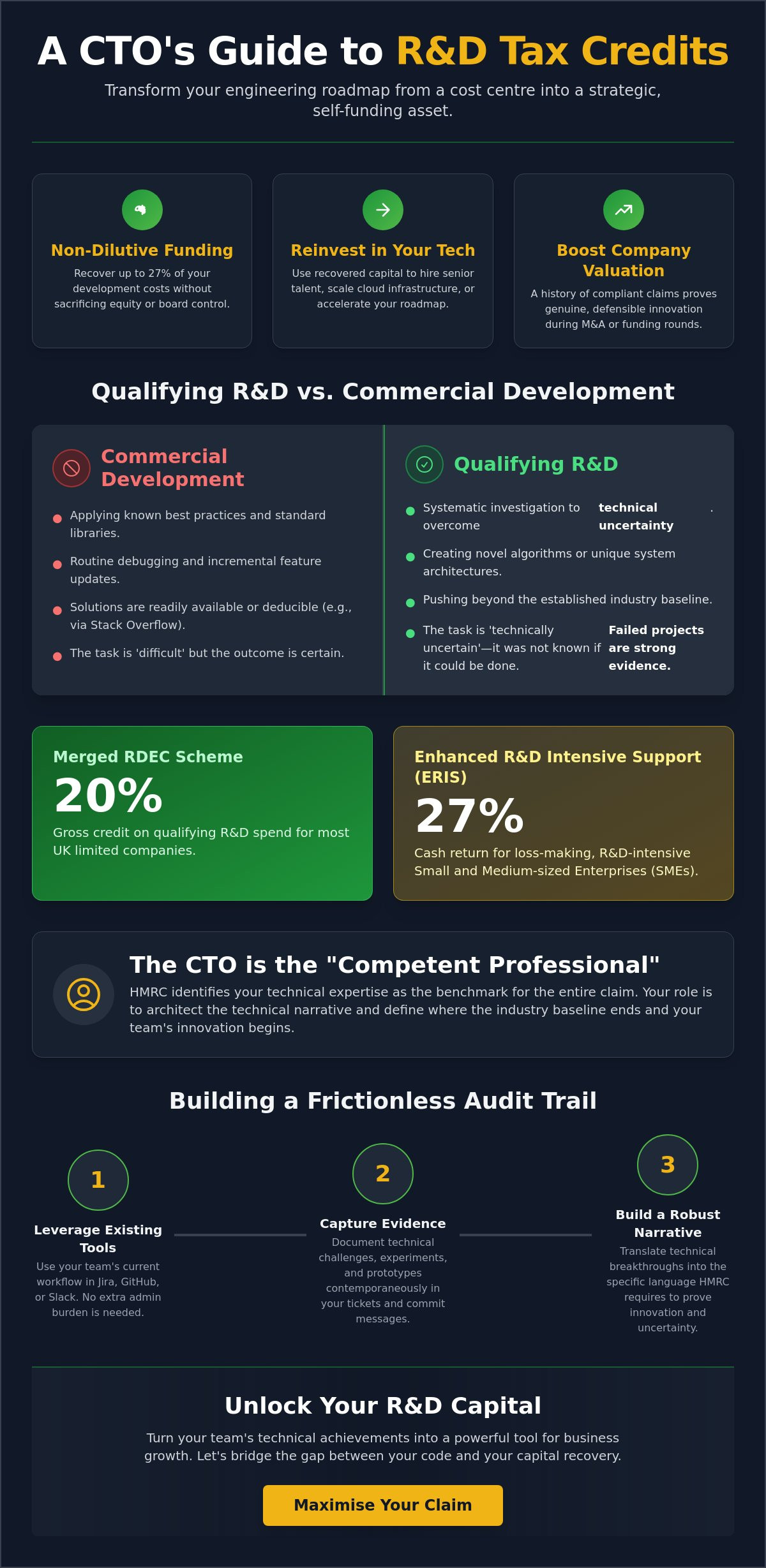
Commercial Software Development vs. Qualifying R&D
A common misconception in the tech sector is that all software development constitutes research and development. In reality, HMRC draws a sharp line between commercial innovation and technical advancement. Building a feature-rich, high-performing application is a commercial achievement. However, it only qualifies for relief if the development process required overcoming a specific technical uncertainty. For those navigating R&D tax credits for CTOs, the challenge lies in separating the functional requirements of a product from the technical hurdles faced during its creation.
Most modern software projects are "dual-purpose." They contain elements of routine configuration alongside genuine technical breakthroughs. To maximise your claim without risking an enquiry, you must isolate the modules where the "Competent Professional" had to step in. If a project involves standard CRUD operations or typical e-commerce workflows, it's likely commercial development. If that same project requires the creation of a bespoke caching layer to handle unprecedented data throughput, that specific workstream enters the R&D zone. Understanding why you should claim for these specific technical wins is essential for long-term capital strategy.
The "Routine Dev" Trap
HMRC often targets UI/UX improvements during audits. Simply making an interface more intuitive or aesthetically pleasing is considered a cosmetic or functional change. It doesn't qualify unless the UI requires a fundamental shift in how the underlying system processes data. Similarly, standard API integrations using well-documented protocols like REST or GraphQL are seen as routine. The R&D begins only when you're forced to develop entirely new communication protocols to solve latency or security issues that existing tools cannot handle. Bug fixing and general maintenance are also excluded; once the technical uncertainty is resolved and the system is stable, the R&D phase ends.
Qualifying Technical Expenditures
Identifying the right costs is just as important as identifying the right projects. Direct staff costs, including gross pay, NICs, and pension contributions, usually form the bulk of a claim. You must calculate the percentage of time each developer spent on qualifying R&D versus routine tasks. Since 2023, cloud computing and data licence fees have been explicitly included as qualifying expenditures, provided they were used directly for R&D activities. Under the Merged Scheme, which governs claims in 2026, payments to subcontractors are generally capped at 65% of the relevant cost. It's also vital to remember that from April 2024, most overseas R&D costs are no longer eligible, prioritising UK-based engineering talent and innovation.
Building a Robust Technical Audit Trail whilst Maximising Innovation
Capturing evidence for a claim shouldn't feel like a secondary job for your engineering team. The most effective documentation strategies for R&D tax credits for CTOs are those that sit quietly within your existing Software Development Life Cycle (SDLC). HMRC values contemporaneous documentation above all else. This means records created at the time the work was performed are far more persuasive than a retrospective report written months after the sprint has closed. By using the tools your team already lives in, such as Jira, GitHub, and Slack, you can build a robust audit trail without slowing down your release velocity.
The goal is to link technical milestones directly to financial expenditure. When you can demonstrate exactly which developers were wrestling with a specific architectural bottleneck, the claim becomes much harder to challenge. This systematic approach transforms documentation from a chore into a protective layer for your business. It ensures that every hour of senior engineering time spent on genuine innovation is accounted for and defensible.
Integrating R&D Capture into the SDLC
Smart tagging is the key to minimising administrative friction. By introducing specific Jira tags or GitHub labels like "R&D-Uncertainty" or "Technical-Experiment", you can flag qualifying work during the sprint planning phase. A high-quality technical narrative should provide a direct thread back to specific commit history, allowing an inspector to see the iterative attempts at resolving a technical obstacle. Architectural Decision Records (ADRs) are particularly valuable here. They document the "why" behind a technical pivot, providing clear evidence that several paths were considered and tested before a solution was found.
Preparing for HMRC Enquiries
If HMRC chooses to review a claim, they often request a technical interview with the CTO. This is a peer-to-peer conversation designed to test the "Competent Professional" benchmark. Inspectors look for red flags such as overly commercial descriptions or a lack of specific technical metrics. They want to hear about the failures, the dead ends, and the specific reasons why a solution wasn't obvious. You can learn more about How to prepare for an HMRC R&D Inquiry to ensure your team is ready for this level of scrutiny.
Building this link between technical milestones and financial expenditure ensures that when the time comes to file, the data is already there. If you want to ensure your technical documentation meets the highest compliance standards, you can start your claim process here with a partner who understands the code as well as the tax code.
Maximising Returns: Why CTOs Partner with Recoup Capital
Many technical leaders find that the biggest hurdle to a successful claim isn't the engineering work itself, but the translation layer. Financial departments often lack the technical depth to identify systemic uncertainty, whilst engineering teams shouldn't be bogged down in the minutiae of tax legislation. Recoup Capital acts as the vital bridge between these two worlds. We provide a specialised service where our chartered tax accountants work alongside experts who actually understand software architecture. This ensures your technical breakthroughs are captured with the precision required to maximise R&D tax credits for CTOs.
Our partnership-oriented approach is built on a success-based fee model. This structure ensures there is zero risk for your technology budget, as our interests are perfectly aligned with your capital recovery. We don't believe in aggressive sales pitches; instead, we prefer to demonstrate value through the quality of the technical narratives we produce and the results we achieve. By reframing your tax relief as a strategic asset, we help you turn historical engineering challenges into future innovation capital. It's about more than just processing paperwork; it's about building a long-term relationship that supports your technical vision.
The Recoup Capital Technical Approach
Our process is designed to be lean and efficient. We know your roadmap is your priority, so we've refined our R&D tax credit claims process to extract necessary technical narratives with minimal disruption to your developers. We handle the heavy lifting of HMRC liaison and technical justification, acting as a protective guide through the regulatory landscape. This allows you to stay focused on shipping code whilst we secure the capital your innovation deserves. We ensure that every technical milestone is linked to its corresponding expenditure, creating a robust and transparent audit trail.
Unlocking Capital for Future Sprints
The impact of a successful claim goes far beyond a simple tax refund. For example, a UK-based software firm recently utilised their recovered capital to fund an entirely new AI division, accelerating their product timeline by six months without seeking external investment. This is the strategic power of viewing tax relief as a tool for growth rather than an accounting exercise. If you're ready to see what's possible for your own engineering roadmap, we invite you to book a technical discovery call with Recoup Capital. We'll conduct a preliminary assessment to identify your qualifying spend and help you organise a strategy that satisfies both your finance director and your engineering team.
Turning Technical Challenges into Strategic Assets
The engineering landscape of 2026 demands more than just shipping code; it requires a strategic approach to capital recovery. By correctly identifying technical uncertainty and distinguishing it from routine commercial development, you can unlock vital non-dilutive funding. Integrating these processes into your existing Jira and GitHub workflows ensures a robust audit trail whilst protecting your developers' time. Mastering R&D tax credits for CTOs isn't just about tax relief; it's about validating your team's innovation and reinvesting in the future of your tech stack.
Recoup Capital operates as your long-term partner, bridging the gap between deep software architecture and complex tax legislation. With our success-based fee model and specific expertise in software and AI claims, we remove the risk and administrative burden from your engineering roadmap. From our hubs in London and Manchester, we provide national coverage to help UK tech firms scale effectively. To explore the potential value hidden within your recent sprints, book a free technical assessment with our R&D specialists today. Let's transform your engineering headaches into your company's most valuable strategic assets.
Frequently Asked Questions
Can we claim R&D tax credits for software projects that were eventually abandoned?
Yes, you can claim for abandoned projects because the tax relief focuses on the process of seeking a technical advance rather than the final commercial outcome. In fact, a project that failed due to technical hurdles is often the clearest evidence of the technological uncertainty required for a successful application. As long as you can document the systematic investigation and the technical reasons why the project couldn't proceed, the costs remain qualifying.
How much of my CTO salary can be included in the R&D claim?
You can include the portion of your salary that directly relates to qualifying R&D activities. This is calculated as a percentage of your time spent on technical leadership, architectural design, or hands-on coding for R&D projects. Your gross pay, National Insurance contributions, and pension costs are all eligible. It's vital to maintain a record of how your time is split between routine management and technical innovation.
Does our use of open-source libraries affect our R&D eligibility?
Using open-source libraries does not disqualify your claim, but the R&D must lie in how you've extended or integrated those tools to achieve a novel result. HMRC won't reward you for simply using a library as intended. However, if you've had to fundamentally modify the source code or build complex wrappers to overcome scalability issues, those efforts are certainly eligible for R&D tax credits for CTOs.
Can we claim for R&D performed by overseas developers or subcontractors?
From April 2024, most overseas R&D costs are no longer eligible for relief under the new UK regulations. There are very limited exceptions, such as when the specific conditions required for the research don't exist in the UK or are legally required to be performed elsewhere. Generally, you should focus your claim on your UK-based engineering team and any domestic subcontractors to ensure full compliance with the current HMRC standards.
What is the difference between the SME scheme and the Merged R&D Scheme in 2026?
Most companies now use the Merged R&D Scheme, which offers a 20% taxable credit. However, the Enhanced R&D Intensive Support (ERIS) remains for loss-making SMEs where R&D spend is at least 30% of total expenditure. ERIS allows for a higher 186% total deduction and a 14.5% payable credit, providing a more significant cash injection for research-heavy startups that meet the specific intensity threshold.
How far back can we retrospectively claim for technical R&D projects?
You can retrospectively claim for technical R&D projects up to two years after the end of the accounting period in which the expenditure occurred. This allows you to recover capital from previous engineering sprints that you might have initially overlooked. It's a valuable way to inject capital back into your current roadmap, provided you have the contemporaneous documentation to support the technical uncertainties faced during those periods.
Do we need to provide the actual source code to HMRC during a claim?
You aren't usually required to provide your entire source code repository to HMRC during a claim. Instead, you must provide a detailed technical narrative that explains the challenges your team faced. If HMRC opens an enquiry, they might request specific code snippets, architectural diagrams, or commit histories to verify the appreciable improvement you're claiming. We recommend using internal tools to keep these records organised without exposing your full IP.
Can we claim for R&D if we have already received an innovation grant?
Receiving an innovation grant no longer automatically disqualifies your project from receiving R&D tax relief under the Merged Scheme. Previously, under the old SME scheme, state aid could complicate or block a claim. In the 2026 regulatory landscape, the rules have been simplified to ensure that companies aren't penalised for seeking multiple forms of innovation funding. This makes R&D tax credits for CTOs a more flexible tool for scaling tech businesses.