
Building a Business Case for R&D Investment: A Strategic UK Guide for 2026

What if the biggest obstacle to your company’s next breakthrough isn't the technical challenge, but the spreadsheet used to justify it? For many UK directors, building a business case for R&D investment feels like trying to catch smoke; you know the value is there, but quantifying "intangible" innovation against rigid internal hurdle rates is notoriously difficult. It's a common frustration to see vital projects stalled because the perceived financial risks, or the fear of HMRC scrutiny, seem to outweigh the potential rewards.
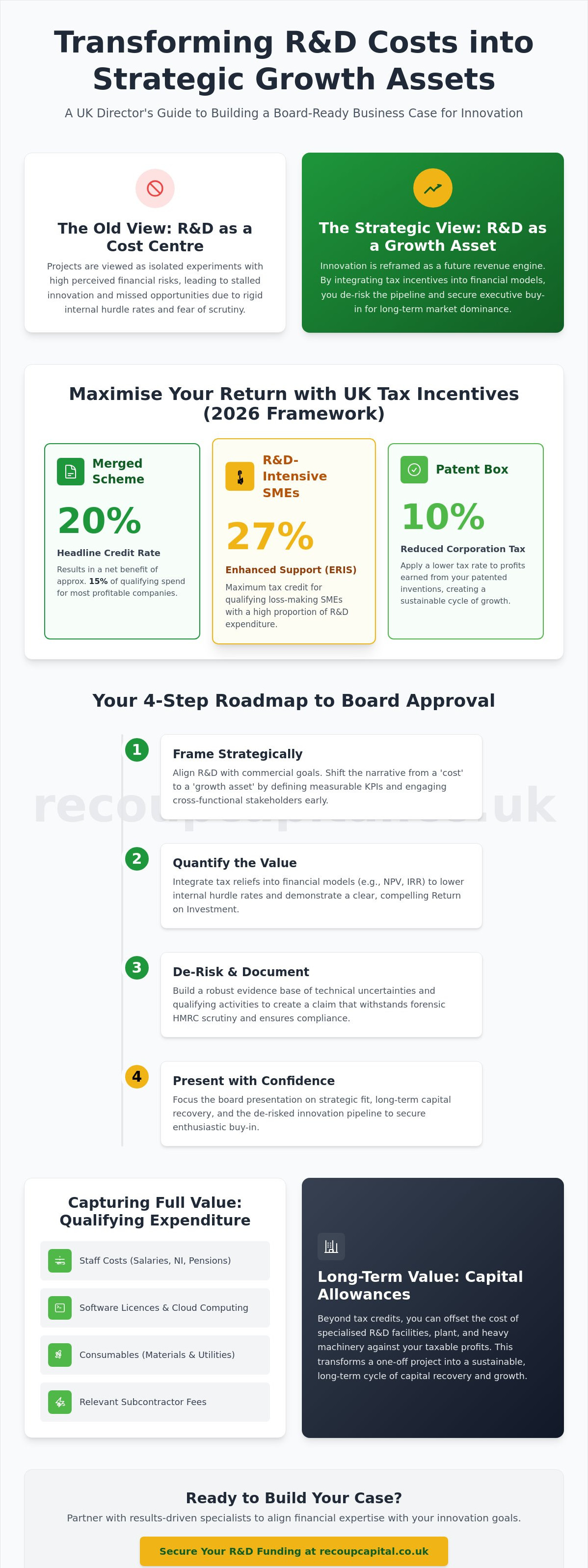
We're here to change that narrative by reframing your innovation costs as strategic assets. This guide will show you how to construct a robust, tax-efficient business case that secures executive buy-in and de-risks your pipeline using the 2026 regulatory framework. You'll learn how to model the 20% headline rate of the Merged Scheme and the 27% credit for R&D-intensive SMEs into your financial forecasts. We will walk through a clear framework for financial modelling that maximises capital recovery whilst ensuring your claims stand up to the latest compliance standards, turning technical uncertainty into a calculated opportunity for growth.
Key Takeaways
- Learn why shifting the narrative from a cost centre to a revenue engine is the critical first step in building a business case for R&D investment.
- Discover how to integrate the latest 2026 tax relief rates into your financial modelling to lower internal hurdle rates and improve project NPV.
- Understand how to categorise technical uncertainties to create a robust evidence base that withstands forensic HMRC scrutiny.
- Master a two-step implementation roadmap for board-level presentations that focuses on strategic fit and long-term capital recovery.
- Explore how partnering with results-driven specialists aligns financial expertise with your specific innovation goals through success-based models.
The Strategic Foundation: Framing R&D as a Growth Asset
Many UK businesses struggle because they treat innovation as an isolated laboratory experiment. When the board reviews a proposal, they often see a list of technical risks and equipment costs rather than a strategic pathway to market dominance. This disconnect is why traditional business cases fail. They rely too heavily on technical milestones that mean little to a Finance Director. Building a business case for R&D investment requires a fundamental shift in perspective. You aren't just asking for a budget; you're proposing a growth asset.
To understand what is R&D in a commercial sense, we must look beyond the prototypes. It's the engine that powers long-term corporate strategy. In a competitive UK landscape, the opportunity cost of inertia is high. If you aren't solving the technical uncertainties of tomorrow, your competitors certainly will. This makes innovation a defensive necessity as much as an offensive strategy. Reframing the narrative from a cost centre to a future revenue engine allows stakeholders to see the long-term value. You can explore more about the strategic benefits of this approach through our guide on why businesses should claim incentives to fuel their growth.
Defining the Problem and Solution
Success begins by articulating the specific technical uncertainty your project aims to resolve. You must move beyond vague goals. Instead, map project outcomes directly to customer pain points and market demand. If your R&D aims to reduce manufacturing energy consumption by 20%, that's a measurable KPI the board will recognise as a success. Clear, quantifiable metrics bridge the gap between technical effort and commercial reality, ensuring the solution is as robust financially as it is scientifically.
Cross-Functional Alignment
Innovation shouldn't happen in a silo. Engaging stakeholders from Finance, Operations, and Marketing early in the process is essential. This builds a coalition of support that can champion the case through the approval cycle. It also helps dismantle the cultural barriers often found in established firms. When Finance understands the potential for capital recovery and Marketing sees a future competitive edge, the business case gains unstoppable momentum. A well-structured approach to building a business case for R&D investment ensures that everyone is invested in the project's success from day one.
Quantifying Value: Integrating Tax Incentives into Your ROI
Data alone rarely wins over a sceptical board. It's the interpretation of that data that counts. When building a business case for R&D investment, your financial modelling must move beyond simple cost-benefit analysis. Traditional Internal Rate of Return (IRR) calculations often fail to account for the unique "Tax Relief Lever" available in the UK. By integrating these incentives early, you effectively lower the hurdle rate for capital expenditure, making ambitious innovation projects far more attractive to decision-makers. This approach transforms a high-risk technical project into a financially sound strategic move.
The Financial Impact of R&D Tax Relief
For accounting periods in 2026, the landscape has shifted toward a merged scheme. For most profitable companies paying the 25% main rate of Corporation Tax, the headline 20% credit results in a net benefit of approximately 15% of qualifying spend. However, loss-making, R&D-intensive SMEs can access the Enhanced R&D Intensive Support (ERIS) scheme, providing a tax credit rate of up to 27%. R&D tax credits act as a "cash-back" mechanism for innovation, providing a vital injection of liquidity. When you estimate qualifying expenditure, ensure you include staff costs, software, consumables, and relevant subcontractor fees to capture the full scope of your investment.
Long-Term Capital Utility
The value of your innovation doesn't end with a tax refund. To truly de-risk the pipeline, you must consider Capital Allowances, which allow you to offset the cost of specialised R&D facilities and heavy equipment against your taxable profits. For projects that lead to patented technology, the Patent Box regime offers a reduced effective Corporation Tax rate of 10% on relevant profits. This long-term view transforms a one-off project into a sustainable cycle of growth. If you are unsure how these layers of relief interact, you might consider requesting a specialised assessment to see how they impact your terminal value projections.
Finally, factor in the impact of success-based fees on your cash flow. Unlike fixed-cost accounting services, this model ensures that the professional fees associated with your claim are only paid out of the recovered capital. This alignment of interests removes the upfront financial barrier to building a business case for R&D investment, allowing you to proceed with confidence. Additionally, Corporate Finance can play a vital role in funding the gap between the initial investment and the eventual tax recovery, ensuring that your operational liquidity remains stable throughout the development lifecycle.
De-risking the Case: Technical Uncertainty and Compliance
Boards often conflate commercial risk with technical risk. When building a business case for R&D investment, you must isolate these variables. A product that fails in the market is a commercial setback; however, a project that fails technically is often exactly what HMRC is looking for. This distinction is vital for your internal modelling. By using pilot phases and "Stage-Gates", you can limit financial exposure whilst exploring high-potential innovations. This structured approach creates an internal "HMRC Compliance Shield" by documenting the systematic process of trial and error from day one.
Demonstrating due diligence is no longer optional in the UK. You should reference the new compliance standards to show the board that your claim is built on a foundation of transparency and forensic accuracy. This proactive stance transforms a potential audit threat into a managed business process. It shows that you aren't just chasing a refund, but are operating within a rigorous, risk-managed framework.
Managing HMRC Expectations
The technical narrative is the most critical part of your business case. It's not enough to describe what you built. You must articulate the technical uncertainty you attempted to resolve. Since August 2023, the mandatory Additional Information Form (AIF) has made contemporaneous record-keeping essential. Your business case should outline how you'll track time, costs, and technical challenges as they happen. This level of detail ensures your R&D definition aligns perfectly with current guidelines, protecting your future capital recovery and reducing the likelihood of time-consuming enquiries.
Mitigating Technical Failure
A healthy innovation pipeline requires a "Pivot or Perish" framework. This allows you to evaluate projects at set intervals and decide whether to continue, redirect, or stop. When building a business case for R&D investment, it's vital to remember that failed projects still qualify for tax relief. In fact, proving that a solution was not easily achievable is often the strongest evidence of technical uncertainty. By diversifying your R&D portfolio to balance high-risk breakthroughs with low-risk incremental improvements, you create a more stable environment for investment. This strategy ensures that even if a specific project doesn't reach the market, the business still recovers a significant portion of its expenditure through R&D Tax Credits.
The Implementation Roadmap: Presenting to the Board
The final hurdle is often the most daunting. You've identified the technical uncertainty and modelled the tax recovery; now you must secure the mandate. Building a business case for R&D investment requires a structured pitch that addresses the unique priorities of each board member. It’s about transforming technical potential into a compelling commercial narrative. The following five-step roadmap ensures your presentation is both forensic and persuasive.
- Step 1: The Executive Summary. Start with the bottom-line impact. Clearly define how this project aligns with the organisation’s long-term strategic goals.
- Step 2: The Evidence Base. Present market data alongside technical feasibility studies. This proves there is a genuine demand for the innovation you’re developing.
- Step 3: The Financial Model. Show the gross investment alongside the net cost. Integrating the 2026 tax incentives discussed earlier is vital here.
- Step 4: The Risk Matrix. Proactively address technical risks and HMRC compliance. Show that you have a plan for failed projects and robust record-keeping.
- Step 5: The Call to Action. Define exactly what is needed to begin. This includes immediate resource requirements and the timeline for the first "Stage-Gate" review.
Tailoring the Message
Every director views a business case through a different lens. The CFO is looking for cash flow stability, ROI, and tax efficiency. They want to know how the Merged Scheme or ERIS will offset the initial capital drain. Conversely, the CEO is focused on competitive advantage and market share. They need to see how this investment secures the company’s future amongst its peers. The wider Board prioritises governance and risk mitigation. They require assurance that the project won't trigger an unnecessary HMRC enquiry. If you need help refining your financial projections, you can explore our specialist support for claiming R&D tax credits to ensure your board-level data is forensic and persuasive.
Visualising the Return
Data is more impactful when it's visual. Use charts to show the "J-curve" of R&D investment, highlighting the initial spend followed by the projected recovery through tax credits and commercialisation. This helps stakeholders understand the timeline for capital return versus project milestones. Visualising the net cost of R&D is essential for reframing the investment from a heavy capital drain to a manageable, tax-efficient growth strategy. By showing the "true" cost after relief, you lower the psychological hurdle for approval and demonstrate a sophisticated understanding of corporate finance. Building a business case for R&D investment in this way transforms the conversation from "can we afford this?" to "can we afford not to do this?".
Partnering for Success: Why Result-Driven Consultancy Wins
Building a business case for R&D investment involves more than just calculating numbers. It requires a forensic understanding of technical uncertainty. Whilst general accountants provide excellent broad financial oversight, they often lack the deep sector-specific knowledge required to identify every qualifying activity. This is where specialist R&D consultants offer a distinct advantage. By employing a success-based fee model, these partners align their interests directly with your business growth. You don't face the pressure of upfront costs; instead, the fee is a percentage of the capital successfully recovered. This model removes the financial barrier to entry and ensures your consultant is as motivated as you are to secure the maximum compliant return. It transforms the consultancy role from a service provider into a genuine stakeholder in your innovation journey.
A truly strategic approach looks beyond a single tax relief to maximise the utility of your capital. For instance, Corporate Finance advisory plays a vital role in restructuring existing debt or identifying new funding streams to support your innovation pipeline. Simultaneously, forensic surveying can identify significant Capital Allowances on the very facilities and specialised equipment where your R&D takes place. This multi-layered strategy ensures that every pound spent on innovation is leveraged to its full potential, providing a much stronger ROI for the board to review.
Maximising Every Opportunity
Many firms overlook "hidden" R&D in sectors like construction, engineering, or food technology. If you're solving a technical challenge on a brownfield site, you might be eligible to combine R&D Tax Credits with Land Remediation Relief. This dual-track approach is particularly powerful for developers and manufacturing firms. It ensures end-to-end support, from the initial technical assessment through to direct HMRC liaison. By identifying these overlapping incentives, you can present a much more robust financial case that significantly de-risks the project's bottom line.
The Recoup Capital Advantage
At Recoup Capital, we don't just process paperwork. We adopt a relationship-first approach, acting as a long-term partner invested in your firm's future. We specialise in transforming financial returns into strategic assets that fund your next breakthrough. By building a business case for R&D investment with our team, you gain access to a proactive and protective guide through the complexities of the 2026 regulatory landscape. We focus on transparency and reliability, ensuring your claims are forensic enough to withstand any level of scrutiny.
Ready to build your case? Book a no-cost introductory consultation with our specialists today.
Securing the Future of Your Innovation Pipeline
The path to securing board approval for your next breakthrough lies in the bridge between technical vision and financial reality. By reframing innovation as a growth asset and integrating the 2026 tax incentives into your initial modelling, you transform the conversation from one of risk to one of strategic opportunity. Successfully building a business case for R&D investment requires a forensic eye for detail and a robust implementation roadmap that addresses the unique concerns of every director. It's about ensuring your project isn't just scientifically sound, but financially resilient.
Recoup Capital acts as your protective guide through this complex landscape. Our team of Chartered tax accountants and technical specialists provides national coverage from our offices in London and Manchester, ensuring your claims are both maximised and compliant. Because we operate on a success-based fee structure, our goals are perfectly aligned with your business growth. We're ready to help you turn technical uncertainty into a calculated strategic advantage. This relationship-first approach ensures that your innovation remains a sustainable engine for long-term success.
Secure your innovation funding with a specialist R&D assessment today and begin a partnership that transforms your financial returns into powerful strategic assets.
Frequently Asked Questions
How do I calculate the ROI of R&D when the outcome is uncertain?
You should calculate ROI by using range-based modelling that accounts for the "net cost" of the project rather than the gross spend. By integrating the 15% net benefit from the Merged Scheme into your initial projections, you effectively lower the hurdle rate for the investment. This approach allows you to present a more realistic financial forecast to the board, even when the technical success of the project remains uncertain.
Can I include R&D Tax Credits in my business case if the project hasn’t started?
Yes, you can and should forecast these incentives as a strategic asset when building a business case for R&D investment. By estimating qualifying costs such as staff time, software, and subcontractors, you can project the timing and scale of capital recovery into your cash flow models. This demonstrates to stakeholders that you have a clear plan for de-risking the innovation pipeline from day one.
What is the difference between SME and RDEC schemes for my financial model?
For accounting periods in 2026, most UK companies now fall under the Merged Scheme, which offers a 20% headline tax credit rate. However, if your firm is a loss-making, R&D-intensive SME with innovation spend exceeding 30% of total expenditure, you may qualify for the Enhanced R&D Intensive Support (ERIS) scheme. This provides a higher credit rate of up to 27%, which significantly changes the internal rate of return for your project.
How does the Patent Box affect the long-term business case for R&D?
The Patent Box regime provides a reduced 10% effective rate of Corporation Tax on profits derived from your patented inventions. Whilst R&D Tax Credits support the development phase, the Patent Box enhances the commercialisation phase of your business case. This long-term tax efficiency ensures that the intellectual property you develop remains a high-yielding asset throughout its entire lifecycle.
Should I use my general accountant or a specialist for the R&D element of the case?
Specialists provide a forensic level of technical assessment that general accountants often lack, particularly in complex sectors like construction or engineering. A specialist ensures your business case captures every qualifying activity whilst maintaining the high compliance standards required by HMRC. This expertise typically results in a more robust and maximised claim, providing the board with greater confidence in the project's financial viability.
What happens to the business case if the R&D project fails technically?
The financial foundation of your case remains secure because failed R&D projects still qualify for tax relief under UK law. In many instances, proving that a solution was not achievable provides the strongest evidence of "genuine technical uncertainty" to HMRC. This ensures that a significant portion of your investment is recovered regardless of the project's commercial outcome, effectively capping your financial downside.
How has the 2026 HMRC compliance landscape changed for R&D claims?
HMRC has introduced higher bars for claim quality, including the mandatory Additional Information Form (AIF) and a focus on UK-based R&D. Your business case must now include a plan for contemporaneous record-keeping to satisfy these forensic requirements. This proactive stance on compliance is a positive development, as well-prepared claims now benefit from a smoother and more predictable processing experience.
How do I justify the cost of specialist R&D consultancy to my board?
You can justify the cost by highlighting the "success-based" fee model, which ensures that consultancy fees are only paid out of recovered capital. This means there is no upfront cost to the business, and the consultant’s interests are perfectly aligned with your firm's growth. When building a business case for R&D investment, this model presents a low-risk way to access high-level tax expertise and forensic technical reporting.