
How to Present R&D Activities to HMRC: A Comprehensive Compliance Guide

Is your R&D narrative actually a technical report, or just a well-written marketing story? With HMRC's increased scrutiny and the mandatory Additional Information Form (AIF) now a standard requirement, the margin for error has vanished. You likely feel the pressure of ensuring every word aligns with the latest DSIT guidelines whilst fearing the administrative burden of a potential enquiry. Understanding how to present R&D activities to HMRC is no longer about simply describing your projects; it's about forensic alignment with specific regulatory benchmarks to protect your capital recovery.
We recognise that the distinction between commercial hurdles and genuine technical uncertainties often feels blurred. You want the confidence that your evidence is robust enough to pass through the merged R&D tax relief scheme without delay. This guide provides a clear framework for structuring your technical narratives and evidence to meet current compliance standards. You'll discover how to translate complex innovation into the precise language HMRC expects, ensuring a successful, enquiry-free submission that secures the strategic assets your business deserves.
Key Takeaways
- Learn how to distinguish between standard commercial innovation and the specific scientific advances required by the DSIT framework to ensure your project qualifies.
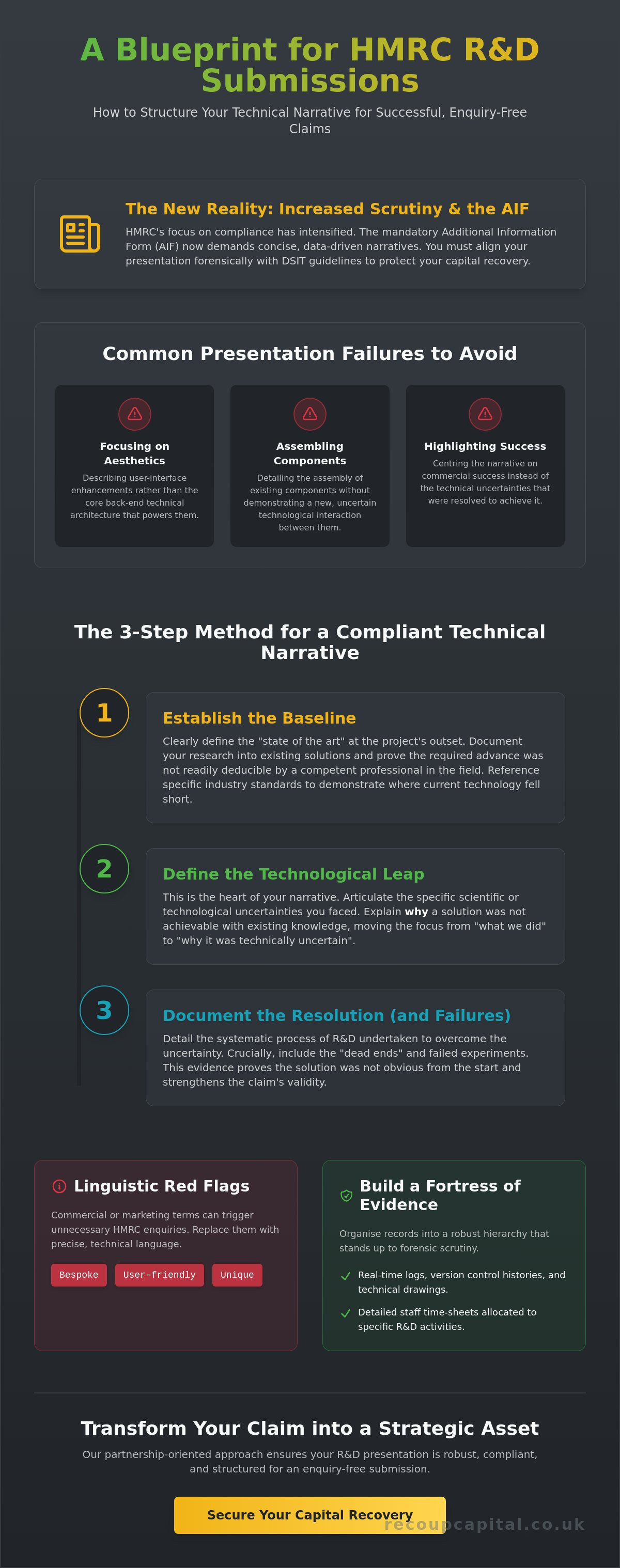
- Master a structured three-step method for how to present R&D activities to HMRC, moving from establishing a technical baseline to defining your specific technological leap.
- Discover how to organise real-time logs and staff time-sheets into a robust hierarchy of evidence that stands up to forensic scrutiny.
- Identify and eliminate common linguistic red flags like "bespoke" or "user-friendly" that often trigger unnecessary HMRC enquiries and claim delays.
- Understand how to transform your R&D tax credit claim from mere paperwork into a strategic business asset through a partnership-oriented approach.
Understanding the HMRC Framework: DSIT Guidelines and the GfC
The foundation of any successful claim lies in the Department for Science, Innovation and Technology (DSIT) guidelines. These rules form the bedrock of the UK's R&D tax credit system, dictating exactly what qualifies as research and development. To succeed, you must demonstrate a search for an advance in science or technology. Many businesses fall into the trap of presenting "business as usual" improvements as R&D. Whilst these projects are often commercially innovative, they don't always meet the strict criteria of overcoming a specific technological uncertainty. Common reasons these presentations fail include:
- Focusing on user-interface aesthetics rather than back-end technical architecture.
- Describing the assembly of existing components without a new technological interaction.
- Highlighting commercial success instead of technical resolution.
HMRC's Guidelines for Compliance (GfC) provide the roadmap for these expectations. The GfC clarifies that an advance isn't just about creating a new product; it's about extending the overall knowledge or capability in a field of science or technology. If your team is simply using established tools to solve routine problems, HMRC will likely view this as standard engineering or development. Mastering how to present R&D activities to HMRC requires you to pivot away from "what we did" and focus on "why it was technically impossible with existing knowledge." You must prove that the solution wasn't readily deducible by a competent professional.
The Definition of Scientific or Technological Uncertainty
Uncertainty is the heart of your narrative. It's the reason your project exists. HMRC distinguishes between a "difficult" problem, which a skilled professional can solve with effort, and a "technologically uncertain" one. In 2026, scientific or technological uncertainty is defined as existing when knowledge of whether something is scientifically possible or technologically feasible, or how to achieve it in practice, is not readily available or deducible by a competent professional working in the field. If the solution was already in the public domain or could be easily worked out by an expert, the project won't qualify for relief. Your presentation must clearly document the technical dead-ends and failed attempts that define this uncertainty.
The Shift Towards Transparency and the AIF
The introduction of the mandatory Additional Information Form (AIF) in August 2023 fundamentally changed the presentation landscape. Claims are now digital-first, requiring concise and data-driven descriptions rather than sprawling, vague reports. You must also identify a "Senior Officer" within your company who takes responsibility for the claim's accuracy. This shift ensures accountability and demands a higher level of transparency. Understanding how to present R&D activities to HMRC in this digital format means prioritising technical facts over marketing language. For a deeper dive into these requirements, you can explore how R&D tax credits are explained in the context of modern compliance. Success now depends on your ability to be precise, technical, and forensic in your documentation.
Structuring Your Technical Narrative: The 3-Step Method
Writing a technical report that satisfies a tax inspector requires a shift in perspective. You aren't just documenting a project; you're building a legal case for tax relief. The most effective way to manage how to present R&D activities to HMRC is to follow a strict three-step structure: Baseline, Advance, and Resolution. This sequence ensures you provide the necessary context before diving into technical specifics. Crucially, your narrative must include the "dead ends" and failed experiments that occurred along the way. If every attempt was successful, HMRC might argue the solution was obvious from the start, making your claim vulnerable to challenge.
Framing the Baseline and State of the Art
Before you can claim an advance, you must establish where the technology currently sits. This involves documenting your search for existing solutions and proving that the problem wasn't "readily deducible" by a competent professional. You should use specific industry standards to show exactly where current technology failed to meet your needs. If you're unsure if your project qualifies as a genuine advance, you can see why claiming R&D tax credits is a strategic move for businesses pushing these boundaries. Proving you exhausted standard methods before starting your R&D is vital for credibility.
Articulating the Technological Uncertainties
You should replace vague project management terms like "challenges" or "delays" with specific technical obstacles. Instead of saying a process was "slow," describe the latency constraints or the environmental factors that caused the system to fail. Quantifying these uncertainties with specific metrics makes your narrative far more persuasive. Every uncertainty you list must link back to the technological advance you're seeking. If you can't explain why a problem was technically uncertain, it likely won't qualify for relief under the current HMRC standards.
Describing the Systematic Investigation
HMRC values a methodical, iterative process over sudden "eureka moments." Your narrative should detail the cycle of testing, analysis, and refinement that your team followed. Methodical testing logs are your best friend here; they provide concrete proof of a systematic investigation. You should link the time spent by your staff directly to these investigation phases. This level of detail transforms a simple description into a robust compliance document. It shows that your project was a structured search for knowledge rather than a series of random trials.
Evidence-Led Reporting: Organising Records for Compliance
HMRC's approach to R&D has shifted significantly. It's no longer enough to provide a high-level summary; you must back every claim with a robust hierarchy of evidence. Contemporaneous evidence, created at the time the R&D occurred, is the gold standard for defending against an enquiry. If you rely solely on retrospective interviews conducted months after the project ended, your claim's credibility diminishes. Mastering how to present R&D activities to HMRC involves curating a trail of documentation that proves the work happened exactly when and how you say it did.
When organising staff time-sheets, they must mirror the technical narrative structure discussed in the previous section. If your narrative highlights three specific technological uncertainties, your time-sheets should reflect the hours spent resolving those exact issues. This alignment is equally vital when presenting subcontracted R&D activities. You must demonstrate that you maintained technical control over the subcontractor's work and that their activities directly contributed to your project's advance. Vague invoices from third parties rarely suffice; you need detailed breakdowns of their technical contributions to maintain compliance whilst protecting your capital recovery.
Technical Documentation as Evidence
Your technical evidence should "show, not just tell" the R&D process. For software developers, version control logs like GitHub provide an indisputable record of iterative testing and code refinement. In manufacturing or engineering, blueprints, lab notes, and even timestamped photos of prototypes offer tangible proof of the systematic investigation. These records ensure your technical evidence aligns seamlessly with the claiming R&D tax credits process. By presenting physical or digital artefacts of the development cycle, you make it much harder for HMRC to dispute the reality of your innovation.
Financial Nexus: Linking Costs to Activities
The "Nexus" principle is fundamental to a successful submission. It requires you to prove that every pound claimed was spent directly on qualifying R&D activities. You should avoid the "allocation by guesswork" trap, which often triggers red flags during a review. Instead, provide a clear breakdown of software licences, consumables, and utility costs that were essential to the project. If you're claiming for cloud computing or data licences, ensure these costs are partitioned to reflect their specific use in R&D. Learning how to present R&D activities to HMRC with this level of financial precision protects your claim and establishes your business as a transparent, compliant innovator.
Avoiding Red Flags: Why HMRC Challenges R&D Presentations
HMRC's automated systems are increasingly sophisticated. Using the wrong vocabulary can trigger an enquiry before a human even reads your report. Words like "innovation", "bespoke", or "user-friendly" are marketing terms, not technical ones. They signal a focus on commercial outcomes rather than technological advances. When considering how to present R&D activities to HMRC, you must replace these with precise descriptions of the scientific or technological uncertainties encountered. Generic descriptions are equally dangerous. Every project requires its own unique narrative. Recycling text across different claims is a major red flag for HMRC's risk-flagging algorithms.
The recent shift towards HMRC R&D tax claim transparency and AI means that automated risk flagging is now more efficient than ever. These systems scan for patterns that suggest "boiler-plate" content or a lack of specific technical depth. If your narrative lacks forensic detail, it's much more likely to be flagged for manual review. You need to demonstrate that your project was a unique response to a specific technical hurdle. This level of detail protects your claim from being categorised as a high-risk submission.
The "Competent Professional" Test
A successful claim rests on the opinion of a "Competent Professional". This isn't just a project manager. It's someone with the relevant qualifications and experience in the specific field of science or technology. To validate your claim, you should present their CV and professional history clearly. Their role is to state that the solution was not readily available to someone with their level of expertise. Their professional judgement is the cornerstone of your presentation. If you're concerned about how your team's expertise is being framed, you can check our FAQs for more guidance on qualifying criteria.
Addressing "Boundary" Issues
Identifying exactly where R&D starts and ends is a common point of contention. You must clearly present the cut-off point where qualifying activities transitioned into routine production or commercialisation. For example, production-line R&D often involves a mix of qualifying testing and standard manufacturing. You need to differentiate between the two carefully. Routine problem solving, even if it's difficult, does not qualify. Qualifying R&D only begins when the team faces an uncertainty that standard industry knowledge cannot resolve. Mastering how to present R&D activities to HMRC requires a clear line between these phases to avoid claiming for ineligible commercial work.
The Recoup Capital Approach: Professionalism over Pitches
At Recoup Capital, we don't just process paperwork; we provide a strategic technical consultancy that transforms your claim into a powerful business tool. Many providers treat R&D as a one-off transaction. We view it as a long-term collaboration. Our success-based fee structure ensures our goals are perfectly aligned with your compliance and success. By combining the expertise of chartered tax accountants with seasoned technical specialists, we bridge the gap between complex innovation and HMRC's strict regulatory expectations. This partnership approach is why we focus on R&D tax credits explained through the lens of business growth rather than mere administrative box-ticking. We understand that how to present R&D activities to HMRC is as much about the 'why' as it is about the 'what'.
Why Result-Driven Consultancy Wins
We reframe your financial returns as strategic assets. These aren't just refunds; they're capital injections that fuel future innovation and expansion. Our team is particularly adept at uncovering "hidden" R&D in sectors like construction and engineering, where technical uncertainties are often mistaken for routine site challenges. For instance, developing a specialised foundation solution in unstable soil conditions isn't just 'good engineering'; it's often a qualifying technological advance. If HMRC does open an enquiry, our proactive defence is a standard part of our service. We stand by our work, ensuring your evidence is presented with the forensic clarity required to withstand scrutiny. This protective guide approach ensures your business remains focused on innovation whilst we handle the regulatory complexities.
Next Steps for Your R&D Presentation
Mastering how to present R&D activities to HMRC requires a blend of technical insight and tax expertise. We start with a no-cost introductory review of your current activities to identify qualifying expenditure you might have overlooked. This initial discovery phase is brisk and efficient, mirroring the streamlined experience we promise throughout our partnership. From there, we handle the heavy lifting. We prepare both the mandatory AIF and the detailed technical report to the highest professional standards, ensuring every technical narrative is robust and evidence-led. Our goal is to make the process approachable and successful, allowing you to focus on your core business whilst we secure your capital. Ready to secure your claim? Contact Recoup Capital for a specialist review.
Securing Your Innovation with Professional Precision
Navigating the complexities of the merged R&D scheme doesn't have to be an intimidating process. By adopting a structured narrative that highlights technical baseline shifts and maintaining a robust hierarchy of contemporaneous evidence, you transform your claim into a defensible strategic asset. Mastering how to present R&D activities to HMRC is ultimately about forensic transparency; it's the difference between a challenged submission and a successful capital recovery that fuels your next breakthrough.
Our team of Chartered Tax Accountants and technical specialists brings deep expertise in complex sectors like Construction and Engineering. We operate on a success-based fee model, ensuring our goals remain perfectly aligned with your long-term collaboration and success. We act as your proactive guide, articulating every technical uncertainty with the precision HMRC demands. If you're ready to move beyond basic paperwork and secure your business's future, Book a Specialist R&D Claim Review today. Your innovation deserves the highest standard of professional protection.
Frequently Asked Questions
What is the most important part of an R&D technical report for HMRC?
The scientific or technological uncertainty is the most critical element of your report. HMRC needs to see that you encountered a technical problem that couldn't be solved with standard industry knowledge. When considering how to present R&D activities to HMRC, you must focus on the specific hurdles rather than the commercial goals of the project. A clear explanation of why the solution wasn't obvious to an expert is essential for a successful claim.
How long should an R&D project description be for the AIF?
Your project descriptions in the Additional Information Form (AIF) should be concise yet detailed. The digital form has specific character limits for each section, often ranging between 2,000 and 5,000 characters. You don't need to write a novel; you need to provide forensic facts. Focus on the core advance and the uncertainties faced to ensure you stay within the digital form's constraints whilst providing enough technical depth.
Can I present R&D activities that were unsuccessful?
You absolutely can, and often should, present unsuccessful R&D activities. Failed attempts and technical dead ends are powerful evidence that a genuine technological uncertainty existed. If a project was easily solved on the first try, HMRC might argue it was routine work. Documenting your failures proves that the solution was not readily deducible by a competent professional, which strengthens your compliance position.
Who should sign off on the R&D technical narrative?
A Senior Officer of the company must be identified as responsible for the claim on the mandatory AIF. Additionally, the technical narrative should be reviewed and validated by the "Competent Professional" who led the research. This person should have the relevant qualifications and industry experience to confirm that the work performed truly sought a technological advance beyond the current state of the art.
What happens if HMRC disagrees with my presentation of R&D?
If HMRC disagrees with your presentation, they will likely open an enquiry to seek further clarification. This doesn't mean your claim is automatically rejected, but it does mean you'll need to provide more granular evidence or technical justifications. Having a robust trail of contemporaneous records is your best defence. A proactive approach during this phase can help resolve disputes and secure your capital recovery.
Is a technical report still necessary if I complete the AIF?
Whilst the AIF is now a mandatory digital requirement, a separate technical report remains a highly valuable tool. It allows you to document the full scope of your innovation in greater detail than the AIF's character limits permit. This report serves as a vital internal record and a primary piece of evidence should HMRC ever decide to open a formal enquiry into your activities in the future.
How do I present software development as R&D to HMRC?
When presenting software development, you must focus on the technological advance in the underlying code or architecture. Avoid describing the "user-friendly" interface or the business benefits of the software. Instead, highlight challenges like novel algorithm development, complex data processing, or overcoming hardware limitations. This ensures you are demonstrating how to present R&D activities to HMRC through a purely technical lens that aligns with DSIT guidelines.
How far back can I go when presenting R&D activities?
You can generally claim for R&D activities undertaken in your current accounting period and the one immediately preceding it. This typically gives you a window of up to two years from the end of the accounting period in which the costs were incurred. It's vital to act quickly, as missing the notification or submission deadlines can result in the loss of significant tax relief opportunities for your business.