
De-risking Your R&D Tax Claim: The 2026 Compliance Checklist for UK Businesses

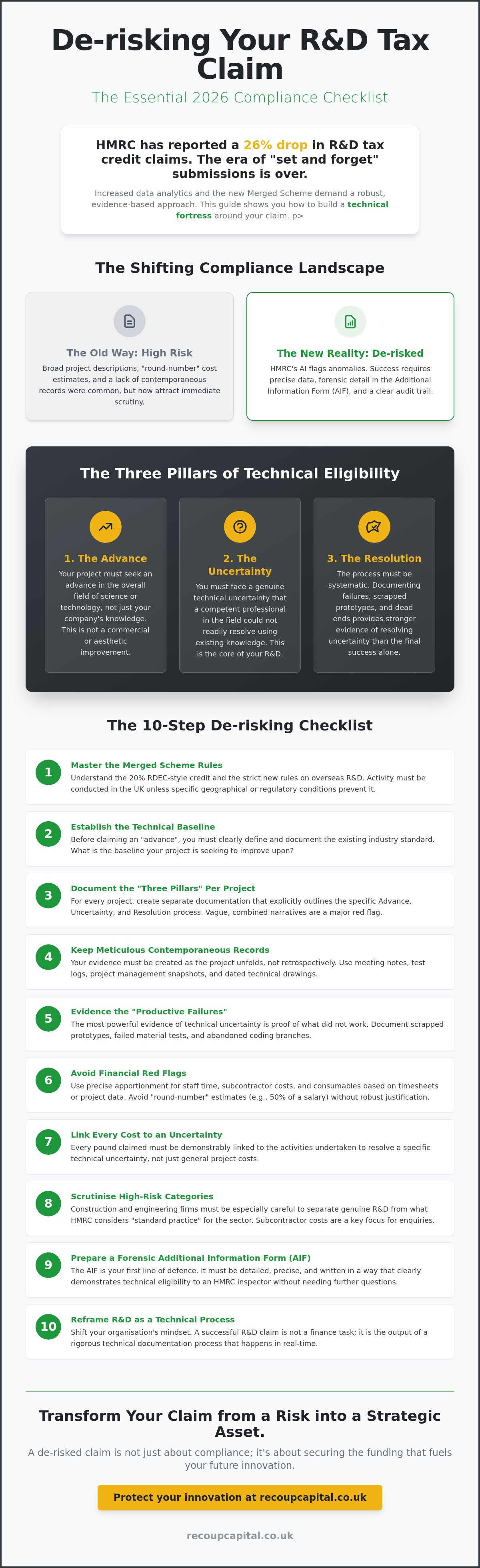
With HMRC reporting a 26% drop in the number of R&D tax credit claims last year, it is clear that the era of "set and forget" submissions is over. The introduction of the merged scheme and the mandatory Additional Information Form means that de-risking your R&D tax claim is no longer optional; it is the only way to ensure your innovation is actually rewarded. You have likely felt the weight of these regulatory shifts, perhaps even hesitating to claim because the fear of a costly HMRC enquiry outweighs the promise of a tax credit. The 2024 merged scheme rules can feel like a labyrinth, and the burden of complex documentation often feels like it's pulling you away from the very innovation you are trying to fund.
We are here to show you that a successful, enquiry-free claim is entirely possible when you build a technical fortress around your projects. You can protect your business from penalties whilst maximising your relief through strategic de-risking and robust record-keeping. This 2026 compliance checklist will guide you through the essential steps to transform your internal processes and turn your financial returns into strategic assets for growth.
Key Takeaways
- Understand how HMRC’s increased reliance on data analytics and the 2024 merged scheme rules have fundamentally shifted the requirements for a successful submission.
- Master the "Three Pillars" of technical eligibility to ensure your projects meet the strict definitions of uncertainty and advance required for compliance.
- Learn how to avoid common financial red flags, such as "round-number" staff allocations, by implementing precise apportionment for subcontractors and consumables.
- Discover a practical 10-step checklist for de-risking your R&D tax claim, focusing on robust evidence like test logs and prototype failures.
- Reframe your R&D tax relief as a strategic business asset by building a technical fortress that withstands scrutiny and supports long-term innovation.
Understanding the Risk Profile of R&D Tax Claims in 2026
HMRC has fundamentally changed how it reviews submissions. The days of broad descriptions and estimated costs are gone, replaced by a sophisticated, data-driven enquiry process. In this environment, de-risking your R&D tax claim isn't about claiming less; it's about ensuring every penny is backed by a technical fortress of evidence. HMRC now employs advanced AI and data analytics to scan every UK R&D Tax Credit Scheme submission for anomalies, such as unusual staff cost ratios or benchmarks that deviate from industry norms.
The distinction between "aggressive" and "optimised" claiming is now the difference between an enquiry and a successful payout. Aggressive claims often involve "round-number" allocations or projects that are actually standard industry practice. Optimised claims, conversely, identify every eligible cost whilst maintaining a realistic, evidenced connection to a specific technical uncertainty. Construction and engineering firms face particularly high scrutiny in 2026. This is often due to the complex nature of site-based work and the frequent use of subcontractors, which can easily lead to "standard practice" being misidentified as innovation. HMRC's algorithms are specifically tuned to flag construction projects that appear to be routine architectural or civil engineering tasks disguised as R&D.
The Shift to the Merged R&D Scheme
For accounting periods starting on or after 1 April 2024, the transition to the unified, RDEC-style merged scheme has simplified the landscape but introduced new pitfalls. This 20% taxable expenditure credit requires a higher standard of financial reporting than the previous SME system. A major risk factor in 2026 involves overseas R&D activity. Unless your project meets very specific criteria for non-UK work, such as geographical or regulatory necessity, including overseas subcontractor costs is a high-risk flag that will likely trigger an immediate enquiry. Businesses must now prove why the work could not have been performed within the UK to remain compliant.
HMRC’s New Compliance Standards
The Additional Information Form (AIF) is now the mandatory gateway for every claim. It forces businesses to break down projects with forensic precision, leaving no room for vague generalisations. If your technical narrative doesn't clearly explain the specific technical advance and the uncertainty encountered, the claim is at risk. You can find more detail on how these mechanics work in our guide on R&D tax credits explained. Successful de-risking requires moving beyond simple project summaries to detailed logs that document failed prototypes and testing cycles as they happen. Technical narratives now require the same level of rigour as a peer-reviewed scientific paper.
Establishing Technical Eligibility: The Foundation of a De-risked Claim
Technical eligibility is the bedrock of any successful submission. In the eyes of HMRC, innovation isn't a marketing buzzword or a vague business goal; it's a precise legal threshold defined by the official government R&D tax relief guidance. If you can't prove that your project sought an advance in science or technology through the resolution of technical uncertainty, the claim is flawed from the start. Effective de-risking your R&D tax claim begins with understanding that your internal perception of "new and exciting" may not align with the statutory definitions required for relief.
HMRC looks for three specific pillars: the Advance, the Uncertainty, and the Resolution. A common pitfall is confusing a commercial advance with a technical one. Developing a faster piece of software is a business win, but unless that speed was achieved by overcoming a technical barrier that couldn't be solved by a competent professional using standard industry practice, it likely won't qualify. To satisfy an inspector, you must document the "failure" points of your project. Evidence of dead ends, scrapped prototypes, and failed testing cycles is often more valuable than the final successful result because it provides tangible proof that technical uncertainty actually existed.
Defining the Technical Baseline
To claim an advance, you must first establish the baseline of what's already achievable. This involves documenting the "state of the art" in your industry and explaining why existing solutions were insufficient for your specific goals. Technical uncertainty occurs when, for example, a civil engineer cannot determine if a novel composite material will maintain structural integrity under specific seismic loads using current industry-standard stress-testing models. By clearly defining this gap, you demonstrate that your team was working at the edge of known science rather than simply applying existing knowledge in a new context.
The Importance of Contemporary Evidence
Retrospective narratives are a major red flag in 2026. HMRC's increased scrutiny means that "re-creating" the story of a project months after it finished is no longer acceptable. High-quality de-risking relies on contemporary evidence, such as real-time developer diaries, version control logs, and meeting minutes that record technical hurdles as they happen. This level of transparency is essential, especially as HMRC R&D Tax Claim Transparency and AI tools now scan for inconsistencies in technical descriptions. If you're unsure if your current project logs meet these rigorous standards, you might find it helpful to review how we structure technical narratives to ensure they withstand forensic examination.
Financial Rigour: Optimising Expenditure without Overreaching
HMRC's data analytics tools are designed to spot financial anomalies before a human inspector ever opens your file. One of the most immediate red flags is the use of "round-number" claims. If your staff allocations are consistently 50% or 100%, it signals to HMRC that the figures are estimates rather than precise calculations based on real-time activity. In 2026, de-risking your R&D tax claim requires a granular approach to apportionment. You must be able to demonstrate exactly how many hours a lead engineer spent on a specific technical uncertainty versus their routine operational duties.
Forensic accounting plays a vital role in ensuring your CT600 stands up to scrutiny. This involves more than just adding up invoices; it's about aligning every pound of expenditure with the technical advances described in your narrative. Subsidised expenditure also requires careful handling under the 2024 merged scheme rules. If your R&D was funded by a grant or is part of a capped contract, the rules for how you calculate your expenditure credit have changed. Failing to account for these nuances can lead to over-claiming, which is a primary trigger for a compliance check. Accuracy is your best defence.
Qualifying Expenditure Categories
Staff costs remain the largest component of most claims, but they must be calculated correctly to remain compliant. This includes gross salary, Class 1 National Insurance contributions, and pension contributions. Bonuses can be included, provided they are not purely dividends in disguise. For 2026, software licences and cloud computing costs are also eligible, but only to the extent they were used for the R&D project itself. If you're unsure which costs qualify, you can learn more about the specifics of claiming R&D tax credits to ensure your financial foundation is solid.
Subcontractor and External Worker Risks
The rules regarding subcontractors and Externally Provided Workers (EPWs) are a frequent source of confusion. You must distinguish between "connected" and "unconnected" subcontractors, as this affects the percentage of the cost you can claim. According to the ICAEW guidance on R&D tax claims, verifying the R&D status of your partners is now a critical step in the compliance process. If a subcontractor is also claiming for the same work, or if the work was performed overseas without meeting the strict 2026 exemptions, your claim could be invalidated. De-risking your R&D tax claim means vetting your entire supply chain to ensure every external cost is both eligible and correctly documented.
The R&D Claim De-risking Checklist: 10 Essential Controls
The theory of compliance is straightforward, but execution is where most businesses stumble. De-risking your R&D tax claim requires a systematic approach to internal controls that begins long before your technical narrative is written. HMRC's current scrutiny levels mean that "good enough" is a thing of the past. If you're wondering why claim R&D tax credits given the increased regulatory burden, remember that these incentives remain a vital strategic asset for reinvestment, provided they're built on a foundation of evidence.
Use these five core controls to anchor your submission:
- Verify technical baseline: Document what a competent professional in your field already knows to prove your project goes beyond standard industry practice.
- Evidence technical uncertainty: Keep a dedicated log of failed prototypes, abandoned code branches, or test results that didn't meet expectations.
- Cross-reference time logs: Ensure your staff's R&D hours align perfectly with payroll records and the PAYE cap requirements.
- Validate subcontractor residency: Confirm that all subcontracted work was performed in the UK, as 2024 rules strictly limit claims for overseas R&D.
- Forensic AIF completion: Treat every field in the Additional Information Form as a legal declaration, avoiding vague language or repetitive descriptions.
Pre-Submission Audit Steps
Before you finalise your CT600, conduct a "Shadow Enquiry" to stress-test your narrative. Imagine you're an HMRC inspector looking for inconsistencies between your financial figures and technical claims. You must also review your submission against the latest HMRC Guidelines for Compliance (GfC3), which provides a clear roadmap of what the authorities expect to see. Finally, check for subsidised R&D overlaps. If a project was partially funded by a separate grant, it may impact your eligibility for the merged scheme or the Enhanced R&D Intensive Support (ERIS) rate.
Post-Submission Readiness
Compliance doesn't end when the "submit" button is pressed. Organise a central evidence file containing all technical logs, invoices, and contracts so you can provide an immediate response if an enquiry is opened. Perhaps most importantly, establish a long-term R&D record-keeping culture within your engineering and finance teams. When documentation becomes a weekly habit rather than an annual chore, the risk profile of your future claims drops significantly. Before you submit your next period's figures, you can request a professional compliance audit to identify and fix any hidden vulnerabilities in your current process.
Strategic Protection: How Recoup Capital Safeguards Your Innovation
Choosing the right partner is the most effective step in de-risking your R&D tax claim. Whilst many software-only platforms promise speed, they often lack the technical depth required to defend a narrative under rigorous HMRC scrutiny. At Recoup Capital, we believe in a relationship-first approach that prioritises your long-term stability over a quick submission. Our success-based fee model ensures our interests are perfectly aligned with your compliance; we only succeed when your claim is both maximised and secure. This removes the aggressive sales pressure often found in the industry, replacing it with a focus on demonstrating value through results.
Our team consists of chartered tax accountants and technical specialists who act as a protective guide through the complexities of the 2026 regulatory landscape. We don't just process paperwork. We proactively manage the HMRC liaison process, providing a robust enquiry defence that shields your internal team from the administrative burden. By building a technical fortress around your innovation, we transform a complex tax procedure into a reliable opportunity for capital recovery. This proactive stance gives you the confidence to claim your full entitlement without the fear of unexpected penalties.
Beyond the Tax Refund
A de-risked R&D claim is a powerful strategic tool. In the context of corporate transactions, a history of clean, well-documented claims significantly improves business valuation. Potential investors or buyers look for financial stability and low-risk tax profiles. By integrating your R&D strategy into our broader Corporate Finance Advisory services, we help you reframe these returns as strategic assets. This capital can then be reinvested into your core operations, driving sustainable growth and providing the fuel needed to scale your next breakthrough.
The Recoup Capital Methodology
Our forensic surveying approach is designed to identify every qualifying penny whilst maintaining absolute compliance. We move beyond the surface, digging into the technical nuances of your projects to ensure every uncertainty is evidenced correctly. We understand that your priority is innovation, not navigating tax codes. That's why we handle the technical burden, allowing you to focus on what you do best. We're committed to transparency and reliability, ensuring your business is positioned for future success. If you want to ensure your next submission is both optimised and enquiry-ready, you can book a no-cost R&D assessment with our specialists today.
Securing Your Innovation for the Long Term
The regulatory environment of 2026 demands more than just identifying qualifying activity; it requires a technical fortress that stands up to HMRC scrutiny. By mastering technical eligibility and ensuring forensic financial precision, you move beyond the fear of penalties and towards the certainty of capital recovery. As we've explored, de-risking your R&D tax claim is a strategic necessity that protects your business valuation whilst providing the fuel for future growth. Whether you are navigating the complexities of construction site innovation or engineering breakthroughs, a robust record-keeping culture is your strongest asset.
Recoup Capital acts as your proactive guide through this landscape. Our expert team of Chartered Tax Accountants and specialists in Construction and Engineering R&D ensure every submission is built on a foundation of evidence. With our success-based fee structure, we're fully invested in your compliance and long-term success. You don't have to face the burden of documentation alone.
Secure your innovation with a de-risked R&D assessment from Recoup Capital
Your next breakthrough is waiting. Let's ensure the relief you've earned is protected so you can continue to lead your industry with confidence.
Frequently Asked Questions
What is the most common reason HMRC rejects an R&D claim in 2026?
HMRC frequently rejects claims because the project is deemed "standard industry practice" rather than a genuine technical advance. Vague descriptions in the mandatory Additional Information Form (AIF) often fail to specify the technical baseline or the exact uncertainty encountered. Without a clear distinction between commercial goals and technical hurdles, inspectors cannot verify that the work meets the statutory definition of R&D. Precision in your technical narrative is the best way to avoid a rejection.
Can I still claim R&D tax credits if my project failed?
You can absolutely claim for failed projects; in fact, technical failure is often the strongest evidence of uncertainty. HMRC recognises that if the outcome was certain, the project wouldn't qualify as R&D. Documenting why a prototype failed or why a specific technical approach was abandoned provides the forensic proof needed for de-risking your R&D tax claim. It demonstrates that the resolution was not obvious to a competent professional in your field.
How much detail does HMRC really need in the technical narrative?
HMRC requires forensic detail that moves beyond high-level project summaries. Your narrative must explicitly define the technical baseline, the specific uncertainties that prevented a straightforward solution, and the systematic process used to resolve them. Instead of saying you "improved software speed", you should explain the specific latency barriers and the algorithmic changes tested to overcome them. Quantitative metrics and contemporary test logs are essential for a successful, enquiry-free submission.
Is it risky to use an R&D tax specialist instead of my regular accountant?
Using a specialist is generally considered a lower-risk strategy because R&D tax legislation is highly specialised and changes frequently. Whilst regular accountants handle broad tax compliance, specialists focus exclusively on the technical and financial nuances of the R&D schemes. This ensures that technical narratives are robust and that qualifying expenditure is identified accurately without overreaching. A partnership between your accountant and a specialist often provides the most secure and optimised outcome.
What happens if HMRC opens an enquiry into my R&D claim?
If an enquiry is opened, HMRC will typically issue a formal letter requesting additional information or evidence to support your claim. This might involve a request for contemporary project logs, payroll records, or a meeting with your technical lead. Having a central evidence file ready for immediate response is a key part of de-risking your R&D tax claim. Professional advisors can then manage the liaison to ensure technical arguments are presented clearly and defended successfully.
How far back can I go to claim R&D tax relief in the UK?
You can generally submit a claim for the two previous accounting periods. For example, if your financial year ended on 31 December 2024, you have until 31 December 2026 to submit or amend your claim for that period. It's important to remember that first-time claimants or those who haven't claimed in three years must also submit a claim notification form within six months of the period end to remain eligible for relief.
Will claiming R&D tax credits increase my chances of a general tax audit?
Claiming R&D tax credits does not automatically trigger a general Corporation Tax audit, but the R&D claim itself is subject to specific compliance checks. HMRC's Risk and Complexity team uses AI to scan for anomalies within R&D submissions specifically. As long as your claim is built on a "technical fortress" of evidence and follows the latest GfC3 guidelines, it shouldn't negatively impact your wider tax standing or your long-term relationship with the authorities.
How does the 2024 merged scheme affect construction companies specifically?
The 2024 merged scheme introduces a unified 20% expenditure credit, but construction firms must be particularly wary of how they handle subcontractors. New rules regarding overseas work and the definition of "subsidised" expenditure mean that site-based R&D must be documented with extreme precision. Construction companies often face scrutiny over whether their work is "standard civil engineering" or a genuine advance, making contemporary evidence like site logs and test results more critical than ever.