
Staff Costs and EPWs in R&D Claims: A Comprehensive Guide for UK Businesses in 2026

In 2026, the difference between a compliant R&D claim and a costly penalty lies almost entirely in how you categorise your people. It is common to feel that your innovation is being overshadowed by the administrative weight of the merged R&D scheme. You probably find tracking staff time across multiple projects a constant headache; and the fear of an HMRC enquiry over the 65% rule for contractors is a genuine concern for many UK directors who simply want to focus on growth.
This guide helps you master the complexities of staff costs and EPWs in R&D claims to ensure you receive every penny of relief you deserve. We will explore how to build clear internal processes that satisfy the latest regulations whilst highlighting the financial differences between hiring staff and engaging contractors. From understanding the impact of overseas work restrictions to optimising your secondary Class 1 National Insurance contributions, you will gain the clarity needed to transform these regulatory hurdles into strategic business assets. We will examine the specific criteria for qualifying expenditure to ensure your next submission is both maximised and robustly defended.
Key Takeaways
- Learn how to precisely apportion technical and administrative time to ensure your claim reflects the true value of your internal innovation.
- Understand the "Staff Provider" definitions and the 65% restriction to accurately calculate staff costs and EPWs in R&D claims for unconnected parties.
- Discover the mandatory record-keeping requirements for the Additional Information Form (AIF) to protect your business from HMRC scrutiny.
- Find out how specialist forensic analysis uncovers hidden qualifying time amongst non-technical staff that generalist accountants frequently miss.
Understanding Staff Costs and EPWs in the R&D Tax Landscape
Staff costs represent the heartbeat of innovation for UK limited companies. They are the primary driver of value because they capture the human intelligence required to overcome technical uncertainties. Under the R&D Tax Credits framework, these costs often form the vast majority of a successful claim. However, since the introduction of the Merged Scheme in April 2024, the rules governing staff costs and EPWs in R&D claims have become more stringent. HMRC now applies a higher level of scrutiny to these categories compared to software or consumables; this is because staff time is often estimated rather than forensically recorded, leading to potential over-claiming.
The 2026 landscape demands precision. If your business relies on a mix of internal talent and outside help, you must distinguish between them clearly. Externally Provided Workers (EPWs) are essential for filling technical skill gaps, but they carry different eligibility rules than your direct employees. Failing to separate these categories can lead to significant delays in your capital recovery or, worse, a formal enquiry. Understanding these nuances isn't just about compliance. It's about protecting your cash flow and ensuring your innovation is properly funded.
What Qualifies as a Staff Cost?
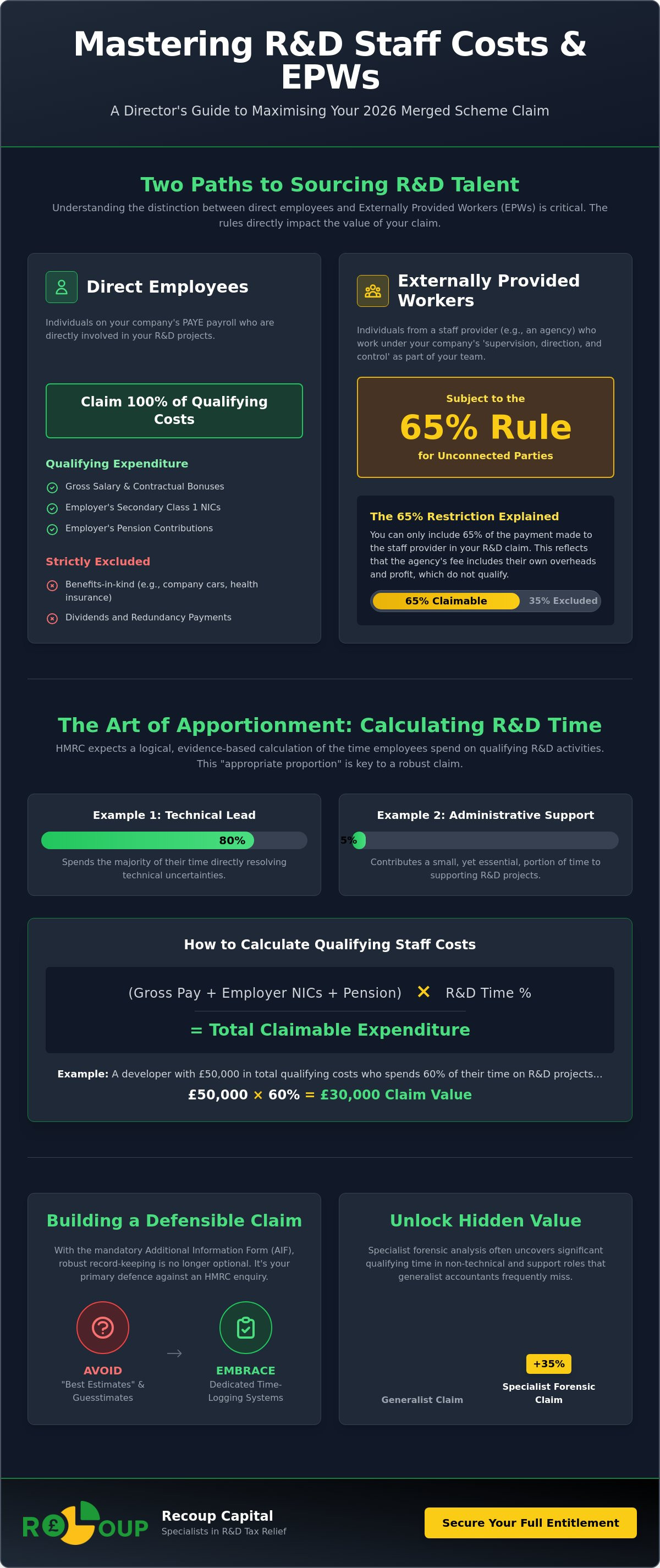
To qualify as a staff cost, an individual must be a direct employee on your PAYE payroll. You can claim for their gross salary, secondary Class 1 National Insurance contributions, and employer pension contributions. It's a common misconception that all staff payments are eligible. Bonuses, for instance, only qualify if they are part of the employee's contractual remuneration and are not dividends in disguise. Benefits-in-kind, such as company cars or private health insurance, are strictly excluded from your calculation. For a deeper look at the mechanics, you can read more about how R&D tax credits explained apply to your specific payroll structure.
Defining the Externally Provided Worker (EPW)
Identifying an EPW requires looking at the "three-party" relationship. This involves your company, a staff provider such as an agency, and the individual performing the work. The distinction between an EPW and a subcontractor rests on "supervision, direction, and control." If the worker operates under your management as if they were an employee, they are likely an EPW. An EPW is an individual provided by a staff agency who works as part of your internal team. Unlike subcontractors who deliver a finished product or service, EPWs are integrated into your daily operations to provide technical manpower. This distinction is vital because it determines whether the 65% cost restriction applies to your claim.
Calculating Qualifying Staff Expenditure: The Art of Apportionment
Apportioning costs isn't just a compliance hurdle; it's a strategic exercise in accuracy. You must determine the "appropriate proportion" of an employee's time dedicated to resolving technical uncertainties. HMRC expects a logical, evidence-based foundation for these figures. A technical lead might spend 80% of their year on R&D, whereas an administrative assistant might only contribute 5% through essential support tasks. Precision here prevents over-claiming while ensuring you don't leave money on the table. Accurately calculating staff costs and EPWs in R&D claims requires a forensic look at how every hour is actually spent on the project floor.
The calculation for the "R&D Salary" is straightforward but requires specific payroll data. You take the sum of Gross Pay, Employer NICs, and Employer Pension Contributions, then multiply this total by the R&D percentage. For example, if a developer earns £50,000 in total qualifying costs and spends 60% of their time on eligible projects, your claim value for that individual is £30,000. Including ineligible elements like dividends or redundancy payments is a frequent error that triggers red flags during inspections. Dividends are a distribution of profit, not a cost of employment, and they cannot be included in your R&D calculation.
The Methodology of Time-Tracking
Robust record-keeping is your best defence against an enquiry. Moving away from "best estimates" towards dedicated time-logging systems provides the evidence HMRC demands. You should be able to justify why a specific percentage was chosen for each staff member. This is especially vital when people work across multiple innovative projects simultaneously. For a broader look at what activities qualify for this time, you can refer to our guide on R&D tax credits explained. Clear documentation transforms a subjective guess into a defensible financial fact.
Ineligible Staff Expenses to Avoid
Errors often creep in when businesses include non-qualifying costs by mistake. Travel expenses, subsistence, and notice pay during non-working periods cannot be included in your claim. The official HMRC guidance on staffing costs provides a definitive list of these exclusions. If you are unsure whether your payroll data is fully compliant, a specialist review of your expenditure can help identify these hidden risks before you submit. Identifying these exclusions early ensures your claim remains robust and ready for scrutiny.
Externally Provided Workers (EPWs) vs Subcontractors: Navigating the 65% Rule
The 65% restriction is a cornerstone of the UK’s approach to Qualifying R&D expenditure. If you hire workers through an agency or an umbrella company, you can usually only include 65% of the relevant payment in your calculation. HMRC implements this cap to account for the staff provider's profit margin and administrative overheads; it ensures that the tax relief targets the actual cost of the innovation rather than the intermediary's markup. When managing staff costs and EPWs in R&D claims, identifying the "Staff Provider" is your first step. This entity is the third party that contracts with the individual to provide their services to your business.
Status as an EPW hinges on the "Supervision, Direction, and Control" (SDC) test. If you manage the worker's daily tasks, set their hours, and dictate the technical methodology, they likely qualify as an EPW. This integration into your internal team is what separates them from a standard subcontractor. By 2026, you must also be acutely aware of the overseas expenditure restrictions. To remain eligible, the R&D activity must be physically carried out within the UK. Unless your project meets very narrow criteria for geographical necessity, costs for workers based abroad will be excluded from your claim.
The Connected Party Exception
There is a significant opportunity to bypass the 65% flat rate if the staff provider is a "Connected Party." This typically applies to companies under the same control, such as a parent company providing staff to a subsidiary. In these instances, you can use the "cost-plus" method. This allows you to claim the actual cost incurred by the staff provider, provided no profit is added to the recharge. Understanding these distinctions is a vital part of claiming R&D tax credits effectively. It often results in a higher claim value than the standard 65% restriction would permit. It's a strategic move that requires careful documentation to satisfy HMRC's transparency requirements.
EPW vs Subcontractor: A Critical Distinction
Distinguishing between an EPW and a subcontractor is essential for financial accuracy. Subcontractors generally operate with a high degree of autonomy; they are hired to deliver a specific outcome or "contracted out" R&D service rather than simply providing manpower. They use their own tools, manage their own schedules, and take on the financial risk of the project. If the individual is integrated into your team and you manage their daily workflow, they are an EPW. The financial impact is clear. EPW costs are often easier to justify as direct R&D support, whereas subcontractor costs may face tighter restrictions under the merged scheme rules depending on who initiated the R&D.
HMRC Compliance and Record-Keeping for Staff-Led Innovation
HMRC's approach to staff costs and EPWs in R&D claims has shifted from a light-touch review to a forensic examination of every individual listed. In 2026, the burden of proof rests entirely on the business to demonstrate that every pound claimed was spent on qualifying activities. This isn't just about having a total figure; it's about being able to tell the story of innovation through the actions of your people. Contemporary evidence is the only shield against an enquiry. If you cannot prove what a specific developer was doing on a Tuesday in November, HMRC may simply discount that portion of your claim. When documenting staff costs and EPWs in R&D claims, the narrative must match the numbers with absolute precision.
The Additional Information Form (AIF) Requirements
The AIF is now a legal prerequisite for a valid HMRC R&D submission. This mandatory digital form requires a granular breakdown of every EPW and staff member involved in your projects. You must categorise their time project by project, distinguishing between qualifying R&D tasks and standard commercial operations. Providing a vague "best guess" is no longer acceptable; HMRC expects to see how each individual contributed to overcoming a specific technical uncertainty. Failure to provide this detail often results in the entire claim being rejected before it is even reviewed.
Defending Your Percentages
Many businesses worry if they don't have formal timesheets. Whilst timesheets are the gold standard, you can build a robust case using secondary evidence. Calendars, commit logs in software repositories, project emails, and task management software like Jira or Trello provide a digital paper trail of innovation. These sources allow you to reconstruct the timeline of your R&D journey with high accuracy. Understanding why claim R&D tax credits with such rigour is essential; it transforms your claim from a potential liability into a bulletproof strategic asset. Forensic accounting techniques can then be used to cross-reference these sources, ensuring your allocations are defensible under the closest scrutiny.
Documenting technical roles requires a nuanced approach. A "Project Manager" often attracts more scrutiny than a "Developer" because their role naturally involves both administrative management and technical leadership. You must isolate the time they spent directly managing the technical resolution of uncertainties, rather than general commercial management or resource planning. If your current internal records feel fragmented, a forensic review of your R&D documentation can identify and bridge these evidence gaps before HMRC raises a query. This proactive approach ensures your staff cost allocations are defended by facts, not just estimates.
Optimising Your Claim: Why Specialist Forensic Analysis Outperforms General Accounting
Generalist accountants provide a vital service for standard statutory compliance. Yet, they often lack the forensic technical knowledge required to identify the subtle overlaps where non-technical staff support innovation. This is where most businesses leave money on the table. A specialist approach doesn't just look at the payroll; it examines the workflow. We identify qualifying activities amongst staff who might not have "Developer" or "Engineer" in their job titles. A CEO providing technical direction or a Quality Assurance manager resolving unforeseen technical bugs are often eligible, yet their time is frequently overlooked by generalists.
By shifting the perspective from a simple tax refund to a strategic business asset, you can reinvest recovered capital into your next phase of growth. Our success-based fee model ensures that our interests are perfectly aligned with yours. We don't just process paperwork. We build a defensible, maximised narrative that stands up to the most rigorous HMRC scrutiny. This forensic depth is essential for accurately capturing staff costs and EPWs in R&D claims, particularly when navigating the complexities of the 2026 merged scheme.
The Recoup Capital Approach
Our end-to-end process begins with a deep technical assessment to map your innovation. We handle the heavy lifting of HMRC liaison and the granular requirements of the Additional Information Form. This includes managing the complexities of "connected party" EPW calculations to ensure you aren't restricted by the standard 65% cap unnecessarily. To understand how we maintain this level of precision in a changing regulatory environment, explore our insights on HMRC R&D Tax Claim Transparency and AI: Navigating the New Compliance Era. We act as a protective guide through these regulatory landscapes, ensuring your claim is robust and fully compliant.
Next Steps for Your 2026 Claim
Securing your innovation capital requires proactive planning. You should begin by reviewing your current payroll structures and any existing contractor agreements to ensure they meet the latest SDC and UK-based activity tests. Contemporary evidence is your strongest asset. If your internal processes aren't yet aligned with the 2026 requirements, now is the time to adjust.
- Audit your staff time-tracking processes for contemporary evidence.
- Review "Staff Provider" contracts for EPW eligibility.
- Identify non-technical staff who contribute to technical problem-solving.
We offer a no-cost introductory consultation to assess your eligibility and identify potential areas for claim expansion. This is a chance to see the value we provide before making any commitment. You can contact Recoup Capital today to begin transforming your 2026 R&D expenditure into a powerful tool for future innovation.
Securing Your Innovation Capital for 2026
The 2026 landscape demands that your people are documented with forensic precision. We've seen how mastering the 65% rule and the art of apportionment can significantly impact your recovery. By moving from estimates to contemporary evidence, you protect your business against the increasing scrutiny of the merged scheme. Correctly managing staff costs and EPWs in R&D claims is no longer just a tax task; it's a strategic necessity for any innovative UK business.
Our team of chartered tax accountants and sector specialists is dedicated to identifying every qualifying hour whilst ensuring total HMRC compliance. We operate on a success-based fee model, so we're fully invested in your results. If you ever face a query, our expert HMRC enquiry support and liaison provide the protection you need. To begin your journey toward capital recovery, book your no-obligation R&D assessment with Recoup Capital. Let's transform your technical challenges into a powerful engine for future growth.
Frequently Asked Questions
Can I claim for staff who only spend a small amount of time on R&D?
Yes, you can claim for any staff member who contributes to a project, regardless of how small their time commitment is. HMRC allows you to apportion a percentage of their qualifying payroll costs based on the actual time they spent on R&D activities. Whether a specialist consultant provides ten hours of technical insight or a junior engineer spends 5% of their month on testing, those costs are eligible if they directly support the resolution of a technical uncertainty.
Are directors’ salaries eligible for R&D tax credits?
Directors' salaries are eligible for relief provided they are paid through PAYE and the work performed is directly related to the R&D project. You must be careful to exclude dividends, as these are a distribution of profit rather than a qualifying employment cost. When calculating staff costs and EPWs in R&D claims, you should only include the director's gross salary, employer pension contributions, and secondary Class 1 National Insurance for the time they spent on technical leadership.
What is the 65% rule for Externally Provided Workers (EPWs)?
The 65% rule is a mandatory restriction applied to the costs of EPWs provided by an unconnected third party, such as a recruitment agency. HMRC implements this cap to ensure the tax relief applies to the worker's labour rather than the agency's profit margin and administrative overheads. If your business and the staff provider are "connected" companies, you may be able to claim the full cost of the labour provided no profit is added to the recharge.
Do I need to have formal timesheets to claim for staff costs?
You don't strictly need formal timesheets to submit a claim, but you must have a robust methodology for estimating time. HMRC accepts contemporary evidence such as project logs, calendar records, and email trails to justify your staff apportionments. Whilst timesheets are the gold standard for compliance, using digital footprints from project management software can help you build a defensible case if your claim is ever scrutinised.
Can I claim for subcontractors and EPWs in the same project?
Yes, you can include both subcontractors and EPWs in a single project, provided you categorise them correctly. EPWs are individuals who work under your direct supervision and control as part of your team, whereas subcontractors are usually separate entities hired to deliver a specific technical outcome. Under the 2026 merged scheme rules, the way these costs are treated depends on who initiated the R&D and where the work was physically performed.
What happens to staff costs if my R&D project fails?
You can still claim for staff costs even if your R&D project is unsuccessful or eventually abandoned. The relief is designed to support the process of seeking a technical advancement, which naturally involves the risk of failure. As long as your staff were working to resolve a technical uncertainty that wasn't easily deducible by a competent professional, their time remains a qualifying expenditure regardless of the project's commercial outcome.
How does the Merged Scheme affect staff cost claims in 2026?
The Merged Scheme unifies the R&D tax relief landscape by offering a 20% taxable credit for most UK companies. In 2026, this means a more consistent approach to staff costs and EPWs in R&D claims, but it also mandates the use of the Additional Information Form (AIF). This scheme places a much higher priority on UK-based innovation, making it essential to prove that your staff and contractors are physically located in the UK during their R&D activities.
Can I claim for overseas staff or contractors?
Generally, you cannot claim for overseas staff or contractors under the rules that came into effect in April 2024. HMRC now requires R&D activities to be physically performed within the United Kingdom to qualify for tax relief. There are very narrow exceptions for projects that require specific geographical or regulatory conditions not available in the UK, but these are exceptionally rare and require a high level of justification to be accepted.