
How R&D Tax Credits Improve Company Valuation for Investment in 2026

What if your R&D tax claim was the primary lever for adding an extra turn to your company's valuation multiple? For many UK tech leaders, the tax credit is often relegated to a year-end accounting task, but in the 2026 investment landscape, it is a critical component of technical due diligence. Investors aren't just looking for cash; they're looking for a clean, compliant history that proves your innovation is defensible. Failing to prepare for R&D tax credit due diligence for acquisitions can lead to uncomfortable price chips or even collapsed deals during the final hours of a sale.
We understand that the shift to the 2024/25 merged R&D scheme and the subsequent rise in HMRC enquiries has created a layer of anxiety for even the most innovative firms. You want to maximise your net benefit, which can reach up to 16.2%, without inviting unnecessary risk. This guide will show you how to present a robust claim that acts as a strategic valuation lever, extending your cash runway whilst de-risking your business for sophisticated investors. We will break down the complexities of the current regulatory framework and explain how to use your tax position to justify a premium valuation at the negotiating table.
Key Takeaways
- Reframe your R&D tax credits from a mere refund into a strategic asset that validates your company’s technical defensibility during investment rounds.
- Understand the accounting mechanics that allow credits to directly improve EBITDA and extend your cash runway, providing measurable justification for a higher valuation multiple.
- Prepare for R&D tax credit due diligence for acquisitions by establishing a clean, compliant claim history that eliminates investor concerns regarding HMRC enquiries.
- Maximise your long-term fiscal efficiency by aligning R&D activities with the Patent Box to secure a reduced 10% Corporation Tax rate on qualifying IP profits.
- Identify the hidden innovation within complex sectors like construction or engineering that generalist accountants often overlook, unlocking untapped capital for growth.
The Strategic Link Between R&D Tax Credits and Company Valuation
In the 2026 fiscal environment, savvy UK directors no longer view R&D tax relief as a mere year-end accounting task. It's a strategic asset, and to ensure full compliance across your financial landscape, you can check out Davis & Co LLP for their insights on upcoming HMRC regulations. When preparing for R&D tax credit due diligence for acquisitions, demonstrating a consistent track record of successful claims signals to buyers that your firm possesses a genuine culture of innovation. This isn't just about a cash injection. It's about validating that your technical progress is recognised by the government as scientifically or technologically significant. This validation provides a layer of institutional credibility that can be difficult to quantify through traditional financial statements alone.
Choosing tax incentives over venture capital means securing non-dilutive capital. You aren't giving away a percentage of your business to fund the next development sprint. This is inherently superior for early-stage growth because it protects founder equity whilst maintaining the cash runway needed to hit the next valuation milestone. Investors have shifted their sentiment recently. They now place a premium on companies that can fund their own innovation through smart tax planning rather than constantly returning to the well of equity funding.
Why Investors Prioritise R&D-Intensive Firms
Investors look for technical moats. A company that consistently invests in R&D is building a competitive advantage that rivals find difficult to replicate. In Britain, the cost of high-tier technical talent is a significant overhead. By utilising the R&D tax credit scheme, businesses effectively lower their net payroll costs for engineers and scientists. This makes the UK an attractive hub for innovation. Investors favour firms that proactively capture all available government support to stretch their investment further. It shows a level of fiscal maturity that de-risks the deal for the buyer.
The 2024 Merged Scheme: A New Valuation Context
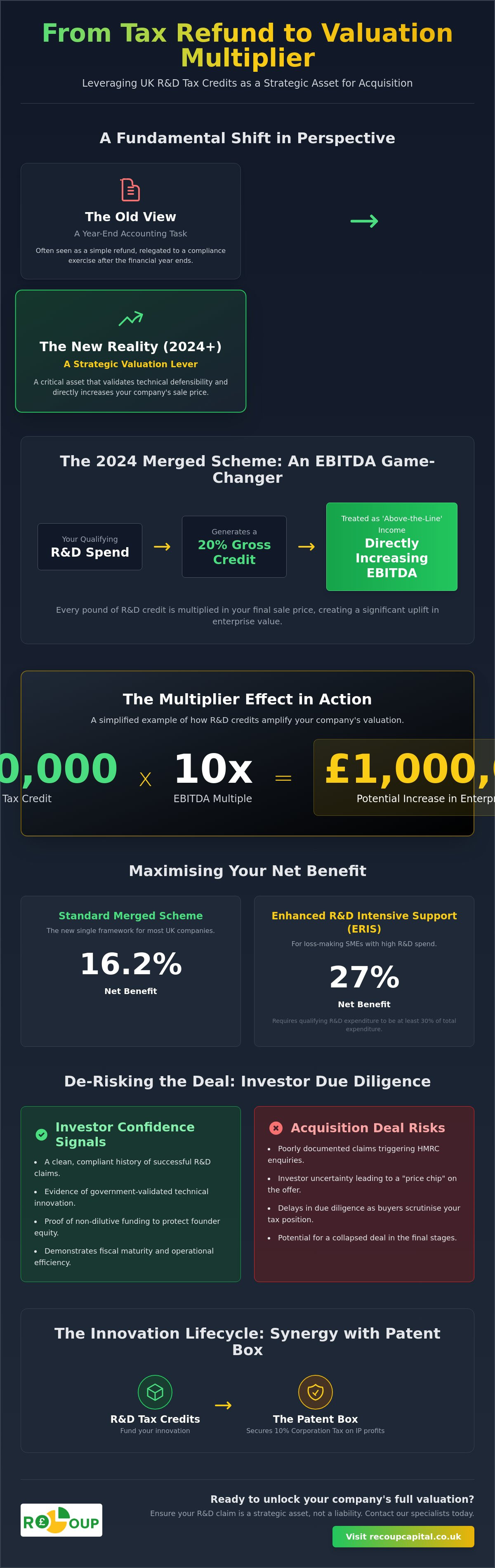
The merger of the SME and RDEC schemes into a single framework in 2024 changed how these credits appear on a balance sheet. Under the merged scheme, the 20% gross credit is treated as "above-the-line" income. This is a total game-changer for valuation. Because it appears as other income rather than a tax reduction, it directly increases EBITDA. When a buyer applies a valuation multiple to your EBITDA, every pound of R&D credit is effectively multiplied in the final sale price.
Whilst the standard net benefit sits around 15% for profitable firms, loss-making, R&D-intensive SMEs can access Enhanced R&D Intensive Support (ERIS). This provides up to 27% relief for those whose qualifying spend hits the 30% threshold. Understanding these nuances is vital during R&D tax credit due diligence for acquisitions, as the specific scheme you fall under can significantly alter your projected cash flow and bottom-line attractiveness. You can learn more about the mechanics of these incentives on our R&D tax credits explained page.
Quantifying the Impact: EBITDA, Cash Runway, and Burn Rate
When a buyer evaluates your business, they aren't just looking at your product; they're dissecting your financial efficiency. The 2024 merged R&D scheme introduced a pivotal change in how these incentives are recorded. By treating the credit as an "above-the-line" item, the 20% gross credit is recognised as other income. This accounting treatment is a significant departure from older SME schemes where the benefit was often buried as a tax reduction. For companies preparing for R&D tax credit due diligence for acquisitions, this transparency is a powerful tool. It allows you to demonstrate a higher operating profit before the buyer even begins their formal audit.
The financial impact of this shift is immediate. Because the credit sits above the tax line, it directly inflates your Earnings Before Interest, Taxes, Depreciation, and Amortisation (EBITDA). In many sectors, particularly software and life sciences, company valuations are calculated as a multiple of EBITDA. If your firm is valued at a 10x multiple, a successfully claimed £100,000 RDEC credit doesn't just put £100,000 in the bank; it potentially adds £1 million to your enterprise value. This mathematical reality makes the accuracy of your claim a high-stakes component of your exit strategy.
EBITDA Uplift: The Multiplier Effect
The difference between below-the-line and above-the-line accounting is the difference between a simple refund and a valuation lever. Specialist R&D consultants play a vital role here. They ensure the maximum eligible cost base is captured according to the latest HMRC guidelines on R&D tax relief, which prevents you from leaving valuation-boosting income on the table. Every pound of eligible expenditure correctly identified by a specialist contributes directly to an improved EBITDA, which is then amplified by your industry's specific valuation multiple during a sale.
Improving Cash Flow and Reducing Burn Rate
Beyond the exit price, R&D credits serve as a vital lifeline for growing firms. By offsetting the high costs of UK-based technical talent, these credits effectively extend your cash runway. A reduced burn rate gives founders significantly more leverage during investment negotiations. You aren't forced to accept predatory terms because the bank account is dry; instead, you're negotiating from a position of relative strength.
Investors find self-funding innovation incredibly attractive. It suggests a management team that is fiscally disciplined and capable of navigating complex regulatory frameworks to protect the bottom line. If you're looking to strengthen your position before a round, exploring our corporate finance services can help align your tax strategy with your broader investment goals. Establishing a clean record during R&D tax credit due diligence for acquisitions ensures these figures are accepted at face value by the buyer's auditors, preventing last-minute price chips that often plague poorly prepared deals.
De-risking the Deal: HMRC Compliance and Due Diligence
The most common question we hear from founders entering an exit phase is whether their R&D claim will act as a lightning rod for HMRC. There's a persistent myth that claiming tax relief invites unwanted scrutiny that could potentially derail a deal. In reality, the opposite is true. A robust, professionally prepared claim is a badge of quality. It demonstrates that your business has already undergone a rigorous internal audit of its technical activities. When you approach R&D tax credit due diligence for acquisitions with a transparent and well-documented history, you aren't just defending a tax position; you're proving the technical merit of your entire enterprise.
Technical narratives are the backbone of this defence. These documents must clearly articulate the scientific or technological uncertainties your team faced and the specific advancements they achieved. Investors look for these narratives to confirm that your IP isn't just a collection of routine improvements, but genuine innovation that provides a technical moat. If your narratives are vague or disconnected from your financial records, they become a liability. A forensic approach ensures that every pound claimed is backed by a verifiable technical milestone, leaving no room for ambiguity during an investor's audit.
Surviving Technical Due Diligence
Venture capital firms and corporate buyers conduct their own technical due diligence to ensure they aren't buying "vapourware." A high-quality R&D claim essentially provides them with a pre-packaged technical audit. It aligns your development roadmap with your financial expenditure, showing exactly where your capital was deployed to solve complex problems. Understanding how the end-to-end process of claiming R&D tax credits works allows you to build this evidence base in real-time. This proactive documentation makes the technical due diligence phase significantly smoother, as the buyer's experts can quickly verify the depth of your innovation through your existing tax submissions.
The Cost of Inaccurate Claims in a Transaction
Aggressive claims prepared by "R&D cowboys" are a significant risk factor in modern M&A. If a buyer's due diligence team identifies inaccuracies or over-inflated costs, they won't just ask you to fix the claim. They'll likely apply a "valuation haircut" to account for the potential HMRC liability and penalties. In some cases, they may even insist on an indemnity or an escrow holdback, locking away a portion of your sale proceeds for years.
This is why using chartered tax accountants for investment-grade submissions is non-negotiable. During the high-pressure data room phase of a deal, you don't want to be scrambling to justify your figures. We ensure our clients' claims are "deal-ready" from day one. By adopting a forensic standard of evidence, we help you avoid the pitfalls of R&D tax credit due diligence for acquisitions, ensuring that your valuation remains intact and your exit proceeds are protected. A clean compliance record is often the final piece of the puzzle that gives an acquirer the confidence to sign on the dotted line.
The Innovation Lifecycle: Synergy with Patent Box and Capital Allowances
True valuation growth isn't a one-off event; it's the result of a continuous lifecycle that moves from technical development to commercial exploitation. While R&D tax credits provide the non-dilutive capital needed to build your technical moat, the Patent Box regime rewards the successful commercialisation of that IP. When preparing for R&D tax credit due diligence for acquisitions, showing an integrated approach to these incentives signals to Private Equity firms that your business is a sophisticated, tax-efficient innovation engine. Acquirers aren't just buying your past; they're buying the future cash flows that these combined reliefs will protect.
This synergy is particularly powerful because the qualifying R&D expenditure used for your tax credit claims also forms the basis of the "nexus fraction" for Patent Box calculations. It's a dual-purpose investment. By aligning these two schemes, you demonstrate that your innovation is both technologically significant and legally protected. This level of foresight is a major green flag during R&D tax credit due diligence for acquisitions, as it proves the management team has a long-term strategy for capital utility and asset protection.
Maximising the Patent Box Benefit
The Patent Box offers a reduced Corporation Tax rate of 10% on profits derived from patented inventions. This is a massive drop from the standard 25% main rate, directly boosting your post-tax profit. For investors using Discounted Cash Flow (DCF) models, this lower tax burden significantly increases the present value of your future earnings. To ensure your physical infrastructure keeps pace with this growth, exploring how Capital Allowances can further improve your tax position is essential for preserving cash during lab or facility expansions.
Integrated Tax Planning for Scale-ups
Sophisticated scale-ups often combine multiple reliefs to maximise their financial runway. For instance, if you're developing new chemical processes while simultaneously remediating a brownfield site for a new production facility, you can claim Land Remediation Relief alongside your R&D. This integrated strategy shows investors that you're leaving no stone unturned in your pursuit of fiscal efficiency. For more detail on this, see our Comprehensive Guide to Land Remediation and Tax Relief in 2026.
Ready to see how these integrated reliefs could transform your exit value? Speak with our corporate finance specialists today to start your valuation audit.
Why Specialist R&D Consultancy is Vital for Investment Readiness
Generalist accountants are indispensable for day-to-day compliance, but preparing a business for a high-stakes exit requires a different level of technical precision. In the context of R&D tax credit due diligence for acquisitions, the gap between a standard tax filing and a specialist-led claim can represent hundreds of thousands of pounds in missed valuation. A specialist doesn't just look at your payroll; they look at your projects through the lens of an engineer or a software developer. This technical depth ensures that every qualifying activity is captured and, more importantly, defended with a narrative that stands up to the most rigorous investor scrutiny.
Working with a consultancy that employs success-based fees creates a natural alignment of interests. It means your advisor is incentivised to identify the maximum compliant value within your business, rather than simply processing the most obvious costs. This partnership approach is particularly valuable when you're scaling toward a funding round or a sale. By ensuring your claims are robust from the outset, you avoid the last-minute panic of trying to justify your figures to a buyer's audit team, protecting your deal from unnecessary delays or price reductions.
Identifying Innovation Beyond the Lab
Investors often have a narrow view of what constitutes "research and development," frequently overlooking significant innovation in sectors like construction, food tech, and engineering. For example, a construction firm developing a new modular assembly technique to overcome specific site constraints is likely performing qualifying R&D, even if they don't have a laboratory. Generalist accountants often miss these opportunities because they lack the forensic surveying skills needed to link on-site problem-solving with HMRC’s technical criteria. Understanding why claiming R&D tax credits is essential for your business growth starts with recognising that innovation happens in the field and on the factory floor, not just in a cleanroom.
Partnering for the Long Term
The UK tax landscape is in a state of constant evolution, and maintaining your valuation between funding rounds requires proactive management. Recoup Capital acts as a protective guide, ensuring that your R&D strategy remains aligned with the latest legislative shifts, such as the 2024 merged scheme rules. This long-term collaboration ensures that your "innovation ledger" is always up to date, making you permanently ready for an unexpected approach from a buyer. For a deeper look at how we prepare companies for these moments, you can explore our R&D tax credits explained page.
Don't leave valuation on the table by under-claiming or misfiling your technical advancements. A clean, maximised claim history is one of the most persuasive documents in your data room. By mastering R&D tax credit due diligence for acquisitions now, you ensure that when the time comes to sell, your innovation is treated as the high-value strategic asset it truly is.
Securing Your Technical Premium at Exit
Mastering the intersection of tax legislation and corporate finance is what separates a standard exit from an exceptional valuation. By transforming your R&D claims into a transparent, audit-ready asset, you provide investors with the technical certainty they crave. A robust approach to R&D tax credit due diligence for acquisitions ensures that your hard-won innovation is rewarded with a premium multiple rather than being chipped away by cautious auditors during the final stages of a deal.
Our team of Chartered Tax Accountants and R&D Specialists brings deep expertise in corporate finance and M&A due diligence to every partnership. We operate on a success-based fee structure, ensuring our interests are perfectly aligned with your long-term business growth. Whether you're preparing for an imminent funding round or a full trade sale, we act as your protective guide through the complexities of the UK tax landscape, helping you justify every pound of your valuation.
Maximise your company valuation with an expert R&D assessment from Recoup Capital today and turn your technical milestones into measurable financial strength. We look forward to helping you realise the full potential of your innovation.
Frequently Asked Questions
How exactly do R&D tax credits increase my company valuation?
R&D tax credits increase your valuation by directly boosting your EBITDA and extending your cash runway. Since the 2024 merged scheme treats the credit as above-the-line income, it appears as operating profit rather than a tax reduction. If a buyer applies a 10x valuation multiple to your business, a successfully claimed £100,000 credit can theoretically add £1 million to your final sale price.
Can I claim R&D tax credits if my company is currently loss-making?
Yes, loss-making companies can surrender their R&D losses for a payable cash credit from HMRC. For accounting periods beginning on or after 1 April 2024, R&D-intensive SMEs can access Enhanced R&D Intensive Support (ERIS). This provides a higher net benefit of up to 27% for firms whose qualifying R&D expenditure is at least 30% of their total relevant expenditure.
What is the difference between RDEC and the SME R&D scheme in 2026?
The distinction between the two has largely disappeared because the SME and RDEC schemes merged into a single framework for accounting periods starting after 1 April 2024. Most companies now claim under this merged scheme at a 20% gross credit rate. The only remaining separate path is ERIS, which is specifically reserved for loss-making SMEs with high R&D intensity.
Will an HMRC enquiry affect my ability to close an investment round?
An ongoing enquiry can lead to delays or "price chips" if the buyer perceives a risk to your historical claims. This is why R&D tax credit due diligence for acquisitions is so critical before you enter the data room. Having a specialist-prepared claim with robust technical narratives provides the transparency investors need to proceed without insisting on escrows or indemnities.
How long does the R&D claim process take from start to finish?
The preparation phase usually takes between four and six weeks as we gather technical evidence and financial data. Once the claim is submitted alongside the mandatory Additional Information Form, HMRC typically aims to process it within 28 to 40 days. However, complex claims or first-time submissions may take longer if HMRC requires further clarification on technical uncertainties.
Do investors prefer R&D tax credits over other forms of government grants?
Investors often prefer tax credits because they are entitlement-based and non-dilutive. Unlike competitive grants, which are limited by fixed budgets and specific project timelines, R&D tax credits are available to any company that meets the qualifying criteria. This makes them a more predictable and sustainable component of a company's long-term financial strategy and valuation model.
Can I claim for R&D work that was contracted out to third parties?
You can claim for subcontracted R&D, but the rules became more restrictive in April 2024. Generally, the company that makes the decision to undertake the R&D and bears the financial risk is the one entitled to the claim. It is vital to review your contracts during R&D tax credit due diligence for acquisitions to ensure you have the legal right to claim for third-party work.
How does the Patent Box work alongside R&D tax credits to improve valuation?
The Patent Box complements R&D credits by offering a reduced 10% Corporation Tax rate on profits derived from patented IP. Whilst R&D credits fund the development phase, the Patent Box rewards the commercialisation phase. This integrated approach significantly increases your post-tax cash flow, making your business much more attractive to Private Equity buyers looking for long-term technical moats.