
Securing Investment with a History of R&D Claims: A Strategic Guide for UK Innovators

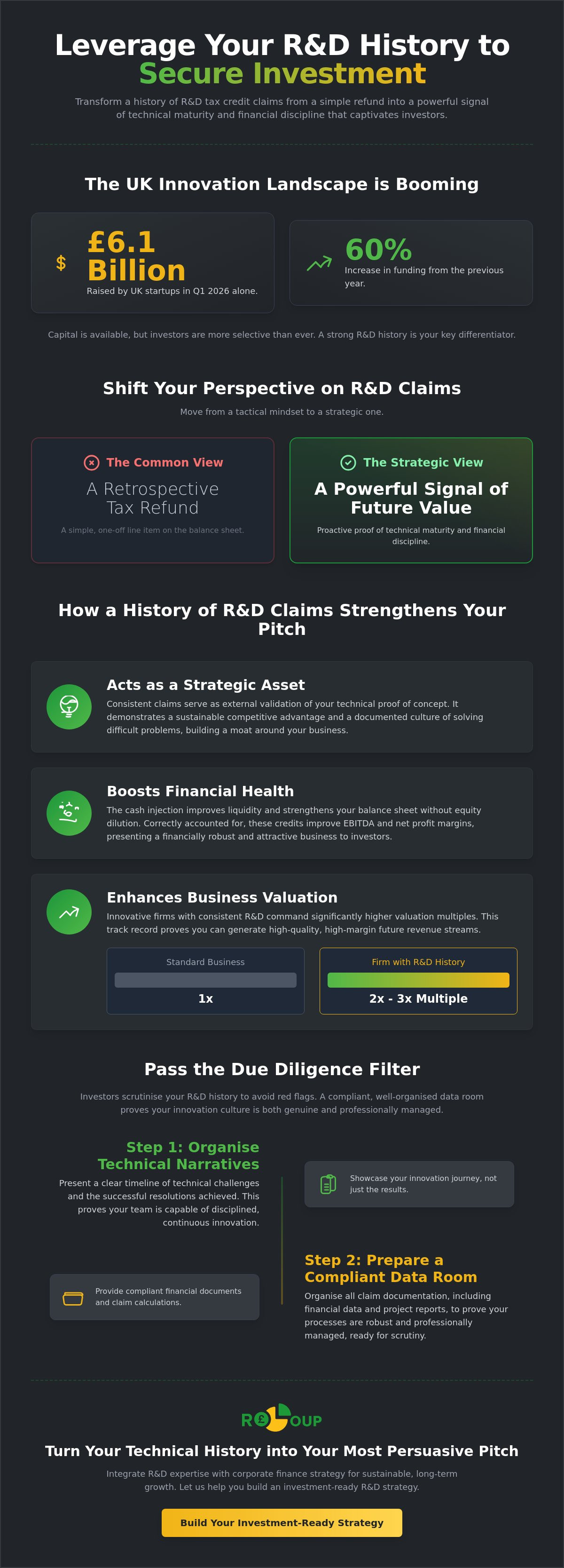
Did you know that UK startups raised a record £6.1 billion in the first quarter of 2026 alone? This 60% increase from the previous year shows that capital is available, yet investors are becoming increasingly selective about where they place their bets. You likely recognise that a great product isn't enough; you need to demonstrate fiscal discipline and technical maturity to stand out. Many founders feel a lingering anxiety regarding HMRC enquiries or worry that their past documentation might not hold up during rigorous due diligence. It's a common concern that can make the process of securing investment with a history of R&D claims feel more like a hurdle than a highlight.
We believe your innovation should be your greatest leverage. This guide will show you how a robust track record of R&D tax credit claims serves as a powerful signal of value to sophisticated investors. We'll explore how to present your R&D activity as a strategic asset that justifies a higher valuation and ensures a smoother path through the funding cycle. From evidencing a culture of innovation to mastering the new compliance requirements of the merged R&D scheme, you'll discover how to turn your technical history into your most persuasive pitch.
Key Takeaways
- Learn how securing investment with a history of R&D claims transforms a retrospective tax refund into a powerful signal of technical maturity and financial discipline.
- Discover how consistent innovation claims directly strengthen your balance sheet and demonstrate high-quality future revenue streams to potential backers.
- Identify the specific technical narratives and documentation standards that venture capital firms scrutinise to avoid deal-breaking red flags during due diligence.
- Master the two-step process for organising a compliant data room that proves your innovation culture is both genuine and professionally managed.
- Explore the benefits of a partnership-first approach that integrates R&D expertise with broader corporate finance strategy for sustainable long-term growth.
Why a History of R&D Claims is a Strategic Asset for Securing Investment
For many UK innovators, R&D tax credits are often viewed as a retrospective windfall or a simple line item on a balance sheet. This narrow perspective misses the broader strategic picture. When you're approaching venture capital or private equity firms, your track record of innovation is a powerful narrative tool. Securing investment with a history of R&D claims shifts the conversation from what might happen to what has already been achieved. It's about reframing these claims as a proactive investment signal that demonstrates your company's commitment to solving complex technical problems. In the eyes of a potential backer, securing investment with a history of R&D claims serves as evidence of a disciplined, forward-thinking approach to growth.
Successful claims provide external parties with technical proof of concept. Whilst an investor might not be an expert in your specific niche, they understand that a history of successful submissions indicates your work meets a high bar for innovation. For pre-revenue startups, these credits are essential for extending the cash runway without the immediate need for equity dilution. By consistently reinvesting this capital into your development roadmap, you prove that your business possesses a sustainable competitive advantage. You aren't just keeping pace; you're setting the tempo for your sector through a documented culture of technical advancement.
The Psychology of the Investor: Innovation as a De-Risking Factor
Investors are naturally risk-averse. They look for moats that protect a business from competition. A history of R&D claims identifies exactly where your intellectual property moat is being built. It demonstrates that the UK's R&D Tax Credit scheme has already, in a sense, vetted your technical narratives. This creates a reassuring layer of external validation. It also signals a corporate culture that values structured experimentation. When you can show a timeline of technical challenges and successful resolutions, you prove that your team is capable of continuous improvement and disciplined innovation.
R&D History as a Financial Health Indicator
A consistent history of claims has a tangible impact on your financial standing. When correctly accounted for, these credits can improve your EBITDA and net profit margins, making the company look more robust on paper. This capital isn't just found money; it's a strategic asset that accelerates your product development and increases your overall attractiveness to funders. By integrating this expertise with broader Corporate Finance strategies, you present a business that is both technically advanced and financially savvy. Ultimately, R&D history acts as a third-party validation of technical risk management.
Enhancing Business Valuation and Cash Flow through Consistent Innovation
Consistent innovation is more than a technical milestone; it's a financial catalyst. When you're securing investment with a history of R&D claims, you're presenting a business that effectively subsidises its own technical evolution through government-backed incentives. This creates a dual impact on your company's appeal. Directly, the cash injection from R&D credits improves your liquidity and strengthens the balance sheet without the sting of equity dilution or high-interest debt. Indirectly, a track record of successful claims signals to investors that your company produces high-quality, high-margin future revenue streams. It proves you're solving difficult problems that create natural barriers to entry for competitors.
Innovative firms in sectors like AI, deep tech, and advanced engineering often command significantly higher valuation multiples than standard service-based businesses. For instance, while a traditional consultancy might be valued on a modest multiple of earnings, a tech-heavy firm demonstrating consistent R&D activity can see that multiple double or triple. According to the Official government guidance on R&D tax relief, the criteria for qualification are stringent, and meeting them consistently builds immense trust with external stakeholders. By leveraging your historical data, you can forecast a tax-efficient growth trajectory that makes your business a far more compelling prospect for capital. If you're looking to refine how these assets appear to funders, integrating them into your Corporate Finance strategy is a sensible next step.
The EBITDA Multiplier Effect
Under the merged R&D scheme in 2026, the 20% taxable credit is typically treated as "Above the Line" income. This is a critical distinction for valuation. By appearing before the tax line, these credits directly boost your reported EBITDA, which is the primary metric many investors use to calculate business value. For loss-making R&D intensive SMEs, the Enhanced R&D Intensive Support (ERIS) provides a 27% net benefit, further padding the cash reserves. Smart founders use this reclaimed capital to hire top-tier talent or invest in specialised equipment, creating a virtuous cycle that further inflates the company's worth during a funding round.
Predictable Capital Recovery
Investors love predictability. A three-year history of compliant claims allows potential backers to model future cash inflows with a high degree of confidence. It effectively reduces your cost of capital; you're using government incentives to fund high-risk development rather than burning through precious investor funds. You can showcase the efficiency of your innovation by measuring your technical output per pound invested. This transparency proves that your R&D department isn't just a cost centre but a highly efficient engine for growth. When you can demonstrate that every £1 of spend is partially de-risked by a 15p to 27p return, the decision to invest becomes significantly easier for any venture capital firm.
The Due Diligence Filter: How Investors Scrutinise Your R&D History
Investors treat your financial history as a map of your future behaviour. When you're securing investment with a history of R&D claims, that map is under a microscope. VCs and PE firms view R&D narratives as a window into your technical integrity. If they find aggressive or poorly documented past claims, it's often seen as a proxy for poor management. A single red flag here can stall a deal or lead to punishing indemnity clauses. You need to demonstrate impeccable compliance hygiene in every historical submission to keep the momentum of your funding round.
A robust specialist report acts as your shield during the warranties and indemnities phase. It provides the granular detail that generic accounting summaries often lack. Sophisticated backers want to see that your technical challenges were genuine and that your methodology for identifying qualifying costs was rigorous. This level of detail protects you from the "HMRC enquiry trap" where a pending investigation might otherwise force an investor to walk away or demand a significant price chip. In the 2026 funding environment, securing investment with a history of R&D claims requires you to prove that your tax position is as solid as your technology.
Risk Mitigation: Avoiding the HMRC Enquiry Trap
Investors are increasingly wary of contingent liabilities. They want to know that your past credits aren't going to be clawed back. Rigorous investor due diligence on R&D claims has become the standard in 2026. This is particularly true given the rise of HMRC R&D tax claim transparency requirements. Backers often view specialist-led claims as inherently safer than those prepared by generalist accountants. Specialists provide the technical depth that proves your innovation is real, not just creative accounting.
Technical Due Diligence (TDD) Integration
Your technical reports must align perfectly with your product roadmap and IP strategy. If you claim a technical breakthrough to HMRC but describe it as "standard development" to an investor, you've created a credibility gap. Technical Due Diligence (TDD) will uncover these discrepancies. Backers look for consistency across all your documentation. Inconsistent narratives between tax claims and investor decks are a major due diligence failure point. By ensuring your tax narratives mirror your actual engineering milestones, you build a cohesive story of success that stands up to the most intense scrutiny.
Preparing Your R&D Documentation for a Successful Funding Round
Preparing for a capital raise requires more than a polished pitch deck and a functional prototype. Securing investment with a history of R&D claims is an exercise in meticulous record-keeping and strategic alignment. To present your innovation as a de-risked asset, you must first ensure your house is in order. This starts with a retrospective audit of your claims from the last three years. Given that HMRC has implemented stricter compliance checks and more detailed evidence requirements in 2026, an internal review identifies potential gaps before an investor's technical auditor finds them. Your goal is to transform disparate project logs into a cohesive Statement of Innovation that highlights the commercial impact of your technical breakthroughs.
Efficiency is a hallmark of a well-run business. You can demonstrate this by aligning your R&D expenditure with Capital Allowances to maximise your total tax position. This shows potential backers that you're squeezing every drop of value from your operational spend. By quantifying the future Patent Box potential of your current projects, you also give investors a glimpse into a high-margin, tax-efficient future. This forward-looking approach proves that you aren't just reacting to past costs but are actively building a tax-efficient growth engine.
Organising the R&D Data Room
A disorganised data room is a deal-killer. You should store time sheets, project logs, and cost breakdowns in a secure, easily accessible format. Technical auditors aren't just looking for success; they want to see the technical uncertainties you faced and the systematic resolutions you employed. Presenting these challenges clearly proves the innovation element of your work is genuine. Including a specialist opinion letter from a firm like Recoup Capital adds an extra layer of institutional credibility, signalling that your claims have already passed a rigorous professional bar. If you're unsure if your documentation meets this standard, you can start a specialist claim review today to secure your position.
Forward-Looking Incentives: Beyond the R&D Credit
Investors are interested in what happens after they sign the cheque. You should introduce the Patent Box as a mechanism to reduce corporation tax on profits derived from patented inventions. For firms in the construction or development sectors, highlighting Land Remediation Relief can support site acquisition strategies by recovering costs associated with decontaminating land. Providing a five-year Tax Roadmap shows that you have a plan for sustainable, innovative growth. This level of foresight transforms you from a startup seeking cash into a strategic partner worth backing for the long term.
Building an Investment-Ready R&D Strategy with Recoup Capital
Whilst many firms view tax relief as a yearly chore, we see it as a cornerstone of your capital strategy. A one-off claim mentality often leaves money on the table and, more importantly, misses the chance to build a narrative of consistent innovation. Securing investment with a history of R&D claims becomes significantly easier when your tax position is integrated with your broader financial goals. We believe in a partnership-first approach that looks beyond the immediate refund to consider how every pound reclaimed can be used to fuel your next stage of growth. It's about moving from being a mere claimant to being recognised as a true innovator in the 2026 market.
Our interests are perfectly aligned with your success. We operate on a success-based fee structure, which means we're as invested in the accuracy and robustness of your claims as you are. This alignment is vital when you're preparing for a capital raise, as it ensures your documentation is of the highest standard for investor scrutiny. We help you transform your financial narrative, turning technical challenges into evidence of a resilient and valuable business. By working together over the long term, we ensure that your R&D strategy is always investment-ready, protecting your reputation amongst the UK's most sophisticated backers.
Strategic Corporate Finance Integration
We bridge the gap between technical tax recovery and high-level Corporate Finance Advisory. This integration is crucial for accurate valuation support; we ensure that your R&D assets and future tax-efficient growth trajectories are fully recognised by potential acquirers or investors. Whether you're looking at strategic business acquisitions or preparing for an exit, our national network of specialists provides the expertise needed to support your journey. We don't just process paperwork; we provide the financial intelligence that helps you scale with confidence.
Long-Term Collaboration for Sustained Growth
The Recoup Method is built on continuous monitoring. We don't just show up once a year; we stay close to your projects to ensure no opportunity for relief is missed as your R&D activities evolve. Our commitment to HMRC compliance is absolute, providing you with a protective guide through increasingly complex regulatory landscapes. This proactive stance ensures that when a due diligence team enters your data room, they find a history of disciplined, well-documented, and compliant innovation. To prepare your business for its next milestone, speak to our R&D and Corporate Finance specialists today and let's start building your investment-ready strategy.
Maximise Your Valuation with a Strategic Innovation Narrative
Your history of technical experimentation is more than a list of past costs; it's the foundation of your future valuation. By reframing R&D claims as a proactive signal of value, you prove to investors that your business is both technically viable and financially disciplined. We've explored how a robust data room and a clear tax roadmap can de-risk your funding round and command higher multiples in a competitive market. It's about ensuring your engineering milestones translate directly into financial strength.
The process of securing investment with a history of R&D claims requires a partner who understands the intersection of tax law and business growth. At Recoup Capital, our team of Chartered Tax Accountants and Specialist Surveyors provides the technical depth and financial authority needed to satisfy the most rigorous due diligence. We offer a success-based fee structure that aligns our goals with your successful capital raise, ensuring your interests are always protected. This unique perspective bridges the gap between technical tax recovery and high-level corporate strategy.
Don't leave your innovation narrative to chance. Discover how Recoup Capital can make your R&D history investment-ready by leveraging our expertise in both R&D and Corporate Finance. We're ready to help you turn your technical achievements into your most persuasive pitch for capital. Your next breakthrough is just the beginning of your growth story.
Frequently Asked Questions
Does a history of R&D claims really increase my company valuation?
Yes, it absolutely does. Securing investment with a history of R&D claims is easier because it provides third-party validation of your technical milestones and proves your innovation is genuine. When these credits are treated as Above the Line income, they directly increase your reported EBITDA. This often leads to higher valuation multiples as investors see a business that is both technically advanced and fiscally efficient.
What happens if an investor finds an error in my past R&D claims during due diligence?
Errors found during due diligence are significant red flags that can derail a deal. They often lead to "price chipping," where the investor lowers their offer to cover potential HMRC clawbacks or demands expensive indemnity clauses. In the worst cases, it might cause the funder to walk away entirely. Having a specialist audit your history before opening the data room is a vital protective step to ensure your reputation remains intact.
Can I claim R&D tax credits if I've already received a government grant or external investment?
You can still claim, but the structure of your relief may change depending on your specific circumstances. Under the rules for accounting periods starting on or after April 1, 2024, most companies fall under the Merged Scheme regardless of grant funding. External investment itself doesn't prevent claims, though it can affect your company's size classification. It's best to have a specialist review your status to ensure you're maximising your return under the latest regulations.
How do investors view Above the Line vs Below the Line R&D accounting?
Investors generally prefer Above the Line accounting because it treats the R&D credit as a form of income before the tax line. This approach directly boosts your EBITDA, which is the primary metric many funders use to calculate business value. Since valuations are often based on a multiple of EBITDA, this simple accounting choice can have a direct, positive impact on the final investment amount you receive.
Should I use a general accountant or a specialist like Recoup Capital when preparing for a sale?
A specialist is usually the better choice when securing investment with a history of R&D claims. Whilst general accountants are excellent for standard compliance, they often lack the technical engineering background to write the robust narratives investors require. Specialists provide the technical depth that stands up to rigorous Technical Due Diligence (TDD) and offers essential protection during the warranties and indemnities phase of a sale.
What is the Merged R&D Scheme and how does it affect my 2026 investment plans?
The Merged R&D Scheme replaced the separate SME and RDEC schemes for accounting periods beginning on or after April 1, 2024. It offers a 20% taxable credit on qualifying expenditure, providing a net benefit of approximately 15p for every £1 spent for companies paying the 25% tax rate. For your 2026 plans, this provides a more predictable cash flow model that is much easier for potential investors to forecast.
How does the Patent Box incentive complement my history of R&D claims for investors?
Patent Box is the logical next step for any firm with a strong R&D track record. It allows you to apply a lower 10% Corporation Tax rate to profits derived from your patented inventions, signalling a long-term, tax-efficient growth engine to investors. It proves that you aren't just innovating for the sake of a refund, but are actively protecting and commercialising your high-margin revenue streams for the future.
What documentation is essential for the R&D section of a virtual data room (VDR)?
Your virtual data room should be comprehensive and well-organised. Essential items include your technical reports for the last three years, detailed qualifying cost breakdowns, and evidence of technical uncertainties and their systematic resolutions. You should also include time sheets and project logs to prove the link between staff activity and R&D. A specialist opinion letter is often the final piece that gives investors total confidence in your claims.