
How to Value a Company with R&D Assets: A Guide for UK Businesses

What if your most significant business expense was actually your most powerful strategic asset? For many UK innovators, traditional accounting methods make R&D-heavy firms look less profitable than they truly are. It's a common frustration to face skeptical investors who focus on immediate margins whilst ignoring the long-term wealth you're building through technical discovery. Understanding how to value a company with R&D assets is essential to bridge this gap and ensure your hard work is reflected in your final valuation.
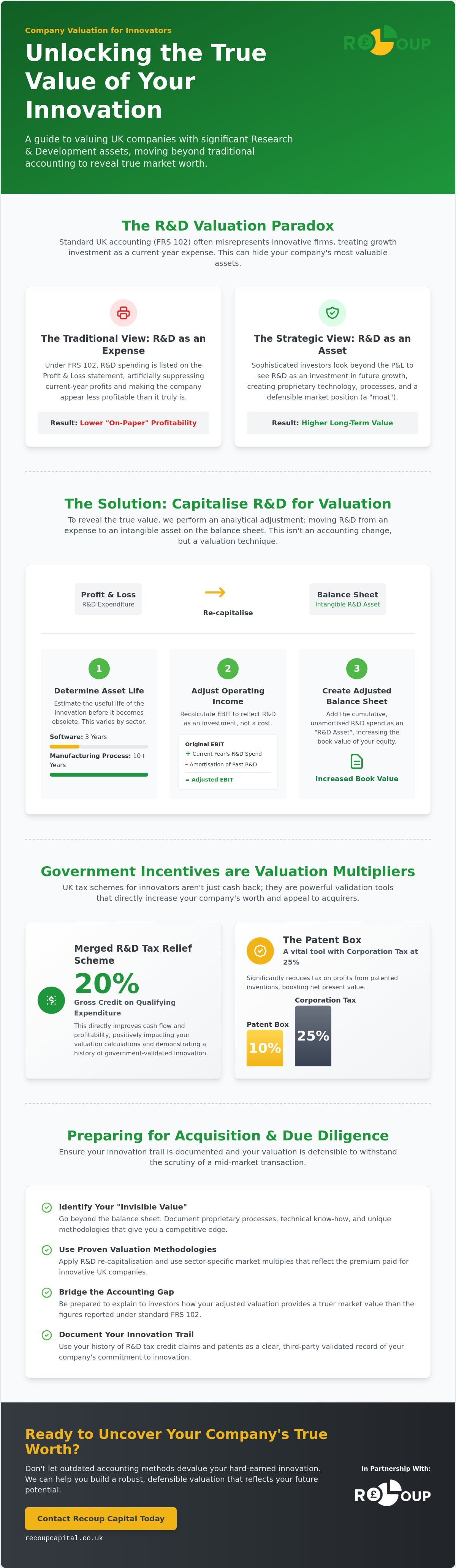
We'll help you navigate the complexities of intangible asset valuation, turning what looks like a deficit into a clear demonstration of future growth. You'll discover how the 20% gross credit from the merged R&D tax relief scheme directly impacts your company worth and why the 10% Patent Box rate is a vital tool with corporation tax now at 25%. This guide provides a clear framework to help you approach investment or acquisition talks with absolute confidence in your innovation's true market price.
Key Takeaways
- Identify the "invisible value" within your business by looking beyond standard balance sheets to capture the worth of proprietary processes and technical know-how.
- Discover how to value a company with R&D assets using proven methodologies like re-capitalisation and sector-specific market multiples tailored for UK transactions.
- Quantify the strategic impact of the merged R&D tax relief scheme and the Patent Box on your overall company valuation and net present value.
- Learn how to bridge the gap between traditional FRS 102 accounting standards and the true market value that sophisticated investors expect to see.
- Gain practical insights into preparing for due diligence, ensuring your innovation trail is documented to withstand the scrutiny of a mid-market acquisition.
Understanding the "Invisible Value" of Research and Development
For many UK businesses, the most valuable assets don't sit in a warehouse or an office block. They exist in the minds of engineers, the lines of proprietary code, and the unique processes that competitors can't easily replicate. Research and development assets represent the primary driver of future competitive advantage for tech-led firms, acting as the engine for long-term growth. However, identifying these assets is only half the battle. You must also understand how to value a company with R&D assets when traditional financial reporting fails to tell the full story.
Under the UK’s FRS 102 accounting standards, most R&D expenditure is recorded as an expense on the Profit and Loss statement rather than an asset on the Balance Sheet. This creates a paradox. A company investing heavily in the future may appear less profitable than a stagnant competitor whilst they're actually building significant long-term wealth. To find the true worth, we must distinguish between "Maintenance R&D", which preserves existing market share, and "Growth R&D", which creates entirely new revenue streams.
The Problem with Operating Expenditure (OpEx)
Expensing R&D artificially suppresses current-year profits. This "on-paper" loss can be a significant hurdle when speaking to traditional lenders who are often conditioned to see high expenditure as a risk. Sophisticated investors in sectors like biotech or high-end engineering take a different view. They look past the bottom line to see the underlying value of the innovation pipeline. They recognise that today's "sunk cost" is tomorrow's market dominance. When considering Three Primary Methodologies for Valuing R&D-Rich Companies, it becomes clear that adjusting historical financial statements is a prerequisite for a fair deal.
Intangible Assets and Market Premium
Innovation creates a "moat" that protects your business from competitors. This defensibility justifies higher valuation multiples during a sale or investment round. Whether it's a registered patent or a closely guarded proprietary process, these intangible assets secure long-term market share. It's also vital to recognise that claiming R&D tax credits isn't just about a cash refund. It's about validating your technical work and demonstrating a track record of innovation. This creates a "market premium" that savvy buyers are willing to pay for. Understanding how to value a company with R&D assets requires looking at these tax incentives as strategic tools that bolster your firm's financial resilience and overall desirability amongst potential acquirers.
Moving from Expense to Asset: Capitalising R&D for Valuation
To truly understand how to value a company with R&D assets, you must move beyond the constraints of traditional bookkeeping. Standard accounting treats innovation as a cost to be managed, but for valuation, it's an investment to be measured. Capitalising R&D is an analytical adjustment for valuation, not just an accounting choice. This process involves taking the R&D expenditure from the Profit and Loss account and moving it to the Balance Sheet as an asset. By doing so, you acknowledge that the money spent on a breakthrough today will generate returns for several years to come.
A critical step in this transition is determining the "Asset Life" of your innovation. In fast-moving software sectors, an R&D asset might only remain valuable for three years before technical obsolescence. In contrast, a patented manufacturing process might have a useful life of ten years or more. Once this duration is set, you apply a straight-line amortisation to reflect the gradual decline in the asset's competitive edge. This provides a realistic view of how your intellectual capital decays over time whilst continuing to support your revenue streams.
Adjusting Operating Income
When you add back the current year's R&D expenditure to your Earnings Before Interest and Taxes (EBIT), you create an "Adjusted EBIT". However, you must also subtract the amortisation from previous years' R&D investments to maintain accuracy. This provides a clearer view of your core operating profitability. It often reveals that an innovative firm is actually more profitable than it appears, as the "losses" were simply investments in future cash flows. This adjustment also changes the perception of your tax burden, as it separates operational efficiency from strategic investment choices.
The Adjusted Balance Sheet
By creating a "Research Capital" line item, your pro-forma balance sheet changes dramatically. Your equity increases, which improves your debt-to-equity ratio and signals financial strength to potential investors. This level of detail is a cornerstone of corporate finance advisory, especially when preparing for a high-value exit. If you're looking to showcase the full strength of your innovation pipeline, exploring a tailored corporate finance strategy can help align your financial reporting with your true market potential. Documenting this "innovation trail" ensures that these adjustments are backed by evidence, making them far more persuasive during due diligence.
Three Primary Methodologies for Valuing R&D-Rich Companies
Selecting the right valuation model is the difference between a fair market price and leaving significant capital on the table. There is no single "correct" way to approach this task. Instead, the choice depends on your firm's maturity and the nature of your innovation. When determining how to value a company with R&D assets, experts typically rely on three distinct frameworks. Each offers a different lens through which to view your technical wealth.
- The Cost Approach: This method focuses on the investment required to recreate the technical asset from scratch. It's often the starting point for early-stage startups where future cash flows are still uncertain. Whilst it provides a solid "floor" for negotiations, it rarely captures the true strategic value of a breakthrough.
- The Market Approach: This involves benchmarking your firm against recent UK transactions within your specific sector. By using multiples like Price-to-R&D, you can see what investors are currently willing to pay for similar innovation profiles.
- The Income Approach: Often considered the gold standard for established firms, this method forecasts future earnings directly attributable to your R&D outputs. It's a forward-looking strategy that rewards successful commercialisation.
Early-stage ventures might find the Cost Approach most reliable because they lack historical revenue. Conversely, established engineering or biotech firms with a proven track record should lean toward the Income Approach to showcase their future potential.
Discounted Cash Flow (DCF) with R&D
Applying a DCF model to an R&D-rich business requires a nuanced touch. You must estimate the "Innovation Cycle" and understand how quickly your technology might face obsolescence. This decay rate is vital. Because research carries inherent risks, investors usually apply a higher discount rate to these specific cash flows. This accounts for the possibility that a project might fail to reach the market. However, if your R&D leads to a dominant market position, the terminal value in your model will reflect substantial long-term cash generation. It's a complex balance of risk and reward.
Market Multiples and Benchmarking
To use the Market Approach effectively, you need to find comparable UK companies with similar R&D-to-Revenue profiles. A popular shortcut in tech and life sciences is the "Value-to-R&D" multiple. This metric helps you understand how the market prices every pound you invest in innovation. You should also consider your "Innovation Efficiency". This measures how effectively your organisation turns R&D spend into actual revenue. A company that generates more revenue per pound of R&D spend will naturally command a higher premium than its less efficient peers. Understanding how to value a company with R&D assets requires this level of comparative depth to ensure your valuation stands up to scrutiny.
The Impact of R&D Tax Credits and Patent Box on Company Worth
When assessing how to value a company with R&D assets, the fiscal environment is just as important as the technology itself. Government incentives aren't just administrative bonuses. They're fundamental drivers of net present value. For a business in its growth phase, the merged R&D tax relief scheme provides a 20% gross credit on qualifying expenditure. This cash injection directly reduces the "burn rate" in your Discounted Cash Flow (DCF) models, extending your operational runway and making the firm significantly more attractive to external funders.
Investors view these credits as a powerful de-risking mechanism. By effectively subsidising the cost of innovation, the UK government lowers your weighted average cost of capital. This ensures every pound of investment goes further. However, the value isn't just in the cash. A history of HMRC R&D tax claim transparency is now a prerequisite for due diligence. Buyers pay a premium for companies that can prove their claims are robust and compliant, as it eliminates the threat of future clawbacks or investigations.
Tax Incentives as a Cash Flow Multiplier
Treating tax credits as "Other Income" rather than a simple cost reduction can shift how a buyer perceives your operational efficiency. If your business has accumulated "carry forward" losses, these represent a deferred tax asset that adds tangible value to your balance sheet. These assets can be used to offset future profits, providing a clear financial benefit that a savvy acquirer will factor into their final offer. It's about turning a technical regulatory process into a strategic valuation lever that increases your total market price.
Intellectual Property and the Patent Box
The real synergy occurs when R&D assets transition into patented products. Under the Patent Box regime, profits derived from qualifying intellectual property are taxed at just 10%. With the main Corporation Tax rate currently at 25%, this 15% saving creates a massive "Tax Shield". This dramatically increases the net present value of your future cash flows. Understanding why they should claim Patent Box relief is essential for any business owner looking to maximise their exit value. If you want to ensure your innovation is fully reflected in your company's worth, it's time to explore your R&D tax credit options today and secure the capital your innovation deserves.
Navigating Mid-Market Transactions with R&D Assets
Preparing for a mid-market exit or a significant investment round is the ultimate test of your valuation strategy. It's the moment when your internal calculations must withstand the rigorous scrutiny of external auditors and aggressive buyer teams. Understanding how to value a company with R&D assets is vital, but proving that value during a high-stakes transaction is a different challenge altogether. Success depends on your ability to present a "Data Room" that transforms technical jargon into clear, financial potential.
One common pitfall is failing to document the "innovation trail". If you can't show the technical uncertainties your team has overcome, a buyer might dismiss your R&D as simple product maintenance rather than a strategic asset. You must also be wary of overvaluing obsolete technology. As we discussed earlier regarding asset life, yesterday's breakthrough can quickly become today's legacy cost. Specialist advisors play a crucial role here, acting as a bridge between your technical team and the buyer's financial analysts to defend your valuation with evidence-based conviction.
Due Diligence: Proving the Value
During due diligence, you must demonstrate that your work meets the strict "Scientific or Technological Advance" criteria set by HMRC. It's not enough to say you're innovative; you need to prove it through robust documentation. This is where the longevity of your asset is often linked to your human capital. Buyers want to see that the expertise required to maintain and evolve the R&D stays within the firm. Partnering with R&D tax credit specialists in the UK ensures that your claims are not only compliant but also structured in a way that increases due diligence confidence.
Strategic Positioning for Sale
To achieve a premium price, you must highlight your "Pipeline Value" to strategic acquirers. This involves showing how current R&D will translate into future market share. A forensic analysis of your business often reveals "Hidden Assets" that can bolster your position. For instance, many firms overlook the value of Capital Allowances for commercial property, which can provide significant tax relief alongside your R&D incentives. By presenting a comprehensive picture of your fiscal health, you make the acquisition more attractive and less risky.
Valuation is an art supported by the science of R&D capitalisation. If you're ready to showcase the true worth of your innovation, you can contact Recoup Capital for expert valuation and corporate finance support. We're here to ensure your hard-won technical breakthroughs are recognised as the strategic assets they truly are, helping you secure the best possible outcome for your business's future.
Secure the Full Value of Your Innovation Strategy
Your technical breakthroughs are more than just line items on a spreadsheet; they're the future of your business. By moving beyond traditional accounting and capitalising your research, you transform perceived costs into measurable market value. Understanding how to value a company with R&D assets is the first step toward a successful exit or investment round. It's about ensuring every pound spent on innovation is recognised by the market and reflected in your final valuation.
Success requires a partner who understands both the technical and fiscal landscape. At Recoup Capital, our team of Specialist Chartered Tax Accountants provides end-to-end support for mid-market transactions. We offer success-based fees for R&D claims, ensuring our interests are perfectly aligned with your growth. Don't leave your hard-won capital to chance during high-stakes negotiations.
Ready to unlock your firm's true potential? Speak with our Corporate Finance experts about your business valuation. Let's work together to build a legacy of innovation that's accurately captured in your bottom line.
Frequently Asked Questions
How do you calculate the R&D asset value on a balance sheet?
Calculate this by summing qualifying R&D costs over the estimated "asset life" and then subtracting annual amortisation. This creates a pro-forma "Research Capital" line item. It's a vital step in learning how to value a company with R&D assets for a potential sale. By treating these costs as investments rather than overheads, you demonstrate a stronger equity position to potential buyers and investors.
Does R&D spending always increase a company’s valuation?
R&D spending only increases valuation if it leads to a defensible competitive advantage or future revenue. Inefficient spending on obsolete technology or projects that fail the "innovation trail" test can actually detract from your worth. Investors look for "Innovation Efficiency," which measures how effectively you turn every pound of research expenditure into tangible market share or proprietary intellectual property.
What is the difference between R&D expensing and capitalisation?
Expensing records R&D costs in the year they occur, whilst capitalisation spreads the cost over the asset's useful life. Expensing reduces current-year profits on your P&L, which can mask your true financial health. Capitalisation moves these costs to the balance sheet as an asset. This adjustment is essential for a fair valuation, as it recognises that today's discovery generates value for years to come.
Can I value R&D if the project hasn’t generated revenue yet?
You can absolutely value R&D projects that haven't reached the commercialisation stage yet. In these cases, specialists often use the Cost Approach to determine the investment required to recreate the asset from scratch. Alternatively, the Market Approach uses sector-specific multiples from similar UK startups to benchmark your potential. This ensures your technical progress is recognised even before the first invoice is sent.
How do R&D tax credits affect my company’s EBITDA?
Under the unified R&D tax relief scheme, the 20% gross credit is recorded "above the line," which directly increases your EBITDA. This is a significant shift from previous SME-only rules that often applied relief as a tax reduction. By boosting your operating profit, these credits improve your valuation multiples and signal a lower "burn rate" to investors, making your firm more resilient and attractive.
What happens to R&D valuation if a key researcher leaves the company?
A key researcher's departure can trigger a valuation "haircut" if your innovation isn't properly documented. This risk highlights the importance of transitioning "know-how" from individuals into company-owned proprietary processes. To maintain your company's worth, you must prove that the intellectual property and technical progress are institutionalised. This ensures the innovation engine continues to run regardless of changes in your personnel.
How often should I re-value my company’s R&D assets?
You should re-value your R&D assets at least annually or ahead of any significant corporate event like a funding round. Technical obsolescence moves quickly, so an asset that was highly valuable last year might need a faster amortisation rate today. Regular reviews help you maintain an accurate "innovation trail." This proactive approach ensures you're always prepared for the scrutiny of a mid-market due diligence process.
Is the Patent Box regime relevant for all R&D-heavy companies?
The Patent Box regime is only relevant if your R&D activities lead to a qualifying registered patent that generates profit. Whilst many R&D-heavy firms benefit from tax credits, only those with patented IP can access the lower 10% Corporation Tax rate. Understanding how to value a company with R&D assets involves identifying these specific "tax shields." They dramatically increase your net present value by protecting your future earnings.