
Creating a Sustainable R&D Documentation Process: A 2026 Guide for UK Firms

What if the most valuable part of your R&D claim isn't the successful breakthrough, but the technical dead ends your team usually forgets to record? For most UK firms, year-end documentation is a source of genuine fatigue, often resulting in a chaotic scramble that leaves technical staff feeling resentful of 'paperwork'. You likely recognise the dread of an impending HMRC enquiry when records are inconsistent or incomplete. However, creating a sustainable R&D documentation process is about more than just satisfying the taxman; it's about transforming your innovation data into a strategic business asset.
We understand that your priority is growth, not administration. This guide provides a roadmap to building a repeatable, low-friction workflow that secures your 20% gross credit under the merged scheme whilst minimising internal disruption. You'll discover how to foster a 'set-and-forget' documentation culture that ensures high-confidence submissions and maximises your capital recovery. We'll examine how to capture technical challenges as they happen, ensuring your firm remains resilient against increased HMRC scrutiny in 2026.
Key Takeaways
- Shift from a reactive 'Year-End Scramble' to a proactive 'Continuous Capture' model that ensures technical insights are never lost to staff turnover.
- Learn the essential steps for creating a sustainable R&D documentation process that integrates real-time project logging without burdening your engineering team.
- Understand how to map financial expenditure directly to technical challenges to build high-confidence submissions that withstand rigorous HMRC scrutiny.
- Future-proof your claims by aligning R&D documentation with 2026 ESG requirements and the UK's evolving Net Zero reporting standards.
- Discover how a specialised partnership can turn your compliance workflow into a strategic tool for long-term capital recovery and business innovation.
What is a Sustainable R&D Documentation Process?
In the context of 2026 tax legislation, sustainability doesn't just refer to your firm's carbon footprint or green energy initiatives. It describes a workflow that is repeatable, low-friction, and robust enough to survive sudden staff turnover or departmental shifts. Many UK firms currently carry significant "documentation debt", where the true cost of administrative neglect only becomes apparent during a high-stakes HMRC audit. Creating a sustainable R&D documentation process ensures that every technological leap and, crucially, every failed experiment is captured as it happens, protecting the long-term value of your capital recovery.
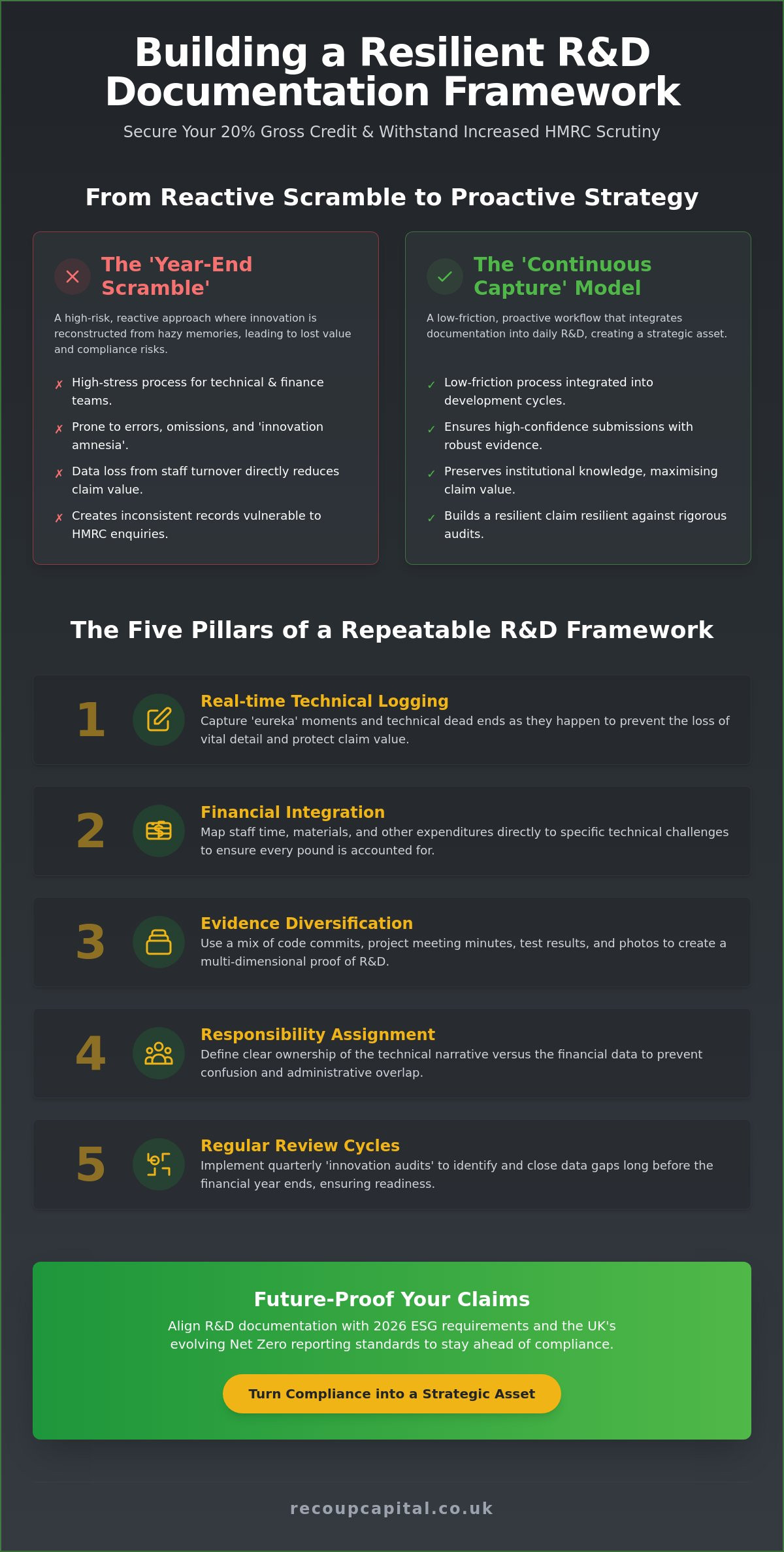
The difference between success and a rejected claim often comes down to the methodology used. Contrast the traditional 'Year-End Scramble' with 'Continuous Capture' methodologies. The scramble is a high-stress period where finance teams attempt to reconstruct a year's worth of innovation from vague calendar entries and hazy memories. This reactive approach is prone to error and often misses the technical nuances that drive a claim's value. Continuous capture, however, integrates documentation into the daily rhythm of your technical team, ensuring that evidence is a byproduct of work rather than an external chore.
The Shift from Reactive to Proactive Record Keeping
Waiting until the end of the financial year to reconstruct your R&D narrative is a high-risk strategy that leads to "innovation amnesia". When technical staff leave an organisation, they take their unrecorded insights with them. This loss of data directly reduces your tax credit uplift, as you simply cannot claim for hurdles you can no longer prove. By applying established Knowledge Management Principles, you can ensure that technical logging becomes a seamless part of the development cycle. This proactive stance transforms documentation from a burden into a strategic asset that secures your 20% gross credit under the merged scheme.
Aligning Innovation with HMRC Compliance Standards
HMRC's expectations for contemporaneous evidence have reached new heights in 2026. To successfully claim R&D tax credits, you must demonstrate that your projects sought to resolve a specific scientific or technological uncertainty. Sustainable documentation proves the 'trial and error' phase was genuine, providing a clear trail of the iterations, failures, and pivots that define qualifying R&D. For UK limited companies, the standard of evidence requires contemporaneous, project-specific records that clearly detail the technical challenges faced and the systematic steps taken to resolve them. Without this trail, you risk leaving significant capital on the table or, worse, facing a costly enquiry that drains internal resources.
The Five Pillars of a Repeatable R&D Framework
Building a robust claim isn't about luck; it's about architecture. Creating a sustainable R&D documentation process requires a framework that supports your technical team without stifling their creativity. When your documentation is structured correctly, it becomes a natural extension of your development cycle. This ensures that when the time comes to submit your claim, you aren't searching for lost data. Instead, you're simply presenting a well-organised narrative of innovation.
A truly repeatable system rests on five essential pillars:
- Pillar 1: Real-time Technical Logging. Capturing the 'eureka' moments and the 'dead ends' as they happen prevents the loss of vital technical detail.
- Pillar 2: Financial Integration. Mapping staff time directly to specific technical challenges ensures every pound spent is accounted for.
- Pillar 3: Evidence Diversification. Using a mix of code commits, project meeting minutes, and even white-board photos creates a multi-dimensional proof of R&D.
- Pillar 4: Responsibility Assignment. Defining who owns the technical narrative versus who manages the financial numbers prevents administrative overlap and confusion.
- Pillar 5: Regular Review Cycles. Implementing quarterly 'innovation audits' helps identify and close data gaps long before the financial year ends.
Capturing Technical Uncertainties as They Occur
HMRC inspectors aren't just looking for your successes. They're often more interested in your failures. According to the UK Government's Definition of R&D, the resolution of scientific or technological uncertainty is the core requirement for any claim. Documenting why a specific prototype failed or why a certain algorithm didn't scale provides the contemporaneous evidence HMRC demands. You can use existing tools like Slack, Jira, or Teams to 'tag' these moments whilst they happen. This approach allows you to describe a technical hurdle in plain English, avoiding the dense jargon that often confuses tax inspectors during an enquiry.
Bridging the Gap Between Engineering and Finance
The most common point of failure in a claim is the 'translation layer' between technical progress and qualifying expenditure. To withstand a forensic HMRC enquiry, your records must show a clear link between a developer's hours and a specific technical uncertainty. Creating a sustainable R&D documentation process means organising staff time logs so they reflect the reality of the workshop or lab. If you're unsure which costs qualify under the merged scheme, our guide on R&D tax credits explained provides a clear breakdown. Establishing this link early makes understanding why you should claim much easier for your leadership team, as the financial return becomes a predictable strategic asset.
Overcoming the 'Time Drain' Objection
"My engineers don't have time for more paperwork." It's the most common objection we hear from UK firms. We understand that your technical talent is your most valuable asset, and every hour spent on administration feels like an hour stolen from innovation. However, the traditional retrospective approach to claims is the true time-waster. Spending a full week in March trying to reconstruct technical hurdles from the previous April is a massive internal disruption. Creating a sustainable R&D documentation process flips this script, replacing the frantic year-end rush with a "little and often" methodology that actually protects your team's focus.
The '15-Minute Rule' is a cornerstone of this approach. If a documentation task takes longer than fifteen minutes a week, the process is likely too heavy. By capturing technical pivots and failed experiments in real-time, you prevent the need for hours of retrospective writing later. This micro-documentation doesn't just satisfy the taxman; it serves as a powerful tool for project management and internal learning. It ensures that technical knowledge stays within the organisation, even if a key developer moves on. It's about making documentation a byproduct of the work, not a separate, resented task.
Automation and AI in the Documentation Workflow
Modern workflows allow for significant automation. AI note-takers can now transcribe technical stand-ups directly into draft R&D narratives, capturing the essence of a challenge whilst it's still fresh. This reduces the friction of manual entry. However, there is a critical 'human-in-the-loop' requirement for 2026. HMRC expects technical staff to verify and refine these records to ensure accuracy. Relying solely on AI without human oversight is a significant compliance risk. For a deeper look at these risks, see our guide on HMRC R&D Tax Claim Transparency and AI. Smart automation should support your team, not replace their technical expertise.
Gamifying Innovation Capture
To make the process stick, you must incentivise your technical team to flag qualifying activities. Instead of documentation being a chore, create a 'culture of innovation' where technical hurdles are celebrated as claimable assets. When an engineer hits a significant roadblock, it shouldn't be seen as a delay; it's a financial opportunity for the firm. Integrating documentation into existing project milestones, such as sprint reviews or code commits, ensures it becomes a natural habit. By rewarding the identification of technical uncertainties, you turn a perceived burden into a shared goal for capital recovery.
Future-Proofing: ESG, Net Zero, and 2026 Regulations
The 2026 regulatory environment has fundamentally changed how UK firms approach their tax strategy. Under the Merged R&D Scheme, which provides a taxable credit of 20% on qualifying expenditure, the margin for administrative error has vanished. One of the most significant shifts is the 'Advanced Notification' requirement. If your firm hasn't made a claim in the last three years, you must notify HMRC within six months of the end of the period of account. This makes planning ahead and creating a sustainable R&D documentation process an operational necessity rather than a year-end luxury. If you miss this window, you risk losing your right to claim entirely, regardless of how innovative your projects were.
Innovation is also being driven by the UK's legally binding target to reach net-zero emissions by 2050. With the government set to establish the Seventh Carbon Budget by June 2026, the pressure to decarbonise is intensifying. This budget proposes an 87% reduction in emissions from 1990 levels by the early 2030s. Consequently, more firms are pivoting toward green tech, where the technical challenges are often unprecedented. Creating a sustainable R&D documentation process allows you to capture these complex pivots as they occur, ensuring your financial recovery keeps pace with your environmental ambitions.
The Synergy Between ESG and R&D Relief
Projects aimed at sustainability often present the highest levels of technological uncertainty. Whether you're developing low-carbon materials or pioneering energy-efficient manufacturing, these initiatives are prime candidates for R&D relief. By documenting environmental impact as part of your technical narrative, you align your tax recovery with your company's broader ESG strategy and the new UK Sustainability Reporting Standards (UK SRS). For developers focused on sustainable site transformations, understanding Land Remediation tax relief is equally vital. This synergy ensures that your pursuit of Net Zero is supported by maximum capital recovery.
Surviving the 2026 HMRC Enquiry Landscape
HMRC's approach to compliance has become increasingly rigorous. "Random" enquiry checks are now a standard part of the landscape, and inspectors specifically look for gaps in the contemporaneous documentation trail. They're no longer satisfied with high-level summaries; they want to see the "forensic" detail of your technical journey. This is why having a specialist partner to stress-test your process before submission is essential. If you want to ensure your documentation stands up to the highest level of scrutiny, you can book a consultation to review your R&D documentation strategy and protect your firm's financial future.
Strategic Capital Recovery with Recoup Capital
Implementing a new workflow is often the hardest part of business change. Whilst the theory of creating a sustainable R&D documentation process is clear, the practical execution requires precision and experience. This is where Recoup Capital steps in. We don't just act as a service provider; we act as your 'documentation architects'. Our team of chartered tax accountants and technical specialists works alongside your engineers to build a framework that captures innovation without increasing their daily burden. By shifting from a 'one-off refund' mindset to a 'strategic growth asset' philosophy, we help you turn technical challenges into predictable capital for future reinvestment.
Our success-based partnership naturally encourages a more sustainable documentation culture within your firm. Because our interests are perfectly aligned with yours, we're invested in the long-term integrity of your records. We've seen first-hand how professional technical assessments can uncover 'hidden' R&D in sectors like construction and engineering, where complex site-specific hurdles are often overlooked. By creating a sustainable R&D documentation process, you ensure these technical uncertainties are captured as valuable assets. When they're documented correctly, they form the bedrock of a robust, high-value claim that withstands the most rigorous scrutiny.
Our Results-Driven Approach
We manage the entire end-to-end process, allowing your team to focus on what they do best: innovating. From the initial technical discovery sessions to direct HMRC liaison, our approach is designed to be low-friction. We use forensic surveying to identify tax-deductible innovation that internal teams or generalist accountants frequently miss. This depth of analysis ensures that your claim reflects the true extent of your R&D activity. You can discover how we can maximise your claim with a no-cost introductory assessment to see where your current process could be strengthened.
Building a Long-Term Partnership
Our commitment goes beyond just processing paperwork. We focus on how your R&D tax credits can fuel your next phase of growth. Transparency is at the heart of everything we do, and we take proactive steps to protect your business from enquiry risks by stress-testing every narrative we produce. We're here to help you navigate the complexities of 2026 regulations with confidence. If you're ready to move away from the year-end scramble, contact our specialists today to organise your documentation for the year ahead and secure your firm's financial future.
Securing Your Firm’s Future Through Documentation Excellence
Transitioning from a reactive year-end scramble to a continuous capture model is no longer just a recommendation; it's a necessity for resilience in the 2026 tax landscape. By implementing a repeatable framework and embracing micro-documentation, your firm can transform administrative burdens into a strategic growth tool. Creating a sustainable R&D documentation process ensures that every technical pivot is recorded as it happens, protecting your capital recovery whilst fostering a genuine culture of innovation that survives staff turnover.
You don't have to navigate these regulatory complexities alone. Recoup Capital operates on a success-based fee model, ensuring our goals are perfectly aligned with your business growth. Our specialist chartered tax accountants bring a proven track record in the construction and engineering sectors, providing the forensic expertise needed to stress-test your claims before submission. Claim your R&D Tax Credits with a partner who understands innovation and turn your technical challenges into strategic assets today. Your next breakthrough deserves the maximum financial support possible.
Frequently Asked Questions
What is the most important document to keep for an R&D tax credit claim?
The most critical evidence is a contemporaneous record that captures the specific technological uncertainties encountered during a project. HMRC prioritises diaries, technical logs, or project meeting minutes created at the time of the work over retrospective summaries. These documents prove that you were actively attempting to overcome a technical hurdle, which is the core requirement for a successful claim in 2026.
Can we use AI to write our R&D technical narratives in 2026?
You can use AI as a tool for transcribing technical stand-ups or drafting initial narratives, but it cannot be the sole author of your submission. HMRC's current compliance landscape requires a "human-in-the-loop" to verify technical accuracy and ensure the narrative reflects real-world challenges. Relying entirely on AI without expert oversight increases your risk of an enquiry during the submission process.
How long should we keep our R&D documentation for HMRC purposes?
You should retain all records related to your R&D claim for at least six years from the end of the relevant accounting period. This includes technical logs, staff time sheets, and invoices for qualifying expenditure. Maintaining this archive is a vital part of creating a sustainable R&D documentation process, as it ensures you're prepared for any retrospective compliance checks or enquiries from HMRC.
What happens if our R&D project failed; can we still document and claim for it?
Failed projects are often the strongest candidates for R&D tax relief because they demonstrate clear technological uncertainty. If you can show that you attempted to achieve a technical advance but were unsuccessful despite your best efforts, those costs are still qualifying expenditure. Documenting the reasons for failure provides the exact type of evidence HMRC inspectors look for when validating a claim.
Do we need a specific software tool to manage our R&D documentation sustainably?
There is no mandatory software required; the best system is usually the one your team already uses. Integrating R&D logging into existing platforms like Jira, Trello, or Slack reduces friction and makes the process more repeatable. The key isn't the specific tool, but ensuring that the workflow captures technical pivots as they happen rather than months after the event.
How much detail does HMRC really need for the technical report?
HMRC requires forensic detail regarding the specific scientific or technological uncertainties your project aimed to resolve. They aren't interested in marketing descriptions or high-level project goals. Your report must explain why the solution wasn't readily deducible by a competent professional and detail the systematic steps, iterations, and testing your team performed to find a resolution.
Is our general accountant capable of creating a sustainable R&D process?
Whilst general accountants are excellent at managing corporation tax, they often lack the technical background required to identify qualifying R&D hurdles in specialised sectors. Creating a sustainable R&D documentation process often requires a partnership with a specialist who understands both the tax legislation and the technical nuances of your industry. This ensures technical narratives are robust enough to withstand a forensic HMRC audit.
What is the 'Advanced Notification' form and how does it affect our documentation?
The Advanced Notification form is a mandatory requirement for firms that haven't claimed in the last three years or are claiming for the first time. You must submit this form digitally within six months of the end of your accounting period. This makes early planning essential, as you must identify qualifying projects and begin your documentation trail long before you actually file your tax return.