
Reinvesting Your R&D Tax Relief: Strategic Growth Strategies for 2026

What if your HMRC tax credit wasn't just a refund for past efforts, but the primary engine for your next three years of growth? Too often, businesses treat these funds as a temporary relief for operational "firefighting" or let them sit idle whilst worrying about the tax implications of new 2026 reporting requirements. It's a common frustration to feel that your innovation spend is a sunk cost rather than a strategic investment.
By reinvesting your R&D tax relief effectively, you can transform a standard credit into a compounding asset that drives long-term corporate value and market authority. This guide provides a clear framework for capital allocation, helping you capitalise on the immediate expensing rules restored by the One Big Beautiful Bill Act. We will explore how to navigate the mandatory project-level detail required by Section G of Form 6765; ultimately, you'll discover how to create a self-funding cycle of innovation that increases your company's valuation year after year.
Key Takeaways
- Learn how to shift your perspective from simple cash recovery to capital utility, treating every HMRC credit as a strategic business asset.
- Discover the most effective pathways for reinvesting your R&D tax relief, including scaling technical talent and funding new laboratory facilities.
- Understand how a robust reinvestment framework can significantly increase your company's valuation by signalling long-term stability to potential acquirers.
- Identify the essential documentation required in 2026, such as the Additional Information Form, to protect your claims under the Merged R&D Scheme.
- Explore how aligning your R&D strategy with Capital Allowances creates a compounding effect that accelerates your overall corporate growth.
What Does Reinvesting Your R&D Tax Relief Actually Mean?
At its core, the process of reinvesting your R&D tax relief is the intentional decision to funnel recovered capital back into the very activities that generated the credit in the first place. It marks a shift from viewing the tax credit as a simple cash refund to treating it as a strategic business tool. For many UK SMEs, this capital represents a lifeline that reduces the overall cost of innovation, allowing for technical risks that might otherwise be financially prohibitive. Before diving into complex allocation strategies, it helps to understand the foundational mechanics. What are R&D tax credits? Essentially, they are a government incentive designed to reward companies for investing in innovation and overcoming technical uncertainties.
The year 2026 represents a significant turning point for capital utility. Following the introduction of the One Big Beautiful Bill Act (OBBBA) in July 2025, the landscape for deducting costs has evolved. With domestic research and experimental expenditures now eligible for immediate expensing, the speed at which you can recycle your relief has increased. This legislative shift encourages firms to move away from "cash recovery" mindset, where funds are absorbed into general reserves, and toward a model where every pound is earmarked for future growth. For a deeper dive into these mechanics, you might find our guide on how R&D tax credits are explained particularly useful during your planning phase.
The Psychology of the "Innovation Windfall"
Many directors still view the credit as a bonus or a seasonal windfall. This mindset is a missed opportunity. When you treat the relief as an unexpected gift, there is a natural temptation to use it for non-growth operational costs like rent or utility arrears. Whilst this might solve a short-term headache, it does nothing to build long-term corporate value. Reframing the credit as a non-dilutive capital injection allows you to protect equity whilst funding high-risk, high-reward projects. It's about moving from "firefighting" to "future-proofing"—an evolution that often starts when you discover Jannine Barron and her regenerative business strategies designed for nature-aligned growth.
The Compounding Effect of the R&D Cycle
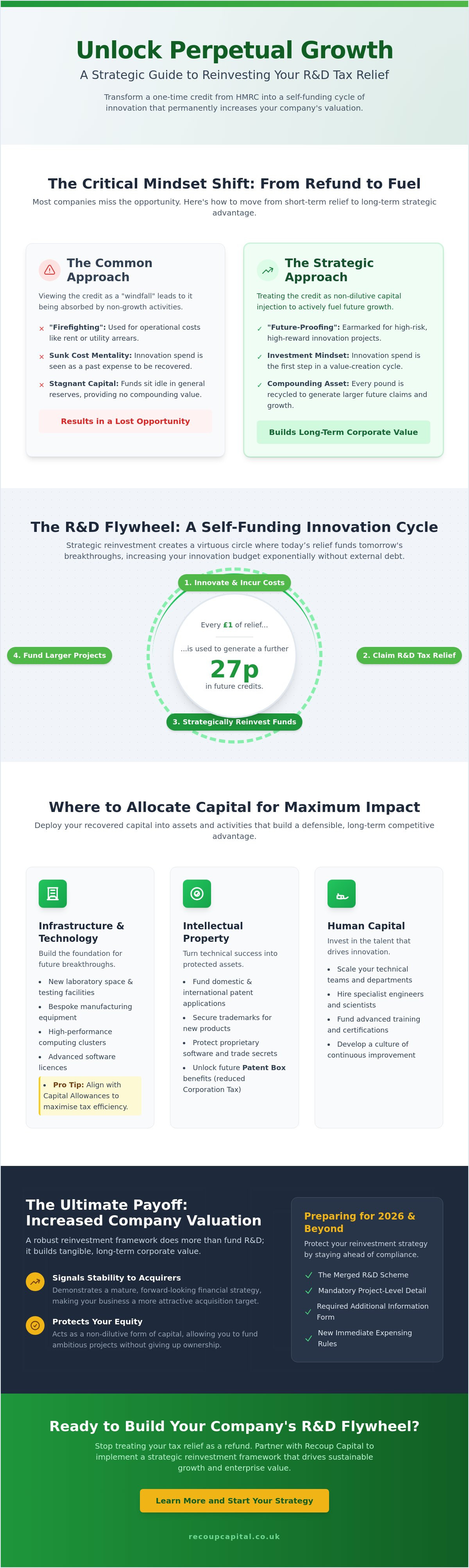
Strategic reinvestment creates a virtuous circle where today’s relief funds tomorrow’s qualifying expenditure. In 2026, the IRS and HMRC have increased scrutiny on documentation, specifically requiring project-level detail through mandates like Section G of Form 6765. By staying organised and reinvesting your R&D tax relief into new technical challenges, you ensure a steady stream of future claims. The R&D Flywheel is a method where every £1 of relief is used to generate a further 27p in future credits. This compounding effect ensures that your innovation budget grows exponentially without requiring additional external investment or debt.
Strategic Reinvestment Pathways: Where to Allocate Your Capital
Receiving your credit from HMRC is a significant milestone, but the real competitive advantage begins with how you deploy those funds. For most innovative firms, the most logical step involves reinvesting your R&D tax relief into the digital and physical infrastructure that supports technical breakthroughs. This isn't just about keeping the lights on. It's about building a foundation that allows you to reinvest into other business activities that drive long-term value. One of the most effective ways to do this is by aligning your R&D strategy with Capital Allowances. If your work requires new laboratory space, testing facilities, or bespoke manufacturing equipment, combining these incentives can significantly offset the initial capital expenditure.
Beyond physical assets, modernising your digital backbone is essential for accelerating technical iterations. Recovered capital can fund the high-performance computing or advanced software licences needed to simulate complex environments, reducing the time spent in the trial-and-error phase. Furthermore, to manage the energy demands of such infrastructure, firms can use Compare Renewables to source cost-effective green energy solutions. Transitioning these technical successes into protected assets is the final piece of the puzzle. By using your relief to fund patent applications, you can eventually benefit from the Patent Box, which offers a reduced effective rate of Corporation Tax on profits derived from patented inventions. It's a holistic approach to financial health.
Investing in Human Capital and Expertise
Staff costs typically represent the largest portion of any R&D claim. It makes sense to funnel relief back into your payroll. By using these funds to attract specialist engineers or senior scientists, you aren't just filling seats. You're actively reducing the 'brain drain' that often plagues growing tech firms. High-calibre talent doesn't just accelerate your product roadmap. It also ensures that your future claims remain robust and are backed by high-level technical documentation that stands up to increased regulatory scrutiny.
Bridging the Gap Between R&D and Commercialisation
The transition from a prototype to a market-ready product is often called the 'valley of death' due to the high costs involved. Reinvesting your R&D tax relief here provides a non-dilutive cushion during this vulnerable phase. For businesses in construction or heavy industry, this might even involve developing physical sites for new operations. If your project involves clearing contaminated land for a new facility, you should investigate how Land Remediation Relief can work alongside your R&D strategy to further improve your cash position. If you're unsure how these different reliefs interact, our team can help you plan your capital structure for maximum impact.
Preparing for Transactions: Using R&D Relief to Increase Business Valuation
When preparing for a mid-market transaction, your tax history becomes a focal point for forensic accountants and potential acquirers. They don't just look at the bottom line; they look at the quality of earnings and the sustainability of your growth model. By reinvesting your R&D tax relief into core technical assets rather than extracting it as immediate profit, you demonstrate a disciplined approach to capital utility. This behaviour signals that the business is a proactive growth engine rather than a stagnant entity. Integrating these credits into your broader Corporate Finance strategy allows you to clean up the balance sheet before a sale, often resulting in a higher valuation multiple.
For instance, using recovered capital to pay down short-term liabilities or invest in proprietary software increases your net asset value. Investors often favour firms that show a consistent, documented history of innovation because it suggests lower future risk and higher barriers to entry for competitors. In the 2026 regulatory environment, where the IRS and HMRC require project-level detail via Section G of Form 6765, your ability to show how relief was cycled back into specific business components becomes a powerful piece of evidence during due diligence.
R&D as a Value Driver in M&A
Acquirers are increasingly wary of "compliance-only" R&D claims that lack a clear connection to business growth. They look for "reinvestment behaviour" to ensure the technical narrative matches the financial data. Consistent claims prove a culture of innovation that isn't dependent on a single breakthrough. During the due diligence process, having a robust trail of how relief was cycled back into the business makes your technical narrative undeniable. It transforms a tax credit from a simple refund into a central pillar of your company's market value.
Debt Restructuring and Growth Capital
R&D credits can act as a crucial "bridge" whilst you negotiate new debt facilities or equity rounds. Because these returns are predictable for established innovators, they can be used for future financial planning with a high degree of confidence. Tax-efficient reinvestment improves your debt-to-equity ratio, making the firm more attractive to institutional lenders. Under the restored immediate expensing rules of the One Big Beautiful Bill Act, the transparency of your reinvestment strategy provides additional comfort to partners, proving that your innovation cycle is both self-sustaining and well-governed.
Compliance and Governance: Protecting Your Reinvestment in 2026
In the 2026 regulatory environment, the process of reinvesting your R&D tax relief requires a more disciplined approach to governance than in previous years. HMRC's Merged R&D Scheme has streamlined the claiming process, yet it has simultaneously increased the burden of proof regarding how funds are utilised. It isn't enough to simply receive the credit; you must demonstrate that the reinvested capital targets genuine qualifying activities. HMRC increasingly scrutinises the "commercial intent" behind your spend. They want to see that the relief is driving technical advancement rather than merely subsidising general business overheads or non-qualifying operational costs.
A vital component of this protection is the mandatory Additional Information Form (AIF). This document requires a granular breakdown of your projects and the specific technical uncertainties you're attempting to resolve. Your technical narrative shouldn't be a static document. It must evolve alongside your reinvestment strategy to reflect new challenges and iterations. If you fail to link your recovered capital to new R&D cycles, you risk your future claims being flagged during the enhanced vetting processes now standard for 2026 filers.
The Impact of HMRC’s New Transparency Standards
The 2026 compliance landscape demands a level of precision that "set and forget" claims simply cannot provide. You must document your R&D cycles with contemporaneous data to satisfy HMRC's transparency requirements. For a deeper look at how technology is shaping these requirements, you can read our insights on HMRC R&D Tax Claim Transparency and AI. Maintaining this level of detail is essential for protecting your future reinvestment capability. Without a clear audit trail, even legitimate innovation can be disqualified during an enquiry.
Avoiding the "R&D Cowboy" Trap
The most common objection we hear from directors is the fear of a time-consuming enquiry. Is the relief worth the risk? Under the new rules, the risk is highest for firms that don't understand the complexities of "subcontracted" work. If your reinvestment involves third-party developers, you must ensure the right to claim remains with your entity. Working with R&D tax credit specialists is the most effective way to mitigate this risk. We act as your protective guide, ensuring your governance is watertight so you can focus on scaling your business with confidence.
If you're ready to secure your innovation strategy and ensure your reinvestment meets the latest compliance standards, speak with our specialists today for a comprehensive review of your 2026 position.
Recoup Capital: Your Partners in Strategic Innovation
At Recoup Capital, we believe that a successful tax claim is only the beginning of your growth story. Our role extends far beyond the initial submission; we focus on helping you organise your capital for maximum long-term impact. Reinvesting your R&D tax relief effectively requires a holistic understanding of how different incentives interact. By combining our expertise in R&D with Capital Allowances and Corporate Finance, we ensure that every pound recovered is positioned to drive your next technical breakthrough. Our success-based philosophy means our interests are perfectly aligned with yours. We only win when your innovation succeeds.
This partnership-first approach is designed to remove the friction often associated with complex financial regulations. We don't deliver traditional sales pitches. Instead, we prefer to demonstrate our value through the tangible results we achieve for our clients. Whether you are scaling a technical team or modernising your infrastructure, our team provides the strategic oversight needed to turn a one-off refund into a sustainable asset. Starting this journey is simple. We offer a no-cost, no-pressure discovery session to help you identify the opportunities waiting within your current projects.
Why a Specialist Partner Outperforms a General Accountant
General accountants provide an essential service for standard compliance, but they often lack the technical depth required to identify every qualifying activity. Our team of specialised chartered tax accountants understands the mechanics of the "Innovation Flywheel" in detail. We conduct deep technical assessments that go well beyond the numbers, ensuring that your technical narrative is robust enough to satisfy 2026's stricter transparency standards. If you are still exploring the basics, our guide on how R&D tax credits are explained offers a solid foundation for understanding your potential entitlement.
Securing Your Future Innovation
The regulatory landscape is becoming increasingly complex, but it doesn't have to be intimidating. We act as a protective guide, helping you manage the risks of the Merged R&D Scheme whilst you focus on what you do best: innovating. Our commitment to long-term collaboration ensures that as your business grows, your tax strategy evolves with it. We help you stay ahead of HMRC’s shifting requirements, protecting your ability to continue reinvesting your R&D tax relief year after year. It's about building a relationship based on reliability, transparency, and a shared vision for your company's future success.
Ready to transform your tax position into a strategic growth engine? Book your strategic R&D review with Recoup Capital today and discover how we can help you scale with confidence.
Securing Your Competitive Advantage Through 2026 and Beyond
The shift from viewing tax credits as a historical refund to a future-facing asset is the defining strategy for the coming years. You've seen how aligning your innovation spend with Capital Allowances and Corporate Finance creates a self-funding cycle that increases business valuation. We've also explored the necessity of robust governance under the Merged Scheme to protect your claims from increased scrutiny. By reinvesting your R&D tax relief into core technical talent and infrastructure, you ensure that every pound recovered works twice as hard for your company's future.
Recoup Capital acts as your protective guide through these regulatory complexities. As Chartered Tax Accountants and R&D Specialists, we bring deep expertise across multiple tax reliefs to provide a truly holistic service. Our success-based fee structure ensures our goals are perfectly aligned with your growth. Don't let your next credit be absorbed by operational firefighting. Maximise your innovation potential—speak to a Recoup Capital specialist today. We are ready to help you turn technical uncertainty into your company's greatest strategic advantage.
Frequently Asked Questions
Can I reinvest R&D tax relief into any part of my business?
Yes, once the credit is received, the funds are yours to use as you see fit. Whilst you can spend it on general overheads, the most strategic approach involves reinvesting your R&D tax relief into qualifying activities like technical staff or laboratory equipment. This creates a self-funding innovation cycle. Spending on non-qualifying areas won't disqualify your previous claim, but it won't fuel your next one. It's about choosing between a one-off bonus and a compounding asset.
Does reinvesting my tax credit increase the value of my next R&D claim?
It can increase your next claim if you allocate those funds to qualifying expenditure. If you use the relief to hire new engineers or purchase consumable materials for a new project, those costs will form the basis of your next submission. This compounding effect is what we call the "R&D Flywheel". By cycling the capital back into technical uncertainty, you effectively lower the net cost of your future innovation and accelerate your technical roadmap.
How does the Merged R&D Scheme in 2026 affect my reinvestment strategy?
The Merged Scheme simplifies the rules but requires more rigorous documentation of commercial intent. In 2026, you must ensure that your reinvested capital is clearly linked to specific business components as required by Section G of Form 6765. This means your reinvestment strategy should be more structured and better documented than in previous years. It's about proving that the relief is actively driving your technical roadmap and resolving new technical uncertainties.
Is it better to use R&D relief for debt reduction or new projects?
This depends on your company's current capital structure and growth stage. Debt reduction can improve your balance sheet and debt-to-equity ratio, which is vital if you're preparing for a transaction. Conversely, funding new projects fuels future claims and market authority. Many firms choose a split approach, using a portion to stabilise the business whilst reinvesting your R&D tax relief into high-growth technical initiatives. Balancing stability with innovation is key to maintaining long-term corporate value.
Can I use R&D tax credits to fund a Patent Box application?
Yes, using your R&D credit to cover the costs of patent applications is a highly effective growth strategy. This transition from research to protected intellectual property allows you to access a lower effective rate of Corporation Tax on profits from those inventions. It's a natural progression that turns technical successes into long-term financial assets. Our team can help you navigate this transition to ensure maximum tax efficiency across your entire innovation portfolio.
What happens if HMRC enquires into a claim that I have already reinvested?
An enquiry doesn't change because the money has been spent; the focus remains on the eligibility of the original claim. If HMRC finds an error, you may be required to repay the overclaimed amount plus potential penalties. This is why maintaining a robust audit trail and working with specialists is essential. We act as a protective guide, ensuring your documentation is watertight before you commit the funds to new projects. Reliability and transparency are your best defences.
Do I need to track exactly where the R&D refund is spent for HMRC?
HMRC doesn't mandate a specific tracking system for the refund itself, but they do require detailed records of the activities you claim for. Under the 2026 transparency standards, you must be able to justify the commercial intent of your R&D spend. Whilst you don't need to show a receipt for the specific refund pounds, you must prove that your ongoing innovation projects meet the technical and financial criteria to qualify for future relief.
How does reinvesting R&D relief affect my company valuation for M&A?
It significantly enhances your valuation by proving a sustainable, self-funding innovation model. Acquirers look for a history of reinvestment because it signals a proactive culture and higher barriers to entry. By cleaning up your balance sheet and investing in proprietary assets rather than extracting cash, you demonstrate a disciplined approach to capital utility. This often results in a higher valuation multiple during the due diligence process, as it reduces perceived future risk.