
How R&D Tax Credits are Paid: A Guide to HMRC Settlement and Timelines in 2026

The difference between a cash refund hitting your bank account and a simple reduction in your Corporation Tax bill can be the deciding factor in your next phase of innovation. Understanding exactly how R&D tax credits are paid is no longer just a task for your accountant; it is a vital component of your 2026 cash flow strategy. You have likely felt the frustration of waiting for HMRC updates, especially as the merged scheme rules have altered the landscape. It is unsettling when you cannot predict whether your relief will arrive as a liquid asset or a tax offset.
This guide clarifies the exact mechanics of HMRC disbursements, from cash payments for loss-making intensive SMEs to tax reductions for profitable firms. We will break down the current 2026 timelines, explaining why some standard claims arrive in four weeks whilst others take twelve. You will gain a clear perspective on the settlement process, allowing you to move from uncertainty to precise financial forecasting. By the end of this article, you will know exactly what to expect when your claim is finalised, turning a complex regulatory procedure into a strategic business tool for growth.
Key Takeaways
- Understand the vital distinction between receiving a cash BACS transfer and a reduction in your Corporation Tax liability to better manage your immediate capital.
- Navigate the 2026 HMRC processing landscape, where standard timelines often shift beyond the traditional 40-day window due to increased compliance scrutiny.
- Learn exactly how R&D tax credits are paid through the merged scheme and why these payments are now recognised as "Other Income" to boost your company's EBITDA.
- Calculate your true net benefit by factoring in the 25% Corporation Tax rate, ensuring your financial forecasting remains accurate and reliable.
- Discover how ensuring your submission is "HMRC-ready" with the correct Additional Information Form (AIF) can prevent costly settlement delays and secure your funding faster.
Understanding the Settlement: How HMRC Pays R&D Tax Credits
HMRC treats the settlement of an R&D claim as a formal discharge of tax liability. This isn't just a simple refund; it's a strategic financial adjustment triggered when you submit your Company Tax Return (CT600). The mechanics of how R&D tax credits are paid depend entirely on your business's financial position at the time of the claim. Whether you are in a profit or loss position dictates whether HMRC will reduce a future tax bill or send a cash BACS transfer to your account. For a broader context, you might find this Wikipedia overview of R&D Tax Credits useful for understanding the historical evolution of these incentives and how they have shaped modern corporate finance.
Cash Payment vs. Tax Offset
Profitable companies typically see their benefit as a tax offset. If you've already paid your Corporation Tax for the period, HMRC will issue a repayment of the overpaid amount. If the tax is still due, the credit simply reduces the balance. For loss-making firms, the process involves "surrendering" a portion of your losses in exchange for a payable tax credit. It's vital to check your account balance first; if you have outstanding liabilities, such as VAT or PAYE arrears, HMRC will often use your R&D credit to clear those debts before releasing any remaining funds. This hierarchy of payment ensures the Treasury is settled before capital is returned to the business.
The Role of the Merged Scheme in 2026
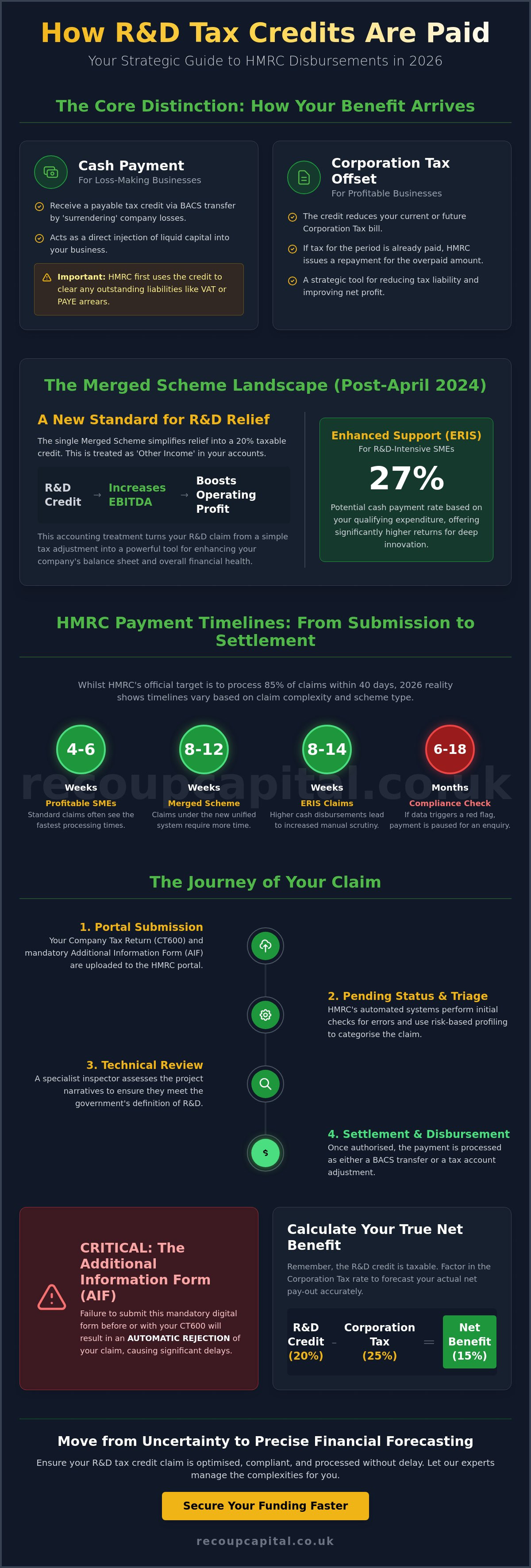
The landscape shifted significantly for accounting periods starting after 1 April 2024. The transition to a single Merged Scheme has simplified the process into a 20% taxable credit. This "above-the-line" credit is recognised as other income in your accounts. It is a powerful tool for your balance sheet because it can significantly enhance your EBITDA and overall operating profit. If you are an R&D-intensive SME under the Enhanced R&D Intensive Support (ERIS) rules, you may still access a higher cash payment worth up to 27% of your qualifying expenditure. Navigating these nuances is essential for accurate forecasting, as we highlight in our guide to R&D tax credits explained. Understanding these mechanics ensures you can treat your relief not just as a windfall, but as a predictable strategic asset for future innovation.
The HMRC Payment Timeline: From Submission to Bank Account
HMRC maintains an official target to process 85% of R&D tax credit claims within 40 days. However, the reality of 2026 shows that the complexity of your chosen scheme dictates the pace. Standard claims for profitable SMEs often settle within a 4 to 6-week window, whilst those under the Merged Scheme typically require 8 to 12 weeks for full processing. If your business qualifies for Enhanced R&D Intensive Support (ERIS), you should forecast a timeline of 8 to 14 weeks due to the higher level of manual scrutiny applied to larger cash disbursements. Understanding how R&D tax credits are paid involves recognising that these windows are not guarantees but benchmarks for a smooth, enquiry-free submission.
The introduction of the mandatory Additional Information Form (AIF) has fundamentally changed the submission rhythm. According to HMRC's official R&D tax relief guidance, failing to submit this digital form before or alongside your CT600 will result in an automatic rejection. This digital-first approach allows HMRC to use risk-based profiling to categorise claims before they even reach a technical inspector's desk. If your data triggers a red flag, your payment will be paused indefinitely whilst a compliance check is conducted, a process that can last anywhere from 6 to 18 months.
Step-by-Step: The Journey of Your Claim
- Portal Submission: Your CT600 and AIF are uploaded to the HMRC portal, initiating the digital validation phase.
- Pending Status: The claim appears in your online tax account. At this stage, HMRC's algorithms check for basic errors or inconsistencies with previous filings.
- Technical Review: A specialist inspector assesses the qualitative nature of your R&D projects to ensure they meet the criteria for scientific or technological advancement.
- BACS Disbursement: Once authorised, the status moves to "issued." The funds are then transferred via BACS, usually arriving in your bank account within 3 to 5 working days of approval.
Factors That Delay Your R&D Payment
Data discrepancies are the primary cause of modern payment bottlenecks. If the figures on your technical report don't align perfectly with the entries on your CT600, the system will flag the claim for manual intervention. First-time claimants are also subject to higher scrutiny as HMRC establishes a baseline for your R&D activity. Seasonal peaks, particularly around December and March, can further stretch internal resources at HMRC, leading to minor delays. Ensuring your submission is technically robust from the outset is the best way to accelerate your return. You can learn more about claiming R&D tax credits to see how a streamlined approach reduces these common friction points.
Calculating the Net Pay-out: What Actually Hits the Bank?
Understanding the headline figures is only half the battle. When you look at the final settlement, there is often a discrepancy between the gross credit awarded and the actual cash that arrives in your account. This is because how R&D tax credits are paid involves several layers of statutory deductions. HMRC prioritises settling your existing tax obligations before releasing any surplus capital. If your company owes VAT or has an outstanding PAYE balance, HMRC will "net off" these liabilities against your R&D credit. Only the remaining balance is disbursed as a cash BACS transfer.
The main rate of Corporation Tax, which stands at 25% for companies with profits over £250,000 in 2026, plays a significant role here. Because the credit under the Merged Scheme is taxable, your net benefit is effectively reduced. For a business paying the 25% rate, a 20% gross credit results in a net benefit of 15p for every £1 of qualifying spend. Companies on the 19% small profits rate fare slightly better, retaining 16.2p per £1. Additionally, the PAYE and NIC cap remains a critical guardrail. HMRC limits the payable credit to £20,000 plus 300% of your total PAYE and National Insurance contributions for the period; this prevents companies with minimal UK payroll from claiming excessive cash refunds.
The Merged Scheme Calculation (RDEC Style)
The Merged Scheme follows a rigorous 7-step process to determine the final pay-out. This begins with the 20% gross credit being added to your taxable profits. HMRC then applies a "notional tax" deduction for loss-making companies. This ensures that firms not currently paying Corporation Tax don't receive a more generous benefit than profitable ones. This calculation can be complex, but it ensures that the relief is treated as a strategic asset on your balance sheet, enhancing your EBITDA before the tax line is even reached.
The SME Intensive Scheme (ERIS) Pay-out
For those qualifying as "R&D intensive," the financial rewards are significantly higher. Under the Enhanced R&D Intensive Support (ERIS) rules, a company is eligible if its qualifying R&D expenditure is at least 30% of its total expenditure. These innovators can surrender their losses at a rate of 14.5%, which translates to a cash payment of up to 27% of the qualifying expenditure. This remains the most lucrative route for loss-making startups and deep-tech firms. It provides a direct cash injection that is not liable to further tax, making it a vital pillar of corporate finance for high-growth entities.
Accounting for R&D Tax Credits: P&L vs. Balance Sheet
The way your business records the credit in your financial statements is just as critical as the cash itself. This treatment directly affects your company's valuation and reported profitability. Under the Merged Scheme introduced for accounting periods starting after 1 April 2024, the credit follows the Research and Development Expenditure Credit (RDEC) model. This means it is recognised as "Other Income" above the taxation line. This distinction is vital for businesses seeking investment or debt financing. Because it sits above the line, it positively impacts your EBITDA and operating profit. It reframes the incentive from a mere tax saving into a fundamental driver of your business's operational performance.
In contrast, if you are claiming under the older SME scheme or the current Enhanced R&D Intensive Support (ERIS), the accounting treatment differs. These credits are typically shown as a deduction from the Corporation Tax charge in the "Taxation" line of your Profit and Loss account. Understanding how R&D tax credits are paid and subsequently recorded allows you to present a more accurate picture of your financial health to stakeholders. Whilst the cash arrival is the ultimate goal, the accounting recognition ensures your balance sheet reflects the value of your innovation throughout the financial year.
Recognising Income whilst Awaiting Payment
You don't need to wait for the BACS transfer to acknowledge the value of your claim. Under FRS 102, you can accrue for R&D income in the financial year the qualifying costs were incurred. This requires "reasonable certainty" that the claim will be successful and that the amount can be reliably measured. Most businesses work closely with their chartered tax accountants to ensure these estimates are robust. Accruing early aligns your innovation costs with the resulting financial benefit, preventing significant fluctuations in your annual accounts. If you are unsure about your eligibility or the potential value of your claim, you can speak with our specialists to clarify your position.
Disclosure Requirements
Transparency is key when reporting specialised financial incentives. You should include a note in your financial statements explaining the nature of your R&D activities and the basis for the credit. This is particularly important for investors who want to see how much capital is being reinvested into growth. Key elements to disclose include:
- The specific scheme used, such as the Merged Scheme or ERIS.
- The accounting policy adopted for recognising the credit.
- Any significant judgements made in calculating the qualifying expenditure.
Clear disclosure highlights your commitment to innovation and explains why your effective tax rate might appear lower than the standard 25%. It also clarifies the company's capital position, showing that the R&D credit is a strategic asset rather than a one-off windfall. Proper documentation ensures your accounting remains compliant whilst demonstrating the long-term value of your technical advancements.
Maximising and Securing Your Payment with Recoup Capital
Securing a successful settlement requires more than just technical knowledge; it demands a proactive defence of your innovation. HMRC's scrutiny has reached record levels in 2026, and a single technical inconsistency can halt your funding for months. Our specialists focus on making your submission technically unassailable from the outset. We ensure the Additional Information Form (AIF) isn't just a box-ticking exercise but a robust justification of your technical advancements. By mastering the nuances of claiming R&D tax credits, we eliminate the common "red flags" that trigger manual reviews. This proactive stance is why our clients often see their settlements processed with greater efficiency, avoiding the lengthy delays that plague less rigorous submissions.
Our role as a protective guide extends beyond the initial filing. If HMRC initiates a compliance check, we manage the entire enquiry process on your behalf. We provide the technical evidence and financial clarity needed to satisfy inspectors, ensuring your payment is defended with professional authority. Understanding how R&D tax credits are paid in this high-scrutiny environment means being prepared for every eventuality. We act as a long-term partner, invested in your future rather than just processing paperwork. This relationship-first approach is anchored by our success-based fee model, which aligns our goals directly with your business's cash flow.
Why a Specialist Approach Speeds Up Payment
Technical errors are the primary cause of payment bottlenecks. Our team of specialists reviews every aspect of your claim to ensure FRS 102 compliance and technical accuracy. We navigate the complexities of the 2026 Merged Scheme, ensuring that your "above-the-line" credit is calculated correctly to boost your EBITDA. By providing a streamlined, expert-led experience, we reduce the administrative burden on your team. This efficiency ensures your capital is recovered as quickly as possible, allowing you to reinvest in your next breakthrough without unnecessary waiting periods.
Beyond the Credit: Strategic Capital Recovery
We view your R&D settlement as a strategic business tool rather than a mere refund. Our specialists look at the bigger picture, linking your R&D payments with other incentives like capital allowances to maximise your total benefit. This integrated approach to corporate finance ensures you are leveraging every available relief to fuel your growth. We help you transform these financial returns into strategic assets that support long-term innovation. If you are ready to secure your business's future, speak to a Recoup Capital specialist today to secure your innovation funding and discover the true value of your technical advancements.
Turning Innovation into Strategic Capital
Navigating the complexities of HMRC settlement in 2026 requires a precise approach to financial forecasting. You now have a clear understanding of the vital distinction between a tax offset and a cash BACS transfer, alongside the specific timelines that dictate when your capital returns. Recognising how R&D tax credits are paid—and how to account for them correctly above the tax line—shifts these incentives from a simple refund to a powerful strategic business tool. This knowledge ensures you can forecast with confidence whilst maintaining a robust balance sheet.
Success in this high-scrutiny environment relies on technical accuracy and absolute transparency. Our team of Chartered Tax Accountants and specialists in construction and engineering R&D ensure your claim is HMRC-ready, minimising delays and defending your entitlement. We operate on a success-based fee structure, meaning our goals are perfectly aligned with your cash flow and long-term growth. Maximise your R&D payment with a free technical assessment from Recoup Capital and transform your technical advancements into the liquid assets your business deserves. We are ready to help you innovate with certainty.
Frequently Asked Questions
How long does it take for HMRC to pay R&D tax credits in 2026?
HMRC maintains a target to process 85% of claims within 40 days, but actual timelines in 2026 depend on your specific scheme. Standard SME claims often settle in 4 to 6 weeks. Those filing under the Merged Scheme should forecast a wait of 8 to 12 weeks. If you are an R&D-intensive firm, the manual review process for higher cash values can extend the timeline to 14 weeks.
Can HMRC pay R&D tax credits directly into my personal bank account?
No, HMRC will only disburse funds to the bank account registered to the limited company making the claim. Because R&D tax relief is a corporate incentive, the payment must remain within the business entity. You cannot nominate a personal account for the BACS transfer. This protocol ensures transparency and prevents potential fraud within the tax system whilst maintaining a clear audit trail.
What happens if I have other tax debts when my R&D claim is approved?
HMRC operates a "netting off" policy where any outstanding tax liabilities are cleared before you receive a penny. If your business has overdue VAT, PAYE, or previous Corporation Tax balances, HMRC will automatically use your credit to settle these debts. Only the remaining surplus is issued as a cash refund to your company bank account, ensuring the Treasury is settled first.
Is the R&D tax credit payment taxable income?
The taxability depends on the specific scheme you are using. Under the Merged Scheme, the 20% credit is "above-the-line" and is treated as taxable income in your accounts. However, for loss-making SMEs qualifying for Enhanced R&D Intensive Support (ERIS), the payable credit is not liable to tax. Understanding how R&D tax credits are paid and taxed is essential for your final EBITDA and profit calculations.
Can I get my R&D payment as a cash refund if my company is profitable?
Profitable companies usually receive their benefit as a reduction in Corporation Tax rather than a direct cash windfall. If you've already paid your tax for the period, HMRC will issue a repayment of the overpaid amount. If the tax is still outstanding, the credit simply reduces the balance you owe. This effectively preserves your cash reserves by lowering your immediate or future tax liabilities.
What is the "PAYE Cap" and how does it affect my payment?
The PAYE cap is a measure that limits the amount of payable credit a company can receive. In 2026, this is set at £20,000 plus 300% of your total PAYE and National Insurance contributions for the period. It primarily affects businesses with very low UK payroll costs. This ensures that the cash refund remains proportionate to the company's domestic economic footprint and employment levels.
Why has my R&D tax credit payment been delayed?
Delays are frequently caused by technical inconsistencies or missing documentation in your filing. If your Additional Information Form (AIF) doesn't align perfectly with your CT600, HMRC's risk-profiling algorithms will flag the claim for a manual enquiry. Seasonal backlogs in December and March can also slow down the disbursement process. Ensuring your submission is robust and technically accurate is the best way to avoid these bottlenecks.
Do I receive the R&D payment all at once or in instalments?
You will receive your settlement as a single lump sum once HMRC has finalised the processing of your claim. Whether it arrives as a tax offset or a BACS transfer, the payment is never staggered into instalments. This single disbursement makes it easier for businesses to plan significant capital investments or clear liabilities. Knowing how R&D tax credits are paid helps you time these strategic moves correctly.