
SME R&D Tax Credit Scheme Explained: A Comprehensive 2026 Guide to UK Innovation Relief

Is your innovation being treated as a simple tax line item or a strategic engine for growth? In 2026, a successful claim is no longer just about filling in forms; it's about navigating a sophisticated financial landscape where the Merged and ERIS schemes dictate your cash flow. You've likely felt the weight of increased HMRC scrutiny and the time-consuming nature of new documentation rules. It's a common concern for directors who want to focus on their core business rather than getting bogged down in technical tax legislation.
Having the SME R&D tax credit scheme explained with precision is the first step toward securing the funding your business deserves. We're here to show you how to transform these complexities into a seamless process that delivers maximum compliant value. This guide provides a clear roadmap through the 20% taxable credit of the Merged scheme and the 186% deduction available via Enhanced R&D Intensive Support (ERIS). You'll discover how to meet the 30% intensity threshold and organise your records to ensure your innovation remains a catalyst for reinvestment.
Key Takeaways
- Gain clarity on the 2026 landscape where the SME R&D tax credit scheme explained details the transition to the Merged and ERIS pathways.
- Identify 'hidden' innovation costs within your daily operations through forensic accounting to ensure every pound of eligible expenditure is captured.
- Determine if your firm qualifies for the 18.6% net benefit under the Merged Scheme or the higher-value relief reserved for R&D-intensive businesses.
- Secure your claim against HMRC scrutiny by mastering new digital submission rules and the mandatory Senior Officer signature requirements.
- Learn how to transform technical tax complexities into a seamless process that delivers strategic capital for your business growth.
What is the SME R&D Tax Credit Scheme in 2026?
The SME R&D tax credit scheme explained simply is a government initiative that rewards UK limited companies for overcoming technical challenges. It's designed to reduce the financial risk of innovation by providing tax relief or cash credits for qualifying expenditure. Since its inception, the history of R&D tax credits has seen various iterations, but the 1 April 2024 reforms represent the most significant overhaul in decades. This shift ensures that the UK remains a competitive hub for global talent and domestic growth.
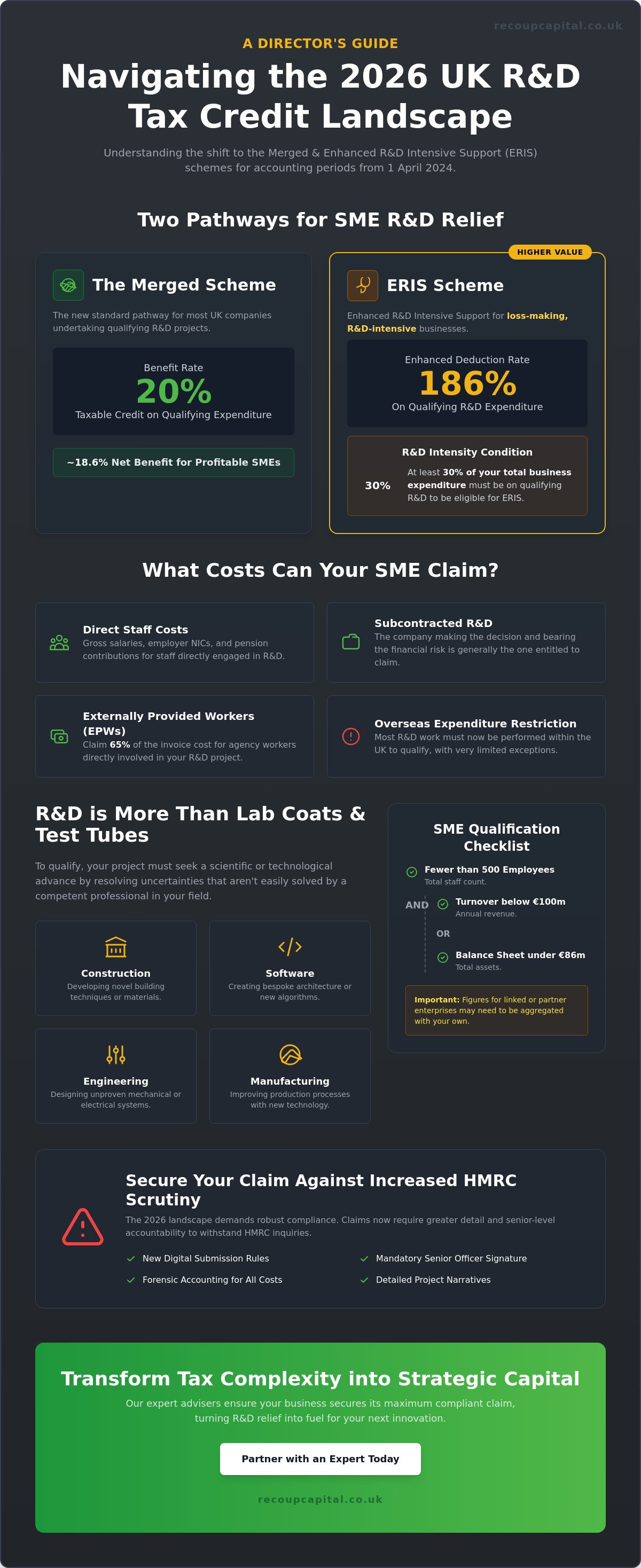
For accounting periods beginning on or after 1 April 2024, the old SME scheme has evolved. Most businesses now claim under the Merged Scheme, which offers a taxable credit of 20% on qualifying expenditure. However, loss-making, R&D-intensive firms can access Enhanced R&D Intensive Support (ERIS), providing a total 186% deduction. At Recoup Capital, we view this relief as strategic capital. It isn't just a tax refund; it's money for reinvestment that fuels your next project and helps your business thrive in a challenging market.
The Core Definition of R&D for Tax Purposes
Many directors assume R&D requires white coats and test tubes. In reality, qualifying work happens daily on construction sites, in software houses, and across engineering bays. To qualify, your project must seek a scientific or technological advance by resolving uncertainties that aren't easily solved by a competent professional in your field. This means moving beyond standard commercial innovation. If you're creating a bespoke software architecture or developing a new material that behaves in an unproven way, you're likely performing R&D. The goal is to solve a problem where the solution wasn't certain from the outset.
Who Qualifies as an SME in 2026?
Eligibility depends on your company's size and financial health. To be classified as an SME, your business must have fewer than 500 employees. Additionally, you need either a turnover below €100 million or a balance sheet total under €86 million. You should be careful with linked or partner enterprises. If another company owns more than 25% of your shares, their staff and turnover figures might need to be aggregated with yours. Understanding these nuances is vital to ensure you're on the right path. You can explore Why your business should claim R&D tax credits to see how these rules apply to your specific sector.
Qualifying Expenditure: What Costs Can Your SME Claim?
Uncovering every eligible pound requires a meticulous eye. While the SME R&D tax credit scheme explained in the previous section sets the stage, the real work begins with identifying 'hidden' costs. These often reside in unexpected places, such as the time spent by a production manager troubleshooting a prototype or an engineer refining a software algorithm. Forensic accounting isn't just a buzzword; it's a necessity to ensure no expenditure is overlooked whilst remaining compliant with expert compliance advice from ICAEW. Many businesses fail to capture the full scope of their R&D because they don't look beyond the core development team.
The 2026 landscape introduces strict restrictions on overseas R&D expenditure. Most work must now be performed within the UK to qualify, with very limited exceptions for specific geographical or regulatory requirements. Similarly, the Merged Scheme has overhauled how subcontracted R&D is handled. Generally, the company making the decision to innovate and bearing the financial risk is the one entitled to the relief. This prevents 'double claiming' and ensures the benefit goes to the firm driving the innovation. Having the SME R&D tax credit scheme explained through the lens of these new subcontracting rules is essential for any business working with third-party developers. If you're unsure how these shifts impact your current projects, a forensic review of your contracts can provide the clarity you need.
Direct Staff Costs and Externally Provided Workers (EPWs)
Staffing is typically the largest component of an R&D claim. You can include gross salaries, Employer NICs, and pension contributions for those directly involved in the project. For agency workers or EPWs, the 65% rule applies. This means you claim for 65% of the invoice cost to account for the agency's margin. Direct engagement involves a staff member being personally involved in the resolution of the scientific or technological uncertainty, rather than providing indirect support services. Capturing the correct percentage of time for each individual is critical for a robust claim.
Consumables, Software, and Cloud Computing
Modern innovation relies heavily on digital infrastructure. You can now claim for data licences and cloud computing costs that are essential to your R&D projects. Materials transformed or consumed during the creation of prototypes also qualify, provided they aren't sold as part of a commercial product later. However, you must exclude capital expenditure like hardware and general telecommunications costs. These distinctions are vital; including ineligible hardware could trigger an enquiry, while missing cloud costs leaves significant money on the table.
Merged Scheme vs. ERIS: Navigating the Intensity Condition
Choosing between the Merged Scheme and ERIS is perhaps the most critical decision your finance team will make this year. For accounting periods starting on or after 1 April 2024, the path you take depends entirely on your company's financial health and the concentration of your innovation spend. Having the SME R&D tax credit scheme explained in the context of these two paths is vital for accurate forecasting; one offers a steady baseline, whilst the other provides a significant boost for those heavily invested in technical advancement.
The Merged Scheme serves as the default baseline for most UK firms. It operates as an "above-the-line" credit, recognised in your profit and loss account. For profit-making firms, this typically results in a net benefit of 18.6% after Corporation Tax is applied. It's a transparent model that provides predictable money for reinvestment, allowing you to plan your next development phase with confidence. Because it mirrors the old RDEC system, it offers a more consistent approach for businesses that have outgrown the traditional SME limits or those that don't meet the high-intensity requirements of the alternative pathway.
ERIS, or Enhanced R&D Intensive Support, is a specialised lifeline for loss-making SMEs. To qualify, your "R&D intensity" must be at least 30%. You calculate this by dividing your qualifying R&D expenditure by your total relevant expenditure for the period. If you meet this threshold, you can claim a total 186% deduction on your costs. HMRC recognises that innovation isn't always a linear process; therefore, a "grace period" exists. If your intensity dips below 30% for a single year after previously qualifying, you can often still claim under ERIS for that period, provided you met the threshold in the immediately preceding year.
Comparing the Benefit Rates
| Scheme Type | Company Status | Net Benefit / Relief Rate |
|---|---|---|
| Merged Scheme | Profit-Making | 18.6% (Net) |
| Merged Scheme | Loss-Making | 16.2% (Net) |
| ERIS | Loss-Making (Intensive) | Up to 26.97p per £1 spent |
The final value of your claim is often influenced by the 2026 Corporation Tax rates, making it essential to align your tax strategy with your R&D cycles. You can find R&D tax credits explained in detail on our dedicated insights page to help you map out these calculations for your specific year-end.
Which Scheme is Right for Your Business?
Consider a tech start-up with a lean team and high development costs; they'll likely exceed the 30% threshold and benefit most from ERIS. Conversely, an established engineering firm with massive material overheads and a large workforce might find their R&D intensity sits at 15%, making the Merged Scheme their mandatory route. Your "loss-making" status is the primary trigger for ERIS eligibility; if you're in profit, the Merged Scheme is your only path, regardless of how intensive your R&D activities are.
Compliance and the HMRC Inquiry Landscape in 2026
The 2026 landscape is defined by a culture of accountability. With the SME R&D tax credit scheme explained through tighter regulations, the days of vague, high-level submissions are over. HMRC now requires the Additional Information Form (AIF) for every claim. It's a mandatory digital gateway. Without it, your claim is simply invalid. This form demands granular detail, linking specific costs to technical uncertainties and identifying the individuals driving the research.
Accountability now rests squarely on the shoulders of your leadership. A Senior Officer of the company must sign off on the claim, signifying that the business takes full responsibility for the data provided. HMRC also tracks the named agent involved. If your consultant has a history of poor submissions or aggressive positioning, your claim is flagged for a human review before it even clears the initial system check. This makes the choice of your partner more critical than ever.
HMRC's increased use of AI has fundamentally changed the game. Automated systems now scan for 'red flag' patterns, such as round-number estimates or narratives that look suspiciously like marketing copy. Consistency between your CT600, your statutory accounts, and your AIF is paramount. You can find more detail on HMRC R&D Tax Claim Transparency and AI on our blog to see how these algorithms profile your business.
You must be wary of 'R&D cowboy' consultants. These firms often over-promise massive returns whilst ignoring the nuances of the 2024/2025 reforms. They frequently leave you to handle an inquiry alone when their aggressive tactics trigger a check. Protecting your business means choosing a partner who values forensic accuracy over a quick win. If you want a claim that stands up to the highest levels of scrutiny, book a consultation with our technical specialists.
The Anatomy of a Compliant Technical Narrative
A robust technical narrative focuses on 'how' the technical uncertainty was overcome, not just what was built. HMRC wants to see the journey of trial and error. This requires contemporaneous records; waiting until year-end to document your progress is a significant risk. If you can't prove when the work happened and why it was difficult, your claim's foundation is weak. We help you organise these records as they happen, ensuring your narrative is evidence-based and compliant.
Preparing for an HMRC Inquiry
An inquiry doesn't have to be a disaster. If HMRC asks for more information, the key is having a specialist who 'speaks HMRC' and understands the legislative nuances. General accountants are excellent for bookkeeping, but they often lack the technical depth required for specialist R&D claims. A proactive approach involves a forensic review of your data before submission. You can explore the end-to-end claiming process to see how we build a protective shield around your innovation capital.
Recoup Capital: Today’s Adviser, Tomorrow’s Partner
At Recoup Capital, we don't believe in the traditional sales pitch. We prefer to let our results speak for themselves. When you have the SME R&D tax credit scheme explained by our technical team, you'll notice a distinct focus on forensic detail rather than high-level promises. We act as a protective guide, ensuring your innovation is accurately recognised whilst shielding you from the risks of poor documentation. Our goal is to transform your technical effort into strategic capital that fuels your future growth.
Our expertise extends far beyond the R&D landscape. We take a holistic view of your business to identify other often-overlooked incentives that can significantly impact your bottom line. This might include Capital Allowances for your commercial property or Land Remediation Relief if you've developed on brownfield sites. By looking at the bigger picture, we ensure your business thrives through every available avenue of financial recovery, turning tax legislation into a powerful tool for reinvestment.
Our Success-Based Fee Model
Our success-based fee structure is designed to align our goals perfectly with yours. You don't pay a penny until your claim is successful. This eliminates the financial risk often associated with specialist tax consultancy and ensures we're as invested in the outcome as you are. Our end-to-end service is comprehensive. We handle everything from technical interviews with your lead engineers to direct liaison with HMRC. For more on how to select the right firm for your needs, read our guide on Choosing an R&D Tax Credit Specialist in 2026.
Next Steps: Your Free 15-Minute Consultation
The first step toward recovering your capital is simple and efficient. We offer a FREE 15-minute consultation to assess your eligibility quickly. We won't waste your time with fluff; we'll get straight to the facts regarding your projects and expenditure. To make the most of this discovery call, have a brief overview of your technical challenges and an estimate of your recent staff costs ready. It's a low-friction way to discover if you're sitting on untapped money for reinvestment. Book your free 15-minute R&D consultation today and see how we can help your business innovate with confidence.
Secure Your Innovation Capital for 2026
The 2026 landscape for innovation relief is complex, but it remains one of the most powerful tools for UK business growth. Having the SME R&D tax credit scheme explained through the lens of the Merged and ERIS pathways allows you to move beyond simple compliance and into the world of strategic reinvestment. Whether you're navigating the 30% intensity threshold or preparing your digital Additional Information Form, the focus must always be on forensic accuracy and technical depth. Relying on contemporaneous records and expert analysis ensures your claim stands up to the highest levels of scrutiny.
Don't let the fear of HMRC enquiries or the burden of documentation distract you from your core mission. Our expert team of Chartered Tax Accountants provides national coverage across the UK, ensuring your claim is robust, compliant, and maximised for value. We operate on a success-based fee model, which means you can explore your funding options without any upfront financial risk.
Book your FREE 15-minute consultation to uncover your R&D potential and turn your technical uncertainties into the capital your business needs to thrive. Your next breakthrough deserves to be fully funded; let's work together to make it happen.
Frequently Asked Questions
What is the difference between the SME scheme and the Merged Scheme?
The Merged Scheme unified the previous SME and RDEC systems for accounting periods starting on or after 1 April 2024. Most businesses now receive a 20% taxable credit under this single system. This change was designed to simplify the landscape, though it significantly altered how subcontracted work is treated. Understanding these shifts is crucial for any firm having the SME R&D tax credit scheme explained for the current tax year.
Can I still claim R&D tax credits if my project failed?
Yes, failure is often a strong indicator of qualifying R&D. HMRC focuses on the resolution of technical uncertainty rather than the commercial outcome. If you attempted a scientific or technological advance and it didn't work, you've likely proven that the solution wasn't readily deducible. Documenting why the project failed can provide the forensic evidence needed for a successful claim and future reinvestment.
How far back can my SME claim for R&D tax credits?
You can typically claim for the previous two completed accounting periods. This deadline is strictly two years from the end of the period in question. For example, if your company year-end is 31 March, you have until 31 March 2026 to submit a claim for the period ending in 2024. Missing this window means the opportunity for financial recovery is lost forever.
What is the 'intensity condition' for R&D intensive SMEs?
The intensity condition is a 30% threshold that dictates which scheme your business uses. To qualify for the Enhanced R&D Intensive Support (ERIS) pathway, your qualifying R&D expenditure must be at least 30% of your total relevant expenditure. This calculation changed from 40% in previous years to 30% for periods starting on or after 1 April 2024, providing a higher benefit rate for loss-making, research-heavy firms.
Do I need a specialist R&D consultant or can my accountant do it?
Whilst your general accountant can file a claim, a specialist brings technical depth that protects your business from inquiries. Accountants excel at bookkeeping, but R&D claims require technical narratives written by experts who understand engineering or software challenges. Specialists identify hidden costs that generalists often miss, ensuring you receive the maximum compliant value without triggering AI-driven red flags in the HMRC system.
What happens if my SME receives a grant for the R&D project?
Under the new Merged Scheme rules, receiving a grant doesn't necessarily restrict your claim as it once did. Previously, notified state aid could prevent an SME from using the more generous scheme for that specific project. The 2024/2025 reforms have simplified this, allowing more businesses to access the 20% taxable credit regardless of their grant funding status, provided all other eligibility criteria are met.
How long does it take for HMRC to process an SME R&D claim in 2026?
HMRC currently aims to process the majority of R&D tax credit claims within 40 days. In 2026, the use of digital submissions via the Additional Information Form has helped maintain this pace despite increased scrutiny. You'll typically receive your credit or tax reduction shortly after this window, provided your submission is complete and doesn't trigger a compliance check or a formal inquiry.
What are the new rules for overseas R&D expenditure?
Relief is now restricted to R&D activities physically performed within the UK. This change, effective for periods starting after 1 April 2024, means payments to overseas subcontractors or externally provided workers are generally ineligible. There are narrow exceptions for specific conditions that cannot be met in the UK, such as deep-sea testing or specific clinical trials, but these require robust justification in your technical narrative to be accepted.