
RDEC Scheme for Large Companies: The Comprehensive 2026 Guide to R&D Tax Credits

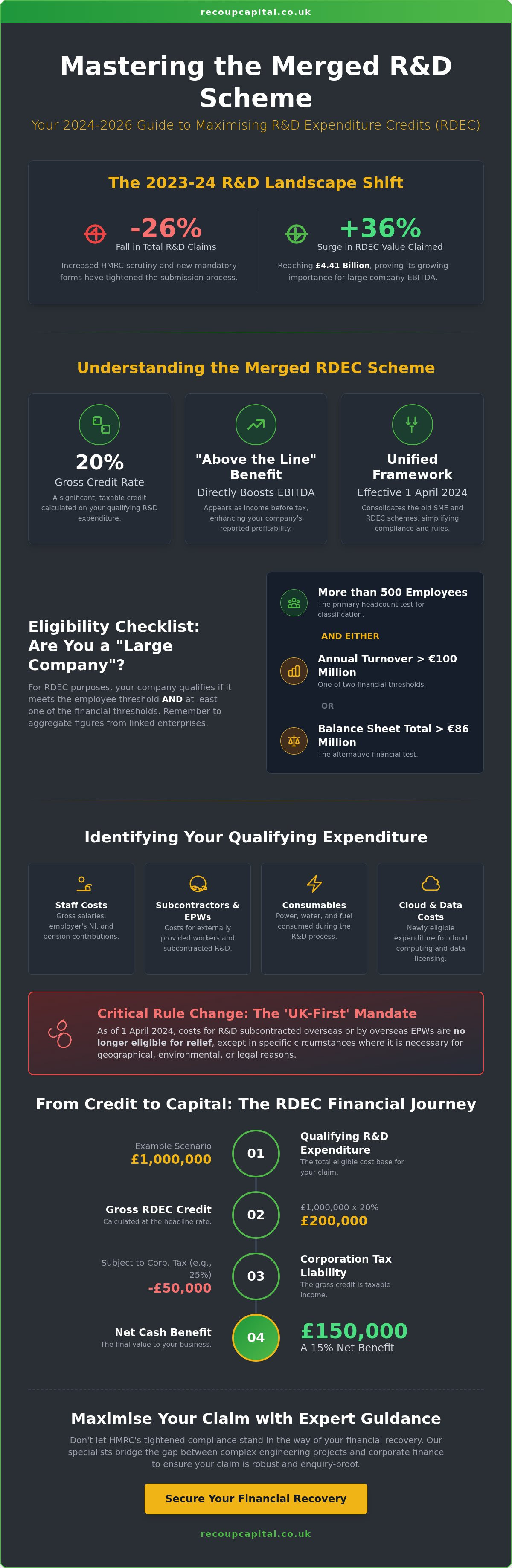
Did you know that while the total number of R&D claims dropped by 26% in the 2023-2024 tax year, the total amount claimed through the RDEC scheme actually surged by 36% to £4.41 billion? It is a clear sign that the RDEC scheme for large companies has become a far more significant driver of corporate EBITDA than ever before. You have likely felt the pressure of HMRC's tightened compliance since the mandatory additional information form was introduced on 8 August 2023. It is frustrating when the rules shift, but you shouldn't let the complexity of the 1 April 2024 merger stand in the way of your financial recovery.
This guide will help you master the nuances of the current regime to ensure you're maximising your 20% gross credit. We'll show you how to identify qualifying indirect activities in large-scale operations and secure robust, compliant documentation that stands up to scrutiny. We will explore the transition to the merged scheme, the 15% net benefit for profitable firms, and how to turn these tax credits into vital money for reinvestment that helps your business thrive.
Key Takeaways
- Understand how the 2024 regime merger simplifies the landscape and why the RDEC scheme for large companies now offers a 20% gross credit for qualifying innovation.
- Discover how "above the line" accounting treatment directly enhances your EBITDA and provides significant capital for strategic reinvestment.
- Master the 2026 rules regarding qualifying expenditure, including new eligibility for cloud computing and the stricter "UK-first" requirements for overseas costs.
- Learn how to navigate HMRC's rigorous compliance standards and the mandatory Additional Information Form to ensure your claim is robust and enquiry-proof.
- Realise the strategic advantage of partnering with technical specialists who bridge the gap between complex engineering projects and corporate finance.
What is the RDEC Scheme for Large Companies in 2026?
The Research and Development Expenditure Credit (RDEC) is a taxable benefit that sits "above the line" in your company's income statement. Unlike traditional tax deductions, it appears as income before tax, which directly bolsters your reported EBITDA. With the current rate fixed at 20% of qualifying expenditure as of 2026, the RDEC scheme for large companies is a strategic asset rather than a simple administrative task. It provides significant money for reinvestment, allowing your business to fund the next generation of UK-based innovation whilst maintaining a healthy balance sheet.
By 2026, the R&D landscape has undergone a fundamental shift. The government has consolidated the previous fragmented system into a unified framework. This isn't just about processing paperwork; it's about recognising the immense value large-scale projects bring to the British economy. Whether you're developing sustainable aerospace components or revolutionising data security, this credit ensures your risk is rewarded with tangible capital. It transforms a complex government process into a proactive opportunity for business growth.
The Evolution of R&D Tax Relief: From RDEC to the Merged Scheme
Historically, large companies and SMEs operated under entirely different rules. However, for accounting periods beginning on or after 1 April 2024, HMRC transitioned to a Merged Scheme. This consolidation was designed to simplify compliance and offer a more consistent approach to innovation. Large companies now follow a process that incorporates several features previously exclusive to the SME regime, creating a more streamlined experience for your internal finance teams. You can find more details on how these changes affect your specific sector in our R&D tax credits explained guide.
Who Qualifies as a "Large Company" for RDEC Purposes?
Determining your eligibility starts with your company's size. Under HMRC's current 2026 criteria, a large company is defined as having more than 500 employees. Additionally, you must have either an annual turnover exceeding €100 million or a balance sheet total of more than €86 million. It's vital to look beyond your immediate payroll. If your business is part of a wider group, the staff and turnover of "linked" or "partner" enterprises must be aggregated, which can often push an apparent SME into the RDEC bracket.
Exceptions exist where smaller firms must use the RDEC route. If your R&D work is subsidised by grants or performed as a subcontractor for another large corporate, you will likely need to claim under these rules. Identifying these nuances is where our partnership adds the most value, ensuring you don't leave money on the table due to misclassification. We act as your protective guide, ensuring your claim is both robust and fully compliant with the latest HMRC standards.
Qualifying Expenditure: Identifying R&D Costs in Large-Scale Operations
Identifying qualifying costs within a multi-million pound budget requires a forensic eye. Under the RDEC scheme for large companies, you aren't just looking for scientists in lab coats. You're looking for the technical uncertainties hidden in large-scale manufacturing, bespoke software architecture, or advanced engineering. Since 1 April 2024, the rules have tightened significantly regarding where this work happens. If you are outsourcing R&D to overseas teams, those costs are generally now excluded unless the work cannot be performed in the UK due to geographical, environmental, or legal factors.
Subcontractors and Externally Provided Workers (EPWs) remain a staple of corporate innovation. Whilst you can still claim for these, the merged scheme principles ensure that the entity making the decision to innovate is usually the one entitled to the relief. Don't overlook consumables. In large-scale operations, the "hidden" costs of power, water, and fuel used during the R&D process can represent a substantial portion of your claim. If you're unsure how to partition these utility costs, you might find it helpful to explore our claiming process for a clearer picture of eligible overheads.
Staff Costs and Indirect Activities
Staff costs often form the backbone of a claim. You should include gross salaries, employer Class 1 National Insurance contributions, and pension contributions. However, the 2026 landscape places greater emphasis on Qualifying Indirect Activities (QIAs). These include maintenance, security, and clerical work that supports the R&D project. QIAs are defined as activities that do not directly result in a scientific or technological advance but are essential to the project’s success.
Software, Data, and Cloud Computing
Modern innovation is increasingly digital. HMRC now recognises data licenses and cloud computing costs as qualifying expenditure, reflecting the rise of AI-driven R&D projects. If your team is using high-performance cloud clusters to run simulations or training machine learning models, those computational expenses are now firmly within the RDEC scheme for large companies. Use this checklist to distinguish between routine IT and R&D:
- Routine IT Maintenance: Standard server upkeep, security patches, and general website hosting (Non-Qualifying).
- R&D-Specific Software: Custom-built tools to solve technical uncertainties or licenses for specialised simulation software (Qualifying).
- Data Processing: General data storage for business operations (Non-Qualifying) versus data sets purchased specifically for R&D testing (Qualifying).
The Financial Impact: RDEC Rates and Accounting Treatment
In 2026, the financial profile of the RDEC scheme for large companies is more attractive than in previous decades. The headline gross credit stands at 20% of your qualifying R&D expenditure. This is a significant uplift from the 13% rate utilised before April 2023; it signals a clear government intent to keep the UK competitive for global innovation. However, the gross figure is only half the story. Because the credit is taxable, the actual cash benefit that reaches your bottom line depends on your corporation tax position.
The "Above the Line" nature of this credit is its most distinctive feature. Unlike a standard tax deduction that reduces your taxable profit, RDEC appears as income in your accounts, typically within your operating profit. This treatment directly boosts your reported EBITDA. It's a strategic advantage for large corporates, as it improves the very metrics used by investors and lenders to value your business. We view this as vital money for reinvestment that helps your organisation stay at the cutting edge of your industry.
Calculating the Net Benefit for Large Corporates
For a profit-making company paying the main Corporation Tax rate of 25%, the math is straightforward. A 20% gross credit, once taxed at 25%, leaves you with a net benefit of 15% on every qualifying pound spent. If your company is currently loss-making, a notional tax rate of 19% is applied instead, resulting in a slightly higher net benefit of 16.2%. This creates a predictable stream of capital that can be forecast into your future innovation cycles. To further enhance your financial recovery, many large firms also look at Capital Allowances to claim relief on the physical infrastructure and machinery that house their R&D projects.
The HMRC Payment Priority: Where Does the Credit Go?
HMRC follows a strict 7-step payment priority to settle your RDEC claim. It isn't always a simple cash payment. First, the credit must offset your current year's Corporation Tax liability. If a surplus remains, it then settles any prior-year tax debts. HMRC will also check for other outstanding liabilities, such as VAT or PAYE, before finally issuing a cash payment to your business.
It's also essential to account for the PAYE cap. To prevent abuse, the payable element of your credit is capped at £20,000 plus 300% of your total PAYE and National Insurance contributions for the period. If your claim exceeds this, the excess isn't lost; it can be carried forward to the next accounting period. This ensures that the RDEC scheme for large companies remains a sustainable, long-term partner in your growth strategy.
Navigating the Claim Process and HMRC Compliance in 2026
HMRC's compliance standards have evolved into a rigorous, evidence-based framework. By 2026, the expectation for transparency is absolute. Large organisations can no longer rely on high-level summaries or broad estimates. Success within the RDEC scheme for large companies depends on your ability to produce granular documentation that links every pound of expenditure to a specific technical challenge. You have a strict two-year time limit from the end of your accounting period to amend your CT600 and include an R&D claim. If you miss this window, the opportunity to recover that capital is lost forever.
The Additional Information Form (AIF) is now the cornerstone of the submission process. Introduced on 8 August 2023, this mandatory digital form requires a named "competent professional" to sign off on the technical narrative. This individual must be a specialist in the relevant field, capable of explaining exactly why a project moved beyond the "standard practice" of a professional in that industry. HMRC uses this form to filter out weak claims before they even reach a caseworker. If you're concerned about the strength of your technical evidence, you can book a free 15 minute consultation to review your documentation with our experts.
The 5 Steps to a Robust RDEC Claim
- Step 1: Technical identification of projects that meet the "scientific or technological advance" criteria for the RDEC scheme for large companies.
- Step 2: Financial quantification of qualifying expenditure across all departments, ensuring overheads and utilities are correctly apportioned.
- Step 3: Preparation of the Technical Report and the mandatory AIF to provide HMRC with a clear, evidence-backed justification for the claim.
- Step 4: Submission of the finalised claim via the CT600 Corporation Tax return.
- Step 5: Ongoing liaison with HMRC to manage any requests for further information and ensure the credit is processed smoothly.
Compliance in the Age of AI and Increased Scrutiny
HMRC's use of sophisticated risk-profiling software means that "templated" or AI-generated technical narratives are now an immediate red flag. We've explored this shift in detail in our guide on HMRC R&D Tax Claim Transparency and AI. For large-scale operations, forensic record-keeping is the only way to survive a potential enquiry. This means maintaining contemporaneous logs of technical failures, testing results, and design iterations whilst the project is active. Relying on memory or generic project descriptions is no longer a viable strategy in this high-scrutiny era.
Why Large Companies Partner with R&D Tax Credit Specialists
Internal tax departments are often exceptionally skilled at managing broad compliance and standard corporation tax liabilities. However, the technical "competent professional" depth required for the RDEC scheme for large companies often falls outside their core remit. This isn't a reflection of their capability, but rather a result of how specialised R&D legislation has become by 2026. By partnering with a specialist, you gain an "expert friend" who understands the engineering or scientific reality behind your accounting entries. This ensures your claim is not just a calculation, but a robust technical narrative that stands up to HMRC scrutiny.
Strategic reinvestment is the ultimate goal of any claim. When integrated with broader Corporate Finance Advisory, your RDEC claim becomes a lever for long-term growth rather than a one-off rebate. Our success-based fee structure ensures our goals are perfectly aligned with your company’s financial recovery. We only succeed when you secure the capital your innovation deserves. It is a partnership built on transparency and results, lacking the aggressive pressure of traditional sales pitches.
Maximising Claim Value Whilst Minimising Risk
Specialists often identify Qualifying Indirect Activities (QIAs) that internal teams overlook, such as the specific maintenance of R&D facilities or the clerical support for technical trials. These omissions can lead to thousands of pounds being left on the table. Our role is to act as a protective guide, ensuring every eligible cost is captured whilst maintaining a conservative, compliant approach. If HMRC does open an enquiry, having a partner who has managed the end-to-end process provides an essential layer of security. This is the core of our "Today’s adviser, tomorrow’s partner" philosophy; we focus on long-term reliability and helping your business thrive.
A Seamless Experience for Large Finance Teams
Efficiency is at the heart of our process. We understand that your time is a finite resource, so our approach is designed to be low-friction and data-led. It begins with a FREE 15 minute consultation to assess your potential eligibility without any initial commitment. By combining the skills of chartered tax accountants with technical specialists from sectors like manufacturing and software, we provide a depth of insight that internal departments often don't have the capacity to maintain. We handle the heavy lifting, from the initial financial quantification to the final submission of the Additional Information Form. If you are ready to transform your innovation into capital, you can claim R&D tax credits with Recoup Capital and experience a truly expert-led partnership.
Secure Your Innovation’s Future Today
Mastering the RDEC scheme for large companies is no longer just about tax compliance; it's a vital component of your corporate finance strategy. You've seen how the 20% gross credit can directly boost your EBITDA and provide essential money for reinvestment. Whilst the 1 April 2024 merger introduced stricter rules on overseas costs and mandatory digital forms, these hurdles shouldn't prevent you from claiming what you're owed. Robust documentation is the key to surviving HMRC scrutiny and securing the capital your innovation deserves.
Our team of chartered tax accountants combines deep sector expertise with a success-based fee structure to ensure your interests are always prioritised. Operating with national coverage, we act as your protective guide through the complexities of tax law. Don't leave your financial recovery to chance. Book your FREE 15-minute R&D consultation with our specialists today. We are ready to help your business thrive and turn today’s technical challenges into tomorrow’s strategic growth.
Frequently Asked Questions
Can my large company still use the RDEC scheme in 2026?
Yes, your business can still access the RDEC scheme for large companies in 2026. For accounting periods beginning on or after 1 April 2024, the old RDEC and SME rules were unified into a single Merged Scheme. This remains the primary vehicle for large corporate innovation claims, offering a 20% gross credit for qualifying expenditure. It's designed to provide a consistent, simplified framework for all large-scale UK innovation.
What is the main difference between the old RDEC and the Merged Scheme for large companies?
The most significant change involves how subcontracted R&D is handled. Under the Merged Scheme, the company that makes the decision to undertake the R&D is generally the one entitled to claim. Additionally, the 2026 landscape requires more detailed digital disclosures via the Additional Information Form (AIF) for every submission. This level of scrutiny was less formalised under the older regime and requires precise technical narratives.
How is the RDEC tax credit actually paid to a large company?
HMRC settles RDEC credits through a 7-step payment priority. The credit first offsets your current year's Corporation Tax liability, followed by any prior-year tax debts. If a surplus remains after covering other tax liabilities like VAT or PAYE, a cash payment is issued. This ensures the government recovers any outstanding debts before providing liquid capital for reinvestment into your next project.
Can large companies claim for R&D work subcontracted to them?
Under the rules in effect for 2026, if a large company is subcontracted by another company to perform R&D, they generally can't claim for that work. The right to claim usually rests with the customer who initiated and funded the project. However, exceptions exist if the customer is an "ineligible body" or a foreign entity not subject to UK tax, in which case the large company may still be eligible.
What happens if our large company is in a loss-making position?
Loss-making companies still benefit significantly from the RDEC scheme for large companies. Instead of the 25% main Corporation Tax rate, a notional tax rate of 19% is applied to the gross credit. This results in a net benefit of 16.2% of your qualifying expenditure. The credit can be used to settle other tax debts or be paid out as a cash sum to support your ongoing innovation pipeline.
Is there a deadline for making an RDEC claim in 2026?
You must submit your R&D claim within two years of the end of the relevant accounting period. This deadline is strictly enforced by HMRC. If your accounting period ended on 31 December 2024, you have until 31 December 2026 to amend your CT600. Missing this window means you lose the legal right to recover that expenditure, so timely submission is vital for your financial recovery.
How does HMRC define a "large company" for R&D tax purposes?
HMRC defines a large company as an entity with 500 or more employees. Additionally, the company must have either an annual turnover exceeding €100 million or a balance sheet total over €86 million. It's vital to include the figures from any "linked" or "partner" enterprises when calculating these thresholds. Being part of a wider corporate group can change your classification even if the UK entity is small.
Can we claim RDEC for overseas R&D expenditure in 2026?
Claims for overseas R&D costs are heavily restricted in 2026. For accounting periods starting on or after 1 April 2024, you can only claim for work performed outside the UK if the specific conditions can't be replicated domestically. This includes geographical or environmental factors, such as deep-sea testing, or specific legal requirements. General cost-saving or a lack of available UK staff aren't valid reasons for claiming overseas expenditure.