
R&D Tax Credit Specialists: The Commercial Guide to UK Innovation Incentives

If HMRC challenged your latest technical claim tomorrow, would your documentation withstand the scrutiny of the 2026 compliance landscape? With the tax authority recently increasing its specialist compliance staff to over 1,200 officers, the margin for error has effectively disappeared. It is a reality that many UK directors find daunting, especially when you are already stretched thin managing day-to-day operations. You deserve to access the incentives your innovation has earned without the constant fear of a protracted enquiry or a rejected claim.
Finding the right r&d tax specialists is the difference between a risky gamble and a secure financial strategy. This guide shows you how to vet potential partners, identify qualifying technical uncertainties you might have overlooked, and ensure your claim is robust enough to pass any inspection. We will walk through the process of securing maximum relief whilst maintaining a seamless workflow that doesn’t distract your team. You will discover how to identify high-value activities and transform your recovered capital into a strategic engine for your next phase of growth.
Key Takeaways
- Understand the critical distinction between financial accounting and the "Technical Narrative" required to secure maximum compliant relief from HMRC.
- Learn how to identify the four pillars of qualifying activity to ensure all eligible expenditure, from staff to consumables, is accurately captured.
- Discover the essential vetting criteria for selecting r&d tax specialists who offer chartered expertise and long-term technical protection.
- Explore how success-based fee structures align your adviser’s interests with your business goals, ensuring value is demonstrated through results.
- Gain insights into transforming a complex government process into a seamless opportunity for significant corporate reinvestment and growth.
Why should I hire an R&D tax specialist rather than using my accountant?
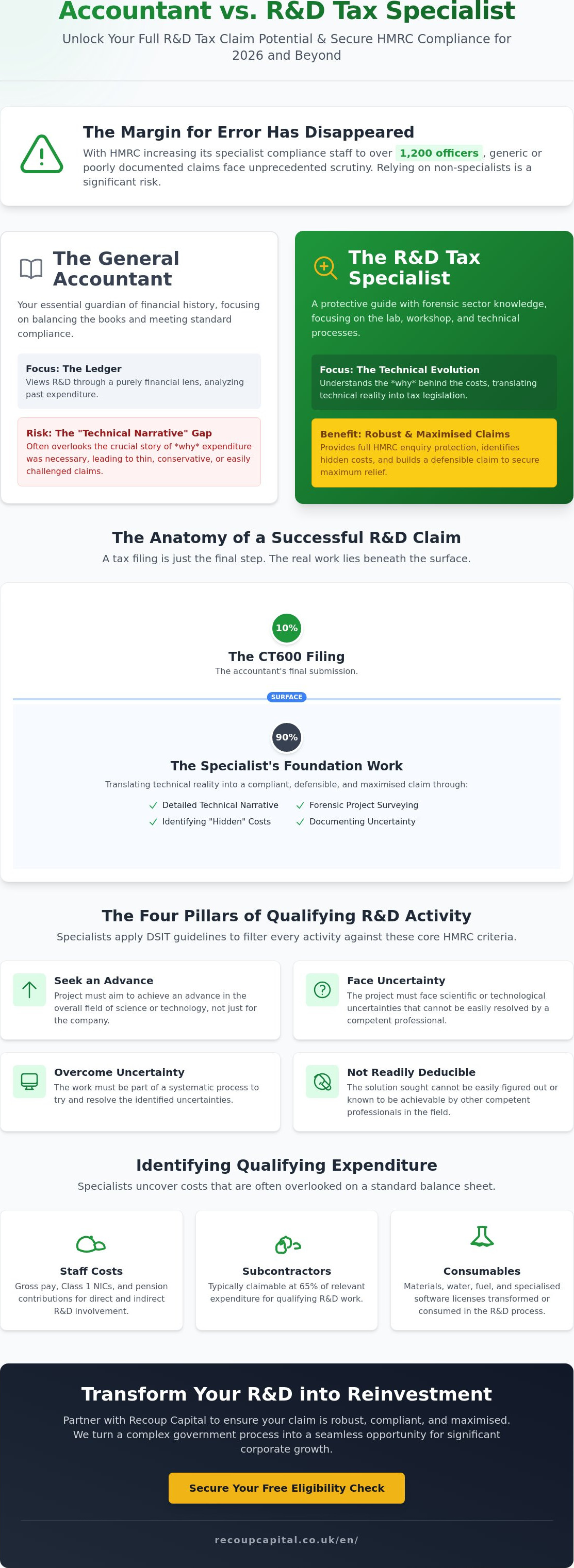
Your accountant is the essential guardian of your financial history. They ensure your books balance and your standard compliance is met. However, claiming for innovation requires a lens that looks forward and inward at your technical processes. While a generalist focuses on the ledger, r&d tax specialists focus on the laboratory, the workshop, and the software repository.
The core difference lies in the documentation of technical evolution. HMRC doesn't just want to see what you spent; they need to understand why the expenditure was necessary to overcome a specific scientific or technological uncertainty. Generalist accountants often overlook this "Technical Narrative," leading to claims that are either too thin to survive an enquiry or so conservative that they leave significant money on the table. Specialists provide forensic sector knowledge, identifying qualifying costs that aren't immediately obvious on a balance sheet, such as indirect activities or specific consumable items.
Choosing a specialist also provides a vital layer of security. We act as your protective guide, offering full HMRC enquiry protection. This means if the tax office asks questions, your specialist defends the technical merits of the claim, a task that often falls outside an accountant's remit. It's about turning a complex government process into a seamless opportunity for growth.
The technical vs financial gap
A CT600 filing is merely the final 10% of a successful R&D claim. The real work happens in the 90% that precedes it, where technical reality is translated into tax legislation. Relying solely on a tax accountant can be risky because they may lack the industry-specific background to identify where "business as usual" ends and true innovation begins. Our team includes engineers and scientists who work alongside tax experts to ensure every technical nuance is captured. If you're just starting, you can see R&D tax credits explained to understand the foundational criteria for eligibility.
HMRC compliance in the 2026 landscape
The regulatory environment has shifted toward extreme transparency. HMRC's increased use of data analytics means that generic submissions are now flagged more frequently than in previous years. Specialists use forensic surveying techniques to dig into your project workflows, uncovering "hidden" costs like specialised software licences or a percentage of utility bills that generalists often miss. This precision isn't just about maximising the claim; it's about building a robust defence against scrutiny. For 2026, the Additional Information Form is a mandatory digital submission that requires a granular breakdown of technical uncertainties and project costs to be filed before the company's tax return. This requirement makes the role of r&d tax specialists more critical than ever to ensure your claim is viewed as legitimate money for reinvestment.
How do specialists identify qualifying expenditure whilst ensuring compliance?
Identifying eligible costs requires more than a glance at a balance sheet. Expert r&d tax specialists apply the Department for Science, Innovation and Technology (DSIT) guidelines to filter every pound spent. HMRC expects projects to meet four specific criteria. They must seek an advance in science or technology, face a scientific or technological uncertainty, attempt to overcome that uncertainty, and not be readily deducible by a competent professional in the field.
Standard engineering often involves complex problems, but it only becomes R&D when the solution isn't guaranteed. Specialists look for the "uncertainty threshold" where established industry knowledge ends. This is the point where your team asks "is this even possible?" rather than "how do we build this?". To justify a claim, businesses must maintain contemporaneous records. HMRC's 2023 requirements for the Additional Information Form (AIF) mean that retrospective guesswork is no longer sufficient for a robust submission.
Typical qualifying costs include:
- Staff costs: Gross pay, Class 1 NICs, and pension contributions for those directly or indirectly involved in the R&D process.
- Subcontractors: Usually claimable at 65% of the relevant expenditure, provided the work falls within the qualifying scope.
- Consumables: Materials, water, fuel, and power transformed or used up during the R&D activity.
- Software: Licences used specifically for R&D, including cloud computing and data costs.
Sector-specific innovation markers
In construction, R&D isn't just about new materials. It often involves land remediation where unique chemical or biological challenges require bespoke engineering solutions. In the software sector, innovation frequently occurs when overcoming legacy system constraints or integrating AI in ways that haven't been documented before. If your technical team is pushing boundaries, you can start claiming R&D tax credits to recover those costs for reinvestment.
The role of forensic accounting
Experienced r&d tax specialists use forensic accounting to unbundle project costs. A "standard" commercial contract might contain 15% qualifying R&D hidden within routine delivery. Specialists separate "routine" work, like bug fixing or standard site prep, from "qualifying" technological advancements. This precision ensures compliance whilst maximising the claim. For commercial property owners, there's often a powerful synergy with Capital Allowances, where embedded fixtures and R&D activities overlap to significantly reduce tax liability.
If you aren't sure where the line sits between standard work and innovation, a quick conversation with an expert can clarify your eligibility without any sales pressure.
What are the typical fee structures for R&D tax credit specialists?
Commercial fee structures in the tax consultancy sector generally fall into two camps: fixed professional fees or success-based contingency percentages. For a business seeking r&d tax specialists, the choice impacts both cash flow and the quality of the submission. Fixed fees might seem stable, but they require payment regardless of whether HMRC accepts the claim. In contrast, the success-based model ensures the specialist only profits when the client receives a tangible benefit. This creates a powerful alignment of interests. The specialist is motivated to be thorough, uncovering qualifying costs that a generalist might overlook, whilst the business avoids the risk of paying for a failed application.
It's vital to distinguish between a success-driven approach and an aggressive one. Reliable specialists don't inflate figures to increase their fee. Instead, they use their technical expertise to justify every pound of expenditure within the legal framework. This professional integrity protects the business from future HMRC enquiries whilst maximising the "money for reinvestment" that fuels growth. Smaller firms often find the percentage model more accessible, whereas very large corporations with multi-million pound claims might occasionally negotiate hybrid structures to suit their internal procurement needs.
Understanding the contingency model
Under a contingency model, fees are calculated as a percentage of the actual tax saving or cash credit secured. This significantly reduces the financial risk for SMEs and start-ups. You aren't just buying a document; you're securing a comprehensive service. This includes the technical audit to identify innovation, the calculation of qualifying costs, and the final submission. If HMRC has questions, the specialist handles the liaison as part of the package. This end-to-end support ensures the process is seamless and allows the business to focus on its core operations while the experts handle the technicalities.
The "no-win, no-fee" commitment
In the context of R&D tax, "no-win, no-fee" means the specialist absorbs the cost of the work if the claim is unsuccessful. It's a bold declaration of confidence in their own expertise. Recoup Capital leads with this results-oriented philosophy, prioritising long-term partnerships over short-term gains. We offer a FREE 15 minute consultation as a risk-free starting point. This isn't a sales pitch; it's a technical assessment to see if R&D tax credits explained simply can actually benefit your bottom line. By removing the upfront financial barrier, we help businesses transition from uncertainty to innovation with total transparency. We act as today’s adviser and tomorrow’s partner, ensuring your claim is robust and compliant.
How do I vet an R&D specialist to ensure HMRC compliance?
Choosing the right partner isn't just about the size of the potential payout; it's about the long-term security of your business. HMRC has significantly intensified its scrutiny of claims. In the 2023-24 tax year, compliance checks rose by 33% as the government moved to reclaim an estimated £1.1 billion lost to error and fraud. You shouldn't settle for "R&D boutiques" that function essentially as high-pressure sales offices. These firms often lack the technical depth required to justify a claim when an inspector starts asking difficult questions. A robust claim requires a dual approach: chartered tax accountants to handle the finance and sector-specific experts to translate your innovation into HMRC's language.
If your potential r&d tax specialists can't immediately explain the "scientific or technological uncertainty" in your specific project, they aren't qualified to represent you. True specialists don't just look at your payroll; they look at your blueprints, your code repositories, and your site logs. They identify the exact moment a project moved from standard practice into genuine innovation. This technical rigour is what prevents your claim from being flagged during automated risk-profiling.
The "Red Flag" checklist for 2026
Vetting a partner requires a critical eye and a healthy dose of scepticism. Avoid firms that promise "guaranteed" percentages of your turnover before they've even reviewed your qualifying expenditure. This is a hallmark of non-compliant "volume" providers who prioritise quantity over quality. Use this checklist during your initial consultation:
- Technical Interviews: Do they insist on speaking with your lead engineers or developers? If they only want to talk to your bookkeeper, walk away.
- The Deliverable: Will they provide a full technical narrative report? A simple spreadsheet of costs is no longer enough to satisfy HMRC.
- Professional Credentials: Are they members of recognized bodies like the CIOT or ICAEW?
- The Pitch: Do they rely on aggressive sales tactics or offer a transparent, value-led demonstration of results?
For a detailed breakdown of what to look for in a modern provider, see our guide on Choosing a Partner for Compliant Innovation.
Defensibility and HMRC enquiry support
You must ask a direct question: "Who handles the defence if HMRC opens an enquiry?" If the answer is "your own company accountant," it's a sign the specialist doesn't stand by their work. The most reliable r&d tax specialists include full enquiry support as part of their standard service. Having former HMRC inspectors on a specialist team provides an invaluable perspective on how the tax office evaluates risk and what evidence they prioritise. This level of HMRC R&D Tax Claim Transparency is vital as the landscape becomes more complex.
Sector-specific experience is equally non-negotiable. If you're in construction, your specialist needs to understand the difference between a standard building design and a novel structural solution for a brownfield site. In software, they must distinguish between routine bug fixing and the creation of new algorithms. Without this niche knowledge, your claim won't have the technical depth needed to survive a formal challenge.
Ready to secure your innovation funding with a partner who prioritises compliance? Book your free 15-minute consultation today to see how we protect your business.
Why is Recoup Capital the right specialist partner for my business?
Choosing the right r&d tax specialists isn't just about finding someone to fill out forms. It's about securing a long-term commercial ally. At Recoup Capital, we operate as today's adviser and tomorrow's partner. Most firms treat R&D claims as a one-off transaction, but we view them as the first step in a broader growth journey. We understand that directors are time-poor. Our process is designed to be seamless and low-friction, requiring minimal input from your team to unlock maximum value.
Beyond the tax credit: Strategic corporate finance
We don't operate in a vacuum. Our team possesses a depth of Corporate Finance expertise that generalist tax firms simply can't match. This allows us to see the bigger picture of your balance sheet. Whilst we're identifying your R&D expenditure, we're also scanning for other often-overlooked incentives. This might include Land Remediation relief for developers or Patent Box benefits for tech innovators. We act as your "Expert Friend." We're knowledgeable enough to handle HMRC's complexities but remain relentlessly focused on your bottom line. Every pound we recover is framed as money for reinvestment. This capital fuels your next innovation cycle, creating a sustainable loop of growth for your organisation.
Getting started: The 15-minute consultation
We've removed the barriers to entry. You won't find aggressive sales pitches here. We prefer to let our results do the talking. As dedicated r&d tax specialists, our process begins with a simple, free 15-minute consultation. During this brief call, we'll assess your eligibility and estimate your potential claim value based on current UK tax legislation. If there's no claim, we'll tell you straight away. If there is, we'll handle the heavy lifting. Our commitment to transparency means you're always in the loop without being bogged down by technical jargon.
- Step 1: Initial 15-minute assessment to confirm eligibility and scope.
- Step 2: Technical interview with our specialist engineers or scientists to capture the narrative.
- Step 3: Full report preparation and submission to HMRC by our expert team.
It's time to stop leaving money on the table. The UK government provides these incentives specifically to help businesses like yours thrive and scale. Don't let complex paperwork stand in the way of your next breakthrough. Book your free assessment today to discover your reinvestment potential and see how we can help your business innovate for the future.
Secure the Capital Your Innovation Deserves
Navigating the complexities of HMRC compliance doesn't have to be a burden on your internal resources. Whilst your general accountant handles the day-to-day, dedicated r&d tax specialists possess the technical depth to identify hidden qualifying expenditure that others often overlook. It's about more than just filling out forms; it's about building a robust evidence base that stands up to scrutiny whilst maximising the money available for reinvestment into your business growth.
Recoup Capital bridges the gap between technical innovation and financial recovery. With specialist teams based in London and Manchester, we've facilitated over £30 million in capital for our clients to date. Our unique approach pairs chartered tax accountants with technical sector experts to ensure every claim is both accurate and optimised. We don't just deliver a pitch; we focus on demonstrating tangible value through results. Today's adviser, tomorrow's partner.
Ready to see what your innovation is really worth? Book your FREE 15-minute consultation with a Recoup Capital specialist today. We're here to help your business thrive through every stage of its development.
Frequently Asked Questions
How do I know if my company is eligible for R&D tax credits in 2026?
You'll be eligible if your company is seeking an advance in science or technology by resolving technical uncertainties. Under the Merged Scheme effective from 1 April 2024, most UK companies now follow a unified set of rules regardless of their size. Whether you're developing new software or improving manufacturing processes, our r&d tax specialists can identify qualifying expenditure within your 2026 projects to secure vital money for reinvestment.
Can I still claim R&D tax relief if my project was a failure?
Yes, you can claim for failed projects because HMRC rewards the attempt to overcome technical challenges rather than the end result. In fact, a project that fails often provides the clearest evidence of the technical uncertainty required for a successful claim. If your team spent 500 hours on a prototype that didn't work, those staff costs and materials remain eligible for relief as long as the work sought a genuine technological advancement.
How long does it take for an R&D tax specialist to process a claim?
A specialist typically takes two to four weeks to prepare a comprehensive technical report and financial schedule. Once submitted, HMRC aims to process claims within 28 to 40 days, although complex cases or those requiring additional checks can take longer. We focus on a seamless delivery to ensure your capital is recovered as quickly as possible, acting as today's adviser and tomorrow's partner throughout the journey.
What is the difference between the SME scheme and the RDEC scheme?
The traditional distinction changed on 1 April 2024 when the SME and RDEC schemes merged into a single system for most businesses. However, an R&D Intensive SME scheme still exists for loss-making companies where R&D expenditure constitutes at least 30% of total spend. This specific pathway offers a higher rate of relief, providing a significant boost for high-growth tech startups that are investing heavily in innovation before reaching profitability.
Will claiming R&D tax credits increase my risk of an HMRC audit?
Claiming doesn't automatically trigger an audit, but HMRC has increased scrutiny, requiring an Additional Information Form for all submissions since 8 August 2023. Working with r&d tax specialists actually reduces your risk by ensuring every technical narrative meets strict legislative standards. We act as a protective guide, using our track record to ensure your claim is robust and transparent, which helps maintain a positive relationship with tax authorities.
Can I claim for R&D work that was carried out by subcontractors?
You can claim for subcontractor costs, but the rules changed for accounting periods starting after 1 April 2024. Generally, the company that makes the decision to initiate the R&D and bears the financial risk is the one entitled to the relief. If you pay a third party to solve a specific technical problem that you've identified, you can typically include 65% of those costs in your final calculation.
What documentation do I need to provide to an R&D specialist?
You need to provide payroll records, subcontractor invoices, and technical project notes that outline the specific uncertainties your team faced. We don't expect you to have a perfect paper trail from day one. Our team helps you organise your existing data into a structured format that satisfies HMRC's 2024 compliance requirements, making the entire process feel straightforward and manageable for your internal finance team.
How far back can an R&D tax specialist go to reclaim past expenditure?
You can typically claim for the two previous completed accounting periods. For a company with a December year-end, this means you have until 31 December 2024 to submit or amend a claim for the period ending in 2022. This two-year window allows us to recover significant historical expenditure, turning your past innovation into immediate liquidity that can be used for your business's future growth and development.