
HMRC AI R&D Claims Challenges: Navigating Automated Scrutiny in 2026

By 2026, the individual reviewing your R&D tax credit claim might not be a person at all. As HMRC ramps up its digital transformation, many businesses are finding that their technical narratives are being picked apart by algorithms before a human inspector even opens the file. We understand that the fear of a long, costly enquiry is a significant deterrent to claiming what you're owed. Facing these hmrc ai r&d claims challenges can feel like trying to hit a moving target whilst the rules of engagement change in real time.
It's natural to feel uncertain about using AI tools for your own report writing or how to meet the latest transparency standards. You deserve to see your tax relief as a strategic tool for growth rather than a compliance headache. This article discovers how you can safeguard your innovation funding against automated scrutiny and ensure your 2026 submissions meet the highest compliance benchmarks. We'll outline the exact steps to turn complex regulations into a seamless opportunity for reinvesting in your business's future.
Key Takeaways
- Understand how HMRC has transitioned from manual reviews to sophisticated AI-driven pattern matching to screen R&D submissions in 2026.
- Discover why using Large Language Models to draft narratives may trigger an enquiry and how to ensure your report passes HMRC’s automated detection.
- Learn how to navigate the evolving hmrc ai r&d claims challenges by aligning your technical data with the specific benchmarks that automated algorithms prioritise.
- Master five essential strategies to protect your innovation funding, focusing on granular technical detail to prevent automated rejections and delays.
- Explore why a human-led, partnership-oriented approach remains the ultimate safeguard for securing significant capital for reinvestment whilst protecting your business.
The New Landscape of HMRC AI R&D Claims Challenges
By 2026, the era of human-led, manual reviews for every tax filing has effectively ended. HM Revenue and Customs (HMRC) now employs sophisticated machine learning algorithms to scan thousands of submissions in seconds. This shift toward automated compliance creates a high-stakes environment for UK businesses. The primary UK's R&D tax credit system has become a focal point for this digital oversight. The Treasury prioritises transparency to ensure that the billions of pounds allocated for innovation reach genuine claimants while filtering out errors. For many directors, these hmrc ai r&d claims challenges represent a move away from collaborative dialogue toward rigid, algorithmic gatekeeping.
HMRC doesn't just look at your numbers anymore; they look for patterns. These automated systems compare your claim against thousands of others in your sector, flagging any deviation from the norm as a potential risk. It's a proactive stance from the government, designed to protect public funds. However, it places a significant burden on the claimant to provide flawless, data-rich documentation from the outset. Addressing these hmrc ai r&d claims challenges requires a meticulous approach to record-keeping that satisfies both human inspectors and digital bots.
The Rise of Automated Enquiries
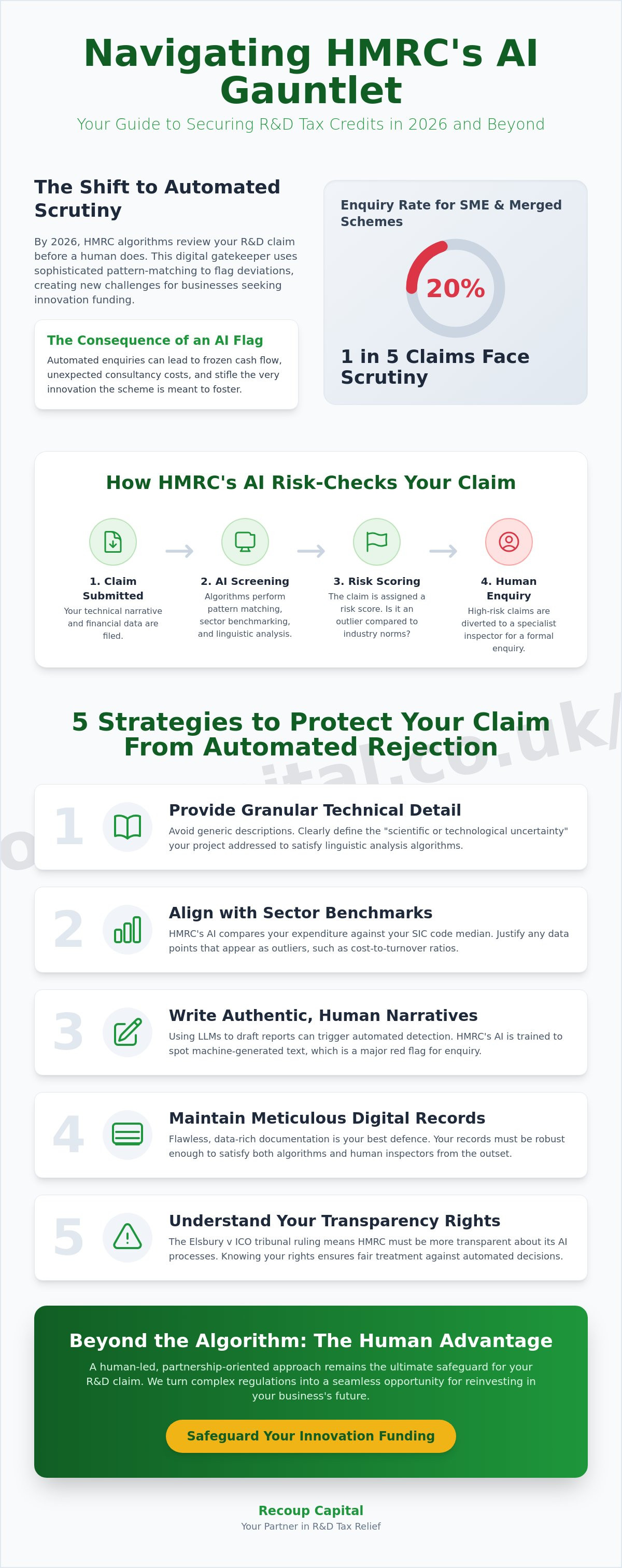
HMRC has replaced random audits with volume-based screening. This algorithmic approach identifies anomalous data points that a human eye might miss. By the start of 2026, enquiry rates for SME and Merged Scheme claimants have stabilised at approximately 20%. This means one in five claims faces intense scrutiny. The financial toll is immediate. Businesses often face frozen cash flow and unexpected consultancy costs to defend their position. Beyond the balance sheet, the emotional weight of an automated enquiry can stifle the very innovation the scheme intends to foster. It's a daunting prospect for a small team to argue against an invisible auditor.
Transparency and the Elsbury Landmark Case
The 2024 tribunal ruling in Elsbury v Information Commissioner changed the rules of engagement. The tribunal ordered HMRC to disclose specific details regarding how they use AI to select claims for enquiry. This landmark decision reinforces a claimant's right to fair treatment. It ensures that the black box of government automation isn't used to issue arbitrary denials. Understanding these transparency requirements is vital for any firm preparing a submission. If you're new to this process, our guide on R&D tax credits explained provides the foundational knowledge needed to navigate these technical hurdles. We believe that clarity is the best defence against automated scrutiny, turning potential setbacks into money for reinvestment.
Understanding the Mechanics: How HMRC AI Risk Checks Work
HMRC's Risk and Intelligence Service (RIS) has undergone a significant digital transformation. By 2026, the initial screening of every R&D claim is handled by sophisticated algorithms designed to spot anomalies before a human inspector even sees the file. These automated systems create new hmrc ai r&d claims challenges for businesses that rely on historical claiming patterns. The AI doesn't just check for mathematical accuracy; it cross-references your submission against vast datasets to identify high-risk profiles. This process relies on "asymmetric information," where HMRC keeps its specific risk triggers secret to prevent claimants from "gaming" the system. When the AI identifies a high-risk score, it triggers a manual intervention, diverting the claim to a specialist inspector for a formal enquiry.
Pattern Matching and Sector Benchmarking
The AI prioritises sector-specific benchmarking by comparing your expenditure to other firms within your Standard Industrial Classification (SIC) code. For example, if a firm in the construction sector claims R&D costs representing 30% of its total turnover whilst the industry median remains closer to 5%, the system flags an "outlier" data point for immediate review. Engineering firms often face similar scrutiny when project costs appear disproportionate to headcount. The algorithm also performs linguistic analysis on technical narratives. Generic descriptions that lack a specific "scientific or technological uncertainty" are frequently flagged. To avoid these traps, it's vital to follow official HMRC guidance regarding what constitutes a valid advancement in your field.
The CT600 and Digital Submission Triggers
The digital Additional Information Form (AIF) acts as the primary data feed for HMRC's automated scrutiny. The AI looks for internal consistency between the AIF and the CT600 tax return. Common data entry errors, such as slight discrepancies in staff cost allocations or qualifying indirect activities (QIAs), are often interpreted by the algorithm as indicators of negligence or fraud. These digital "trips" can delay your funding by months. In 2026, contemporaneous records serve as the primary defensive shield against AI-driven flags, proving that technical uncertainties were identified in real-time rather than reconstructed in hindsight.
Navigating these automated hurdles requires a precision-led approach to data and documentation. If you are unsure how your current technical narratives might be perceived by these algorithms, you can see how R&D tax credits are explained through the lens of modern compliance. Taking the time to align your data now ensures that your claim moves seamlessly through the system, providing the money for reinvestment your business needs to thrive.
The AI vs AI Dilemma: Why Automated Report Writing Triggers Enquiries
HMRC's digital transformation isn't a one-way street. Whilst many firms have adopted Large Language Models (LLMs) to draft technical narratives, the tax office has countered with its own sophisticated detection algorithms. By 2026, the hmrc ai r&d claims challenges revolve around a sophisticated game of "cat and mouse" where synthetic text is flagged almost instantly. HMRC's systems are now trained on millions of previous submissions, allowing them to identify the linguistic fingerprints of generative AI with startling accuracy.
The danger isn't just in the detection; it's in the fabrication. AI models operate on probability, not fact. This leads to "hallucinations" where the software invents technological breakthroughs or scientific uncertainties that never actually occurred. If an HMRC caseworker identifies a single fabricated technical detail, the credibility of the entire claim evaporates. You're no longer just looking at a rejected claim; you're potentially facing "careless" or "deliberate" inaccuracy penalties that can reach 100% of the claim value. Relying on unverified automation removes the vital human nuance that proves a claim's legitimacy.
The Risks of Generative AI in R&D Reporting
ChatGPT and its contemporaries don't understand the DSIT (Department for Science, Innovation and Technology) guidelines. They can't grasp the specific nuance of what constitutes a "scientific or technological uncertainty" within your specific business context. Using AI to "flesh out" thin documentation is a high-risk strategy that HMRC often views as a lack of reasonable care. Without a human-in-the-loop to verify that every sentence aligns with real-world engineering trials, the report becomes a liability. HMRC's 2023-24 compliance reports already show a marked increase in enquiries for narratives that lack granular evidence of failed attempts and technical iterations.
Differentiating Routine Development from Innovation
AI often fails to distinguish between "standard practice" and genuine innovation. It tends to describe routine software integration or basic engineering as "groundbreaking" because it lacks the industry context to know what a competent professional would consider mundane. This is where the hmrc ai r&d claims challenges become most apparent. Identifying the specific "gap in knowledge" requires forensic human analysis and a deep dive into your project's technical hurdles. When claiming R&D tax credits, the focus must be on the specific technical challenges your team faced, not a polished, AI-generated summary of your product's features. We focus on the "why" and the "how," ensuring your narrative stands up to the most rigorous automated and human scrutiny.
5 Essential Strategies to Protect Your Claim from Automated Rejection
HMRC’s adoption of automated risk profiling means that vague descriptions are now a liability. Precision is your best defence. To shield your business from the growing list of hmrc ai r&d claims challenges, you must move beyond the "compliance by numbers" approach. You need a strategy that treats your tax filing as a forensic document rather than a simple form. By 2026, the margin for error will be effectively zero as algorithms become more adept at spotting inconsistencies across multi-year filings.
To ensure your claim survives the first wave of automated scrutiny, focus on these five core pillars:
- Prioritise granular technical narratives: High-level summaries often trigger red flags; instead, provide specific technical details that explain the "how" and "why" of your innovation.
- Ensure 100% alignment: Your technical report and financial figures must be perfectly synchronised. Discrepancies in dates or staff roles are the primary triggers for automated enquiries.
- Maintain contemporaneous evidence: Don't rely on memory; keep real-time logs, Slack threads, and version control histories to prove the R&D process happened as described.
- Address the "baseline" technology: Clearly define the industry standard at the start of your project to prove that your work represents a genuine technical advance.
- Utilise specialist audits: A pre-filing review by an expert consultant can identify the subtle triggers that an AI might flag before the document ever reaches HMRC.
Building a Forensic Technical Narrative
Documenting "failed" experiments is one of the most effective ways to prove genuine technical uncertainty. Success is easy to explain, but the AI looks for the struggle. If you don't show the hurdles, HMRC may assume the solution was obvious to a competent professional. Use project-specific terminology that demonstrates human expertise; this signals that the work was led by specialists rather than generated by a template. Your narrative should read as a peer-to-peer communication with another expert in your field.
Audit-Proofing Your Financial Data
Consistency is the foundation of a successful claim. You must cross-reference staff time-logs with R&D project timelines to ensure every pound claimed is backed by a recorded hour of work. This becomes even more critical when handling subcontracted costs under the 2026 Merged Scheme rules, where the definition of who "owns" the R&D has tightened significantly. Whilst you're reviewing your innovation spend, remember that capital allowances often serve as a complementary relief. Both require the same level of forensic rigour to withstand HMRC's automated filters.
The hmrc ai r&d claims challenges of 2026 require a proactive, partnership-led approach to ensure your funding remains secure. We don't just process paperwork; we build a protective barrier around your innovation.
Beyond the Algorithm: Why Human-Led R&D Consultancy Is Still Essential
As HMRC ramps up its digital defenses, the margin for error in R&D tax relief claims has effectively vanished. Automated systems are efficient, but they lack the nuance of human context. They see data points where a specialist sees innovation. This is why human-led consultancy remains the most effective way to address hmrc ai r&d claims challenges. Whilst an algorithm can flag an anomaly, it cannot understand the technical uncertainties your engineers faced during a complex project. It cannot appreciate the "eureka" moments or the failed prototypes that still qualify for relief.
At Recoup Capital, we operate on a simple philosophy: "Today’s adviser, tomorrow’s partner." We don't view ourselves as a one-off service provider. Instead, we act as a long-term strategic ally. Having a chartered tax accountant defend your claim provides an "insurance policy" that software simply cannot offer. We provide the professional authority needed to justify your expenditure to HMRC, ensuring your claim is robust enough to withstand 2026-era automated scrutiny. Proactive compliance isn't a burden; it's a strategic business advantage that protects your reputation and your cash flow.
The Recoup Capital Difference
We combine deep sector-specific knowledge with forensic tax expertise to ensure your claim is technically sound and financially accurate. Our team includes specialists who understand the language of your industry, whether you're in software development, engineering, or life sciences. We reject the traditional "sales pitch" in favour of a value-driven approach. We demonstrate our worth through results, not promises. You can learn more about our selection criteria for R&D tax credit specialists UK to see how we compare to others in the market. Our process is designed to be thorough yet efficient, ensuring we capture every eligible pound whilst maintaining total transparency.
Money for Reinvestment: The Strategic Goal
We encourage our clients to reframe the way they view tax credits. This isn't just a refund or a tax break. It's money for reinvestment. It's the capital that funds your next hire, your next piece of equipment, or your next breakthrough. By treating R&D relief as a tool for future innovation, you turn a compliance task into a growth engine. We make starting this process as easy as possible. Our low-friction approach begins with a simple conversation to assess your eligibility without any upfront commitment.
Don't let your innovation go unrewarded because of automated red tape. Secure your business's future by partnering with experts who understand the evolving landscape of hmrc ai r&d claims challenges. Take the first step toward reclaiming your capital today.
Book your free 15-minute R&D consultation today and discover how much your innovation is truly worth.
Future-Proofing Your R&D Strategy for 2026 and Beyond
As HMRC ramps up its digital compliance measures, the landscape of hmrc ai r&d claims challenges is shifting from manual review to sophisticated algorithmic scrutiny. Relying on generic, AI-generated reports now risks immediate flagging by HMRC's risk-profiling software, which often leads to costly and time-consuming enquiries. To protect your claim, you must move beyond automated templates and embrace a strategy that combines technical depth with human expertise. Success in 2026 requires more than just submitting data; it demands a robust narrative that an algorithm cannot dismiss.
Recoup Capital acts as your protective guide through these regulatory complexities. Our team of chartered tax accountants and sector specialists brings a proven track record in the construction, engineering, and tech industries to every claim. We operate on success-based fees, ensuring our interests are perfectly aligned with your financial recovery. We don't just process paperwork; we provide the professional authority needed to turn your innovation into vital money for reinvestment. It's about more than just a refund; it's about helping your business thrive in an increasingly automated world.
Secure your innovation funding with a free 15-minute consultation
We're ready to help you navigate these changes with confidence and clarity.
Frequently Asked Questions
Is HMRC really using AI to review R&D tax credit claims?
Yes, HMRC has integrated advanced machine learning into its risk-profiling systems to scan every claim submitted for potential errors. Their 2023-24 Annual Report detailed a £161 million investment in digital transformation, specifically targeting tax non-compliance through automated data analysis. These algorithms identify patterns that deviate from industry norms, making hmrc ai r&d claims challenges a central concern for businesses seeking reinvestment capital. It's a proactive move to reduce the £1.1 billion lost to error and fraud annually.
Can I use ChatGPT to write my R&D technical narrative?
You can use LLMs as a starting point, but relying on ChatGPT for your final narrative is a high-risk strategy. HMRC's Guidelines for Compliance 3 (GfC3) require specific evidence of scientific or technological uncertainty that AI often fails to articulate with technical precision. Automated detectors now flag repetitive, generic phrasing typical of AI-generated content. If your report lacks the authentic technical detail of your lead engineers, it's likely to trigger a manual review and an unwanted enquiry.
What are the most common triggers for an HMRC R&D enquiry in 2026?
The most frequent triggers include discrepancies between your Additional Information Form (AIF) and your annual accounts. HMRC data shows that 20% of enquiries stem from unusual expenditure patterns compared to sector benchmarks. Other triggers include claiming for routine software development or failing to name the lead specialist. If your claim falls outside the 5% to 15% qualifying expenditure range typical for your specific industry, the algorithm will automatically flag it for human scrutiny.
How long does an HMRC AI-driven enquiry usually take to resolve?
Most AI-driven enquiries currently take between 6 and 12 months to reach a final resolution. While the initial flagging happens in seconds, the subsequent manual investigation by an HMRC caseworker involves multiple rounds of technical correspondence. Our experience shows that providing comprehensive documentation in the first response can reduce this timeline by 90 days. It's vital to stay patient whilst your specialist handles the technical back and forth with the tax office to protect your claim.
What is the "Merged R&D Scheme" and how does it affect AI screening?
The Merged R&D Scheme combined the previous SME and RDEC pathways into a single system for accounting periods beginning on or after 1 April 2024. This unified framework allows HMRC to apply a standardised set of AI screening rules across all business sizes simultaneously. It makes the hmrc ai r&d claims challenges more uniform, as the algorithm now looks for consistent "contracted out" R&D rules that apply to almost every claimant regardless of their company turnover.
Will HMRC disclose if my claim was flagged by an algorithm?
HMRC won't explicitly state that an algorithm flagged your claim when they open an enquiry. You'll receive a standard "check of tax return" letter that outlines the specific areas of concern or requests further evidence. However, if the questions you receive feel generic or follow a rigid template, it's a strong indicator that an automated risk-assessment tool prompted the investigation. We help you look past the template to address the underlying technical concerns with professional clarity.
What happens if HMRC decides my AI-generated report is inaccurate?
If HMRC finds your report is inaccurate due to careless AI use, you face penalties ranging from 0% to 30% of the potential tax lost. Under Schedule 24 of the Finance Act 2007, submitting a report you haven't properly verified is often classed as a lack of reasonable care. In extreme cases where the information is deemed deliberate, penalties can climb to 70%. It's a serious risk that can jeopardise your future funding and your company's compliance record.
How much does it cost to have a specialist review my R&D claim before filing?
Many specialist firms operate on a contingency basis, meaning there's no upfront cost for a pre-filing review. Instead, they typically charge a percentage of the successful claim, which industry reports suggest ranges from 10% to 25% depending on the claim's complexity and total value. This "no win, no fee" approach ensures your interests are aligned with your adviser's. It's a seamless way to secure expert peace of mind without impacting your company's immediate cash flow.