
Land Remediation: A Comprehensive Guide to Processes and Tax Relief in 2026

Could the ground beneath your next project be your most significant source of untapped capital rather than a financial liability? While the thousands of UK developers often see land remediation as a bottomless pit of unforeseen costs, the reality in 2026 is that these sites hold the highest potential for strategic reinvestment. You've likely felt the sting of a project margin eroding as cleanup requirements mount, and handling the nuances of HMRC criteria can feel like a full time job in itself.
We're here to change that perspective by showing you how to reclaim 150% of your qualifying expenditure as money for reinvestment. This guide provides a clear path to identifying qualifying contamination, from asbestos to heavy metals, and explains how to turn those tax savings into liquid capital for your future developments. You'll gain a comprehensive understanding of the current regulatory landscape and a roadmap to ensure your business doesn't miss out on its share of the £65 million in relief claimed annually by UK firms according to HMRC statistics.
Key Takeaways
- Learn how to align with the UK’s 2026 brownfield-first strategy to transform environmental liabilities into high-value assets.
- Identify the specific HMRC criteria for 'relevant harm' to ensure your site qualifies for significant tax relief.
- Discover the critical differences between 150% and 50% claim rates and how they impact your company’s bottom line.
- Master the step-by-step process for separating land remediation costs from standard construction expenditure to maximise your recovery.
- Find out how a partnership-led approach can secure vital money for reinvestment through a risk-free, success-based fee structure.
What is Land Remediation? Turning Environmental Liabilities into Assets
Land remediation is the technical process of removing, sequestering, or neutralising contaminants from soil and groundwater. It's a strategic pivot that transforms high-risk, polluted sites into safe, developable assets. While many developers see contaminated soil as a barrier to progress, the UK’s 2026 planning framework treats these sites as the primary engine for urban growth. By 2026, the "brownfield-first" strategy will be the dominant force in British construction, making the ability to clean and repurpose land a vital commercial skill. This Environmental Remediation Overview provides a foundation for understanding how these complex biological and chemical processes work to restore ecological balance.
Effective land remediation does more than just tick a regulatory box. It directly influences the long-term valuation of commercial property. A site cleared of historical industrial pollutants carries significantly less risk for future investors and insurers, often leading to a 15% to 25% increase in land value once the certificate of completion is issued. When paired with Land Remediation Relief (LRR), the process becomes a powerful financial lever. LRR allows companies to claim up to 150% tax relief on qualifying expenditure, essentially turning the cost of cleanup into a source of capital for the next phase of development.
The Core Objectives of Remediation Activities
The primary goal of any remediation project is the protection of human health and the local ecosystem. This isn't just a moral obligation; it's a legal one. Activities must ensure strict compliance with Part IIA of the Environmental Protection Act 1990, which identifies land that poses a significant possibility of significant harm. Successful projects focus on:
- Hazard Mitigation: Neutralising substances like heavy metals, hydrocarbons, and asbestos.
- Regulatory Certainty: Meeting HMRC and Environment Agency standards to avoid future litigation or fines.
- Sustainable Growth: Preparing derelict sites for high-density residential or commercial use, reducing the pressure on the UK’s Green Belt.
Why Land Remediation Relief is Frequently Overlooked
A common misconception persists that only "highly toxic" or catastrophic sites qualify for tax relief. In reality, the criteria are broader. Many developers miss out on significant claims because they don't realise that removing natural contaminants like Japanese Knotweed or clearing redundant underground services can often qualify for LRR. At Recoup Capital, we see LRR as a "money for reinvestment" tool rather than a simple tax refund. It’s about liquidity. By recovering 150% of the costs associated with cleaning a site, businesses can bridge the gap between acquisition and construction. If you want to understand how these incentives fit into your broader growth strategy, you should explore why claim tax incentives for your business to see the long-term impact on your bottom line. Moving beyond the "cost centre" mindset allows you to treat remediation as the first step in a profitable development cycle.
Defining a 'Contaminated State': What Qualifies for Relief?
HMRC defines a 'contaminated state' through the lens of 'relevant harm'. This means the land must pose a tangible risk to people, property, or the wider ecosystem. It's not enough for the ground to be merely subpar; it needs to represent a potential threat. For a business to claim relief, the site must be located within the UK and owned by a limited company. This is a crucial distinction. Sole traders and partnerships aren't eligible for this specific tax benefit, which is designed to incentivise corporate investment in difficult sites.
The source of the contamination matters. HMRC typically looks for pollutants introduced by previous industrial activity. Naturally occurring substances often fall outside the scope unless human intervention has concentrated them or worsened the situation. Think of an old gasworks versus a naturally rocky outcrop. The former is a prime candidate for land remediation tax relief because the contamination is a byproduct of human industry. The relief allows companies to deduct 150% of qualifying costs from their taxable profits, turning a technical challenge into a financial advantage.
Common Qualifying Contaminants in UK Construction
Construction projects frequently encounter a cocktail of industrial leftovers that require professional intervention. Common qualifiers include:
- Industrial pollutants: Heavy metals like lead or arsenic, hydrocarbons from leaked fuel, and ground gases like methane or carbon dioxide.
- Harmful organisms: Japanese Knotweed is the most notorious example. HMRC allows for relief on its removal or containment because it causes significant structural damage and spreads aggressively.
- Building-related hazards: The removal of asbestos from existing structures is a major qualifying activity. If you're stripping out asbestos to make a building safe for renovation, those costs are often eligible.
Even invisible threats count. Radon gas or methane migrating from adjacent landfills can trigger a claim if the levels are high enough to cause harm. This expenditure is essentially money for reinvestment that many developers leave on the table simply because they don't realise the scope of the relief.
Identifying Derelict Land for Development
Derelict land is a different beast entirely. To qualify for relief under the derelict land criteria, the site must have been out of use since at least 1998. It must also be in a state where it cannot be reused without the removal of former buildings or structures. This isn't just about clearing a few bushes; it requires substantial site preparation to make the land productive again.
The tax benefits here are significant. Bringing these 'brownfield' sites back to life helps solve the UK housing crisis while boosting your bottom line. You can explore more about the specifics in our Contaminated Land Remediation: A Guide to Processes and Tax Relief in 2026. If you aren't sure if your site meets the 1998 threshold, it's worth checking your land registry records. This relief can turn a stalled project into a profitable venture.
Understanding these definitions is the first step toward a successful claim. If you're currently managing a site with these issues, a quick chat with an expert could reveal hidden capital. You can learn more about qualifying costs to see where your project stands.
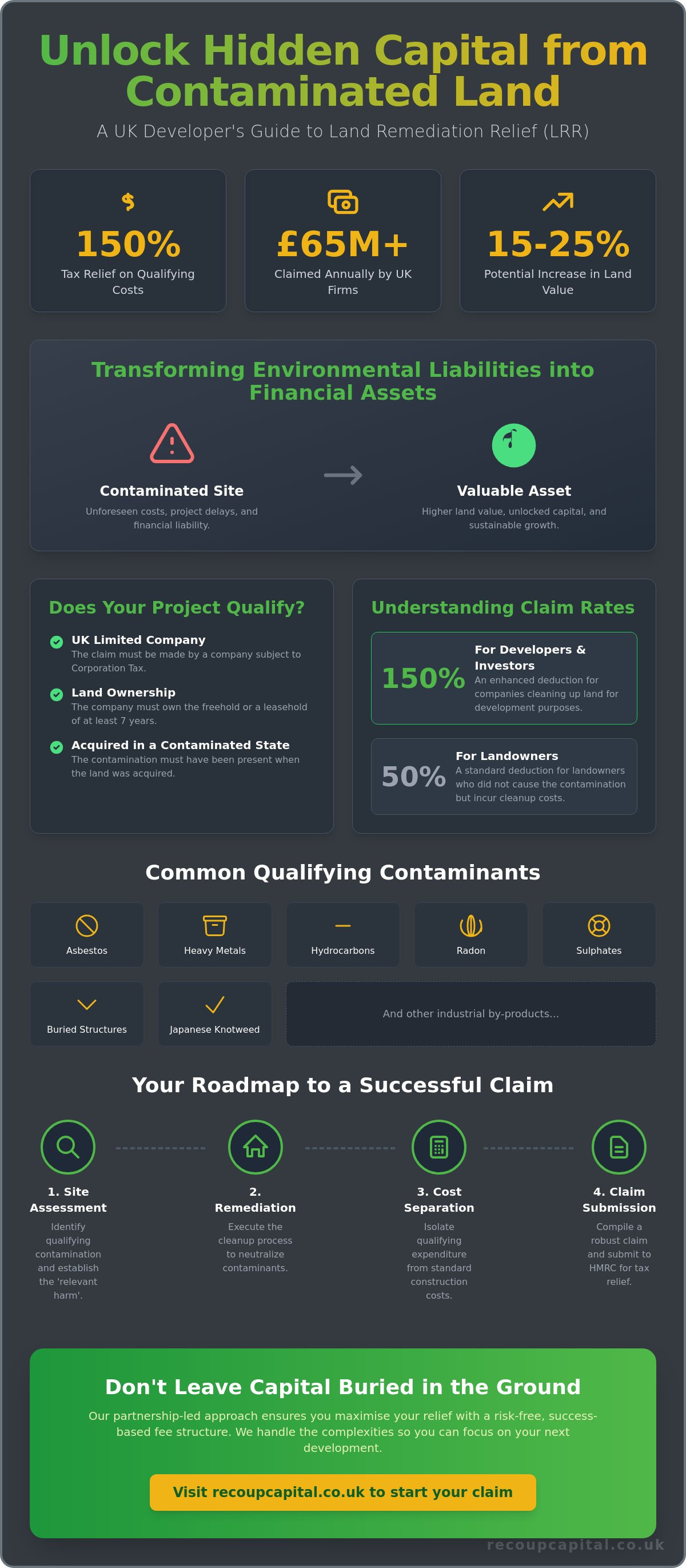
The Mechanics of Land Remediation Relief: 150% vs. 50% Claims
How much capital is your company leaving buried in the ground? For UK limited companies, land remediation relief isn't just a tax break; it’s a strategic tool for financial recovery. The relief functions through two primary rates tailored to your business model and your relationship with the property. Whether you're a long-term investor or a fast-moving developer, understanding these mechanics is essential for turning environmental liabilities into money for reinvestment.
Owner-Occupiers and Investors: Maximising the 150% Deduction
For companies holding land as a fixed asset, the 150% deduction offers a significant reduction in corporation tax liability. It's a straightforward calculation. If your business spends £100,000 on qualifying remediation, you can deduct £150,000 from your taxable profits. This effectively provides tax relief on 1.5 times the actual cost. This isn't just for external contractors. You can claim for:
- Direct staffing costs for employees dedicated to the remediation project.
- Materials used specifically to treat or remove contaminants.
- Subcontracted specialist services.
This deduction applies to both capital and revenue expenditure, provided the company didn't cause the contamination. You can find more detail in our guide to Understanding Land Remediation Relief for Property Owners.
Property Developers: Unlocking the 50% Enhanced Relief
Developers face a different set of rules because they treat land as "stock in trade" rather than a long-term asset. Because the initial 100% of the expenditure is already deducted as a normal business expense in their accounts, the relief provides an additional 50% enhanced deduction. This creates a level playing field, ensuring developers still benefit from a total 150% deduction against their profits.
Timing is vital. You must claim this in the year the expenditure is incurred. Missing this window can lead to lost opportunities. For mid-market developers, this 50% boost often provides the competitive edge needed to secure brownfield sites that others might find financially unviable. It transforms a risky acquisition into a profitable venture by providing significant tax savings early in the development cycle.
If your company is currently loss-making, you aren't locked out of these benefits. HMRC offers a 24% tax credit option. This allows you to surrender the enhanced loss in exchange for a cash payment. For a £100,000 spend, a loss-making company could receive £24,000 directly into their bank account. It’s a vital lifeline that supports innovation and growth when cash flow is tightest. Our role is to ensure this process is seamless, acting as today’s adviser and tomorrow’s partner to help your business thrive.
The Roadmap to a Successful Claim: A Step-by-Step Process
Securing Land Remediation Relief requires more than just ticking boxes; it's a strategic operation to uncover value hidden within your project's history. To ensure your claim stands up to HMRC scrutiny in 2026, you need a structured approach that bridges the gap between site work and tax legislation. It's about turning complex environmental challenges into money for reinvestment.
- Step 1: Forensic Analysis. We conduct a specialist review of all site-related expenditure to find costs buried in general contracts.
- Step 2: Qualification. We separate standard construction costs from qualifying land remediation activities, such as treating contaminated soil or removing redundant services.
- Step 3: Evidence Gathering. Our team collates technical evidence, including pre-remediation site surveys and specific remediation strategies.
- Step 4: Quantification. We calculate the 150% enhanced deduction and draft a comprehensive technical report for HMRC.
- Step 5: Submission. Your claim is filed via the CT600, and we manage any subsequent HMRC enquiries on your behalf.
Forensic Expenditure Analysis: Finding the 'Hidden' Costs
General accounting practices often overlook qualifying land remediation costs because they're frequently bundled into large-scale groundworks contracts. A specialist surveyor identifies specific tasks, like "breaking out" buried concrete structures or dealing with unexpected ground gases, that qualify for relief. Identifying these nuances can significantly increase the value of your claim. You can often find additional value by maximising Capital Allowances alongside Land Remediation to ensure no tax saving is left on the table.
Navigating HMRC Compliance and Transparency
HMRC's focus on compliance has intensified, making a robust technical report essential. This document shouldn't just list costs; it must explain why the site was contaminated and how your actions mitigated that risk. We act as your protective guide, ensuring every claim is transparent and accurate. As digital filing evolves, understanding HMRC R&D Tax Claim Transparency and AI: Navigating the New Compliance Era becomes vital for any business seeking tax incentives. We handle the complexities so you can focus on your next development.
Ready to see what your site is really worth? Book your FREE 15 minute consultation to start your recovery journey today.
Partnering for Success: How Recoup Capital Maximises Your Relief
We don't just process paperwork; we build long-term financial foundations. Our "Today’s adviser, tomorrow’s partner" philosophy means we're invested in your firm's growth long after the first claim is settled. We operate on a 100% success-based fee structure. This ensures our interests are perfectly aligned with yours. We only win when you recover capital, removing the financial risk of exploring your eligibility. Our team handles the heavy lifting, from initial site audits to final HMRC submissions, reducing the administrative burden on your internal staff by up to 80%.
Maximising your return requires a holistic view of your project's lifecycle. Land remediation relief rarely exists in a vacuum. We've found that projects requiring soil decontamination often involve innovative engineering solutions that qualify for R&D tax credits. Similarly, the infrastructure installed on remediated land frequently triggers significant capital allowances. We integrate these workstreams into a single, cohesive strategy. This joined-up approach prevents "double dipping" while ensuring no qualifying pound is left on the table.
From Technical Assessment to Reinvestment
Our specialists go beyond basic accounting to identify the full scope of your eligible expenditure. We look at the hidden costs, such as site security, professional fees, and indirect overheads that generalists often overlook. We transform these identified tax credits into "money for reinvestment," providing the liquidity needed to break ground on your next development. It's about turning a regulatory requirement into a strategic advantage. Contact us for a free 15-minute consultation to see how we can unlock your project's hidden value.
Why Choose a Specialist Over a Generalist Accountant?
The technical depth required for complex land remediation claims is substantial. While a generalist accountant is excellent for day-to-day compliance, they may lack the specific environmental and tax law expertise to challenge HMRC on nuanced site conditions. We've facilitated millions in relief for the UK construction sector by defending robust, evidence-backed claims. Our specialists understand the 2026 regulatory landscape and the specific evidentiary standards HMRC demands. For a deeper look at why specialist support is vital for your innovation strategy, read our guide on R&D Tax Credit Specialists UK: Choosing a Partner for Compliant Innovation in 2026.
- Seamless End-to-End Service: We manage every interaction with HMRC so you don't have to.
- Technical Expertise: Our team includes specialists who understand the chemistry and engineering behind remediation.
- Risk Mitigation: We provide a robust defense for every claim, ensuring full compliance with current UK tax legislation.
Turn Environmental Liabilities into Strategic Capital
Navigating the complexities of HMRC's 150% tax relief doesn't have to be a burden on your business. You've seen how identifying a contaminated state can unlock significant money for reinvestment, turning stagnant sites into profitable assets. Whether you're dealing with hazardous substances or natural contaminants like radon, the potential for financial recovery is substantial. Our team of specialist chartered tax accountants brings deep expertise in the UK construction and engineering sectors to ensure no qualifying expenditure is overlooked. We operate on a success-based fee structure, meaning our goals are perfectly aligned with your bottom line. We're here to act as your protective guide, transforming technical legislation into a seamless opportunity for growth.
Effective land remediation is more than just a regulatory requirement; it's a strategic financial tool for the modern developer. Don't leave your capital buried in the ground when it could be fueling your next project. Our results-oriented approach ensures that you receive the maximum benefit without the stress of a traditional sales pitch. As today's adviser and tomorrow's partner, we're ready to help your business thrive and innovate.
Book your FREE 15-minute consultation with our specialists today
Frequently Asked Questions
Can I claim Land Remediation Relief if I caused the contamination?
No, the "polluter pays" principle strictly prevents you from claiming if you're responsible for the contamination. Under Section 1144 of the Corporation Tax Act 2009, the claimant must not be the person who caused the environmental damage. If you or a connected party introduced the pollutant, you're ineligible for the relief. This ensures the tax incentive focuses on cleaning up legacy sites rather than subsidizing current industrial pollution.
Is Land Remediation Relief available for residential property developments?
Yes, commercial companies developing residential property can benefit from this relief. While the end use is residential, the claimant must be a company subject to UK Corporation Tax. You can claim for costs like removing asbestos or treating Japanese Knotweed on land held as trading stock. This provides vital money for reinvestment into your next housing project, turning a technical challenge into a financial opportunity.
What is the time limit for making a retrospective land remediation claim in 2026?
The statutory time limit for an HMRC land remediation claim is exactly two years from the end of your accounting period. If your accounting period ended on 31 December 2024, you must submit your claim by 31 December 2026. Missing this deadline means forfeiting the 150% tax deduction on qualifying expenditure. We recommend starting the process at least 6 months before the deadline to ensure all technical reports are robust.
Does the removal of Japanese Knotweed always qualify for tax relief?
No, Japanese Knotweed removal only qualifies if the infestation was present at the time you acquired the site. If the weed spread to your land after the purchase date, it's considered a maintenance issue rather than a remediation expense. To qualify for the 150% relief, you must prove the contamination was a pre-existing condition that required specialist treatment to render the site safe for development.
Can loss-making companies receive a cash payment for land remediation?
Yes, loss-making companies can surrender their land remediation loss for a tax credit worth 16% of the qualifying expenditure. This cash payment provides immediate liquidity when you need it most. For every £100,000 spent on qualifying cleanup, a loss-making company could receive up to £24,000 directly from HMRC. It's a powerful way to turn a technical debt into a strategic financial asset for your business growth.
What is the difference between land remediation relief and capital allowances?
Land remediation relief covers the cost of cleaning up land, while capital allowances relate to plant and machinery. LRR is a 150% deduction for revenue expenditure on site decontamination. Capital allowances apply to items like air conditioning or lift systems. You can't claim both for the same pound spent. Identifying the correct category is essential to maximize your claim and ensure full compliance with current HMRC regulations.
How much does it cost to use a specialist to file a land remediation claim?
Most specialists work on a contingency basis, which means they charge a percentage of the successful tax saving. This model ensures you don't face upfront costs and aligns the specialist's interests with your success. You get expert guidance through complex tax laws without risking your current cash flow. A FREE 15 minute consultation can clarify how this structure works for your specific development project.
Do I need a specific type of survey to prove the land was contaminated?
Yes, you need robust Phase 1 and Phase 2 environmental surveys to substantiate your land remediation claim. These reports must identify specific pollutants, such as arsenic, lead, or hydrocarbons, and outline the necessary remediation strategy. HMRC requires clear evidence that the land was in a contaminated state at acquisition. Without these technical documents, your claim lacks the necessary foundation for approval and could be rejected during an inquiry.