
Construction R&D Tax Relief: A Comprehensive Guide to Innovation in Building

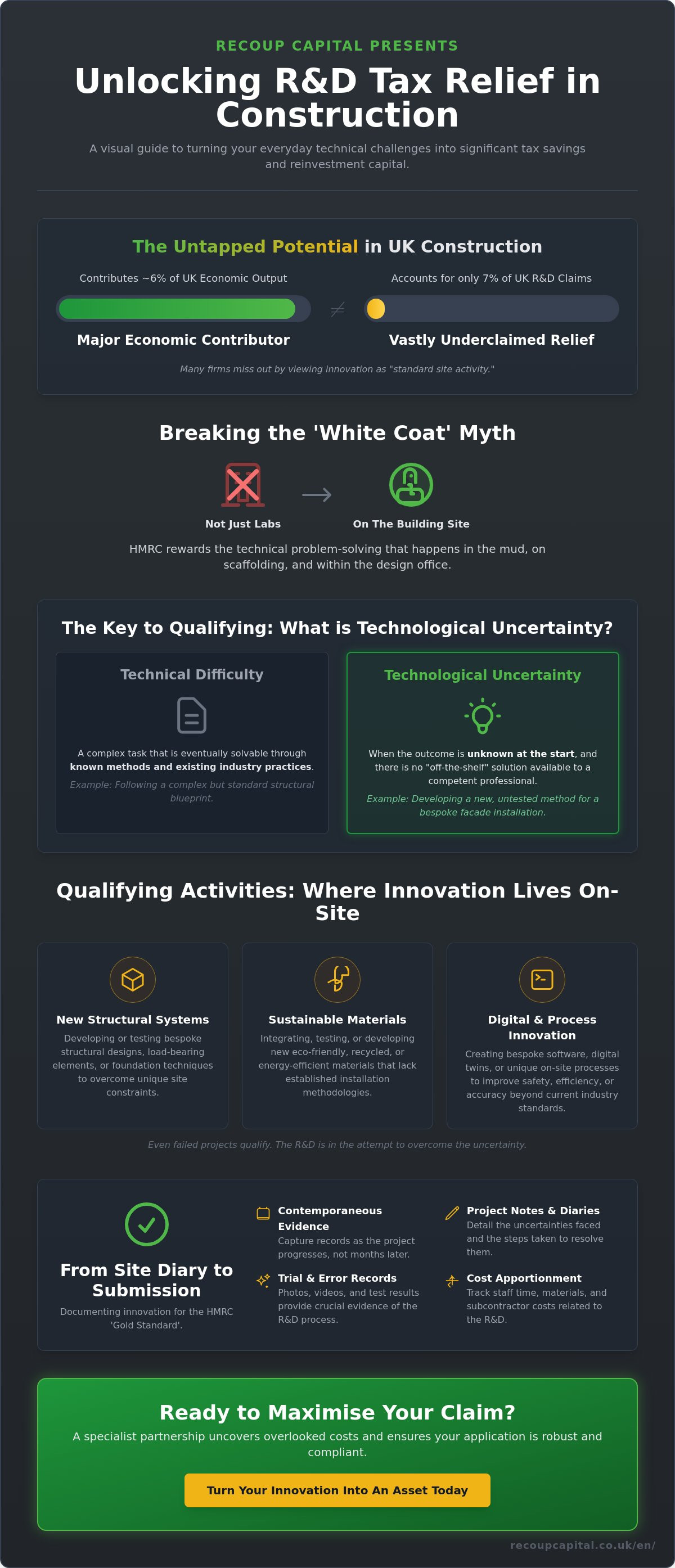
Did you know that the construction sector accounts for only 7% of the total value of UK R&D claims, despite the industry being a hub for complex engineering solutions? Many firms miss out on construction r&d tax relief because they view bespoke structural fixes or innovative material usage as standard site activity rather than qualifying innovation. It's understandable why you might feel hesitant. The rules often seem opaque, and the threat of a technical enquiry from HMRC makes the process feel like a risk rather than a reward. We're here to change that.
You deserve to see a tangible return on the ingenuity your team displays every day. This guide provides the clarity you need to manage the claim process with confidence and precision. We'll demonstrate how to identify eligible expenditure and structure a robust, compliant application that secures essential money for reinvestment. By the end of this article, you'll have a clear roadmap to turning your technical hurdles into significant tax savings without the stress of traditional sales pitches or complex jargon.
Key Takeaways
- Learn why you do not need a laboratory or "white coats" to qualify, as HMRC rewards the technical problem-solving already happening across your building sites.
- Navigate the 2026 landscape of construction r&d tax relief to understand how the Merged Scheme impacts your firm’s eligible expenditure and potential for reinvestment.
- Identify hidden opportunities for innovation within your everyday processes, from testing new structural systems to developing bespoke, sustainable materials.
- Discover how to simplify record-keeping by capturing contemporaneous evidence that meets the HMRC "gold standard" without overstretching your site teams.
- Explore how a specialist partnership can maximise your financial recovery by uncovering overlooked costs and integrating R&D with wider Capital Allowances.
Breaking the 'White Coat' Myth: What is Construction R&D Tax Relief?
Construction is often mischaracterised as a low-tech industry defined by repetitive manual labour. This perspective is a costly mistake for UK building firms. Many directors believe that Research and Development (R&D) is the exclusive domain of pharmaceutical giants or software developers working in sterile laboratories. In reality, HMRC designed construction r&d tax relief to reward technical problem-solving that happens in the mud, on the scaffolding, and within the design office. You don't need a white coat to qualify; you just need a project that pushes the boundaries of current building standards.
At its core, this relief is a government incentive created to stimulate innovation across the British economy. It allows companies to recoup a portion of their expenditure on projects that seek to overcome technical challenges. According to the Office for National Statistics, the construction sector contributed approximately 6% of the UK’s economic output in 2023, yet it remains one of the most under-represented sectors in tax credit claims. By understanding how R&D tax credits explained apply to your specific projects, you can transform technical hurdles into "money for reinvestment" that fuels your next phase of growth.
The Definition of Scientific or Technological Uncertainty
The threshold for a claim isn't based on how hard the team worked, but on the presence of "uncertainty." This occurs when your team faces a problem that a competent professional in the field cannot solve using standard industry knowledge or existing practices. It's the difference between a "technical difficulty," which is a complex task that is eventually solvable through known methods, and a "technical uncertainty," where the outcome is unknown at the start.
To provide a clear benchmark for your records: Technological uncertainty exists when the knowledge of whether a specific technical goal is achievable, or how to achieve it in practice, is not readily available or deducible by a competent professional working in the field. If your engineers had to conduct trials, develop prototypes, or iterate designs because there was no "off-the-shelf" solution, you are likely looking at a qualifying activity under the UK's R&D Tax Credits framework.
Why HMRC Supports the Construction Industry
The UK government uses these tax incentives as a strategic tool to modernise the built environment. With the legal requirement to reach Net Zero by 2050, there is an urgent need for the industry to develop more sustainable materials and energy-efficient assembly methods. HMRC isn't just being generous; they're investing in the future of British infrastructure.
- Economic Resilience: Innovation keeps UK firms competitive on a global stage.
- Safety Standards: Developing new fire-retardant materials or safer structural systems reduces long-term risk.
- Sustainability: Credits encourage the shift away from carbon-heavy traditional methods toward modular or green alternatives.
We see this relief as a partnership between the state and the innovator. It provides a vital safety net that allows you to take the risks necessary to improve your processes. Today’s adviser, tomorrow’s partner; we ensure that your technical bravery is matched by financial recovery.
Qualifying Activities: Where Innovation Lives on the Building Site
Construction R&D tax relief often goes unclaimed because firms assume innovation requires a white lab coat. It doesn't. Innovation frequently hides in the everyday struggle to make a building stand up or keep heat in. HMRC defines R&D as an attempt to achieve an advance in science or technology through the resolution of scientific or technical uncertainty. If your team spent weeks troubleshooting a structural failure or refining a bespoke process, that time represents eligible expenditure. Even if the project was ultimately abandoned or failed to meet its technical goals, the effort to overcome those hurdles qualifies under the official government guidance. Innovation can be a new material, a physical structural system, or even a streamlined digital process.
Innovative Building Materials and Sustainable Systems
Developing bespoke concrete mixes to meet specific load-bearing requirements or creating high-performance insulation for 19th-century retrofits is classic R&D. With the UK's commitment to reducing carbon emissions by 68% by 2030, many firms are testing new ways to integrate renewable energy into structural frameworks. This isn't just about installation; it's about the technical challenge of making these systems work within non-standard constraints. Testing new methods to improve thermal efficiency or reduce a project's carbon footprint often involves significant trial and error, all of which counts toward your claim.
Structural Engineering and Complex Site Constraints
Restricted urban sites often force engineers to develop novel underpinning or façade retention systems that haven't been used before. When ground conditions are unstable, creating a unique technique to secure the foundation qualifies as innovation. There's also significant synergy between construction r&d tax relief and Land Remediation Relief when dealing with contaminated sites. If you're developing new methods to neutralise pollutants whilst simultaneously building, you could be sitting on a dual claim. Designing modular or off-site construction methods to improve speed and safety also falls under this bracket, as it requires moving beyond established industry norms.
Digital Transformation and Construction Tech
Customising Building Information Modelling (BIM) software for applications it wasn't designed for is a clear indicator of R&D. This includes developing automation tools for structural monitoring or site surveying that improve accuracy beyond industry standards. Mathematical modelling in engineering qualifies as R&D when it's used to predict the performance of a structure under previously untested stresses or environmental conditions. These digital breakthroughs are just as valuable as physical ones on the building site.
Every hour your team spends solving these technical puzzles is money for reinvestment. You can explore your potential claim with our specialists to ensure no eligible activity is left off your balance sheet.
Navigating the Financials: The Merged Scheme and Qualifying Costs
The 2026 tax landscape for builders and civil engineers is defined by a unified approach. The Merged Scheme now serves as the primary vehicle for claiming construction r&d tax relief, replacing the previous dual-track system that separated SMEs from larger corporations. This single pathway offers a gross credit of 20 per cent, providing a predictable stream of money for reinvestment into your next big project. It's a significant shift from the old SME and RDEC regimes, designed to reward firms that push the boundaries of what's possible on-site.
For firms with global footprints, comparing the UK's streamlined approach to the US requirements found in IRS Form 6765 highlights how HMRC has moved toward a more integrated "above-the-line" credit system. This means the relief appears as income in your accounts before tax, making your balance sheet look stronger to investors and lenders. You can find more details on how these mechanics function in our guide to R&D tax credits explained.
What Costs Can You Actually Claim?
Identifying qualifying expenditure is where many construction businesses leave money on the table. You aren't just looking for "innovation" in a lab; you're looking for it in your daily payroll and procurement. Staffing costs often form the bulk of a claim. This includes gross pay, Class 1 National Insurance, and pension contributions for any employee directly involved in solving technical uncertainties. If a project manager spends 40 per cent of their month troubleshooting a unique structural failure, 40 per cent of their qualifying costs should be in your claim.
- Consumables: You can claim for materials, water, fuel, and power that are transformed or consumed during the R&D process. If you've developed a new high-durability concrete mix, the materials used in the failed prototypes are eligible.
- Software: Licences for Building Information Modelling (BIM) or bespoke simulation tools are qualifying costs if they're used to facilitate your innovative work.
- Subcontractors: In the Merged Scheme, the rules around who claims for contracted-out R&D have tightened. Generally, the decision-maker who "intended" for the R&D to take place holds the right to claim. It's vital to review your contracts to ensure you aren't missing out on these significant sums.
The Merged Scheme vs. Legacy R&D Incentives
The transition to a single scheme has simplified life for large-scale construction groups. Previously, navigating the different rates and rules between SME and RDEC schemes was a complex administrative burden. The current "above-the-line" credit provides a clearer picture of your financial recovery from the outset. This transparency allows your finance team to forecast more accurately, treating the tax relief as a strategic asset rather than a year-end surprise.
Whilst the R&D Intensive SME scheme still exists for those with very high R&D spend relative to total expenditure, the vast majority of construction firms now benefit from the Merged Scheme's consistency. This evolution reflects a government commitment to making the UK a global hub for building innovation. It's no longer about jumping through hoops; it's about demonstrating the genuine technical challenges you've overcome to deliver a better built environment.
From Site Diary to Submission: Documenting Innovation for HMRC
Site teams often view record-keeping as a distraction from the physical build. It's the primary objection we hear. Yet, documenting your construction r&d tax relief claim isn't about creating extra work; it's about protecting your financial recovery. HMRC considers contemporaneous evidence to be the gold standard. This means capturing data as it happens, rather than trying to remember technical challenges 12 months after the project finished. HMRC's Guidelines for Compliance (GfC3), updated in 2023, explicitly state that records should ideally be created at the time the work is being done.
The regulatory environment is shifting. The move toward HMRC R&D tax claim transparency in 2026 means that generic descriptions will no longer suffice. You need a seamless way to track innovation that doesn't disrupt project flow. When done correctly, this documentation transforms from a compliance chore into a strategic tool that secures money for reinvestment.
Building a Robust Technical Narrative
A successful submission starts with a clear baseline. You must define what was technologically possible in the industry before your project began. This establishes that you weren't just following standard practice. From there, your narrative should focus on three core areas:
- Technological Uncertainties: Identify the specific hurdles where the solution wasn't obvious to a competent professional.
- Systematic Investigation: Document the process of testing, failing, and refining. This is the heart of R&D.
- The Outcome: Explain whether the uncertainty was resolved and what new knowledge was gained, even if the project didn't succeed as planned.
Capturing Evidence in the Field
Primary evidence doesn't have to be a formal report. Site diaries, timestamped photos, and meeting minutes are incredibly powerful. They provide an authentic snapshot of the innovation process. Project managers play a vital role here. By identifying R&D trigger points, such as when a specified material fails to perform or a structural design requires a bespoke workaround, they can flag activities for documentation early. This proactive approach ensures no eligible expenditure is left on the table.
It's equally important to align your financial records with these technical activities. When your labour costs and subcontractor invoices match the dates of the technical challenges recorded in your site diaries, you create a robust audit trail. This level of detail makes the process of claiming R&D tax credits significantly smoother. We act as today’s adviser and tomorrow’s partner to ensure your field data translates into a high-value, compliant claim.
Ready to turn your site data into capital? Book your free 15 minute consultation today to see how we can help your business thrive.
Maximising Your Claim: Why a Specialist Partnership Wins
Choosing between a generalist accountant and a specialist tax consultant often determines whether a firm receives a modest rebate or a transformative injection of capital. While generalists provide essential compliance for day-to-day operations, they frequently lack the engineering depth required to identify the nuances of construction r&d tax relief. A specialist understands that a site manager's struggle with bespoke structural stability isn't just a project delay; it's a qualifying technical uncertainty.
Our approach goes beyond simple ledger reviews. We employ forensic surveying to identify Capital Allowances alongside R&D opportunities. This dual-track strategy is vital because many construction firms overlook the tax relief available on "embedded fixtures" within their buildings. By conducting these detailed surveys, we often uncover qualifying expenditure in plant, machinery, and integral features that a standard profit and loss statement might miss. It's about ensuring no pound is left on the table.
The Value of a Specialist R&D Partner
Specialists identify "hidden" R&D by looking at the technical challenges your team solves every day. Whether it's developing a new way to pour concrete in sub-zero temperatures or integrating smart sensors into legacy infrastructure, these activities represent significant innovation. We ensure every claim is fully compliant with the 2026 HMRC standards, which have introduced stricter documentation requirements and digital filing mandates. This technical rigour protects your business whilst reducing the administrative burden on your internal finance and site teams. You build; we document.
Today’s Adviser, Tomorrow’s Partner
We don't view tax relief as a one-off transaction. At Recoup Capital, we position construction r&d tax relief as a long-term strategy for business growth. Our success-based fee structure means we only receive payment when your claim is successful. This aligns our interests perfectly with yours. There are no upfront costs and no hidden risks. We act as a protective guide, shielding our clients from the risk of HMRC enquiries by providing robust, evidence-backed technical reports that stand up to scrutiny.
We're here to help your business thrive by turning your past innovation into money for reinvestment. Our philosophy is simple: we demonstrate value through results rather than delivering a traditional sales pitch. If you want to see how much capital you could recover for your next project, it starts with a simple conversation.
Ready to uncover the hidden value in your projects?
Book your FREE 15 minute consultation with our team to assess your eligibility and start your journey toward financial recovery.
Turn Your Technical Hurdles Into Strategic Capital
Innovation isn't confined to a laboratory; it's found in the bespoke engineering solutions and complex technical hurdles your team overcomes on-site every day. By moving beyond the "white coat" myth, your firm can unlock significant funding through construction r&d tax relief. Recoup Capital has already facilitated over £100m in capital for UK businesses. We understand that what feels like standard problem-solving is often a qualifying breakthrough when framed correctly for HMRC.
Navigating the financials of the Merged Scheme requires professional precision. Our team of chartered tax accountants and industry specialists handles the heavy lifting, from auditing site diaries to final submission. We operate on a success-based fee structure, meaning we're as invested in the value of your claim as you are. It's time to transform your past expenditure into money for reinvestment. We're ready to act as today's adviser and tomorrow's partner, helping your business thrive whilst you focus on the next build.
Book your FREE 15-minute R&D consultation
Frequently Asked Questions
Can a construction company claim R&D tax relief for failed projects?
Yes, you can absolutely claim for projects that didn't reach their intended conclusion. HMRC guidelines state that the relief is designed to reward the attempt to overcome technical uncertainty, regardless of whether the final product was a success. If your firm spent 400 hours trying to develop a new sustainable cladding system that ultimately failed safety tests, those costs still qualify as valid expenditure. This ensures that the financial risk of innovation doesn't cripple your business growth.
How far back can our construction firm claim R&D tax credits?
You can typically claim for the two most recent completed accounting periods. This means if your financial year ended on 31 December 2023, you have until 31 December 2025 to submit or amend a claim for that period. Missing these statutory deadlines means losing out on significant money for reinvestment. We often find that firms overlook qualifying activities from 18 months ago that could provide a vital cash injection today.
Does "standard" building work ever qualify for R&D relief?
Standard construction following established industry practices rarely qualifies for construction r&d tax relief on its own. However, if a "standard" project requires you to develop a bespoke solution for a unique site constraint, like building on a 45 degree slope with unstable soil, the innovation begins. If the solution isn't readily deducible by a competent professional in the field, it moves from routine work into the realm of qualifying R&D.
What is the difference between R&D and Capital Allowances in construction?
R&D tax relief focuses on revenue expenditure, such as staff wages and consumable materials used during the innovation process. In contrast, Capital Allowances relate to your firm's investment in fixed assets like plant machinery, vehicles, or the building itself through Annual Investment Allowances. While Capital Allowances cover the £50,000 you spent on a new excavator, R&D relief covers the £15,000 in wages spent developing a custom hydraulic attachment for that excavator.
How long does it take for HMRC to process a construction R&D claim?
HMRC aims to process 95% of R&D tax credit claims for Small and Medium-sized Enterprises (SMEs) within 40 days of submission. While some claims are processed in as little as 28 days, complex filings or those requiring further clarification can take longer. Our role as your partner is to ensure the initial submission is robust and clear to minimise these delays. This efficiency helps turn your innovative efforts into tangible capital for your next big project.
Can we claim if we are acting as a subcontractor on a project?
Yes, subcontractors can often claim, though the rules changed significantly for accounting periods beginning on or after 1 April 2024. Under the new merged scheme, the right to claim generally sits with the company that makes the decision to undertake the R&D. If your firm is tasked with solving a specific technical problem that the main contractor couldn't solve, you may be eligible. It's vital to review your contracts to identify who holds the intellectual risk.
What happens if HMRC decides to enquire into our R&D claim?
An HMRC enquiry is a formal request for more information to verify the technical or financial details of your claim. It doesn't mean you've done something wrong; HMRC currently aims to enquire into approximately 20% of claims to maintain scheme integrity. If this happens, we act as your protective guide, providing the necessary evidence and technical justifications to satisfy the inspector. Having a specialist partner ensures these enquiries are handled with professional authority and minimal stress.