
R&D Tax Credit Software vs Specialist: Which is Best for Your 2026 Claim?

HMRC's AI-driven audit tools are currently rejecting thousands of automated claims that lack a robust technical narrative. This shift has created a high-stakes environment for innovative businesses. When you evaluate R&D tax credit software vs specialist consultancies, the choice is no longer just about cost; it's about which path truly secures your capital in 2026.
You likely feel the pressure of the new merged scheme rules and the strict Claim Notification deadlines. It's a complex environment where a small error in an Additional Information Form can trigger a compliance check lasting up to 18 months. We recognise the challenge of trying to maximise your 20% taxable credit whilst managing the heavy administrative burden of data collection and technical documentation.
This article clarifies the critical differences between automated platforms and specialist-led strategies to ensure you receive your full entitlement safely. We will explore how to protect your business from HMRC scrutiny and transform your tax return into a strategic asset for future innovation. By comparing these two approaches, you can decide which model offers the reliability and protection your organisation deserves.
Key Takeaways
- Understand why the 2026 merged R&D scheme requires a more sophisticated approach to technical narratives than automated platforms typically provide.
- Decide between R&D tax credit software vs specialist led-consultancies by factoring in the risk of HMRC enquiries and potential under-claiming.
- Identify qualifying expenditure that software often overlooks in complex sectors like construction and engineering to maximise your capital recovery.
- Learn how to navigate the mandatory Additional Information Form (AIF) to safeguard your submission against the latest AI-driven compliance checks.
- Utilise our five-step decision framework to choose the most secure and profitable route for your organisation's specific R&D profile.
R&D Tax Credit Software vs Specialist: Understanding the Landscape
The UK tax incentive landscape has undergone its most significant transformation in a decade. With the implementation of the merged R&D scheme for accounting periods starting on or after 1 April 2024, the rules have tightened considerably. For businesses looking to recover capital in 2026, the choice between R&D tax credit software vs specialist consultancies is a strategic decision. It dictates your claim's safety and its ultimate value.
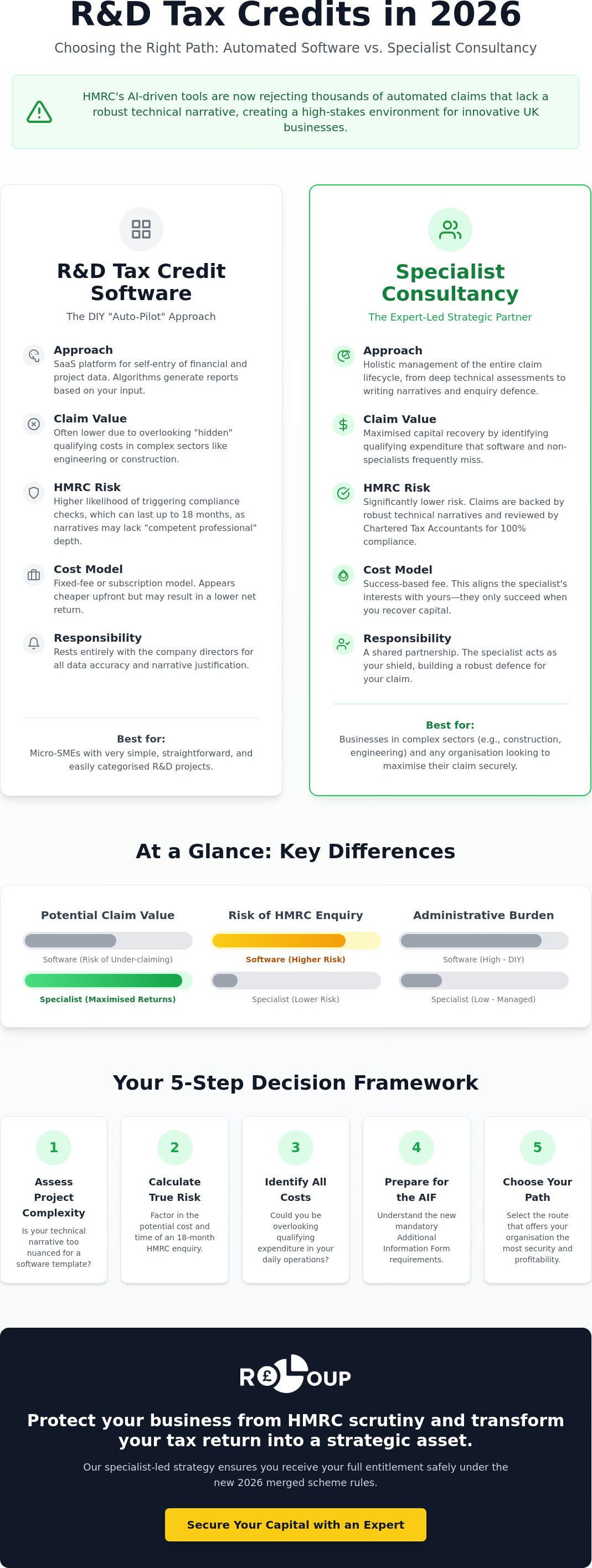
R&D tax credit software refers to SaaS platforms where you input your own financial and project data. These tools use algorithms to generate a report based on your entries. Conversely, an R&D specialist is a professional consultancy that manages the entire lifecycle of a claim. They provide deep technical assessments, write the mandatory narratives, and act as your shield during HMRC enquiries. This distinction is critical. The decision you make impacts both the final credit value and the likelihood of a lengthy, stressful compliance check.
The Rise of DIY R&D Software
These platforms have successfully lowered the barrier to entry for micro-SMEs with straightforward projects. They often operate on a subscription or fixed-fee basis. This appeals to businesses with tight margins or very simple, repetitive R&D activities. If your innovation is easily categorised, software can offer a streamlined way to organise your costs. However, the DIY nature means the responsibility for accuracy sits entirely with the company directors. It's a tool for data entry. It is not a substitute for professional tax advice.
The Role of the Specialist Consultant
A specialist takes a far more holistic view of your innovation. Beyond just crunching numbers, they uncover "hidden" qualifying costs that software might miss. This is particularly common in complex sectors like engineering or construction where R&D is woven into everyday operations. At Recoup Capital, we utilise a success-based fee model. This approach ensures our interests align with yours. We only succeed when you recover capital. Every claim we handle undergoes a rigorous review by a Chartered Tax Accountant to ensure 100% compliance with HMRC standards. This level of scrutiny is vital in 2026. HMRC's AI-driven checks are increasingly flagging automated submissions that lack a "competent professional" narrative. A specialist doesn't just file paperwork; they build a robust defence for your claim.
The Case for R&D Tax Credit Software: Speed and Cost
For many startups and micro-SMEs, the primary draw of automated platforms is the perceived saving on both time and money. When you weigh up the choice of R&D tax credit software vs specialist support, the immediate appeal of a platform is often the price tag. These tools typically offer fixed-fee or tiered subscription models. For a business with a very small, straightforward claim, this can feel more predictable than a percentage-based consultancy fee. It's a solution built for the DIY era, promising to turn a complex tax filing into a manageable task you can complete from your own desk.
Speed is the other significant factor. A software platform can often generate a report in a matter of hours once the data is uploaded. This is a stark contrast to the weeks of deep-dive consultations and technical interviews often required by high-end firms. For companies with repetitive R&D activities and easily identifiable costs, this efficiency is a major benefit. If you're unsure if your projects are too complex for a template, it’s worth exploring how claiming R&D tax credits works with a more guided approach.
Lower Upfront Costs and Subscriptions
Software provides a sense of absolute control. You see the dashboards, you track the expenditure throughout the year, and you decide exactly what goes into the final report. This "always-on" tracking is excellent for real-time monitoring of your innovation spend. However, there's a hidden risk. A lower fee often corresponds to a lower total claim value. Without a human expert to probe your projects, you might leave thousands of pounds on the table simply because you didn't know a specific cost was eligible. While the UK has its own specific framework, international standards like the IRS guidelines on the research credit demonstrate a global trend towards stricter documentation requirements that simple software often fails to meet.
Efficiency for Simple Claims
When does software truly shine? It's most effective for companies with one clear, well-documented project. If your costs are neatly tucked away in one software development programme, a platform can organise them effectively. But there is a growing danger in 2026: template fatigue. HMRC's AI tools are now highly proficient at spotting repetitive, software-generated technical narratives. If your claim looks exactly like a thousand others, it's more likely to be flagged for a manual review. Software is only as good as the data entered by the user. If that user isn't a specialist, the risk of an accidental over-claim or a missed opportunity remains high. Efficiency shouldn't come at the expense of compliance.
Why Specialists Win on Technical Nuance and Claim Maximisation
While software offers speed, it often lacks the discernment required to navigate the nuances of complex technical projects. The debate of R&D tax credit software vs specialist led-consultancy often centres on fee structures, but the real value lies in claim maximisation. A platform follows a rigid, linear path. A specialist explores the periphery of your operations to find value where you least expect it. This human-led approach ensures that every penny of qualifying expenditure is identified and defended.
Forensic accounting is another area where specialists outperform automation. Identifying indirect R&D costs, such as utilities, administrative support, and consumables, requires a deep understanding of how innovation integrates with your broader business. Software is designed for data entry. It cannot ask the probing questions that uncover these additional pockets of capital. By contrast, a specialist reviews your entire cost base to ensure no eligible expense is overlooked.
Identifying the "Hidden" R&D
Specialists excel at identifying innovation within traditional sectors like construction or engineering. In these fields, R&D isn't always found in a laboratory; it's often embedded in day-to-day problem solving and structural challenges. Software templates frequently miss these activities because they don't fit a standard "tech" profile. Recoup Capital’s expertise involves a deep technical discovery process that moves beyond simple data entry. We look for the "technological uncertainty" in bespoke structural designs or material science applications. Beyond the core staff costs, we apply forensic accounting techniques to capture indirect expenses. Utilities and specific software licences can often be apportioned to the claim. Without this human oversight, you risk a significant "lost opportunity" cost that far outweighs any subscription fee.
The Power of the Technical Narrative
HMRC's priorities have shifted. They now place immense weight on the "why" and the "how" of a project rather than just the financial totals. This requires a narrative written from the perspective of a "competent professional." Automated tools rely on templates that can feel repetitive and hollow. With HMRC using AI-driven risk assessments, software-generated text is increasingly likely to trigger a red flag. The importance of expert guidance on R&D tax credits cannot be overstated when crafting these documents. A specialist translates your team's technical achievements into a bespoke narrative that clearly demonstrates a technological advance. This tailored approach ensures your claim isn't just a set of numbers, but a compelling, compliant story of innovation. Our success-based fee model reflects this commitment to quality; we only benefit when your claim is both maximised and secured.
HMRC Compliance: The Risk of "Auto-Pilot" Claims
HMRC's approach to R&D tax relief has shifted from a light-touch regime to one of rigorous, AI-assisted enforcement. In 2026, the tax authority is actively cracking down on "erroneous" claims, particularly those generated by volume-based software tools that prioritise speed over technical accuracy. When you evaluate R&D tax credit software vs specialist led-consultancies, the most significant differentiator is the level of protection you receive. An automated platform can calculate figures based on your input, but it cannot foresee the specific technical challenges an inspector might raise during a compliance check.
This creates what we call the "Enquiry Gap." If HMRC flags your submission, software support often stops at the technicalities of the platform itself. You're left to navigate complex tax law and defend your technical decisions alone. A specialist acts as your shield, providing a robust defence that is built into the process from day one. We don't just file your claim; we stand by it as a long-term partner, ensuring your business remains protected from the emotional and financial toll of an investigation.
The Additional Information Form (AIF) Hurdle
The introduction of the mandatory AIF was specifically designed to curb fraud and ensure that only genuine innovation receives funding. This form requires highly detailed, project-specific technical narratives that must meet a stringent set of criteria. Automated tools often struggle with this requirement, frequently producing generic or repetitive answers that act as red flags for HMRC's AI scanners. A specialist ensures that your AIF is bespoke, accurate, and reflects the true nature of your innovation. At Recoup Capital, we liaise directly with HMRC on your behalf to clarify any points of uncertainty. This proactive communication is essential for maintaining transparency and securing your capital recovery without delay.
Enquiry Defence: A Human Necessity
HMRC's focus in 2026 is on the "competent professional" narrative. If your documentation sounds like it was generated by an algorithm, it's far more likely to trigger a manual review. An enquiry can last anywhere from 6 to 18 months, causing significant disruption to your operations. Unlike software providers, we provide full enquiry defence as standard, bringing technical and legal weight to your side of the table. For a deeper look at how the tax authority is evolving its audit processes, you can read our sibling article on HMRC transparency. Ensuring your claim is 100% compliant is our priority. If you value peace of mind and technical excellence, discover why a partnership-led approach is the most secure route for your business.
Decision Framework: When to Automate and When to Call a Specialist
Choosing the right path for your 2026 submission requires a pragmatic assessment of your business's specific needs. Whilst the choice of R&D tax credit software vs specialist led-consultancy may seem like a simple cost-benefit analysis, it’s actually a question of strategic alignment. To help you navigate this, we've developed a five-step checklist to determine which route offers the best protection and return for your innovation.
- Step 1: Assess the Claim Value. If your potential return is significant, the cost of a specialist is often far outweighed by the additional qualifying expenditure they identify.
- Step 2: Evaluate Technical Complexity. Does your R&D span multiple departments or involve intricate supply chains? Complex projects require a human eye to untangle.
- Step 3: Gauge Your Risk Appetite. Are you prepared to manage an HMRC enquiry independently? If the prospect of a 12-month investigation is daunting, a specialist-led defence is essential.
- Step 4: Audit Internal Resources. Do you have the internal time to master HMRC’s ever-changing guidelines? Keeping pace with 2026 regulatory shifts is a full-time commitment.
- Step 5: Verify Narrative Quality. Can you produce a "competent professional" technical narrative that meets AI-driven compliance checks? Software templates often fall short here.
Small vs. Large Claims: The Tipping Point
There is a distinct threshold where the DIY approach becomes a "false economy." For claims exceeding £50,000, the expertise of a specialist almost always pays for itself through more thorough cost identification and risk mitigation. High-value innovation often involves nuanced staff apportionments and indirect costs that software simply isn't programmed to capture. We encourage you to arrange a no-cost introductory consultation to assess your potential value. This ensures you don't leave vital capital on the table through an over-simplified filing process.
Final Verdict: The Hybrid Future
The most successful businesses in 2026 don't choose between technology and expertise; they utilise both. At Recoup Capital, we believe in a "human-in-the-loop" model. We combine efficient data collection methods with high-level technical oversight from Chartered Tax Accountants. This hybrid approach represents the gold standard for compliance. It provides the speed of modern tools with the protective shield of a long-term partner. When weighing up R&D tax credit software vs specialist options, remember that the most robust results come from combining the two. When you're ready to transform your tax return into a strategic business asset, Book an R&D assessment with Recoup Capital. We'll ensure your innovation is rewarded and your business is fully protected.
Secure Your Innovation with a Strategic Partnership
The 2026 tax landscape leaves little room for error. Whilst automated tools offer a basic framework for data entry, the ultimate decision between R&D tax credit software vs specialist consultancies comes down to your risk appetite and the value you place on your innovation. HMRC's increased focus on the Additional Information Form means that a generic technical narrative is no longer enough to guarantee safety. You need a robust, bespoke defence that translates your hard work into a compliant claim.
Recoup Capital brings together technical experts and tax professionals to ensure your claim is both maximised and protected. With our success-based fee model and a 100% enquiry defence record, we act as a long-term partner for your growth. We specialise in identifying complex R&D within traditional sectors like construction and engineering, finding capital that others often miss. This ensures you don't leave vital funds on the table through an over-simplified filing process.
Maximise your claim with a specialist R&D assessment from Recoup Capital today. Your innovation deserves a dedicated guide through the regulatory landscape. Let's turn your technical achievements into strategic financial assets together.
Frequently Asked Questions
Is R&D tax credit software HMRC-approved?
HMRC does not officially approve, accredit, or endorse any specific R&D tax credit software or specialist consultancy. The legal responsibility for the accuracy of a claim always rests with the company directors. Whilst some platforms claim to be "HMRC-ready," this simply means they follow standard filing formats. It doesn't guarantee that the technical narratives will meet the rigorous standards required for a successful 2026 submission.
Can I switch from a software tool to a specialist mid-claim?
You can transition from a software tool to a specialist at any point before your final submission to HMRC. If you've started data entry but feel the technical narrative is generic or the financial apportionments are incomplete, a specialist can step in to conduct a more thorough discovery. This is often a strategic move for businesses that realise their project complexity exceeds the capabilities of a standard template.
What are the typical fees for an R&D tax credit specialist vs software?
The fees for an R&D tax credit software vs specialist differ based on the depth of service and the level of risk mitigation provided. Software typically follows a lower, fixed-price or tiered subscription model. Specialists generally operate on a success-based percentage of the recovered tax credit. Whilst the upfront cost of software is lower, the specialist model ensures that your claim is maximised and fully defended, which often leads to a higher overall return for your business.
Does using software increase the risk of an HMRC enquiry?
Using software can increase the risk of an enquiry if the generated technical narratives are repetitive or lack specific detail. HMRC's 2026 AI-driven compliance tools are specifically designed to flag "auto-pilot" claims that use generic templates. Because software relies on user-inputted data without expert verification, it often fails to provide the "competent professional" perspective required to prove a technological advance, making a manual audit more likely.
How much time does a specialist require from my technical team?
A specialist typically requires a few hours of focused time from your technical leads to conduct thorough interviews and project reviews. This investment is crucial for identifying the specific technological uncertainties your team solved. Whilst software might seem faster by letting you fill in forms at your own pace, the specialist approach actually reduces your total administrative burden by handling the heavy lifting of narrative writing and financial calculations.
Can software handle the new 2026 merged RDEC scheme rules?
Most modern software platforms have updated their algorithms for the 2026 merged scheme, but they often struggle with the nuances of the transition. The merged rules introduce complex changes regarding subcontracted R&D and overseas expenditure restrictions. Software can calculate the 20% taxable credit, but it cannot provide the expert tax advice needed to navigate these specific regulatory hurdles or identify limited exceptions for work performed outside the UK.
What happens if HMRC rejects a claim made through software?
If HMRC rejects a software-based claim, you are typically responsible for managing the resulting enquiry and defending your technical decisions independently. Most software providers offer technical support for their platform but don't provide full enquiry defence or legal representation. This can lead to significant delays in capital recovery. A specialist provides a protective shield, defending the claim's technical merits directly with HMRC until a resolution is reached.
Why do specialists often find more R&D than software platforms?
Specialists often uncover more qualifying expenditure because they look beyond obvious laboratory projects to find innovation in day-to-day problem solving. Through forensic accounting and technical interviews, we identify R&D in complex sectors like engineering and capture indirect costs like utilities or specific administrative support. Software is limited by the data you choose to enter; a R&D tax credit software vs specialist comparison shows that human expertise reveals innovation you might have dismissed as standard practice.