
R&D and Manufacturing Overview: Navigating Innovation Incentives in 2026

UK manufacturers claim over £1.2 billion in tax relief every year; yet many firms still leave vital capital on the table because they struggle to separate routine production from genuine innovation. It's a common frustration. You've likely felt the pressure of trying to document technical breakthroughs whilst keeping the assembly line moving. This r&d and manufacturing overview provides the clarity you need to identify eligible projects with total confidence. We'll show you exactly how to navigate the 2026 compliance landscape without the fear of a looming HMRC enquiry.
Whether you're utilising the 20% Merged Scheme rate or the enhanced support for R&D intensive businesses, you deserve a framework that works as hard as your machinery. We'll explore the latest standards for the mandatory Additional Information Form and the current restrictions on overseas expenditure. By the end of this guide, you'll have a clear roadmap to transform your technical uncertainties into strategic financial assets that can be reinvested directly into your workforce and future growth.
Key Takeaways
- Identify hidden R&D opportunities within smart factory transitions and Industry 4.0 upgrades that often bypass traditional accounting.
- Navigate this r&d and manufacturing overview to clearly distinguish between routine shop-floor improvements and qualifying technical advances.
- Gain a comprehensive understanding of the 2026 Merged Scheme to ensure you capture every pound of eligible expenditure under the new single-framework rules.
- Learn to construct robust Technical Narratives that meet HMRC's heightened documentation standards and protect your business from future enquiries.
- Explore the strategic synergy between R&D Tax Credits and the Patent Box to significantly reduce your Corporation Tax on innovative products.
The Strategic Landscape of R&D in the UK Manufacturing Sector
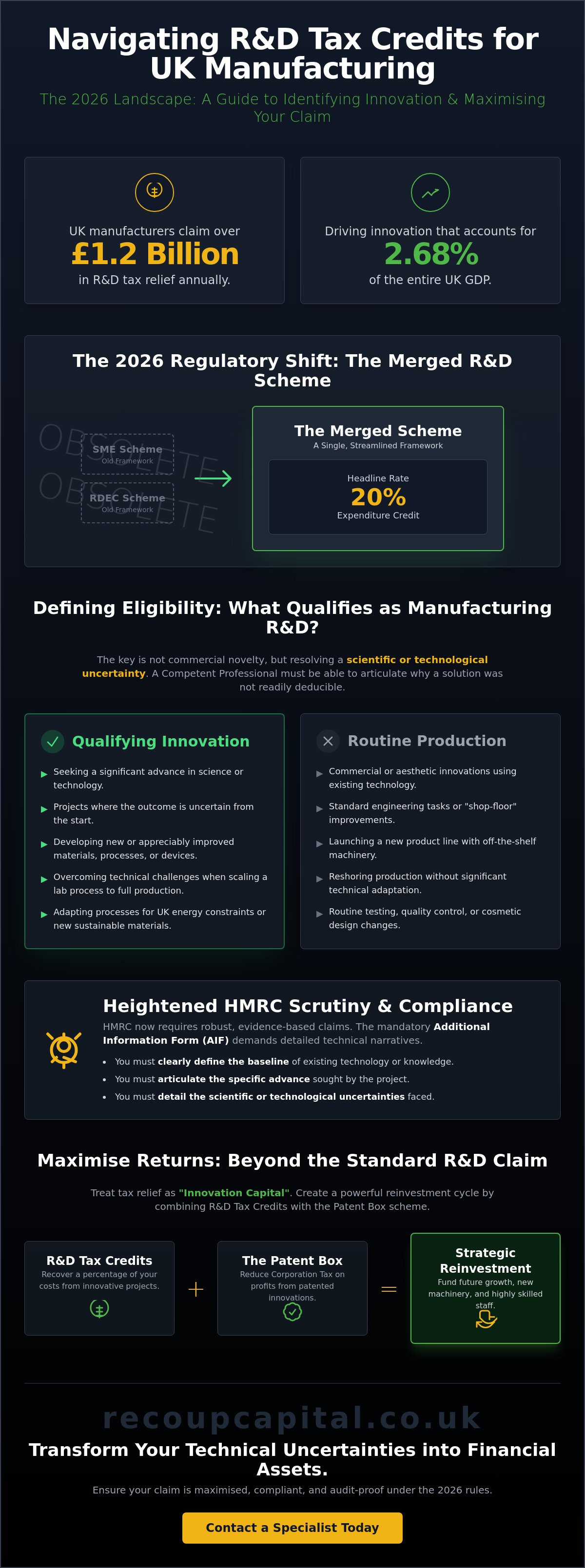
UK manufacturing isn't just a sector; it's the engine room of national growth and technological advancement. With manufacturers claiming over £1.2 billion in tax relief annually, the industry remains a primary driver of the 2.68% of GDP the UK currently spends on innovation. This r&d and manufacturing overview highlights how the landscape has shifted as we move through 2026. The arrival of Industry 4.0 has transformed the shop floor, where smart factories, AI integration, and advanced automation have blurred the boundary between standard production and high-level innovation. What once looked like a routine process upgrade might now involve complex technical uncertainties that qualify for significant relief.
The transition to the Merged R&D Scheme represents the most significant regulatory shake-up in recent years. By replacing the old SME and RDEC split with a single 20% headline rate, the government has created a more streamlined framework, yet one that demands far greater precision. Staying ahead of these changes isn't just about compliance; it's a matter of maintaining a competitive edge. As operational costs continue to rise, a proactive approach to identifying qualifying spend ensures that your business can recover vital capital to outpace global rivals.
Manufacturing Innovation as a Strategic Asset
The UK’s most successful manufacturers don't view tax relief as a simple year-end rebate. Instead, they treat it as "innovation capital." This mindset shift allows for a continuous reinvestment cycle where successful claims fund the next generation of bespoke machinery or highly skilled staff. To manage this effectively in a high-scrutiny era, many organisations are partnering with R&D tax credit specialists UK to ensure their claims are both maximised and audit-proof. This partnership approach transforms a complex regulatory hurdle into a streamlined business tool for long-term growth.
The 2026 Regulatory Climate for Manufacturers
HMRC has sharpened its focus significantly, moving away from broad interpretations toward a strict, evidence-based model. The mandatory Additional Information Form (AIF) now requires a level of technical depth that can be daunting for busy production teams. It's no longer sufficient to claim for general "process improvements." You must clearly define the specific Research and development (R&D) activities that sought to resolve a scientific or technological uncertainty.
One of the most common pitfalls in 2026 is failing to distinguish between "routine" manufacturing and genuine innovation. Whilst global supply chain shifts have encouraged many firms to reshore their activities, the act of moving production isn't R&D in itself. However, the technical challenges of adapting processes for UK energy constraints or sustainable materials often qualify. Mastering this distinction is essential for a successful R&D tax credits strategy that stands up to HMRC scrutiny.
Defining Eligibility: What Qualifies as Manufacturing R&D?
Determining what counts as R&D within a busy factory environment is often the most challenging part of the process. At its core, the incentive isn't about how "new" your product is to the market. It's about whether you sought an advance in science or technology by resolving technical uncertainty. This r&d and manufacturing overview clarifies that whilst your sales team might celebrate a commercial innovation, HMRC only cares about technical innovation. If you've launched a new product line using existing, off-the-shelf technology, it won't qualify, regardless of how much revenue it generates.
The eligibility decision rests on the "Competent Professional". This is typically a lead engineer or technical director who can explain why a solution wasn't readily deducible by someone with similar skills. As the UK looks to harness the power of research within its industrial strategy, the role of these experts in documenting technical barriers becomes vital. They must be able to articulate why a project was a step into the unknown rather than a standard engineering task.
Technical Uncertainty on the Shop Floor
Identifying unpredictable outcomes is the first step toward a successful claim. Technical uncertainty arises when the outcome of a project can't be predicted from the outset. For example, scaling up a lab-based process to high-volume production often reveals unforeseen mechanical stresses or material failures. Reducing waste through novel material blends or improving component durability under extreme conditions are classic examples of qualifying hurdles. A bespoke order for a client only becomes R&D if you've had to overcome a challenge that didn't have a known, documented solution.
Eligible Manufacturing Activities in 2026
Prototyping and testing don't stop being R&D the moment a physical object is created. The phase continues as long as you're refining the product to solve technical problems. Developing novel tooling or bespoke machinery to achieve a specific result is a high-value activity. With 60% of UK manufacturers increasing investment in digital technology and AI in 2026 (PwC UK), software integration is a growing area of interest. Customising ERP or MES systems to solve unique technical challenges often qualifies. For a broader look at these definitions, refer to our guide on R&D tax credits explained.
If you're unsure where your production stops and innovation begins, exploring your eligibility can help clarify the path forward.
Qualifying Costs and the Merged R&D Scheme Framework
The transition to the Merged R&D Scheme marks a pivotal shift for the UK supply chain. Since April 2024, the previous distinction between the SME and RDEC schemes has largely vanished, replaced by a single unified framework. For most manufacturers, this means a headline credit rate of 20% on qualifying expenditure. This r&d and manufacturing overview highlights that whilst the system is now more streamlined, the rules surrounding who can actually claim have become more nuanced, particularly regarding subcontracted and subsidised work.
One of the most significant changes involves how HMRC treats "contracted-out" R&D. Under the Merged Scheme, the right to claim generally sits with the company that makes the decision to initiate the R&D and bears the financial risk. If your firm is acting as a subcontractor, you might find you can no longer claim for activities that were previously eligible under the old SME rules. It's vital to review your commercial contracts to ensure you aren't losing out on valuable relief due to technicalities in how your projects are structured.
The Core Cost Categories for Manufacturers
Identifying qualifying expenditure requires a forensic look at your production cycle. Staff costs remain the cornerstone of most claims, encompassing gross salaries, employer NICs, and pension contributions for anyone directly involved in resolving technical uncertainties. In a factory setting, consumables are often a significant, yet overlooked, category. This includes materials, fuel, and energy transformed or "used up" during the R&D process; for instance, the scrap metal produced during failed prototype runs or the chemicals consumed in testing a new coating process. Since 2023, software licences, data sets, and cloud computing costs are also eligible, reflecting the industry's shift toward digital twins and AI-driven process simulation.
Calculating the Net Benefit in 2026
The headline 20% credit provides a net benefit of approximately 15p for every £1 of R&D spend for profitable companies after Corporation Tax is applied. For loss-making manufacturers, the credit can be surrendered for a payable cash sum, providing a vital lifeline for firms in their early growth stages or those undergoing heavy capital reinvestment. However, if your business is "R&D intensive" (spending at least 30% of total expenditure on R&D), you may still access the Enhanced R&D Intensive Support (ERIS) scheme, which offers a higher net return of up to 27p per £1.
Precision is paramount. HMRC expects you to separate R&D consumables from general production stock with absolute clarity. If you're unsure how to partition these costs, exploring your potential return with a specialist can prevent costly errors in your Corporation Tax return and ensure your claim remains robust under scrutiny.
Best Practices for Documenting Manufacturing Innovation
HMRC's approach to compliance in 2026 is proactive and data-driven. They no longer accept retrospective "best guesses" made months after a project concludes. This r&d and manufacturing overview emphasises that real-time record keeping is the only way to safeguard your claim. Your internal systems should capture the narrative of innovation as it happens, rather than trying to reconstruct it during tax season. Detailed logs that show the evolution of a project provide the necessary evidence to justify your claim's validity.
Technical Narratives are the heart of your submission. These documents shouldn't be written by your marketing team; they need to speak the language of HMRC inspectors. Focus on the specific technological uncertainties you encountered and the systematic process used to resolve them. Avoiding the "boilerplate" trap is essential. Generic descriptions that could apply to any factory in the UK are a fast track to an enquiry. Instead, provide specific details about the bespoke machinery adjustments or material failures that occurred during your trials.
Building a Robust Evidence Portfolio
Capture every digital "breadcrumb" generated during the development cycle. CAD drawings, version-controlled software code, and test logs are invaluable. Even email trails discussing technical hurdles can serve as evidence. Timesheets are particularly vital for justifying staff cost allocations, especially when employees split their time between R&D and standard production. To ensure your records meet the latest standards, consider how HMRC R&D tax claim transparency and AI tools are being used to flag inconsistencies in documentation. Digital accuracy is your best defence.
Preparing for an HMRC Enquiry
Modern manufacturing claims often trigger red flags if they show high consumable-to-staff ratios without clear justification. If your claim involves significant material waste from prototype failures, your documentation must explain why that waste was a necessary part of the R&D process. Conduct a "mock enquiry" internally to test the strength of your evidence before submitting your CT600. This proactive step helps identify gaps in your narrative that an inspector might question. A specialist review ensures your technical descriptions align with current legislation, providing peace of mind whilst protecting your financial return.
If you want to ensure your records are audit-ready, book a documentation review to verify your evidence portfolio.
Maximising Returns: Beyond the Standard R&D Claim
Successful manufacturers treat tax planning as a strategic discipline rather than a year-end box-ticking exercise. Whilst R&D tax credits offer immediate capital recovery, they frequently act as a gateway to a broader suite of valuable incentives. This r&d and manufacturing overview highlights that a siloed approach to tax often leaves significant capital on the table. By taking a holistic view of your financial position, you can transform regulatory compliance into a long-term engine for industrial growth. Reinvesting these combined returns into new machinery or specialised staff creates a virtuous cycle of innovation that is difficult for competitors to match.
The goal is to move beyond seeing a refund as a one-off windfall. Instead, it should be viewed as a strategic asset. When you align your technical breakthroughs with your wider tax strategy, you secure the liquidity needed to scale operations and navigate the economic pressures of 2026. This integrated approach ensures that every pound spent on resolving technical uncertainty works twice as hard for your bottom line.
Patent Box and Intellectual Property
If your R&D projects result in a patented invention, the Patent Box scheme allows you to apply a reduced 10% effective rate of Corporation Tax to the profits derived from those products. The R&D process naturally generates the technical breakthroughs required for patents; however, many firms fail to connect the two. Integrating your IP strategy with your R&D documentation ensures you're prepared to claim this relief as soon as a patent is granted. It's a powerful synergy that rewards the entire lifecycle of innovation, from the initial prototype to the final commercial sale.
Capital Allowances and Land Remediation
Manufacturing is inherently asset-heavy. Beyond the product itself, you can claim Capital Allowances on the "embedded" costs within your facility. This includes essential infrastructure like heating, power systems, and specialised ventilation that keeps your production lines running. If you're expanding or developing new manufacturing sites, Land Remediation Relief can provide up to 150% tax deduction for the costs of clearing contaminated land or removing asbestos from derelict buildings.
Understanding why to claim multiple reliefs simultaneously is essential for maximising your cash flow. These incentives aren't mutually exclusive; they're complementary tools designed to support every stage of industrial development. Combining these returns creates a substantial strategic asset that can be used to fund your next breakthrough or secure your position amongst the UK's leading innovators. Taking this broad perspective ensures you never miss an opportunity to strengthen your business's future.
Transforming Technical Uncertainty into Industrial Growth
The 2026 landscape for UK industry demands a proactive shift in behaviour. Whilst the technical challenges on your shop floor remain complex, the opportunity to recover vital capital has never been more significant. This r&d and manufacturing overview has highlighted the necessity of precision in your documentation and the strategic advantage of stacking incentives like the Patent Box and Capital Allowances. Moving forward, the goal is to integrate these financial returns into your long-term innovation strategy; ensuring your business remains resilient amongst global competition.
Navigating the Merged Scheme and the mandatory Additional Information Form doesn't have to be a burden. Our specialist chartered tax accountants provide the professional authority needed to secure your claim, backed by a proven track record with HMRC enquiries. We operate on success-based fees, meaning we only succeed when you do. Book a no-cost R&D assessment for your manufacturing business today to uncover the hidden value in your production cycles. Let's work together to turn your technical uncertainties into the strategic assets that fuel your next breakthrough.
Frequently Asked Questions
What is the difference between R&D and routine manufacturing?
Routine manufacturing involves using proven processes to create products; whilst R&D requires you to overcome a technical hurdle that doesn't have a known solution. If your lead engineer cannot predict the outcome of a process change without experimentation; you're likely in the R&D zone. Routine work focuses on production volume and consistency. Conversely; R&D focuses on resolving scientific or technological gaps through systematic testing and trial.
Can we claim for R&D if we are a subcontractor for a larger manufacturer?
Under the 2026 Merged Scheme rules; the right to claim generally belongs to the entity that initiates the R&D and bears the financial risk. If you are a subcontractor performing work directed by a larger manufacturer; you may not be eligible unless you are the one resolving the technical uncertainty. It's essential to review your commercial contracts to determine who holds the right to the R&D expenditure in the eyes of HMRC.
Do we need a laboratory or a dedicated R&D department to qualify?
You don't need a white-coat laboratory or a formal R&D department to qualify for tax relief. Most manufacturing innovation happens directly on the shop floor amongst the machinery and production lines. If your engineers are experimenting with material blends or adjusting bespoke tooling to achieve a specific technical result; those activities qualify. Eligibility is defined by the nature of the technical work; not the specific room in which the experimentation occurs.
How far back can a manufacturing company claim R&D tax credits?
Manufacturing companies can typically claim for the two previous accounting periods. This means you have a rolling window to identify and document qualifying expenditure before the statutory deadline passes. It's a vital part of any r&d and manufacturing overview to ensure you don't miss out on historical capital recovery. Acting quickly allows you to secure these strategic assets for reinvestment in your current operations and future growth.
What happens if our R&D project was a technical failure?
Technical failure doesn't disqualify your project; in fact; it often provides the strongest evidence that technical uncertainty existed. HMRC rewards the attempt to innovate; not just the final success. As long as your team was systematically trying to resolve a scientific or technological gap; the costs remain eligible. Documenting why a project failed is just as important as documenting a breakthrough for a robust and compliant R&D tax credit claim.
How does the Merged R&D Scheme affect manufacturing companies in 2026?
The Merged Scheme simplifies the landscape by providing a single 20% headline credit rate for almost all UK manufacturers. This r&d and manufacturing overview clarifies that the change provides a net benefit of approximately 15p per £1 of spend for profitable firms. For loss-making companies; the credit can be surrendered for a payable tax credit. This 2026 framework ensures a more consistent approach to innovation incentives across the entire manufacturing supply chain.
Can we claim for materials used during the testing phase of a new product?
You can claim for consumables such as raw materials; chemicals; and energy that are transformed or "used up" during your R&D trials. If a prototype run results in scrap metal or wasted components; these costs are generally eligible expenditure. However; you cannot claim for materials that are eventually sold to a customer as part of a finished product. Precise record-keeping is required to separate these R&D-specific materials from your general production stock.
How long does it take for HMRC to process a manufacturing R&D claim?
HMRC typically aims to process R&D tax relief claims within 28 to 40 days of submission. This timeline can fluctuate depending on the complexity of your technical narrative and whether an Additional Information Form was correctly filed. Ensuring your documentation is audit-ready from the start helps prevent unnecessary delays. Once approved; the credit is either applied to your Corporation Tax bill or paid as a cash sum directly to your business.