
How Long Does an R&D Tax Claim Take? The 2026 UK Timeline Guide

Did you know that HMRC is now reviewing 20% of all R&D claims, a rate roughly 40 times higher than before the pandemic? When you're managing a growing business, the primary question is rarely about the policy itself, but rather: how long does an R&D tax claim take to reach the bank account? You likely feel the pressure of cash flow uncertainty whilst trying to decipher complex tax jargon and gather technical data. It's a significant administrative burden that can feel like a distraction from your core mission of innovation.
We recognise that waiting for capital recovery shouldn't be a guessing game. This guide provides the exact 2026 UK timeline, from the initial data collection stages to final HMRC payment. You'll discover why some claims resolve within the 40-day target whereas others face longer scrutiny under the new merged scheme. We will walk you through the preparation requirements, typical processing windows for ERIS and RDEC, and the strategic steps you can take to ensure your claim is processed with maximum efficiency and minimal delay.
Key Takeaways
- Define the three-act lifecycle of a claim and understand why the internal clock begins at data collection rather than at the point of submission.
- Navigate the 2026 benchmarks for SME and RDEC schemes, including how HMRC’s 40-day processing target impacts your immediate cash flow.
- Discover exactly how long does an R&D tax claim take during peak filing periods and how a high-quality technical narrative prevents lengthy enquiries.
- Identify the common CT600 filing errors and mandatory Additional Information Form requirements that often cause avoidable delays or system rejections.
- Learn how partnering with specialists can transform your claim into a strategic asset by identifying qualifying costs with speed and precision.
Understanding the R&D Tax Credit Timeline: Preparation to Payment
Many directors ask, "how long does an R&D tax claim take?" expecting a simple number of weeks from HMRC. In reality, the process is a three-stage lifecycle: internal preparation, technical filing, and government processing. Whilst HMRC has specific targets for their side of the desk, the true timeline begins the moment you decide to identify qualifying activity. This end-to-end journey relies heavily on your internal data readiness and how well you align the submission with your financial year-end.
Phase 1: The Internal Preparation Period
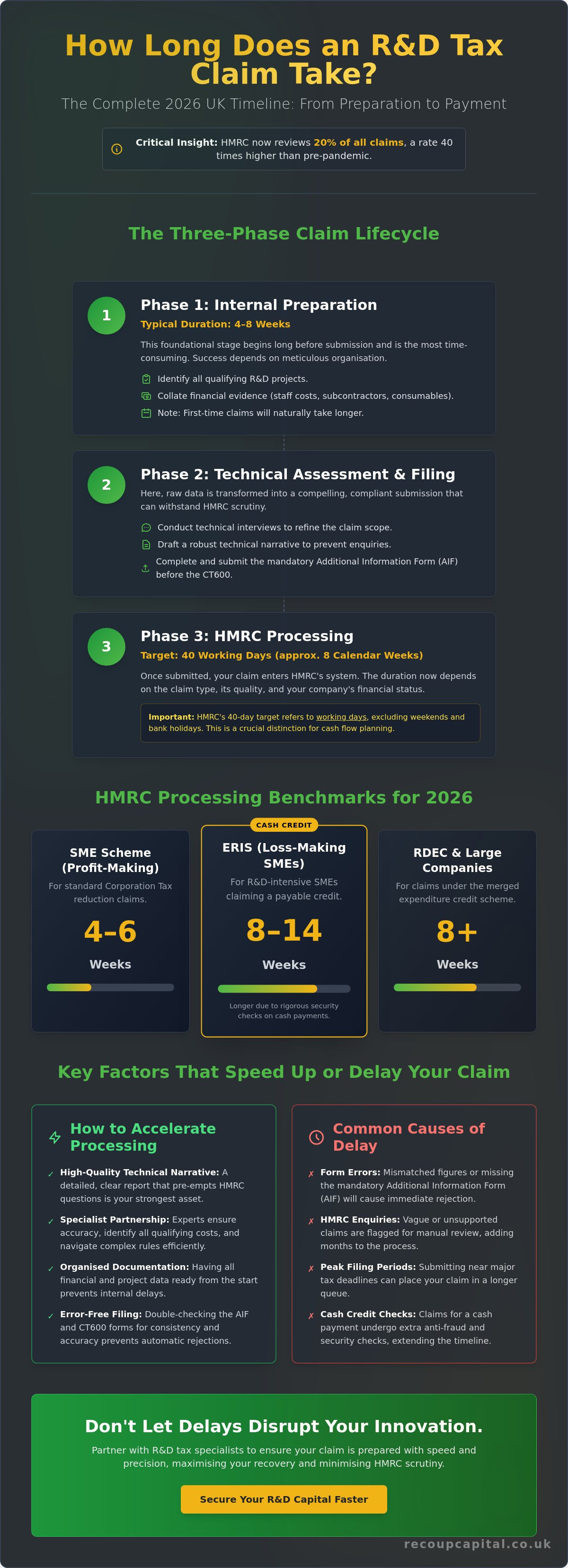
The clock doesn't start when you hit "submit" on a tax return. It starts during the data collection phase. For an established company, this initial stage typically takes between four and eight weeks. You must identify qualifying projects that meet the criteria for R&D Tax Credits, which involves digging through technical logs and project timelines. This is often the most time-consuming part of the process because it requires input from both your finance and technical teams.
You'll also need to collate financial evidence across several categories:
- Gross staff costs and pension contributions for those directly involved.
- Expenditure on subcontractors and externally provided workers.
- Consumable items, such as materials or software licences, used in the R&D process.
First-time claims naturally take longer as you establish a methodology for tracking these costs. Repeat claims are often swifter because the administrative framework is already in place. Knowing how long does an R&D tax claim take at this stage depends entirely on how quickly your team can organise the necessary documentation.
Phase 2: The Technical Assessment and Filing
Once the data is gathered, the technical assessment begins. This involves interviews with your lead engineers or developers to refine the claim scope. These conversations ensure that every technological uncertainty is documented correctly to withstand HMRC scrutiny. A robust technical narrative is your best defence against delays later in the process.
Before the CT600 corporation tax return is filed, you must complete the mandatory Additional Information Form (AIF). This digital form requires detailed project descriptions and a breakdown of costs. Missing this step leads to an automatic rejection by HMRC's systems. Having R&D tax credits explained by a specialist helps ensure this phase moves quickly and accurately.
When reviewing HMRC communications, distinguish between "working days" and "calendar days". HMRC’s 40-day target refers only to working days. This means a 40-day window actually spans eight weeks on the calendar, excluding bank holidays. Understanding this distinction prevents frustration whilst you wait for your strategic capital to be released.
HMRC Processing Times for SMEs and Large Companies (RDEC)
In 2025, HMRC exceeded its internal goals by processing 90% of R&D claims within a 40-day window. As we progress through 2026, the answer to how long does an R&D tax claim take has become more nuanced due to the full implementation of the merged scheme. Whilst the system is now more streamlined for many, the speed of your capital recovery still depends heavily on your company's financial profile and whether you're seeking a cash payment or a tax offset.
SME Scheme Processing Benchmarks
The standard benchmark for most profit-making SMEs remains 4 to 6 weeks. This period covers the initial review where HMRC's automated systems and caseworkers verify your Additional Information Form (AIF) against the figures in your CT600. You can refer to the official government guidance to ensure your submission meets every technical requirement, as even minor discrepancies can trigger a manual hold.
You'll know your claim has moved from "received" to "processing" when there's an update in your Government Gateway account or when a caseworker is assigned. For loss-making SMEs qualifying for Enhanced R&D-Intensive Support (ERIS), the timeline is slightly longer. These businesses should expect a wait of 8 to 14 weeks. This is because cash credit payments undergo more rigorous security checks than simple tax reductions.
RDEC and Large Company Timelines
Large companies and those claiming under the Research and Development Expenditure Credit (RDEC) typically face a longer wait, often between 8 and 12 weeks. The complexity of large-scale corporate structures and the significant volume of qualifying expenditure mean HMRC’s Wealthy, Mid-Sized and Business (WMBC) teams take a more granular approach to verification. If your claim involves intricate group accounting or international subcontractors, the window can occasionally extend beyond 90 days.
Despite these variables, understanding why claim R&D tax credits remains vital for long-term growth. The credit isn't just a refund; it's a strategic asset that fuels future innovation. Generally, a tax offset is processed faster than a cash refund. Cash payments require an additional layer of anti-fraud validation, which can add 10 to 14 working days to the final stage of the process. If you're unsure which route your business falls under, consulting our frequently asked questions can provide immediate clarity on your specific situation.
Key Factors That Can Speed Up or Delay Your Claim
While we've established the general benchmarks for 2026, several variables dictate exactly how long does an R&D tax claim take in practice. It's rarely a linear path. Your industry, the timing of your submission, and even the clarity of your technical writing play pivotal roles in how quickly HMRC releases your funds. Understanding these levers allows you to position your business for the swiftest possible recovery.
Seasonality and HMRC Capacity
HMRC capacity isn't static. It fluctuates significantly based on the time of year. March and December represent the peak seasons for corporate filings because they align with the most common financial year-ends in the UK. During these windows, the volume of submissions can create temporary bottlenecks. If you file your claim during these periods, you might find yourself at the back of a very long queue whilst caseworkers work through the backlog.
Conversely, filing in the off-season, such as the summer months, often results in faster payouts. There is simply less competition for caseworker attention. You should also consider that government budget changes can shift HMRC processing priorities overnight. If a new regulation is being rolled out, staff may be redirected, which naturally extends wait times. Planning your filing to avoid the end-of-year rush is a simple yet effective strategy for maintaining cash flow predictability.
Sector-Specific Complexity and Technical Depth
Certain industries face more scrutiny than others. If your business operates in software development or biotech, the R&D is often obvious. However, sectors like construction and engineering often inhabit a grey area of innovation. Proving technical uncertainty amongst standard building practices is a complex task. You aren't just documenting a project; you're proving that the solution wasn't readily deducible by a competent professional in the field.
These grey area claims require significant technical depth. If your narrative is vague, HMRC is far more likely to open an enquiry, which can extend the timeline from weeks to months. Providing concrete examples and clear data from the start is essential when claiming R&D tax credits in complex sectors. For smaller businesses, applying for Advanced Assurance can be a game-changer. This voluntary check gives you a guarantee that HMRC will accept your claims for the first three years, provided they match what was agreed. It's a proactive way to remove uncertainty and accelerate future payments, transforming your R&D returns into a reliable strategic asset.
How to Minimise Delays and Navigate HMRC Scrutiny
Identifying qualifying innovation is only the first step. The administrative precision of your filing ultimately dictates how long does an R&D tax claim take to move from submission to settlement. Since the introduction of the mandatory Additional Information Form (AIF), the margin for error has effectively vanished. If you attempt to file a CT600 corporation tax return without a valid AIF reference, HMRC's systems trigger an automatic rejection. This isn't merely a minor setback; it resets your processing clock and can flag your business for increased scrutiny.
Common errors in the CT600, such as mismatched figures or incorrect box entries, remain a leading cause of avoidable delays. These technical glitches force a manual caseworker review, which immediately pushes your claim outside the standard 40-day target. By employing forensic accounting techniques during the preparation phase, you can ensure that every penny of staff cost and subcontractor expenditure is perfectly categorised and evidenced before it reaches a caseworker's desk.
The Compliance Checklist for Faster Processing
Speed and quality are inextricably linked. Your technical narrative must mirror the "Guidelines on the Meaning of R&D" with absolute clarity. Avoid generic descriptions of your projects. Instead, focus on the specific technological uncertainties you encountered and how you attempted to overcome them. This level of detail prevents the "back-and-forth" queries that often stall progress for weeks.
Ensure your subcontractor costs are split correctly between qualifying and non-qualifying activities. Many businesses lose time during the review phase because they cannot provide a clear audit trail for externally provided workers. A specialist review before you hit submit ensures that your claim is "enquiry-proofed" from the outset. This proactive organisation transforms your claim from a piece of paperwork into a strategic financial asset.
Handling HMRC Enquiries Without the Stress
It is a sobering fact that compliance enquiries are occurring at 40 times the levels seen before the pandemic. HMRC is currently reviewing roughly 20% of all claims. If your submission is selected for a check, it can add anywhere from 6 to 18 months to your capital recovery timeline if handled poorly. Whilst this sounds daunting, an enquiry is simply a request for verification rather than an accusation of wrongdoing.
You should remain proactive and transparent. Provide the requested technical logs, payroll data, and project specifications as quickly as possible to maintain momentum. Understanding the shift toward HMRC R&D tax claim transparency and AI is vital for any modern business navigating this landscape. If you're worried about the robustness of your technical evidence, reach out for a confidential assessment to ensure your claim stands up to the highest standards of professional scrutiny.
Why Partnering with R&D Tax Specialists Accelerates Your Recovery
Navigating the complexities of the 2026 tax landscape requires more than just a standard accounting spreadsheet. When you evaluate how long does an R&D tax claim take, the efficiency of your advisory team is often the deciding factor between a swift payment and a protracted enquiry. Whilst generalist accountants provide essential services for daily operations, they often lack the technical depth required to translate engineering challenges into tax-compliant narratives. Specialists bridge this gap by speaking the language of your developers and engineers, identifying qualifying costs that might otherwise be overlooked.
A primary benefit of this partnership is the alignment of incentives. By operating on a success-based fee structure, we ensure that our goals are perfectly synced with your need for speed and accuracy. There is no incentive to delay. Instead, the focus remains on producing a robust, high-quality submission that passes through HMRC’s automated filters without friction. This approach minimises the administrative burden on your internal staff, allowing them to remain focused on their core innovative work whilst we handle the technical heavy lifting.
Beyond the Paperwork: Strategic Partnership
We view R&D returns as much more than a simple refund. They are strategic assets that fuel business growth and reinvestment. By managing the entire liaison process with HMRC on your behalf, we protect your time and provide a buffer against the stress of regulatory scrutiny. This relationship-first approach transforms a complex compliance task into a streamlined opportunity for capital recovery. For businesses looking beyond tax relief, our expertise in Recoup Capital Corporate Finance can help integrate these returns into a broader strategy for long-term financial health.
Ready to Start Your Claim?
The biggest mistake any business can make is waiting until the two-year filing deadline is looming. Procrastination often leads to rushed data collection and a higher risk of technical errors, which inevitably extends the question of how long does an R&D tax claim take. Starting early allows for a more detailed forensic review of your expenditure, ensuring 100% compliance whilst maximising the value of your claim.
Our process begins with a no-cost introductory assessment to determine your eligibility and potential claim value. This low-friction entry point provides immediate clarity without any upfront financial commitment. We are here to act as your protective guide through the regulatory landscape, ensuring your innovation is rewarded with the capital it deserves. If you're ready to accelerate your business growth, book a consultation with our R&D specialists today and secure your company's future.
Secure Your Business Future with Confidence
Understanding how long does an R&D tax claim take involves more than just watching the calendar. It's about mastering the three distinct stages of preparation, technical filing, and HMRC processing. We've seen that whilst HMRC aims for a 40-day turnaround, the quality of your technical narrative and the precision of your Additional Information Form ultimately determine your success. By aligning your claim with your financial year-end and avoiding peak filing seasons, you can significantly reduce wait times and improve your cash flow predictability.
Navigating these regulatory complexities doesn't have to be a solo journey. Our expert team of chartered tax accountants specialises in identifying qualifying innovation across sectors like construction and engineering, ensuring every claim is robust and compliant. With our success-based fee structure, we're invested in your speed and results from day one. Don't leave your capital recovery to chance. It's time to treat your tax returns as strategic assets for future growth. Start your R&D tax credit assessment with Recoup Capital and turn your technical uncertainties into a tangible competitive advantage.
Frequently Asked Questions
How long does it take HMRC to pay out R&D tax credits in 2026?
HMRC maintains a target to process 85% of R&D tax relief claims within 40 days. For most profit-making SMEs, the end-to-end journey from submission to payment typically concludes within 4 to 6 weeks. However, if you are a loss-making SME using the Enhanced R&D-Intensive Support route, you should prepare for a longer verification window of 8 to 14 weeks.
Can I speed up my R&D tax credit claim?
You can accelerate your recovery by ensuring your Additional Information Form is submitted correctly before your CT600. Filing during the "off-season" summer months rather than the March or December peaks also reduces the time your claim spends in the HMRC queue. When asking how long does an R&D tax claim take, remember that internal data readiness is the most effective lever you can pull to gain speed.
Does an HMRC enquiry stop the whole claim timeline?
Yes, an enquiry effectively pauses the standard processing clock whilst a caseworker conducts a manual review. This can extend the resolution of your claim by 6 to 18 months depending on the complexity of the query. Providing technical logs and project evidence immediately upon request is the best way to regain momentum and satisfy HMRC's requirements.
How far back can I claim R&D tax credits?
You can generally submit a claim for the two previous accounting periods. This means you have a two-year window from the end of the accounting period in which the qualifying R&D activity took place. Missing this deadline is a common mistake that prevents businesses from recovering significant strategic capital.
What is the Additional Information Form and does it take long to complete?
The Additional Information Form is a mandatory digital submission that provides HMRC with the technical and financial details of your projects. Whilst the form itself is straightforward to navigate, gathering the necessary evidence and drafting the technical narratives often takes 4 to 8 weeks for a first-time claimant. Accuracy here is vital to avoid automatic system rejections.
Is the R&D claim timeline different for construction companies?
The processing targets remain the same, but construction claims often face a longer preparation phase due to the "grey area" nature of the innovation. HMRC caseworkers frequently apply higher levels of scrutiny to distinguish standard building practices from genuine technological uncertainties. This means your technical narrative must be exceptionally detailed to avoid lengthy back-and-forth queries.
Will I receive the money as a cash payment or a tax reduction?
Profit-making companies usually receive the benefit as a reduction in their Corporation Tax liability, which is often processed swifter than a cash payment. Loss-making companies can surrender their losses for a payable cash credit. This route typically adds 10 to 14 days to the final stage of the process as HMRC conducts additional anti-fraud validations on cash outflows.
How much time will my internal team need to spend on the claim?
Your technical leads should expect to spend roughly 2 to 4 hours in interviews to define the project scope. Your finance team will likely need a few days to collate payroll data and subcontractor invoices. Partnering with a specialist reduces this internal burden, as we handle the technical writing and HMRC liaison to determine how long does an R&D tax claim take for your specific circumstances.