
Penalties for Incorrect R&D Claims: A 2026 Guide to HMRC Compliance

In 2026, HMRC penalties are no longer just about the numbers; they're a test of corporate behaviour and digital transparency. With the total number of R&D claims dropping by 26% according to recent government data, the tax authority has sharpened its focus on rigorous compliance and the accuracy of the mandatory Additional Information Form. You might feel a growing sense of anxiety regarding potential enquiries or the complexity of the Merged R&D Scheme. It's a valid concern, especially as penalties for incorrect R&D claims can range from 30% for careless errors to a staggering 100% for deliberate and concealed inaccuracies.
The legal concept of "reasonable care" has become your most vital defence. HMRC doesn't expect you to be a tax expert, but they do expect you to act as a prudent business owner would. This involves keeping contemporaneous records and seeking specialised professional advice; for businesses with US requirements, Nationwide Tax Relief Co offers expert tax resolution services. If you can't demonstrate this level of diligence, the penalties for incorrect R&D claims can escalate quickly. HMRC views a lack of oversight as a behavioural failure, and they've made it clear that "I didn't know" is no longer a valid excuse for inaccuracies in your filing.
We believe that regulatory procedures shouldn't be a barrier to your innovation or business growth. This guide will help you understand the specific financial and legal risks of inaccurate submissions whilst showing you how to safeguard your business from scrutiny. You'll gain a clear understanding of the current penalty tiers, learn actionable steps to rectify past mistakes, and discover a framework for future compliant claiming. By transforming these intimidating requirements into a structured process, you can focus on what matters most: driving your business forward with confidence.
Key Takeaways
- Understand how the Merged R&D Scheme has unified compliance standards, shifting HMRC's focus towards rigorous veracity checks for all businesses.
- Learn how the behavioural framework determines penalties for incorrect R&D claims, with fines ranging from 0% for reasonable care to 100% for deliberate concealment.
- Discover why the Additional Information Form is the new digital gatekeeper and how to accurately document your scientific or technological advances.
- Identify proactive steps to mitigate risk, including the implementation of an internal R&D policy and conducting forensic health checks on past submissions.
- Explore how a specialist partnership can align your innovation goals with long-term compliance, turning tax relief into a secure strategic asset.
HMRC’s Compliance Landscape: R&D Tax Relief in 2026
HMRC's approach to R&D Tax Credits has undergone a radical transformation. Gone are the days of volume-based processing where claims were largely accepted at face value. In 2026, the tax authority prioritises "veracity" above all else. This shift is reflected in the data; government statistics show that the total number of claims fell by 26% in the 2023-24 period, marking the lowest level in nearly a decade. HMRC now employs advanced AI and data analytics to scan every submission for anomalies, comparing your expenditure against specific industry benchmarks. These digital tools are specifically designed to catch the types of errors that lead to penalties for incorrect R&D claims, ensuring that only genuine innovation receives funding.
The legal concept of "reasonable care" has become your most vital defence. HMRC doesn't expect you to be a tax expert, but they do expect you to act as a prudent business owner would. This involves keeping contemporaneous records and seeking specialised professional advice. If you can't demonstrate this level of diligence, the penalties for incorrect R&D claims can escalate quickly. HMRC views a lack of oversight as a behavioural failure, and they've made it clear that "I didn't know" is no longer a valid excuse for inaccuracies in your filing.
The Impact of the Merged R&D Scheme on Risk
For accounting periods beginning on or after 1 April 2024, the separate SME and RDEC schemes have been unified into a single framework. This isn't just an administrative update; it's a centralisation of compliance standards. Whether you're a startup or a multinational, you're now measured against the same rigorous criteria. Transparency regarding subcontracted activities is now mandatory, and 2026 claims require more granular, project-level data than ever before. You must prove the specific "Scientific or Technological Advance" for every individual project, rather than providing a broad departmental summary that lacks technical depth.
HMRC’s "Volume Provider" Crackdown
HMRC has stepped up its efforts to identify claims prepared by high-risk or unregulated agents. In 2026, your choice of partner acts as a primary compliance signal to the tax office. If your claim is prepared by an agent known for "cookie-cutter" technical narratives, it's far more likely to be flagged for a full enquiry. These generic descriptions fail to capture the unique technical uncertainties your team faced and overcome. Using a specialist who understands the forensic requirements of the R&D tax credits process is now a strategic necessity to ensure your claim stands up to scrutiny whilst protecting your professional reputation.
Calculating the Penalties: The Behavioural Framework
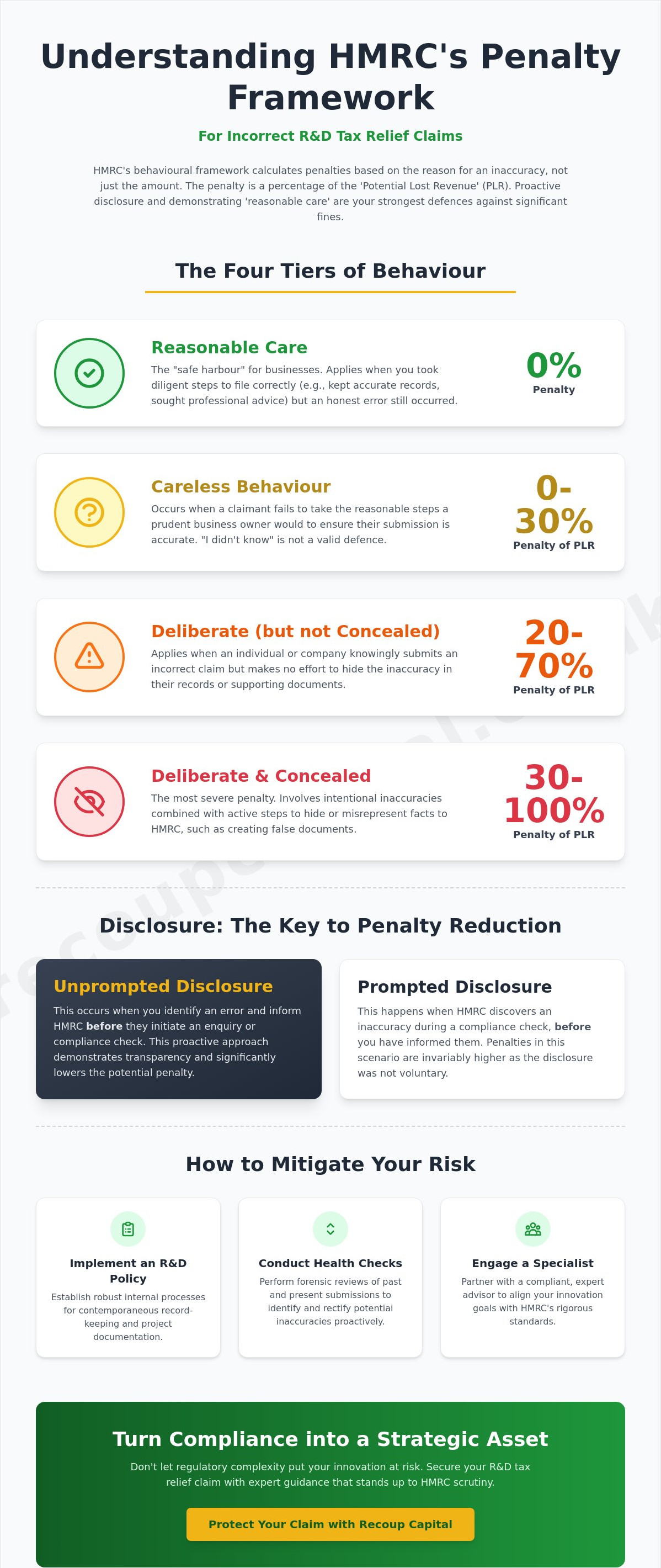
HMRC doesn't apply fines as a flat rate. Instead, they use a behavioural framework to determine penalties for incorrect R&D claims. The penalty is calculated as a percentage of the "potential lost revenue" (PLR). This represents the amount of tax that would have been lost to the Exchequer if the error had gone undetected. It's a system designed to punish dishonesty whilst protecting those who make genuine, honest mistakes. HMRC evaluates the narrative behind the numbers to decide if an inaccuracy was a simple slip-up or a calculated attempt to inflate a claim.
The distinction between prompted and unprompted disclosure is a critical factor in the final assessment. If you identify an error and report it to HMRC before they initiate an enquiry, it's classed as an unprompted disclosure. This proactive approach significantly lowers the penalty floor. Conversely, if HMRC discovers the inaccuracy during a compliance check, the disclosure is prompted, and the financial consequences are invariably higher. According to HMRC's Compliance Handbook, the tax office has the discretion to reduce penalties based on the quality of your cooperation.
Penalty Tiers and Percentage Ranges
- Reasonable Care: 0% penalty. This is the "Safe Harbour" for companies that kept accurate records and sought professional advice but still made an error.
- Careless Behaviour: 0% to 30% of the potential lost revenue. This applies when a claimant fails to take reasonable steps to ensure their submission is accurate.
- Deliberate but not Concealed: 20% to 70% of the potential lost revenue. This tier is for inaccuracies made intentionally but without an active attempt to hide them.
- Deliberate and Concealed: 30% to 100% of the potential lost revenue. This is the most severe tier, reserved for cases involving the falsification of documents or intentional hiding of facts.
Factors That Mitigate or Increase the Fine
HMRC uses a "Quality of Disclosure" test to decide where a fine sits within a percentage range. They look at three specific actions: telling them about the error, helping them quantify the loss, and giving them full access to records. A history of compliant filing can also work in your favour, potentially leading to a suspended penalty for careless errors. If you're unsure where your current documentation sits on this scale, we can help you understand the R&D tax credits process in more detail.
Verifying your agent's credentials is now a cornerstone of a "Reasonable Care" defence. HMRC increasingly expects directors to perform due diligence on their tax partners. If you use an unregulated agent who lacks technical expertise, HMRC may argue you haven't taken reasonable care, making you vulnerable to penalties for incorrect R&D claims. Choosing a partner with a transparent, forensic methodology is a strategic move that protects your business from being categorised as careless or deliberate during an enquiry.
The Additional Information Form (AIF): The Digital Compliance Gate
The AIF is the mandatory digital portal through which every claim must pass. It's no longer a supplementary document; it's the primary evidence base for your submission. HMRC uses this data to feed their risk-assessment algorithms, which scan for inconsistencies at a granular level. If the narrative is thin or the numbers don't align with industry norms, the system flags the claim for a human inspector. This is where penalties for incorrect R&D claims often originate. The form requires you to name a senior officer within the company who takes responsibility for the accuracy of the claim. This ensures accountability at the board level, making it essential for directors to have a clear grasp of the R&D tax credits explained in their technical reports.
Common AIF Errors That Trigger Enquiries
Many businesses fall into the trap of using vague language that fails the "Baseline" vs "Advance" test. HMRC's inspectors are looking for a clear "Scientific or Technological Advance." If your technical description doesn't explicitly define the industry baseline and how your project moved beyond it, you're inviting an enquiry. Another common pitfall involves the miscategorisation of Externally Provided Workers (EPWs) or subcontractors. Since the introduction of the Merged R&D Scheme, the rules around who can claim for these costs have tightened considerably. Failing to link specific costs to specific project activities is seen as a lack of reasonable care. According to HMRC's penalty framework, these types of careless inaccuracies can lead to significant financial adjustments and reputational damage.
Documentation Standards for 2026
In 2026, retrospective spreadsheets are no longer sufficient. HMRC expects contemporaneous project records that document the R&D process as it happens. This includes meeting minutes, version control logs, and technical specifications created during the development phase. We view this requirement not as a hurdle, but as an opportunity to showcase the genuine innovation occurring within your business. It's also vital to document "failed" projects. These are often the strongest evidence of authentic R&D intent because they demonstrate a genuine technical uncertainty that couldn't be easily resolved. Finally, ensure your R&D narratives align perfectly with your CT600 tax return. Any discrepancy between the technical report and the financial filing is a major red flag. By maintaining these high standards, you protect your business from the risk of penalties for incorrect R&D claims whilst building a robust case for your innovation incentives.
Mitigating Risk: Defending Your R&D Claim
Defending your claim starts long before an inspector knocks on your door. In the current climate of heightened scrutiny, establishing a robust internal R&D policy is the most effective way to prove you've exercised "Reasonable Care." This policy should outline how you identify qualifying projects, how you track technical uncertainties, and how you apportion costs. By formalising these processes, you create a paper trail that protects your business from the most severe penalties for incorrect R&D claims. We also recommend conducting a forensic "health check" on any claims submitted within the last two years. This allows you to identify potential vulnerabilities whilst you still have the opportunity to make an unprompted disclosure.
If you discover an inaccuracy through this review, reporting it to HMRC voluntarily is a strategic move. It demonstrates transparency and can significantly reduce, or even eliminate, financial fines. Voluntary disclosure is always viewed more favourably than errors uncovered during a forced audit. For more insights on how the tax authority is using technology to spot these discrepancies, read our guide on HMRC R&D Tax Claim Transparency and AI. Taking proactive steps today ensures that your tax relief remains a strategic asset rather than a liability.
Responding to an HMRC Enquiry Letter
Receiving an enquiry letter can be daunting, but your response strategy determines the outcome. First, don't panic. Carefully review the specific questions raised and note the statutory deadlines for response. Second, gather all supporting evidence immediately, including technical logs, timesheets, and payroll records. Third, appoint a specialist to manage the technical dialogue. HMRC inspectors often use industry-specific terminology that requires a precise, expert response. Finally, review your original submission for errors. If you find a mistake before HMRC identifies it during the enquiry, you can still argue for a lower penalty based on your cooperation and "telling" behaviour.
The "Reasonable Care" Checklist for Directors
Directors hold ultimate responsibility for tax submissions. To safeguard your position and avoid penalties for incorrect R&D claims, use this checklist during every claim cycle:
- Did you perform due diligence on your R&D tax specialist's track record and technical credentials?
- Did you provide all relevant financial and technical information to the agent without omission?
- Did you review and sign off on the technical narrative personally to ensure it accurately reflects your innovation?
If you can answer 'yes' to these, you're in a much stronger position to defend your claim. If you're concerned about a previous filing or want to ensure your future submissions are bulletproof, you can organise a secure claim review with our technical team today.
Choosing a Compliant Partner: The Recoup Capital Approach
Most tax agents focus on the immediate return, but we believe your long-term security is the true measure of success. Our success-based fee model is a deliberate choice that aligns our interests directly with your compliance. We don't just process paperwork; we invest our time in ensuring your claim is bulletproof. Because our reward is tied to the successful and sustained recovery of your capital, we have a vested interest in preventing penalties for incorrect R&D claims. This approach shifts the focus from simple volume to the forensic accuracy HMRC now demands in 2026.
We've built our reputation on a foundation of transparency and technical excellence. By pairing chartered tax accountants with seasoned technical specialists, we ensure every claim is viewed through both a financial and a scientific lens. This dual-layered perspective is essential for claiming R&D tax credits with confidence. We don't rely on generic templates or surface-level interviews. Instead, we dig deep into your projects to uncover the genuine technological uncertainties that define a compliant claim, ensuring your Additional Information Form (AIF) stands up to the most rigorous digital checks.
Our Multi-Stage Review Process
Our methodology is designed to catch errors before they ever reach an inspector's desk. The process begins with technical vetting, where our specialists evaluate the eligibility of your projects before a single financial figure is considered. Once the technical narrative is robust, our chartered tax accountants review all CT600 integrations to ensure the numbers align perfectly with your wider corporate tax position. The final stage is an "Enquiry-Proof" audit of your AIF submission. This rigorous internal check mimics HMRC's own risk-assessment protocols, allowing us to identify and resolve potential anomalies before they can trigger penalties for incorrect R&D claims.
Beyond R&D: A Holistic View of Tax Incentives
We view tax relief as a strategic asset for business growth rather than a one-off refund. Our expertise extends beyond R&D, allowing us to integrate your claim with other incentives like Capital Allowances for maximum compliant relief. This holistic approach ensures you aren't leaving money on the table whilst maintaining a clean record with the tax authorities. We also provide strategic corporate finance advice to help you reinvest your returns effectively, driving further innovation and long-term value. If you're ready to secure your business's future and innovate without the fear of scrutiny, you can book a no-cost R&D compliance review today.
Secure Your Innovation with Confidence
The landscape of R&D tax relief has fundamentally changed. HMRC's focus on technical veracity and digital transparency means that "reasonable care" is no longer just a suggestion; it's your primary defence. By mastering the Additional Information Form and implementing robust internal policies, you can transform complex regulatory hurdles into a predictable framework for growth. Protecting your business from penalties for incorrect R&D claims requires a forensic approach to every project and expenditure. It's about ensuring that your documentation reflects the true depth of your innovation whilst meeting the rigorous standards of the 2026 compliance era.
Our team of Chartered Tax Accountants and technical specialists operates on a success-based fee model, ensuring our interests are perfectly aligned with your long-term compliance. With a proven track record in handling HMRC enquiries, we act as your proactive guide through the complexities of the tax landscape. We don't just process paperwork; we build the technical evidence required to turn your tax relief into a secure strategic asset. Secure your innovation’s future with a compliant R&D assessment. Your innovation deserves to be rewarded, not scrutinised. Let's build a future where your tax incentives act as a powerful tool for your business growth.
Frequently Asked Questions
Can HMRC fine me if my R&D claim was submitted by an agent?
Yes, you remain legally responsible for the accuracy of your tax return even if you use an external agent. HMRC expects company directors to exercise "reasonable care" by performing due diligence on their chosen specialist and reviewing the final submission for accuracy. If an agent makes an error, the resulting penalties for incorrect R&D claims are issued to your business, not the advisor. This makes choosing a partner with a forensic methodology a strategic necessity.
What is the maximum penalty for an incorrect R&D claim?
The maximum penalty is 100% of the "potential lost revenue," which represents the total tax amount underpaid to the Exchequer. This top-tier fine is reserved for deliberate and concealed inaccuracies, where a company intentionally provides false information or hides facts. Whilst most errors fall into the "careless" category with lower percentage ranges, HMRC has the statutory power to match the full value of the tax at stake if they find evidence of systematic dishonesty.
How far back can HMRC go to investigate R&D claims?
HMRC can generally investigate claims from the last four years if they suspect a careless mistake. However, this window extends to six years if they believe the inaccuracy was deliberate. In cases involving suspected fraud or intentional concealment, the investigation period can reach back up to 20 years. Maintaining contemporaneous records for the full statutory period is essential to defend against retrospective enquiries and avoid delayed penalties for incorrect R&D claims.
Will an error in my R&D claim trigger a full company tax audit?
An error in an R&D claim doesn't automatically trigger a full company audit, but it does flag your business as "high risk" in HMRC’s digital systems. Once an enquiry identifies a significant inaccuracy, inspectors may decide to look at other areas of your CT600 tax return to ensure wider compliance. Maintaining a clean record with R&D incentives helps preserve your overall corporate reputation and reduces the likelihood of broader cross-tax investigations by the authorities.
What is an "unprompted disclosure" and does it really reduce fines?
An unprompted disclosure occurs when you notify HMRC of an error before they have contacted you regarding an enquiry. This proactive behaviour can significantly reduce your financial exposure. For careless errors, an unprompted disclosure can lower the penalty floor to 0%, effectively removing the fine entirely. It demonstrates that your business takes compliance seriously and acts as a powerful indicator of "reasonable care" during the mitigation process, potentially saving your company thousands in fines.
What happens if HMRC disagrees with our technical definition of R&D?
If HMRC disagrees with your technical assessment, they will typically issue a "closure notice" adjusting the claim value. If they believe you didn't have a valid technical basis for the claim, they may also argue that you failed to take reasonable care. This is why proving a "Scientific or Technological Advance" in your Additional Information Form is vital. Providing robust evidence of technical uncertainty helps defend your definition against inspector challenges and protects you from behavioural penalties.
Can I appeal an HMRC penalty for an R&D claim?
You have a legal right to appeal an HMRC penalty within 30 days of the date on the penalty notice. The first step is usually a formal internal review by a different HMRC officer who was not involved in the original decision. If the disagreement persists after this review, you can take the case to an independent tax tribunal. Success in an appeal often hinges on proving that the company took reasonable care or that the technical definitions were applied correctly.
How long does an HMRC R&D enquiry usually last?
Most R&D enquiries last between six and twelve months, though complex cases involving multiple projects can extend well beyond a year. The duration often depends on the speed and quality of your responses to HMRC’s specific questions. Using a specialist to manage the technical dialogue can streamline the process, ensuring that requests for information are met promptly and accurately. This efficient handling helps minimise business disruption whilst working toward a fair resolution with the inspector.