
HMRC R&D Enquiry Process: A Comprehensive 2026 Guide for UK Businesses

Did you know that approximately 17% of all R&D tax relief claims now face a formal compliance check? This significant level of scrutiny means the HMRC R&D enquiry process is no longer a rare exception but a standard component of the UK's regulatory landscape. It's natural to feel a sense of anxiety when a letter arrives from the Revenue, particularly when you've already earmarked that capital for future growth. You've worked hard to innovate, and the fear of clawed-back credits or unexpected penalties can feel like a heavy burden on your leadership team.
We believe that an enquiry shouldn't be a source of dread, but rather a technical dialogue that you're fully prepared to lead. This guide provides a clear roadmap to help you navigate the complexities of modern compliance with absolute confidence. We'll preview the essential stages of a check, explain how to satisfy the latest documentation requirements under the Merged Scheme, and show you how to implement a robust defence strategy that protects your financial and reputational interests. By reframing these challenges as opportunities to prove your scientific merit, you can secure your funding and focus on what matters most: your next big breakthrough.
Key Takeaways
- Understand the critical 30-day response window following a Letter of Enquiry and how to manage the multi-stage HMRC R&D enquiry process with professional precision.
- Identify the technical red flags within the mandatory Additional Information Form (AIF) that frequently trigger compliance checks in high-scrutiny sectors like software and engineering.
- Learn how to leverage contemporaneous evidence, such as Slack logs and technical version control, to build a robust defence for your scientific uncertainties.
- Discover the strategic advantage of assembling a dedicated defence taskforce to ensure your technical narratives and financial breakdowns remain consistent under scrutiny.
- Gain peace of mind by adopting an evidence-first philosophy that prepares every claim to withstand potential Revenue challenges from the very outset.
Understanding the HMRC R&D Enquiry Landscape in 2026
An HMRC R&D enquiry is a formal compliance check designed to verify two critical elements: the technical eligibility of your projects and the accuracy of your financial expenditure. It's helpful to view this not as a legal confrontation, but as a technical audit where the Revenue seeks to confirm that your work truly pushes the boundaries of current knowledge. The Research and Development (R&D) Tax Credits scheme remains a vital catalyst for UK growth, yet its administration has become significantly more rigorous over the last few years.
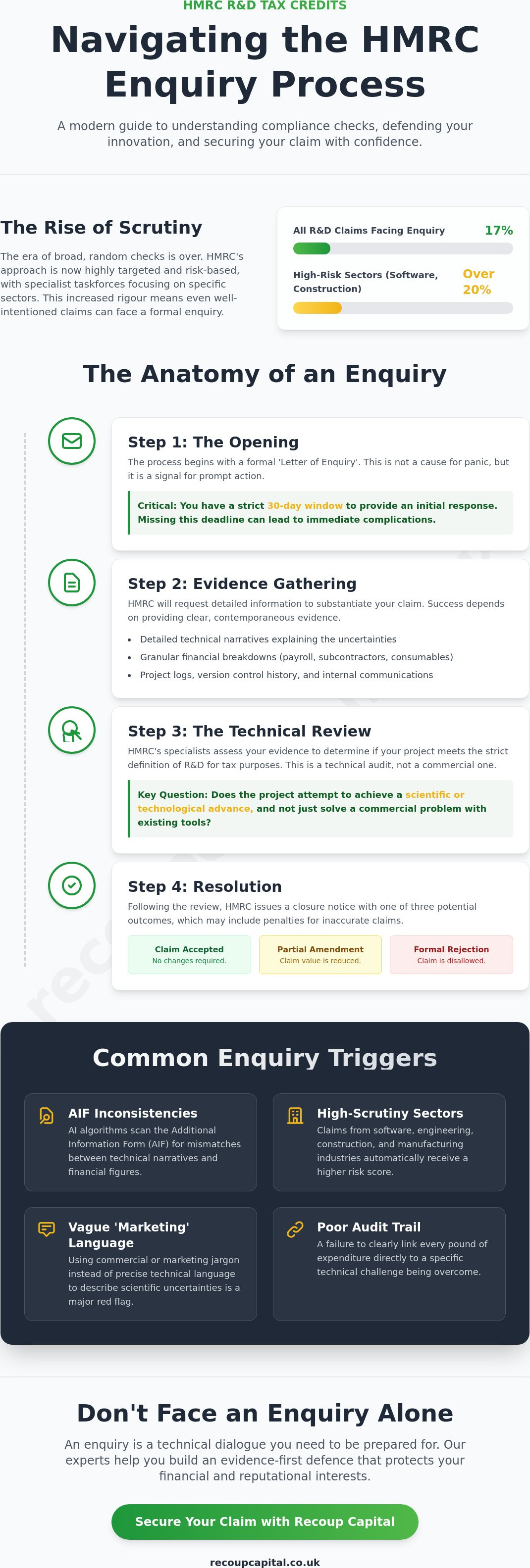
HMRC has bolstered its specialist R&D taskforce for 2026 to ensure the system remains sustainable. This increase in manpower has led to a fundamental shift in inspector behaviour. We've moved away from the era of broad, random checks. Instead, the HMRC R&D enquiry process is now a highly targeted, risk-based operation. Whilst the overall enquiry rate settled at approximately 17% for the 2023/24 tax year, specific sectors such as construction, software engineering, and heavy manufacturing are seeing intervention rates climb above 20%. Even legitimate, well-intentioned claims in these industries are now under the microscope.
The Impact of the Merged R&D Scheme on Compliance
The unification of the SME and RDEC schemes into a single merged system for accounting periods beginning on or after 1 April 2024 has fundamentally altered the risk profile of the average claim. This consolidation was intended to simplify the landscape, but it also introduced stricter oversight mechanisms. For instance, a Senior Officer within your company must now take personal responsibility by signing off on the accuracy of the submission. This requirement ensures that accountability sits firmly with the claimant, making it essential to understand the R&D tax credits explained in the context of these new 2026 regulations. The Revenue now looks for a clear "audit trail" that links every pound claimed directly to a specific technical uncertainty.
Why 'Good Enough' Documentation No Longer Suffices
The days of submitting narrative-heavy reports filled with marketing jargon are over. HMRC now employs advanced AI algorithms to scan the mandatory Additional Information Form (AIF) for inconsistencies amongst technical descriptions and financial figures. If the software flags a discrepancy, a manual enquiry is almost certain to follow. Success in 2026 depends on your ability to distinguish between "innovation" and "standard industry practice." Inspectors are specifically trained to identify where a project merely solves a commercial problem using existing tools rather than overcoming a genuine scientific or technological uncertainty. Moving from vague project summaries to data-driven technical evidence is no longer optional; it's the baseline for a successful defence.
The Anatomy of the HMRC R&D Enquiry Process: Step-by-Step
The HMRC R&D enquiry process typically begins with a formal 'Letter of Enquiry' landing on your desk. This isn't a signal to panic, but it is a signal to act quickly. The Revenue usually grants a strict 30-day window to provide an initial response. Missing this deadline can lead to immediate complications, so prompt acknowledgement is essential. Understanding the sequence of events that follows will help you maintain control of the narrative.
The process generally follows four distinct stages:
- Step 1: The Opening. Receipt of the letter and the start of the 30-day response clock.
- Step 2: Evidence Gathering. Submitting detailed technical narratives and granular financial breakdowns.
- Step 3: The Technical Review. HMRC assesses whether your project meets the criteria for a 'Scientific or Technological Advance'.
- Step 4: Resolution. Receipt of a closure notice, which may result in claim acceptance, partial amendment, or a formal rejection with potential penalties.
The Initial Letter and the Information Request
Analysing the tone of the initial letter is your first priority. Is it a general 'Check of Return' or a specific challenge to your technical methodology? HMRC inspectors will typically request payroll records, subcontractor invoices, and project logs to validate the figures in your Additional Information Form (AIF). You should refer to the official government guidance to ensure your records align with current expectations. Whilst it's tempting to send every email and spreadsheet to prove your hard work, providing too much irrelevant data can actually obscure your core technical argument. Precision is far more valuable than volume.
Technical Interviews and Inspector Site Visits
HMRC may request a meeting with your 'Competent Professionals', the lead engineers or developers who directed the R&D. These interviews are designed to test the depth of the technical uncertainty you claim to have faced. Preparing your team is vital. They must be able to explain why the solution wasn't obvious to a professional working in the field. Having a specialist partner present during these meetings provides a necessary buffer, ensuring the conversation stays focused on the technical merits rather than drifting into commercial generalities.
Timelines and the Resolution Phase
The duration of the HMRC R&D enquiry process varies significantly. A straightforward check might conclude within six months, but complex cases involving multiple projects can drag on for over two years. Once the review is complete, HMRC will issue a 'Closure Notice'. If you're currently facing a request for information, understanding the nuances of claiming R&D tax credits under the 2026 rules can help you structure your response more effectively. You always retain the right to appeal a decision if you believe the inspector has misunderstood the technical complexity of your work.
Common Triggers: Why HMRC Selects Specific R&D Claims
Understanding the specific factors that lead to an intervention is vital for any risk-management strategy. While we've discussed the broader shift toward a data-led landscape, the HMRC R&D enquiry process is often set in motion by very specific discrepancies within your submission. The Revenue no longer relies on luck; they use sophisticated risk-profiling to identify claims where the technical boundaries appear blurred or the financial figures don't align with industry norms. By identifying these triggers early, you can refine your submission to avoid unnecessary scrutiny.
The most prominent trigger in 2026 remains the Additional Information Form (AIF). As the primary digital gateway for every claim, any lack of detail here serves as an immediate invitation for a compliance check. We see this most frequently in sectors like construction and software development, where enquiry rates often exceed 20%. In these fields, the line between a high-quality commercial project and a qualifying technical advancement is frequently misunderstood. This leads to submissions that look like 'standard practice' to an inspector's eye, even when genuine innovation has occurred.
Errors in the Additional Information Form (AIF)
Small administrative inconsistencies can have significant consequences for your business. HMRC often flags claims where the listed 'main' internal R&D lead lacks the technical credentials expected for the project's complexity. If your technical narratives are vague or fail to isolate a specific technological uncertainty, the Revenue's AI will likely mark the claim for manual review. It's also essential to ensure that your CT600 filing perfectly mirrors the data in your AIF. Even a minor mismatch in qualifying indirect activities (QIAs), such as the time spent on administrative support for a project, can suggest a lack of internal oversight, prompting a deeper dive into your historical records.
The 'Commercial vs Technical' Advancement Debate
The most common reason for a claim failing during an enquiry is the confusion between commercial innovation and technical breakthroughs. HMRC is particularly vigilant regarding 'bespoke' projects in construction or engineering that solve a client's specific problem without actually advancing the field's underlying technology. To succeed, you must demonstrate that your project was 'not readily deducible' by a competent professional working in your industry. Focusing on the market value of the end product rather than the technical obstacles faced is a classic trap that often leads to a full rejection. Gaining a clear perspective on R&D tax credits explained through a technical lens is the best way to avoid this pitfall and ensure your claim stands up to scrutiny.
Strategic Response: Defending Your Innovation with Evidence
Entering the HMRC R&D enquiry process requires a decisive shift from passive compliance to active defence. You shouldn't simply wait for questions; you should lead the technical narrative. We recommend assembling a 'Defence Taskforce' that unites your finance team, technical leads, and specialised consultants. This collaborative approach ensures that your financial figures are always underpinned by technical reality. When an inspector challenges a specific cost, your lead engineers can provide the immediate, authoritative context that prevents a minor query from escalating into a full claim rejection.
Evidence is the bedrock of any successful defence in 2026. HMRC increasingly dismisses retrospective narratives as insufficient if they aren't supported by contemporaneous documentation. You must present proof created whilst the R&D was actually taking place. This includes Slack logs discussing technical roadblocks, Git commit histories showing failed iterations, and internal emails regarding technical specifications. These records provide a transparent window into your experimentation. They prove that your team was grappling with genuine technological uncertainties rather than standard industry challenges.
Building a Robust Technical Evidence File
To withstand a deep dive, you should map every pound claimed to specific "work packages" for total transparency. This granular level of detail makes it significantly harder for an inspector to dismiss costs as general overheads. Gathering witness statements from lead developers or project managers adds a layer of human credibility that data alone sometimes lacks. Using a structured R&D tax credits explained framework helps align your technical evidence with the Revenue's latest 2026 guidelines. This ensures your defence speaks the same language as the inspector, reducing the risk of technical misunderstandings.
Alternative Dispute Resolution (ADR) and Appeals
If you reach a stalemate with an inspector, Alternative Dispute Resolution (ADR) is a powerful tool to break the deadlock. ADR involves an independent HMRC mediator who has not been involved in your case. They act as a neutral third party to facilitate a technical dialogue and resolve disputes without the need for a formal tribunal. The benefits of ADR are clear: it's often faster, less stressful, and far more cost-effective than a full legal battle. If the enquiry outcome remains unfavourable after ADR, you still retain the right to request a 'Statutory Review' or lodge a formal appeal with the Tax Tribunal. Taking a proactive stance during these final stages can often lead to a partial or full reinstatement of your claim.
If you're currently facing a challenge from the Revenue, our team can act as your professional buffer and lead your defence strategy. Secure expert representation today to protect your innovation capital and focus on your business growth.
Navigating Compliance with Recoup Capital: Your Long-Term Partner
Recoup Capital operates on an 'Evidence-First' philosophy. We don't just file claims; we prepare every submission as if it will face an immediate audit. This proactive stance is the most effective way to manage the HMRC R&D enquiry process. By anticipating the technical questions an inspector might ask, we ensure that the foundation of your claim is unshakable from day one. Our role is to act as your shield, handling all correspondence and face-to-face meetings with HMRC whilst your leadership team focuses on driving innovation.
Our commitment to your business goes far beyond the initial submission. We've built a track record of helping UK businesses reinvest capital into innovation-led growth by turning tax returns into strategic assets. Success in 2026 requires more than just processing paperwork; it demands a partner who acts as a knowledgeable guide through a shifting regulatory landscape. We're here to ensure your innovation remains a catalyst for success rather than a source of administrative stress.
Why Specialist Advice Beats a Generalist Approach
General accountants are excellent for day-to-day compliance, but they often lack the technical depth required to defend complex scientific uncertainties. Our team bridges this gap by pairing specialised tax accountants with technical experts who speak the language of your engineers. This dual expertise is vital when reframing commercial projects as qualifying technical breakthroughs. You can learn why to claim with a partner who understands the specific nuances of the 2026 landscape. We don't just fill in forms; we build a technical case that respects the intelligence of the Revenue's specialist taskforce.
Preparing for the Future of R&D Compliance
The regulatory environment is shifting toward real-time transparency. We help you implement internal systems to capture R&D data as it happens, rather than trying to reconstruct narratives months after the work has finished. This approach significantly reduces your 'Risk Profile' with HMRC. Detailed and transparent claiming R&D tax credits processes demonstrate to the Revenue that your business is a low-risk, compliant innovator. This transparency is key to building a relationship of trust with the authorities.
We view ourselves as a long-term partner invested in your future. This relationship-first approach is why we offer a time-limited, no-cost introductory review of your current R&D position. By reframing your tax returns as strategic assets, we help you turn potential refunds into tools for business expansion. We explicitly reject traditional sales tactics, preferring to demonstrate our value through the robust, evidence-based results we deliver for our partners. Contact our team today to ensure your HMRC R&D enquiry process is handled with the professional authority your innovation deserves.
Securing Your Innovation Strategy for 2026 and Beyond
The landscape of R&D tax relief has undeniably shifted toward a more rigorous compliance model. Success now hinges on your ability to produce data-driven evidence and maintain technical clarity from the moment you submit your Additional Information Form. Understanding the HMRC R&D enquiry process is the first step in protecting your business from financial risk, but having a proactive defence strategy is what ensures your capital remains a strategic asset for growth. By reframing these technical dialogues as a chance to validate your innovation, you can move forward with absolute confidence.
Our team of Chartered Tax Accountants and technical specialists brings a proven track record in construction and engineering R&D to every partnership. We work alongside you to transform complex regulatory requirements into approachable opportunities for capital recovery. Because we operate on a success-based fee structure, our goals are always perfectly aligned with yours. Secure your R&D claim with a specialist review from Recoup Capital today. Let's turn the challenge of compliance into a solid foundation for your next breakthrough.
Frequently Asked Questions
What is the first thing I should do when I receive an HMRC R&D enquiry letter?
Acknowledge the receipt immediately and review the 30-day deadline specified in the letter to ensure you don't miss the response window. You should then contact your technical leads and R&D specialist to begin reviewing the specific projects or costs being challenged. Failing to respond promptly can lead to the immediate rejection of your claim or the application of avoidable financial penalties.
How long does the HMRC R&D enquiry process typically take in 2026?
The duration varies based on the complexity of the technical challenges, but most straightforward checks conclude within six to nine months. If the Revenue requires multiple rounds of information or site visits to interview your competent professionals, the process can extend beyond eighteen months. Maintaining organised records and responding promptly to every request is the most effective way to prevent the timeline from dragging on.
Can HMRC charge penalties if my R&D claim is rejected?
HMRC can apply financial penalties if they determine that a claim was submitted with careless or deliberate inaccuracies. These penalties are typically calculated as a percentage of the potential tax lost and depend on whether the error was voluntarily disclosed. Ensuring your technical narratives are robust and your financial breakdowns are precise is the best defence against these additional costs during the HMRC R&D enquiry process.
Do I need to hire a specialist if I am already working with a general accountant?
A specialist is often necessary to bridge the gap between financial figures and complex technical engineering that general accountants may not fully grasp. Specialists employ technical experts who can articulate scientific uncertainties in a way that satisfies the Revenue's specialist taskforce. This partnership ensures that your narratives are not just financially accurate but also scientifically sound, which is a common stumbling block for generalist firms.
What are the most common reasons for an HMRC R&D enquiry being opened?
The most frequent triggers include inconsistencies in the Additional Information Form (AIF) and project descriptions that focus on commercial rather than technical advancement. HMRC also targets claims where the technical uncertainty isn't clearly defined or where qualifying costs appear disproportionate to the industry average. Using advanced data analytics, the Revenue now automatically flags submissions that deviate from established benchmarks for your specific sector.
Can I appeal HMRC’s decision if they reject my R&D tax credit claim?
You have a statutory right to appeal any decision within 30 days of receiving a formal closure notice from the Revenue. You can request a statutory review by a different officer or apply for Alternative Dispute Resolution (ADR) to mediate the technical disagreement. If these routes don't yield a satisfactory result, you can take your case to a First-tier Tax Tribunal for an independent legal judgement.
What is the Additional Information Form (AIF) and why is it important?
The AIF is a mandatory digital submission that provides the Revenue with a detailed technical and financial breakdown of your R&D activities. It's critical because it acts as the primary data source for HMRC's risk-profiling algorithms. Any errors, missing contact details, or vague project summaries in this form are the leading cause of modern enquiries. A well-prepared AIF is your first line of defence.
Will an enquiry into one year's R&D claim trigger audits for previous years?
It is possible, as HMRC has the power to look back at earlier accounting periods if they discover systemic errors in your current submission. If an inspector finds that your methodology for identifying qualifying projects was flawed, they may extend the HMRC R&D enquiry process to cover all open tax years. This makes it vital to ensure your internal record-keeping systems are consistent and robust across every period.