
Examples of Qualifying R&D Projects in Manufacturing: A 2026 UK Guide

In manufacturing, R&D is rarely found in a clinical laboratory; it is found in the technical "head scratching" required to make a production line do something it was never designed to do. You probably view these daily challenges as mere problem-solving, yet they often represent the very essence of innovation that HMRC rewards. We understand that the evolving 2026 regulatory landscape feels daunting, especially whilst you're trying to stay competitive against peers who are already reclaiming significant capital through the merged scheme.
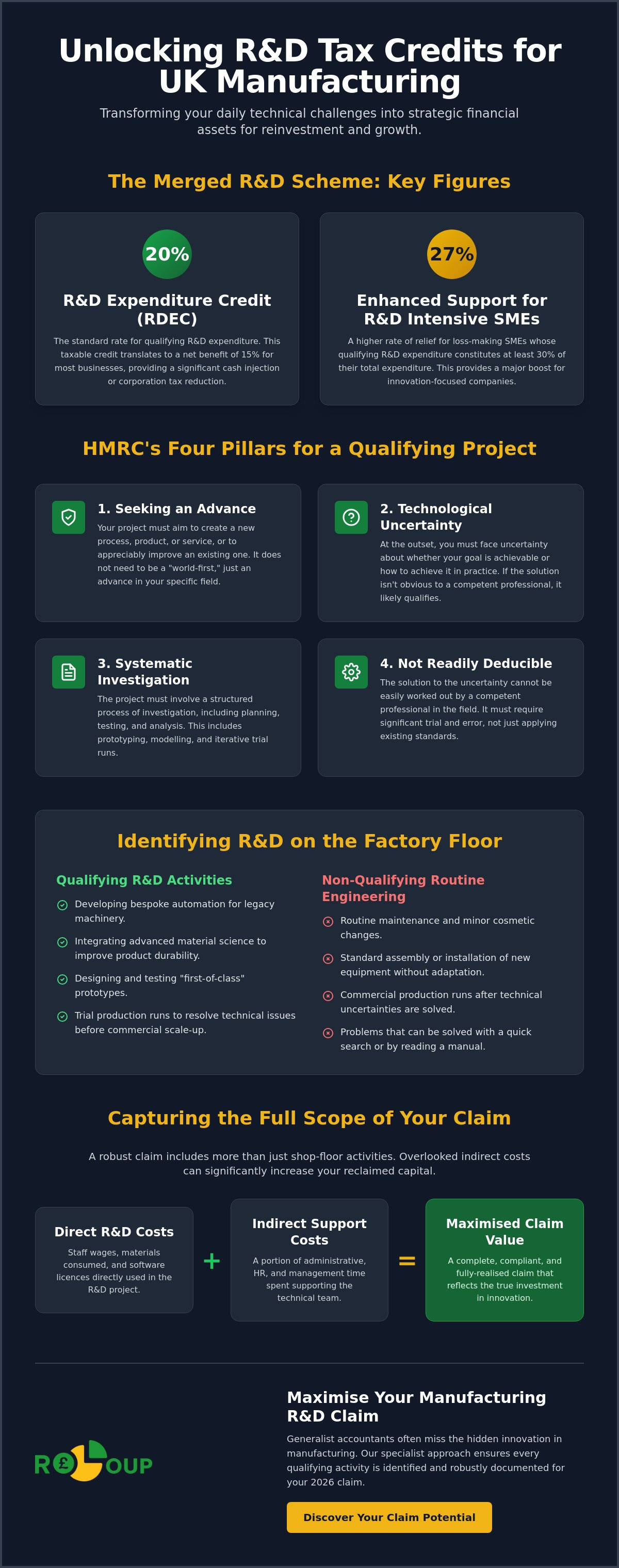
You want to ensure your claim is robust without triggering an unnecessary enquiry or falling foul of new restrictions on overseas expenditure. This guide provides a clear list of examples of qualifying R&D projects in manufacturing to help you validate your own technical advancements, from robotics to material science. We'll break down the latest 20% expenditure credit and the 27% intensive support threshold, giving you the confidence to transform your technical uncertainties into strategic financial assets for reinvestment in new machinery.
Key Takeaways
- Learn how to identify the precise "trigger point" where technical innovation begins in your production cycle and where it officially transitions into full-scale manufacturing.
- Discover how to capture the full scope of your claim by identifying qualifying activities on the shop floor and often-overlooked indirect support costs in the back office.
- Review concrete examples of qualifying R&D projects in manufacturing, ranging from developing bespoke automation for legacy machinery to integrating advanced material science.
- Gain clarity on the 2026 HMRC compliance standards to ensure your claim is robust enough to withstand scrutiny whilst maximising your capital recovery.
- Understand why a specialist approach is essential for uncovering "hidden" innovation that generalist accountants frequently miss, turning technical challenges into strategic business assets.
What is Manufacturing R&D? Defining Innovation in 2026
In 2026, the threshold for innovation on the factory floor has matured. It's no longer enough to simply purchase a new piece of kit; the real value lies in how you adapt that technology to overcome specific technical barriers. Broadly speaking, Research and development (R&D) in manufacturing is any activity that seeks to resolve a technical challenge through the creation of new products or the significant improvement of existing processes. Under the merged R&D scheme that became standard for accounting periods starting after 1 April 2024, the focus is firmly on the technical "head-scratching" your team performs daily.
Many directors mistakenly believe their project must be a "world-first" to qualify. This isn't the case. You only need to seek an advance in the overall knowledge or capability in your specific field of technology. If your engineers are struggling with a problem that isn't easily solved by a quick search or a standard manual, you've likely found a qualifying activity. Whilst routine engineering keeps the lights on, R&D drives the growth that pays for them. Amongst the noise of a busy factory, these innovations are often hidden in plain sight.
The Four Key HMRC Criteria
HMRC assesses your claim based on four fundamental pillars. First, you must be seeking an advance in a field of science or technology. Second, you must encounter a scientific or technological uncertainty. This means your team didn't know at the outset if the desired result was even possible or how to achieve it. Third, the project must involve a systematic investigation, such as prototyping and iterative testing. Finally, the solution shouldn't be "readily deducible" by a competent professional in your industry. If a seasoned engineer couldn't solve it without significant trial and error, it probably counts.
Manufacturing vs. Standard Engineering
Distinguishing between routine engineering and R&D is the most common hurdle for manufacturers. Routine maintenance, minor cosmetic changes, or standard assembly don't qualify. However, if you're developing bespoke automation for legacy machinery or experimenting with new chemical compositions to increase durability, you're moving into R&D territory. Identifying examples of qualifying R&D projects in manufacturing requires looking at the "Competent Professional" test. This asks whether a specialist in your field would view the problem as a genuine technical challenge rather than a simple fix. At Recoup Capital, we provide R&D tax credits explained through the lens of your specific production line, ensuring every incremental gain is captured for your 2026 claim.
The Boundary of a Project: When Does R&D Start and Stop?
Determining exactly where a project begins and ends is often the difference between a successful claim and an HMRC enquiry. Many manufacturers stop their claim too early or start too late, leaving significant capital on the table. According to HMRC's guidelines on R&D, the project begins the moment you start work to resolve a specific technological uncertainty. It doesn't start when you have the solution; it starts when you realise the solution isn't readily available. This "trigger point" is usually when your team identifies that standard methods or "off-the-shelf" components won't meet a new performance requirement.
The project boundary also extends to Indirect Qualifying Activities (IQA). This includes the time spent by managers planning the technical aspects of the project, or the administrative effort required to support the research team. Whilst these aren't shop-floor activities, they're essential to the R&D process. Identifying examples of qualifying R&D projects in manufacturing requires a holistic view of the entire development cycle, from the first feasibility study to the final resolution of technical doubt.
Prototyping and Trial Runs
The transition from a prototype to full-scale production is where the boundary becomes most blurred. HMRC draws a firm line at "commercial production", but the path there is rarely linear. Qualifying costs often include:
- Design, construction, and testing of "first-of-class" prototypes.
- Trial production runs used to test whether a new process can actually scale without technical failure.
- The cost of raw materials consumed or scrapped during these experimental phases.
Once the technical uncertainty is resolved and the process is "proven", the R&D phase ends. Any subsequent production, even if it's the very first batch sold to a customer, is generally considered commercial activity rather than R&D.
The Value of Technical Failure
It's a common misconception that a project must be successful to qualify for tax relief. In fact, a project that is scrapped because the technical barriers proved insurmountable is often the easiest to justify to HMRC. Failure is the ultimate proof that technical uncertainty existed. If the solution was easy, you wouldn't have failed. Documenting these "dead ends" provides a clear audit trail of the systematic investigation your team undertook.
At Recoup Capital, we specialise in identifying the value in these abandoned innovations. We help you document the technical hurdles that led to the project's termination, ensuring that the time and materials invested are still recognised as qualifying expenditure. If you're unsure whether your current production line difficulties meet these criteria, our team can help you in claiming R&D tax credits by mapping out your project timelines and identifying every qualifying pound.
Direct vs Indirect: Capturing the Full Scope of Manufacturing Costs
Capturing the full value of your claim requires a meticulous look beyond the obvious engineering payroll. In the 2026 regulatory environment, HMRC expects a granular breakdown of expenditure, categorised into Direct Qualifying Activities (DQA) and Indirect Qualifying Activities (IQA). Many manufacturers leave significant capital on the table by focusing only on the shop floor, whilst ignoring the essential support structures that make innovation possible. It's no longer enough to provide high-level estimates; you must demonstrate exactly how every pound spent relates to resolving your technical uncertainties.
Direct activities are the "hands-on" elements of your project. For instance, examples of qualifying R&D projects in manufacturing often involve heavy DQA during the physical assembly of a first-of-class prototype or the iterative testing of a new chemical bonding process. These costs are the heartbeat of your claim, representing the direct effort to push technological boundaries.
Qualifying Direct Activities
- Design and Prototyping: The time and materials spent designing, building, and testing experimental models or specialised tooling that doesn't yet exist.
- Software Integration: Developing or significantly adapting bespoke manufacturing execution systems (MES) to handle innovative production techniques.
- Technical Supervision: The proportion of time technical leads and project managers spend directly overseeing R&D experimentation and troubleshooting.
Indirect activities are the support functions that, whilst not experimental themselves, are vital for the R&D to take place. This holistic view of innovation aligns with Innovate UK's vision for manufacturing, which emphasises that back-office expertise and strategic planning are just as critical as shop-floor execution in high-value sectors.
Qualifying Indirect Activities
- Administrative Support: Handling the specific logistics, HR, and accounting requirements for a dedicated R&D project team.
- Feasibility Studies: Background research conducted by specialists to determine if a technical advancement is even possible before the physical work begins.
- Facility Maintenance: A proportion of the costs for maintaining, cleaning, and securing dedicated R&D labs or testing areas.
Handling "mixed-use" assets is where most manufacturers stumble. If a staff member splits their week between routine production and an R&D project, their salary must be apportioned accurately. The same rule applies to consumables like power and raw materials. In 2026, contemporaneous record-keeping is non-negotiable. If you can't produce a project log or time-tracking data from the time the work was performed, HMRC may disregard those costs entirely. We help our partners implement robust tracking systems so that their R&D tax credits are backed by evidence that stands up to the closest scrutiny.
Concrete Examples of Qualifying R&D Projects in Manufacturing
To understand how your work fits into the 2026 UK landscape, it's essential to look at the physical reality of innovation. These examples of qualifying R&D projects in manufacturing demonstrate how technical uncertainty manifests across different niches. Whether you're re-engineering a production line to handle volatile materials or developing a product with unprecedented tolerances, the common thread is the resolution of a problem that lacked an off-the-shelf solution. Innovation in 2026 is often found in the integration of disparate technologies to achieve a result that was previously considered impossible or commercially unviable.
Sustainability is a significant driver of modern R&D. With the UK manufacturing sector moving towards high-value, knowledge-intensive niches, many firms are now integrating recycled polymers into high-stress components. This isn't a simple material swap; it requires extensive testing to ensure structural integrity isn't compromised under load. Similarly, re-engineering legacy processes to reduce energy consumption often involves complex thermodynamic modelling and iterative trial runs. These activities aren't just "green" initiatives; they are rigorous technological investigations that meet HMRC's strict criteria for advancement.
Digital transformation also provides a wealth of opportunities for capital recovery. Current data suggests that 60% of manufacturers are increasing their investment in digital technology, AI, and automation. Developing bespoke IoT sensors to monitor machine health in harsh environments, such as high-heat foundries, involves significant hardware and software uncertainty. You aren't just installing a sensor; you're creating a system that can survive and communicate under conditions where standard electronics typically fail.
Product-Led Innovation Examples
- Aerospace Alloys: Developing a lighter, stronger alloy for engine components that must maintain safety standards whilst operating at higher temperatures than current materials allow.
- Advanced Food Preservation: Creating a novel preservation method that extends shelf life by 20% without the use of chemical additives, requiring new pressure or thermal processing techniques.
- Medical Device Precision: Designing bespoke surgical instruments that require unique manufacturing tolerances beyond the standard capability of existing CNC machinery.
Process-Led Innovation Examples
- Chemical Scaling: Taking a lab-based chemical process and scaling it to industrial volume whilst managing thermal instability that only occurs at mass-production levels.
- Additive Manufacturing: Developing a novel 3D printing process for complex metal geometries that previously required multiple assembly steps, reducing waste and improving structural unity.
- AI Quality Control: Implementing machine-learning systems to identify defects in high-speed production lines that were previously "unsolveable" by human inspectors or standard vision systems.
If these scenarios mirror the challenges your engineers face daily, it's time to quantify that effort. You can start claiming R&D tax credits today by speaking with a specialist who understands the technical nuances of your shop floor and the complexities of the 2026 merged scheme.
Maximising Your Claim: Why a Specialist Approach is Required
The 2026 merged R&D scheme has introduced a level of complexity that traditional accounting often struggles to navigate. Whilst your generalist accountant is essential for annual compliance and corporation tax, they may lack the technical vocabulary to identify the subtle innovation occurring on your production line. Manufacturing R&D is unique because it's frequently disguised as standard problem-solving. Without a specialist who understands both the factory floor and the latest tax legislation, you risk leaving significant strategic assets unclaimed.
At Recoup Capital, we act as a protective guide through the increasingly rigorous HMRC landscape. We don't just look at your ledger; we look at your blueprints and process logs. Our team identifies "Hidden R&D" by speaking directly with your engineers, uncovering examples of qualifying R&D projects in manufacturing that a non-specialist would simply overlook. This proactive approach ensures your claim is both maximised and robust enough to withstand the heightened scrutiny that defines the current regulatory era. We believe in demonstrating value through results, turning complex procedures into an approachable opportunity for growth.
The Specialist Advantage
Technical sector knowledge is just as vital as financial expertise. We specialise in translating complex shop-floor engineering into HMRC-ready technical reports that clearly articulate the scientific or technological advance. This bridge between the machine shop and the tax office is where value is created. We operate on a success-based model for Claiming R&D Tax Credits, meaning our interests are perfectly aligned with yours. Our goal is to transform your technical challenges into capital that can be reinvested in your future growth.
Next Steps for Your Manufacturing Business
The first step toward securing your capital recovery is a preliminary "Innovation Audit". We'll walk your production line with you to identify the specific activities that meet the 2026 criteria. Given the new transparency standards, having a comprehensive "Defence Document" is no longer optional; it's a strategic necessity. This document serves as your primary protection during an enquiry, providing the technical evidence HMRC requires. You can learn more about how technology and record-keeping are shaping these requirements in our guide on HMRC R&D Tax Claim Transparency and AI.
We invite you to start a no-obligation consultation to assess your qualifying projects. There's no pressure and no traditional sales pitch. We prefer to demonstrate our value through the results we achieve for our partners. By identifying every qualifying pound, we help you secure the funds needed to stay at the forefront of the UK's high-value manufacturing sector. Let's work together to turn your technical uncertainties into a strategic business tool.
Securing Your Manufacturing Future through Strategic Capital Recovery
Identifying innovation on the shop floor is the first step toward transforming technical challenges into strategic assets. Whether you're navigating the transition from prototype to production or capturing indirect support costs, the 2026 merged scheme offers significant opportunities for those with robust documentation. By reviewing the examples of qualifying R&D projects in manufacturing outlined in this guide, you'll see how your team's daily problem-solving often meets HMRC's strict criteria for advancement.
Recoup Capital has already recovered over £100m in tax relief for UK businesses. We operate on a success-based fee structure with no upfront costs, providing you with access to chartered tax accountants and sector specialists who understand your industry's technical nuances. We invite you to book a technical assessment with our R&D specialists to explore your potential for recovery. Let's work together to ensure your innovation is properly rewarded whilst keeping your business at the forefront of the UK manufacturing sector.
Frequently Asked Questions
Do I need a dedicated R&D department or laboratory to claim?
No, you don't need a laboratory or a formal research department to qualify for relief. Most manufacturing innovation happens directly on the shop floor during live production trials. HMRC focuses on the nature of the technical activity rather than the job titles of your staff or the setting where the work occurs. If your engineers are solving technical uncertainties amongst standard machinery, those activities qualify.
Can I claim for R&D projects that were commercially unsuccessful?
Yes, technical failure is often the strongest evidence that your project qualifies for tax credits. If a project was scrapped because the technical barriers proved insurmountable, it demonstrates that the solution wasn't readily deducible. This technical uncertainty is the core requirement for any claim. HMRC rewards the attempt to innovate, regardless of whether the final product reached the market or generated profit.
How far back can a manufacturing company claim R&D tax credits?
You can typically claim for your two most recently completed accounting periods. The statutory deadline is exactly two years from the end of the accounting period in which the expenditure was incurred. This rolling window allows you to look back at past projects and recover capital that may have been overlooked at the time the work was performed.
Is "incremental improvement" enough to qualify for R&D tax relief?
Yes, incremental improvements qualify as long as they involve resolving a technological uncertainty. You don't need a world-first invention to succeed. If you are making a process significantly more efficient or a material more durable through systematic testing, these are valid examples of qualifying R&D projects in manufacturing. Small, iterative gains in performance often represent significant technical advancements under HMRC guidelines.
What is the difference between the SME and RDEC schemes in 2026?
For accounting periods starting on or after 1 April 2024, most companies now use the Merged Scheme. This provides a taxable expenditure credit of 20% on qualifying costs. However, a separate scheme called Enhanced R&D Intensive Support (ERIS) remains for loss-making SMEs whose R&D spend accounts for at least 30% of their total expenditure, offering a higher credit of 27%.
Can I claim for the costs of raw materials used during trials?
Yes, you can claim for the cost of consumable materials that are transformed or used up during the R&D process. This includes raw materials used to build prototypes or those scrapped during experimental production runs. It's important to note that if the resulting products are sold to customers, those specific material costs must be excluded from your qualifying expenditure.
What evidence does HMRC require for a manufacturing R&D claim?
HMRC requires a robust technical narrative and a granular breakdown of costs. You must clearly explain the technical advance you sought and the specific uncertainties your team faced. In 2026, contemporaneous records such as project logs, design iterations, and testing results are essential. These documents prove that a systematic investigation took place and help protect your business during an enquiry.
How does the Patent Box scheme interact with R&D tax credits?
These two incentives are complementary and can be used together to maximise your capital utility. Whilst R&D tax credits support the initial development phase by reducing research costs, the Patent Box scheme offers a reduced 10% Corporation Tax rate on profits derived from patented inventions. Using both allows you to recover capital during development and keep more of your earnings during commercialisation.