
R&D Tax Relief for Process Improvements: A 2026 Guide for UK Businesses

You don't need a lab coat or a petri dish to claim back thousands of pounds from HMRC. Most UK directors assume that R&D tax relief for process improvements is reserved for pharmaceutical giants, whilst the reality is far more inclusive. If you've spent the last year struggling to automate a bespoke workflow or re-engineering a production line to increase efficiency, you aren't just fixing things. You're innovating. It's perfectly natural to feel uncertain about whether your operational tweaks meet the appreciable improvement threshold, especially with HMRC's 2026 focus on rigorous documentation and transparency.
We're here to help you bridge the gap between technical effort and financial reward. This guide provides a clear framework for identifying qualifying costs within your process innovation projects under the current merged scheme rules. You'll learn how to distinguish routine maintenance from genuine technological advancement, ensuring you can submit a compliant claim with absolute confidence. From understanding the 20% expenditure credit to utilising the Targeted Advance Assurance pilot, we'll show you how to turn your operational hurdles into strategic tax assets.
Key Takeaways
- Discover why R&D tax incentives extend far beyond traditional laboratories to include the innovative process improvements happening daily on your factory floor or within your digital infrastructure.
- Master the "Competent Professional" test to determine if your specific operational challenges qualify as R&D tax relief for process improvements under the latest HMRC guidelines.
- Identify hidden qualifying costs within your automation and waste reduction projects that can be reframed as strategic financial assets to fuel further business growth.
- Establish a robust documentation strategy to define your project boundaries and capture every qualified research expense whilst maintaining full compliance with 2026 transparency standards.
- Learn how a partnership-led approach helps you navigate the complexities of the merged scheme to uncover capital recovery opportunities that generalist providers often overlook.
Beyond the Lab: Understanding R&D Tax Relief for Process Improvements
Many business owners overlook R&D tax relief for process improvements because they don't see themselves as "scientists". They think R&D requires a sterile laboratory and a team of PhDs. The reality? HMRC is far more interested in the technical uncertainty you solved on the assembly line or within your proprietary software stack. If you are developing a new way to integrate disparate systems or re-engineering a manufacturing process to handle higher volumes with lower failure rates, you are likely conducting R&D. These projects happen on factory floors and in server rooms every day.
It's vital to distinguish between commercial innovation and technological innovation. Improving a process simply to increase profit margins or better appeal to customers is a business decision. However, if that improvement requires you to overcome a technological hurdle that isn't easily solved by a competent professional, it enters the territory of the UK's R&D Tax Credit scheme. These process-based claims are often the most lucrative because they involve high staff costs and long periods of trial and error that are frequently hidden within "business as usual" budgets.
The "Appreciable Improvement" Standard
An appreciable improvement means moving the needle significantly beyond what is standard in your industry. It isn't just about routine maintenance or minor software updates. A competent professional in your field should be able to look at the project and agree that the solution wasn't obvious. Whether you are increasing throughput through custom automation or enhancing the reliability of a chemical reaction in a production cycle, the focus is on the technical advancement itself. You must prove that the improvement represents an advance in the overall field, not just a minor tweak for your own company's benefit.
Why 2026 is a Critical Year for Process Claims
2026 marks a period of heightened scrutiny. With the merged R&D scheme now fully bedded in for accounting periods starting after 1 April 2024, companies must be more precise than ever. The mandatory Additional Information Form (AIF) requires a granular breakdown of how your process improvement qualifies. If you need a refresher on the basics, our guide to R&D tax credits explained provides the foundational context needed to navigate these regulatory shifts. By 1 April 2026, the 20% expenditure credit has created a landscape where precision in your claim documentation directly impacts your bottom line. Accuracy is no longer optional; it's a strategic necessity.
The Criteria for Success: What Makes a Process Improvement "Qualifying R&D"?
Identifying R&D tax relief for process improvements requires looking beyond the surface of your daily operations. It isn't enough to simply be the first in your local area to adopt a new technique or to buy a faster piece of equipment. HMRC looks for specific technical markers that prove you've pushed the boundaries of what is currently possible in your industry. To qualify for Research and Development (R&D) tax relief, your project must aim to resolve a scientific or technological uncertainty. This means the solution wasn't something a skilled person in your field could have easily deduced or found in a manual.
Overcoming Technological Uncertainty
Uncertainty is the heartbeat of a successful claim. It's the difference between "we didn't know which machine to buy" and "we didn't know if these machines could communicate at the required speed." System uncertainty often arises when you combine several standard components in a way that hasn't been done before, creating unpredictable results. One manufacturer faced this when a high-speed packaging robot failed to synchronise with a legacy conveyor system, requiring custom-built sensors and iterative software patches to prevent mechanical failure. If you're constantly asking "is this even possible?" rather than "how much does it cost?", you're on the right track.
The Role of the Competent Professional
A competent professional is someone with relevant qualifications and significant experience in their field, such as a lead engineer, a senior architect, or a head of software development. Their role is to confirm that the problem was genuinely difficult and that the solution represents an "appreciable advance." If your lead developer had to spend weeks testing different algorithms because the "obvious" route failed, their expertise provides the evidence needed. It's about distinguishing between a skilled trade, which follows established rules, and a technological advance, which writes new ones.
Most "off-the-shelf" software integrations fail the test because the uncertainty is purely commercial or related to user training. However, if you're writing bespoke code to bridge a gap that no existing API can handle, you're back in R&D territory. You must document the process of experimentation; every failed trial, every discarded prototype, and every iterative test is proof of the uncertainty you're trying to solve. If you're unsure if your technical hurdles meet this bar, you might want to explore how to start claiming with a specialist who understands these nuances. This iterative testing isn't just a project delay; it's the evidence that turns an expense into a strategic asset.
Industry Applications: From Automation to Waste Reduction
Process innovation isn't a niche activity. It's the engine room of business growth. Integrating R&D tax relief for process improvements into your broader financial strategy requires seeing your daily operations through a technical lens. Many firms assume their work is too "standard" to qualify, yet they're often solving complex problems that their competitors haven't even identified. Whether you're in a high-tech sector or a traditional industry, the search for efficiency frequently leads to qualifying R&D activity.
Manufacturing and Engineering Innovation
In the factory environment, R&D often lives in the struggle to eliminate bottlenecks. Developing bespoke tooling or jigs to solve a specific production hurdle isn't just "good engineering"; it's a search for a technical advance. We see significant success when companies integrate IoT sensors to create predictive maintenance systems. This goes beyond buying a sensor; it involves the complex task of synchronising hardware with custom software to predict failures before they occur. If you're working in the built environment, exploring Construction R&D Tax Relief can reveal how bespoke modular techniques and site-safety protocols often meet the same high bar for innovation.
Bespoke Software and Internal Systems
The line between routine IT work and R&D is often thin, but it's defined by technical challenge. Standard CRM implementations or basic website builds don't qualify. However, if you're creating custom APIs to force a legacy mainframe to communicate with a modern cloud environment, you're likely overcoming significant architectural complexity. The technical hurdle lies in data processing speeds and system stability under load. When your developers are forced to write novel code because no off-the-shelf solution exists, they're conducting R&D. This applies to logistics firms too, especially those developing proprietary algorithms for route optimisation that outperform standard GPS capabilities by accounting for bespoke variables like vehicle-specific weight limits or complex delivery windows.
Waste reduction is another fertile ground for R&D tax relief for process improvements. If you're re-engineering a production cycle to use 15% less raw material whilst maintaining structural integrity, you've achieved an appreciable improvement. This isn't just about saving money; it's about the technical testing and iterative modelling required to prove the new process works. These projects represent strategic assets that can be reframed into significant capital recovery, providing the liquidity you need to fund your next phase of operational evolution. Don't let these opportunities sit on your balance sheet as mere expenses.
Navigating HMRC Compliance: Documenting Your Process Innovation
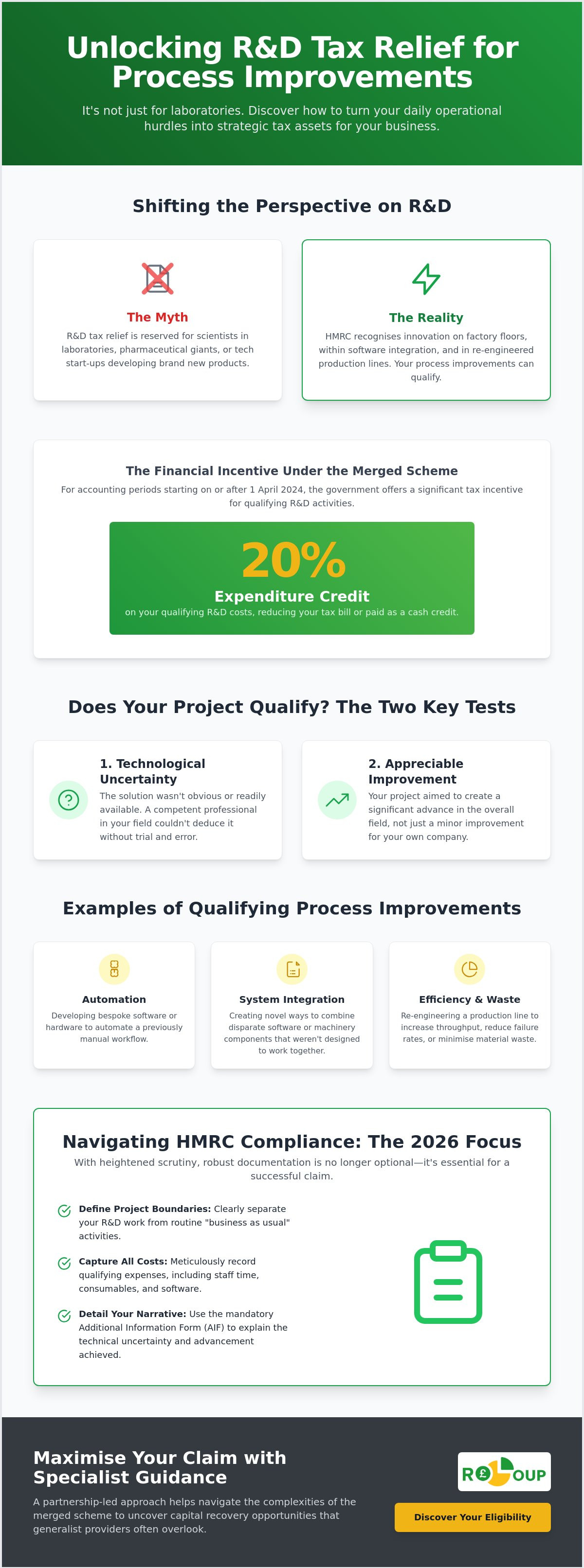
HMRC’s scrutiny has intensified, making robust documentation the most critical component of R&D tax relief for process improvements. You cannot simply claim at the end of the year and hope for the best. Success requires a proactive approach that begins the moment a technical challenge is identified. This means defining the "boundary" of your R&D; the project starts when you begin work to resolve a technological uncertainty and ends when that specific problem is solved or the project is shelved. By clearly identifying these start and end points, you protect your claim from being dismissed as routine maintenance or general business activity.
Capturing Qualified Research Expenses (QREs) involves more than just looking at invoices. You must track staff time, consumables used in testing, and relevant software licences. The goal is to create a technical narrative that speaks HMRC’s language, focusing on the "how" and "why" of the technical struggle rather than the commercial success of the end product. Aligning your claim with the current transparency standards is the best way to avoid unnecessary enquiries and secure your capital recovery. This level of detail ensures that your process innovation is viewed as a strategic asset rather than a regulatory risk.
Capturing Staff Costs and Time
Guessing staff involvement at the end of the financial year is a high-risk strategy that often leads to HMRC enquiries. Contemporaneous records are essential for proving exactly how much time your engineers or developers spent on qualifying activities. For staff only partially involved, you must have a logical method for apportioning their time based on real-world data. As the regulatory environment evolves, staying informed on HMRC R&D Tax Claim Transparency is vital, especially as AI tools begin to play a role in both claim preparation and HMRC’s own risk-profiling systems. Accurate time-tracking transforms a vague estimate into a defensible financial fact.
The Technical Narrative: Telling the Story of Failure
HMRC actually values hearing about what didn’t work. A narrative that only shows a straight line to success looks like routine development, not R&D. You must strip away the "marketing speak" and focus on the technical hurdles. A technical hurdle in a failed automation trial is the point where the physical constraints of the legacy machinery prevent the high-frequency data transmission required for real-time sensor feedback. Highlighting these failures proves that the solution wasn't obvious and that genuine experimentation took place. If you want to ensure your internal records meet these 2026 standards, you can start your claim assessment here to see how your process innovation stacks up against current expectations.
Maximising Your Claim with Recoup Capital
Generalist accountants provide vital support for your standard compliance, but they often lack the technical depth to identify R&D tax relief for process improvements hidden within your operations. At Recoup Capital, we don't just process paperwork. We act as your protective guide through the complexities of the 2026 regulatory landscape. Our team bridges the gap between your technical reality and HMRC's strict requirements, ensuring that every hour spent on iterative testing is accounted for. We operate on a success-based fee structure, which aligns our goals directly with your capital recovery. This relationship-first approach ensures we are invested in your long-term growth rather than just a one-off transaction.
The Recoup Capital "End-to-End" process handles everything from the initial technical assessment to direct HMRC liaison. We understand that the fear of an enquiry can be a barrier to claiming, which is why we take a forensic approach to your data. By identifying the specific technological uncertainties you've overcome, we build a robust narrative that stands up to scrutiny. We protect your business from the risks of "aggressive" or inaccurate claims by maintaining total transparency and technical accuracy throughout the submission process. We believe in demonstrating value through results rather than a traditional sales pitch.
The Value of a Specialist R&D Partner
Our forensic approach uncovers the R&D that often goes unnoticed in server rooms and on factory floors. We don't expect you to know every regulation; that's our role. If HMRC raises questions, we handle the enquiry on your behalf, providing the peace of mind you need to focus on your core business. You can see the strategic impact of these credits by exploring why claim, where we reframe financial returns as strategic assets for future innovation. We turn your past technical struggles into the liquidity needed for your next breakthrough.
Beyond R&D: A Holistic Approach to Tax Relief
We look at your business through a wide lens to ensure no capital recovery opportunity is missed. This involves integrating your R&D claim with Capital Allowances to maximise the benefit of your investment in plant and machinery. For those involved in the built environment, considering Land Remediation Relief can provide further tax efficiencies when dealing with contaminated sites. Our goal is to provide a comprehensive financial strategy that supports your innovation at every level. If you're ready to transform your operational improvements into a strategic business tool, book a no-obligation technical assessment with Recoup Capital today.
Turning Process Innovation into Strategic Growth
Your business is likely sitting on a wealth of unclaimed value. The technical hurdles you've overcome to automate workflows or reduce material waste aren't just operational wins; they're the foundation of a robust claim. Successfully navigating R&D tax relief for process improvements in 2026 requires a shift from viewing R&D as a lab-based curiosity to seeing it as a core business strategy. Precision in your technical narrative and documentation is now the primary difference between a successful return and a time-consuming enquiry.
We're here to ensure you don't leave capital on the table. Our in-house Chartered Tax Accountants bring specialist expertise in the construction and engineering sectors, providing the forensic detail required by modern HMRC standards. Because we operate on a success-based fee model, our partnership is entirely focused on delivering the best possible outcome for your organisation. You can secure your R&D tax relief with a specialist technical assessment today. Let's work together to transform your technical challenges into the capital you need to fund your next breakthrough.
Frequently Asked Questions
Can I claim R&D tax relief for automating a manual process?
Yes, automation qualifies if you're resolving a technological uncertainty that a competent professional couldn't easily solve. Simply purchasing off-the-shelf robotics isn't enough. You must be creating a bespoke integration or modifying hardware in a way that requires iterative testing and technical experimentation. This ensures your R&D tax relief for process improvements claim is based on genuine innovation rather than just capital expenditure on existing technology.
What counts as "appreciable improvement" in a manufacturing process?
An appreciable improvement is a non-trivial advance that goes beyond routine maintenance or minor tweaks. It must represent a significant step forward for the industry, such as developing a new method to reduce material waste by 15% or increasing production throughput through novel chemical cooling techniques. HMRC looks for evidence that the improvement was difficult to achieve and required overcoming specific technical hurdles that weren't previously documented.
Is bespoke software development for internal use eligible for R&D tax credits?
Yes, internal software development is eligible if it seeks to achieve a technological advance. This includes creating custom algorithms to handle data more efficiently or building bespoke middleware to integrate legacy systems that don't naturally communicate. Routine website development or standard CRM implementation doesn't qualify. The project must push the boundaries of software engineering, such as significantly improving processing speeds or enhancing data security through novel architectural designs.
How much can I claim back for R&D process improvements in 2026?
In 2026, the merged scheme allows most companies to claim a taxable expenditure credit of 20% on qualifying R&D costs. For a company paying the main Corporation Tax rate of 25%, this results in a net benefit of around 15%. Loss-making, R&D-intensive SMEs may qualify for Enhanced R&D Intensive Support (ERIS), potentially receiving a cash credit of up to 27p for every £1 spent on qualifying research activities.
Do I need to have a successful project to claim R&D tax relief?
No, you don't need a successful outcome to submit a valid claim. HMRC recognises that R&D is inherently risky and that many projects fail to reach their technical goals. In many cases, proving that a project was abandoned because the technical uncertainty was too great is the strongest evidence that R&D was taking place. Every failed prototype and discarded trial is a record of your innovative effort.
What documentation does HMRC require for process-based R&D claims?
You must provide a detailed technical narrative alongside the mandatory Additional Information Form (AIF). This documentation should outline the specific scientific or technological uncertainties you faced and the steps taken to overcome them. You also need precise records of qualifying expenditure, including staff time, consumables, and software licences. HMRC's 2026 standards require high levels of transparency, so contemporaneous records are far more effective than year-end estimates.
Can I claim R&D tax relief if I used a grant to fund the process improvement?
Yes, you can still claim, but the rules regarding subsidised expenditure have changed under the merged scheme. For accounting periods beginning on or after 1 April 2024, the presence of a grant no longer automatically bars a company from claiming the expenditure credit. However, the specific interaction between your grant funding and qualifying R&D costs must be carefully analysed to ensure your R&D tax relief for process improvements is calculated accurately.
What is the deadline for submitting an R&D claim for process innovation?
The deadline is strictly two years from the end of the accounting period in which you incurred the R&D costs. If your financial year ended on 31 December 2024, you must submit your claim by 31 December 2026. This window is non-negotiable; missing it prevents you from reclaiming any tax or receiving credits for that period. It's vital to begin your assessment early to ensure all technical narratives are finalised before this date.