
Claiming Capital Allowances on Software: The 2026 UK Business Guide

Is your software investment a mere operational cost, or is it actually the most valuable piece of "plant" your business owns? In the digital economy, treating your software spend as a simple overhead is a strategic error that leaves thousands in relief on the table. We understand that the process of claiming capital allowances on software often feels like a regulatory minefield, particularly when you're trying to distinguish between revenue and capital expenditure whilst managing the Intangible Fixed Assets (IFA) regime. It's a common frustration for growing businesses, but it's also a significant opportunity for capital recovery.
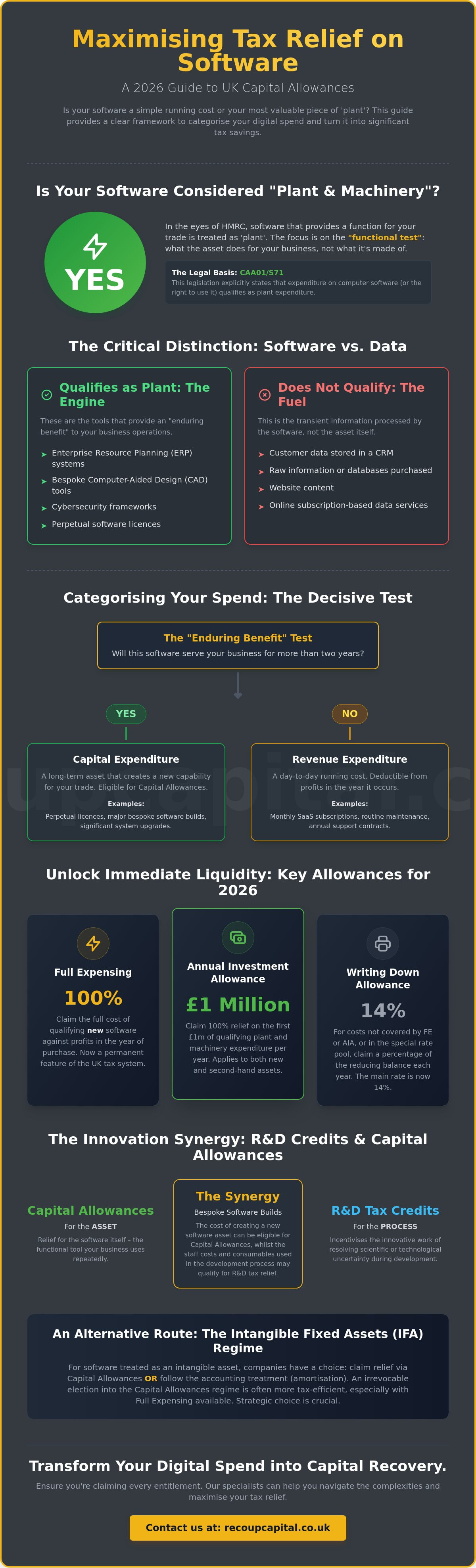
This 2026 guide provides the clear framework you need to categorise your digital spend and maximise tax relief. You'll discover how to leverage the permanent full expensing rules and the £1 million Annual Investment Allowance to transform your tax position. We will walk you through the latest 2026 updates, including the shift in the main rate Writing Down Allowance to 14% and the nuances of the IFA election, to ensure your organisation stays compliant and cash-rich.
Key Takeaways
- Identify whether your digital spend meets the "enduring benefit" test to qualify as a capital asset rather than a simple revenue expense.
- Navigate the complexities of the Intangible Fixed Assets (IFA) regime to determine the most tax-efficient route for your specific software licences.
- Unlock immediate liquidity by claiming capital allowances on software through the £1 million Annual Investment Allowance or permanent full expensing.
- Master the synergy between capital allowances and R&D Tax Credits to ensure your bespoke software builds are incentivised from every available angle.
- Establish a robust framework for your year-end declarations that satisfies HMRC whilst significantly reducing your Corporation Tax liability.
Is Computer Software Considered "Plant and Machinery" for Tax?
Can a line of code really be a machine? In the eyes of HMRC, the answer is a resounding yes. Many directors still view "plant and machinery" as heavy equipment, like diggers or lathes. However, the modern definition is far more expansive. For tax purposes, software acts as a functional tool of your trade. It's the digital architecture that allows your business to perform its core tasks. This means the process of claiming capital allowances on software is often just as lucrative as claiming for a fleet of vehicles.
HMRC's approach is surprisingly pragmatic. They recognise that in the 2026 economy, a sophisticated software suite is just as essential to a business's operation as a physical tool is to a mechanic. If the software is used to provide a function within the business, it qualifies. It's about what the asset does, not what it's made of.
The Legal Basis: CAA01/S71 Explained
Section 71 of the Capital Allowances Act 2001 provides the legal foundation for these claims. It explicitly states that expenditure on computer software, or the right to use it, is treated as expenditure on plant. This is a vital distinction. It means you don't need to "own" a physical product to make a claim. The "right to use" through a perpetual licence is sufficient. This legal framework underpins the entire system of UK capital allowances, ensuring that digital-first businesses aren't disadvantaged compared to traditional firms.
The "functional test" is the key metric here. If the software supports the business's trade, it's likely to qualify as plant. Physical ownership is no longer a requirement; the focus has shifted entirely to the utility the software provides to your operations. If you want to dive deeper into how these rules apply to your specific industry, our overview of capital allowances offers a helpful starting point.
Software vs. Data: Where HMRC Draws the Line
Whilst software qualifies as plant, HMRC is very specific about what constitutes an asset. Think of software as the engine and data as the fuel. You can claim for the engine, but not the fuel. For instance, your spreadsheet software is a qualifying tool, but the customer data stored within it isn't. The software provides the "enduring benefit" to the business structure, whilst the data is a revolving resource. Identifying the "engine" of your digital operations is the first step toward claiming capital allowances on software effectively.
Consider these examples of qualifying digital plant:
- Enterprise Resource Planning (ERP) systems that manage your entire supply chain and logistics.
- Bespoke CAD tools used by architects or engineers to create billable designs.
- Cybersecurity frameworks that protect your operational integrity and client assets.
By 2026, the definition of qualifying assets has expanded to reflect the reality of modern work. As long as the software is an "instrument" of the trade, it's a potential candidate for significant tax relief. It's a proactive way to reinvest in your business innovation rather than simply processing paperwork.
Capital vs. Revenue: Categorising Your Software Spend
Deciding whether your digital investment is a day-to-day running cost or a long-term asset is the most critical step in your tax strategy. It's the difference between a simple deduction and a powerful capital recovery. Whilst your internal accounts might capitalise an item on the balance sheet, HMRC's criteria for claiming capital allowances on software follow specific legislative tests that look beyond accounting entries. The goal is to determine if the spend creates an "enduring benefit" for your trade.
The "Enduring Benefit" test asks one simple question: will this software serve your business for more than two years? If the answer is yes, you're likely looking at capital expenditure. Perpetual licences and major bespoke builds that create a new capability for your trade fall squarely into this bracket. Conversely, routine maintenance and monthly subscriptions are typically treated as revenue expenditure, deductible from your profits in the year they occur. If you're unsure where your recent digital spend sits, exploring your capital allowances options with a specialist can clarify your position before your next CT600 filing.
The "Enduring Benefit" and Asset Tests
Determining the lifespan of a digital asset requires a look under the hood. If you are simply fixing bugs or maintaining current performance, you're "repairing" the software; this is a revenue cost. However, if you're adding significant new functionality, you've created a capital asset. HMRC's manual confirms that expenditure on computer software as plant includes these transformative upgrades. One-off implementation costs, such as the initial configuration and data migration for a new system, are also frequently classified as capital because they are essential to bringing the asset into use.
SaaS and Cloud: The 2026 Tax Challenge
The shift toward Software-as-a-Service (SaaS) has complicated the landscape. In 2026, most cloud-based procurement is treated as "Opex" (operating expenditure), meaning it's a revenue cost. But the lines are blurring. If your contract grants you a specific "licence to use" rather than just a "right to access a service", or if you have paid a significant upfront fee for a multi-year term, you might still be eligible for capital treatment. Distinguishing between a service contract and a software licence is a nuanced task that can significantly impact your cash flow. It's no longer enough to look at the invoice; you must examine the underlying terms of the agreement to ensure you aren't missing out on claiming capital allowances on software that qualifies as a long-term asset.
The Intangible Fixed Assets (IFA) Regime for Companies
For many UK limited companies, the path to tax relief isn't always a straight line. Whilst we've established that software can be classified as "plant", the Intangible Fixed Assets (IFA) regime often acts as the default regulatory framework. Governed by the CIRD10000 manual, this regime dictates how most corporate intangible assets are taxed. Crucially, the IFA rules usually take precedence. If your software is classified as an intangible asset in your accounts, you're generally required to follow the IFA route unless you proactively choose otherwise.
This creates a complex choice for directors. Under the IFA regime, tax relief typically follows the accounting amortisation. If you write down the software over five years in your books, you get tax relief over those same five years. However, there's a powerful tool available: the Section 71 election. By making this election, you can pull your software expenditure out of the IFA regime and into the capital allowances pool. This is a vital strategic move if you want to accelerate your tax relief through claiming capital allowances on software instead of waiting for yearly amortisation to trickle through your accounts.
Understanding CIRD10000 and Corporate Precedence
Most software acquired or created by companies after 1 April 2002 falls under these rules. The tax treatment of software depends heavily on how it's presented on your balance sheet. If the software is "tangible", for example, if it's bundled with hardware like a server, it bypasses the IFA regime entirely and stays in capital allowances. But for standalone digital assets, the IFA regime is the standard. This means your tax relief is tied to your accounting policy, which might not always be the most cash-efficient approach for your current growth phase.
Making an Election: When to Switch Regimes
Why would you opt out of the default? The answer lies in timing and liquidity. By electing into the capital allowances regime, you gain access to "Full Expensing." This allows you to claim a 100% first-year deduction, providing immediate relief rather than spreading it over several years. To make this work, you must submit an election to HMRC within two years of the end of the relevant accounting period.
Calculating the Net Present Value (NPV) of each option is essential. Whilst IFA relief is steady, the immediate cash injection from claiming capital allowances on software can be more valuable for reinvestment. It's a choice between long-term steady relief and a front-loaded strategic asset. If your business is investing heavily in new digital infrastructure, our team can help you evaluate these capital allowances opportunities to ensure you're choosing the most profitable path.
Maximising Relief: Full Expensing and Annual Investment Allowance (AIA)
Why wait years for tax relief when you can claim it all today? For most UK businesses, the Annual Investment Allowance (AIA) is the primary tool for claiming capital allowances on software. It provides a 100% upfront deduction on qualifying expenditure up to a limit of £1 million per year. Because software is typically classified as a "Main Pool" asset, it would otherwise attract a Writing Down Allowance (WDA) of 18%, which is scheduled to reduce to 14% from April 2026. Utilising the AIA ensures you recover your capital immediately rather than letting it erode over a decade.
Timing is everything. To benefit from these allowances, the expenditure must be incurred in the relevant accounting period. If you are part of a group of companies, you must share the £1 million AIA limit across the entire group. This requires strategic planning to ensure the allowance is allocated to the entities with the highest profit margins. If you are planning a significant digital overhaul, speaking with a specialist can help you time your expenditure to maximise these allowances before your year-end deadline.
Claiming 100% Relief via AIA
The mechanics of the AIA are straightforward but powerful. When you purchase a perpetual software licence or invest in a major bespoke system, that cost is added to your main pool. By applying the AIA, you effectively reduce your taxable profits by the full cost of the software in the year of purchase. This immediate tax saving provides a vital cash flow injection that can be reinvested into further innovation. It's a proactive way to turn a necessary business expense into a strategic financial asset.
Full Expensing and First Year Allowances (FYA)
For limited companies, "Full Expensing" offers an even more robust opportunity. Originally a temporary measure, this 100% first-year allowance has been made permanent for new and unused main pool plant and machinery. This is particularly beneficial for companies that have already exhausted their £1 million AIA limit. However, the "new and unused" criterion is a common pitfall.
HMRC is strict on this definition. Software must be original; "second-hand" licences or software transferred between companies within a group often fail this test. You must be able to document that the digital asset is being brought into use for the first time in your trade. Ensuring your records clearly distinguish between new builds and transferred assets is essential for claiming capital allowances on software without triggering an HMRC enquiry. This level of diligence protects your claim and secures your long-term collaboration with the tax authorities.
The Innovation Synergy: Capital Allowances vs. R&D Tax Credits
Bespoke software development sits at a unique intersection. It's both a capital asset and a vehicle for innovation. Smart directors recognise that claiming capital allowances on software is only half the battle. To truly maximise recovery, you must understand how these allowances interact with R&D Tax Credits. The "Double Dip" rule is the primary hurdle here; HMRC prevents you from claiming the same pound of expenditure under two different regimes. You cannot treat a developer’s salary as a revenue expense for R&D whilst also capitalising it for plant and machinery allowances. It's a binary choice for each specific cost, but a dual opportunity for the project as a whole.
Think of it as a strategic split between the "known" and the "unknown". Capital allowances cover the established infrastructure, the licences, and the foundational code that forms the asset. R&D credits target the specific technical challenges, the parts of the build where your team had to overcome technical uncertainty. By bifurcating your costs this way, you create a robust, defensible claim that withstands HMRC scrutiny and ensures you aren't leaving money on the table. It's about ensuring your digital transformation is as tax-efficient as it is technologically advanced.
Bespoke Development: Capitalising the Build
Identifying the capitalisable portion of a project is a forensic task. When internal staff spend months building a proprietary platform, their wages often transition from revenue costs to capital expenditure. This is especially true if the build creates an enduring benefit for the company. Linking your Capital Allowances claim to your R&D narrative ensures consistency. If you're telling HMRC that a project was a technical breakthrough, your accounting treatment should reflect that investment in a long-term asset. This alignment demonstrates professional clarity and reduces the risk of enquiries during the 2026/27 tax year.
The Recoup Capital Advantage: A Holistic Tax Strategy
General accountants often miss these nuances. They might default to one regime and ignore the other, leaving significant relief unclaimed. At Recoup Capital, we specialise in this hybrid strategy. We perform a success-based forensic review of your digital spend to ensure every pound is working its hardest. We help you claim R&D tax credits for the technical uncertainties whilst claiming capital allowances on software for the underlying infrastructure. Our partnership-oriented approach moves beyond simple paperwork. We act as a protective guide through these regulatory complexities, ensuring your business is positioned for long-term growth.
This isn't just about a one-off refund; it's about building a sustainable tax strategy that treats your financial returns as strategic assets. We focus on results rather than traditional sales pitches, demonstrating our value through the capital we recover for your innovation. Secure your no-obligation software expenditure review today with Recoup Capital and discover how a holistic approach can transform your bottom line.
Transform Your Digital Investment into a Strategic Asset
Software is no longer a mere operational overhead; it's a powerful vehicle for capital recovery. By correctly categorising your digital spend and making proactive elections within the IFA regime, you can unlock significant cash flow through the permanent full expensing rules. We've explored how the synergy between claiming capital allowances on software and R&D Tax Credits ensures every pound of your innovation is incentivised. This dual approach doesn't just lower your Corporation Tax bill; it provides the liquidity needed for your next phase of growth.
Navigating these regulatory complexities requires a partner with a proven track record of HMRC compliance. Our expert team of Chartered Tax Accountants specialises in forensic reviews that identify missed opportunities without the pressure of traditional sales tactics. We operate on a success-based fee structure, which means we only benefit when you do. It's a relationship-first approach designed for long-term collaboration and business success.
Maximise your digital tax relief with a Recoup Capital specialist review today and turn your technology costs into a strategic business tool. Your future innovation starts with the capital you recover today.
Frequently Asked Questions
Can I claim capital allowances on Microsoft 365 or Adobe subscriptions?
Subscription-based services like Microsoft 365 or Adobe are typically treated as revenue expenditure because you don't own a perpetual asset. These costs are deductible from your annual profits as an operating expense rather than through the capital allowances system. To qualify for capital treatment, the expenditure usually needs to result in an asset with an enduring benefit to the business, such as a one-off perpetual licence purchase.
What is the difference between software capital allowances and the IFA regime?
The primary difference lies in the mechanism of relief and the timing of tax deductions. Capital allowances treat software as a physical "plant" asset, allowing for 100% upfront relief via AIA or full expensing. The IFA regime is the default for most companies and links relief to the amortisation rate used in your accounts. Choosing the right path is a vital part of claiming capital allowances on software to maximise your immediate cash flow.
Can I claim capital allowances on a website build?
You can claim for a website build if it performs a functional role in your trade, such as a portal for processing orders or managing client accounts. If the website is purely for advertising or brand awareness, HMRC often treats it as a revenue expense. When the site acts as a tool for generating income over several years, it meets the criteria for capital treatment as a functional asset.
Is bespoke software development eligible for capital allowances?
Bespoke software development is eligible, provided you can identify the capitalisable costs associated with creating the functional asset. This often includes the wages of internal developers or the fees of external agencies. It's essential to separate the innovative "uncertainty" costs, which may qualify for R&D Tax Credits, from the "asset" costs to ensure you don't breach the double-dipping rules.
What happens if I sell or decommission software I have claimed on?
Selling or decommissioning software triggers a "balancing event" in your capital allowances pool. If you sell a licence for more than its tax written-down value, a balancing charge may increase your taxable profit for that year. If you simply scrap or decommission the software, you may be able to claim a balancing allowance to write off the remaining value, provided the asset is no longer in use.
Can I claim capital allowances on software bought as part of a business acquisition?
You can claim on software acquired through a trade and asset purchase, provided the software is identified as part of the capital assets being transferred. In a share purchase, the company's existing capital allowance history remains unchanged; you don't get to "reset" the cost to the purchase price. Identifying the fair market value of software during an asset acquisition is a complex task that benefits from specialist oversight.
How far back can I go to claim capital allowances on old software?
You can claim on any qualifying software that is still in use by your business, regardless of when it was originally purchased. Whilst you can only amend your tax returns for the previous two accounting periods, you can bring the tax written-down value of older assets into your current pool. This is a powerful way of claiming capital allowances on software that your general accountant may have previously overlooked.
Do I need a specialist surveyor for software capital allowances?
You don't need a specialist surveyor for digital assets, but you do need a tax specialist who understands the nuances of the IFA regime and capital expenditure. Unlike property claims, which require a physical survey, software claims rely on a forensic analysis of your development logs, licence agreements, and accounting records. Our team of Chartered Tax Accountants provides the necessary expertise to ensure your claim is both maximised and compliant.