
What Qualifies as R&D for Tax Purposes? The 2026 UK Guide

What if the technical hurdle that stalled your production line for three months in 2025 is actually the key to a substantial cash injection today? Many directors mistakenly believe that only lab-coat science counts, whilst the latest statistics show that the majority of successful claims stem from resolving technical uncertainties in sectors like engineering and software. It is natural to feel confused by the overlap between commercial progress and genuine innovation, especially when you are trying to determine exactly what qualifies as R&D for tax purposes under the 2026 HMRC guidelines.
We understand that the fear of a formal enquiry can make the process feel more like a risk than a reward. This guide provides a clear framework to help you identify eligible projects and understand which specific costs are recoupable. We will explore why the "uncertainty of the journey" is the true measure of eligibility, giving you the confidence to transform your technical challenges into vital money for reinvestment. By the end of this guide, you will have the clarity needed to proceed with a claim that stands up to scrutiny.
Key Takeaways
- Discover why innovation isn't limited to laboratories and how sectors such as food tech and civil engineering often hold hidden claim potential.
- Master the precise HMRC framework for what qualifies as R&D for tax purposes by identifying the technical advances and uncertainties within your projects.
- Identify the specific qualifying expenditures, from staff NI contributions to software licences, that can be recovered to help your business thrive.
- Understand how to manage the 2026 merged R&D scheme and the mandatory Additional Information Form to ensure a seamless and compliant submission.
The HMRC Definition: Beyond Lab Coats and Test Tubes
HMRC doesn't expect every claimant to be wearing a white coat or working in a sterile laboratory. R&D tax credits are a powerful government incentive designed specifically for UK limited companies. They reward those who take technical risks to drive progress. Whilst many associate innovation with high-tech research centres, the reality is far more inclusive. In 2024, HMRC statistics revealed that thousands of successful claims originated from sectors like food technology and civil engineering. Identifying what qualifies as R&D for tax purposes often starts with a simple question: are you solving a problem that your competitors would struggle to resolve?
The core requirement is a search for an "overall" advance in knowledge. This means your project must aim to create something that doesn't currently exist in your industry, rather than just something new to your specific company. If you're simply implementing a solution that is already public knowledge or common practice amongst your peers, it won't qualify. You must be pushing the boundaries of what is scientifically or technologically possible. This distinction between commercial innovation and scientific advance is the foundation of a successful R&D tax credits claim.
What Constitutes a "Project" in R&D?
A project begins the moment you identify a technical challenge that cannot be solved with existing expertise. It ends when you have a working prototype or reach the start of commercial production. Crucially, success is not a prerequisite. If your team spent six months attempting to develop a more durable composite material but eventually abandoned the effort due to technical failure, those costs are still valid. However, routine "copycatting" of a competitor's existing product, where the path to the result is already known, is strictly excluded from relief.
Science and Technology vs. Social Sciences
HMRC distinguishes between "hard" and "soft" sciences. Advances in management structures, economics, or social behaviours are ineligible. Conversely, engineering challenges and software development are prime candidates. For 2026 compliance, an eligible project must seek to resolve a scientific or technological uncertainty through the application of hard sciences like physics, chemistry, or computer science. This boundary ensures the relief supports genuine technical breakthroughs rather than purely organisational shifts. Understanding what qualifies as R&D for tax purposes means focusing on these hard science disciplines to ensure your claim remains compliant and robust.
The Two Pillars of Qualification: Advance and Uncertainty
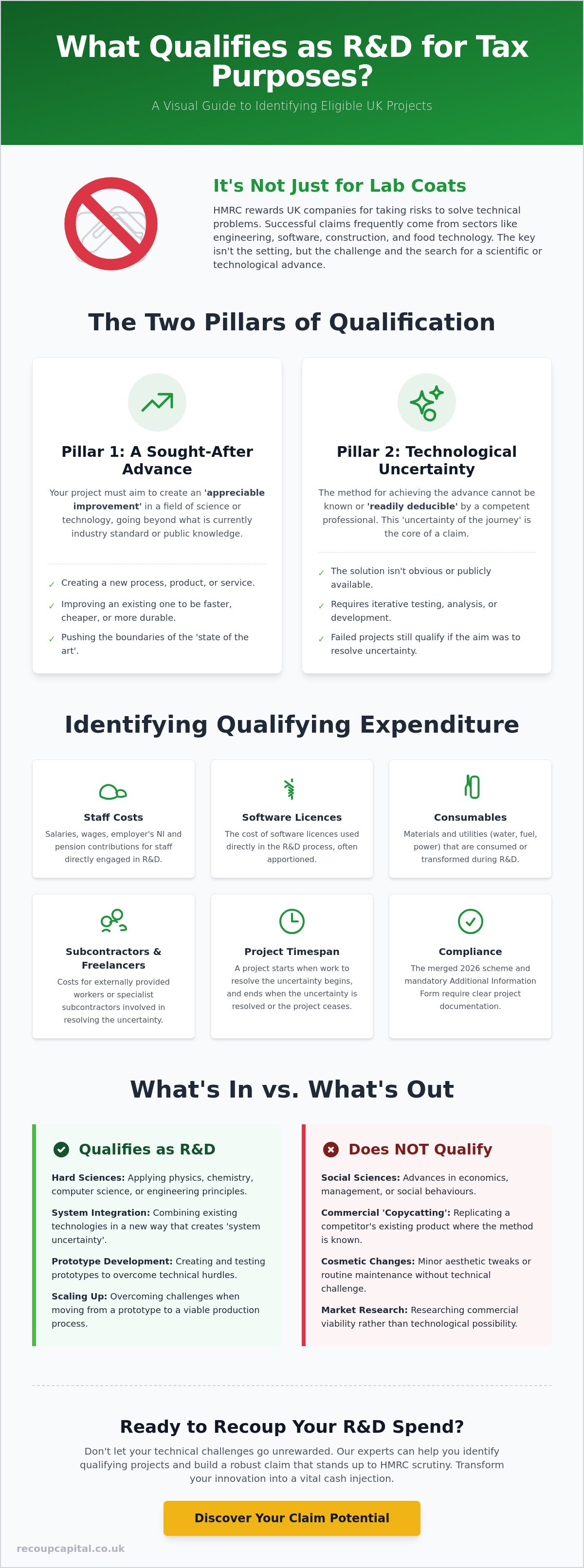
Determining what qualifies as R&D for tax purposes requires looking beyond the final product and focusing on the technical obstacles encountered during development. HMRC builds the entire relief framework upon two fundamental pillars: the sought "Advance" and the "Technological Uncertainty" that stands in its way. An advance isn't merely a new feature for your company; it's an attempt to create something better, faster, smaller, or more durable than what currently exists in the wider industry. If a solution is already "publicly available" or could be "readily deducible" by an expert in the field, the project fails the R&D test.
Many successful claims in 2026 involve "system uncertainty." This occurs when you are integrating multiple established technologies in a way that hasn't been done before. Whilst the individual components might be well-understood, the way they interact creates a new, unpredictable challenge that requires iterative testing and technical resolution. This "uncertainty of the journey" is often where the most significant eligible expenditure is found, especially in complex engineering or bespoke software architecture. If your team is struggling to make disparate systems talk to each other effectively, you are likely standing on the threshold of a valid claim.
Seeking an Appreciable Improvement
An appreciable improvement goes beyond minor cosmetic changes or routine maintenance. To qualify, the improvement must be non-trivial. For instance, a construction firm developing a new concrete additive that increases material durability by 15% in sub-zero temperatures would likely meet this threshold. It is about pushing the "state of the art" forward. For a deeper dive into how these improvements are measured against current industry standards, you can view our guide on R&D tax credits explained.
The Role of the Competent Professional
HMRC relies heavily on the testimony of a "competent professional" to validate a claim. This is typically an experienced engineer, developer, or scientist with a proven track record in their specific sector. Their role is to define the "technical baseline" at the project's inception, usually by documenting the state of existing knowledge as of a specific date, such as 1st April 2026. They must be able to explain why the proposed solution was not obvious to someone with their level of expertise.
Because HMRC officers are tax specialists rather than structural engineers, the professional's evidence is the primary shield during an enquiry. They must demonstrate that the technical hurdles were significant enough to require a period of trial and error. If you are unsure whether your lead technician meets this definition, it may be helpful to assess your internal expertise with a specialist to ensure your technical narratives are robust and compliant. Correctly identifying what qualifies as R&D for tax purposes through the eyes of your technical team is the most effective way to secure the money for reinvestment your business deserves.
Industry-Specific Innovation: Examples from Construction and Engineering
Many construction and engineering directors overlook significant tax relief because they view technical problem-solving as "part of the day job." Whilst software and pharmaceuticals dominate the headlines, heavy industries are often the most fertile ground for innovation. In 2023, HMRC reported that while construction accounts for roughly 7% of UK GDP, it represents a disproportionately low percentage of R&D claims. Understanding what qualifies as R&D for tax purposes in these sectors is the first step toward securing money for reinvestment. The process is what matters.
Often, these projects involve complex site developments where standard methods simply won't suffice. For developers, there is frequently a strategic overlap between R&D and land remediation. If you're forced to develop a new, untested method to neutralise bespoke ground contaminants or stabilise a unique geological formation, you may be eligible for both forms of relief. This dual approach ensures your business thrives by recouping costs from the most challenging phases of a build. You are solving problems that others can't.
R&D in the Construction Sector
Innovation in construction isn't just about the finished building; it's about the methods used to get there. Qualifying activities often include the development of new modular building techniques that reduce assembly time by 20% or more. You might also be creating advanced fire-safety materials that exceed current 2026 regulatory standards. Overcoming unique ground conditions with non-standard foundation designs is another common area for claims. It's vital to remember that "bespoke" design alone isn't enough. To meet the threshold of what qualifies as R&D for tax purposes, the project must involve a technical uncertainty that a competent professional couldn't easily resolve.
Engineering and Manufacturing Breakthroughs
In the world of manufacturing, R&D usually centres on process optimisation and material science. Automating a manual production line with custom-coded robotics often requires significant iterative testing to ensure the new system integrates with legacy hardware. Similarly, if your firm is working to reduce its carbon footprint by 30% through chemical innovation in the manufacturing process, these efforts likely qualify. These technical hurdles represent the "uncertainty of the journey" that HMRC rewards. For more detailed insights into your specific sub-sector, you can explore our dedicated page on claiming R&D tax credits to see how your recent breakthroughs might translate into financial recovery.
Identifying Qualifying Expenditure: What Costs Can You Claim?
Once you have established that your project meets the technical criteria, the focus shifts to the ledger. Quantifying what qualifies as R&D for tax purposes requires a forensic look at your expenditure. The largest component is almost always staff costs. This includes gross salaries, employer National Insurance contributions, and pension contributions for those directly engaged in the technical resolution. It is vital to exclude bonuses or benefits in kind, as HMRC remains strict on these boundaries in 2026. Only the time spent on the qualifying activity should be included.
Beyond personnel, you can claim for software licences used specifically for the R&D project and consumables that are transformed or used up during the process. If you have constructed three different prototypes to test structural integrity, the materials used are eligible. However, if those prototypes are later sold as commercial products, the rules change significantly. This ensures the relief focuses on the cost of the "uncertainty" rather than subsidising standard commercial stock. Correctly identifying these costs transforms a complex tax filing into vital money for reinvestment.
Indirect Activities and Support Staff
Not every person involved in a project qualifies for relief. Whilst direct supervisors and technical leads are included, support roles like HR, payroll, or general maintenance are explicitly excluded. You must apply a "percentage of time" rule to staff who split their weeks between routine operations and innovation. For the physical space where this work happens, capital allowances may provide additional relief for building and equipment costs that fall outside the R&D scope. This ensures you maximise every available incentive for your facility.
Externally Provided Workers (EPWs) and Subcontractors
The 2026 landscape for third-party help is more complex due to the Merged Scheme. You must distinguish between Externally Provided Workers (EPWs), who are typically agency staff under your supervision, and subcontractors hired to perform a specific technical task. For unconnected subcontractors, you can generally claim 65% of the relevant costs. A major shift effective from 1st April 2024, and continuing into 2026, is the restriction on overseas expenditure. Unless specific exemptions apply, the R&D activity must generally take place within the UK to remain eligible for relief.
To ensure you aren't leaving money on the table, you should book a free 15 minute consultation to review your expenditure profile with a specialist. Properly categorising what qualifies as R&D for tax purposes ensures your claim is both maximised and protected against future scrutiny.
Navigating the Merged R&D Scheme: How to Maximise Your Claim
By 2026, the complexity of the UK tax system has crystallised into a single, unified system. The previous distinction between the SME and RDEC schemes has largely vanished for accounting periods beginning on or after 1st April 2024. This merged scheme aims to simplify the process, yet it introduces rigorous new compliance standards. Central to this is the "Additional Information Form" (AIF). This mandatory digital submission requires a granular breakdown of your technical projects before your Corporation Tax return is even filed. Without a precise understanding of what qualifies as R&D for tax purposes, businesses risk their claims being rejected at the first hurdle.
There is, however, a vital exception for "R&D Intensive SMEs." If your qualifying expenditure accounts for at least 30% of your total business spend, you may still access higher rates of relief, particularly if your firm is loss-making. This carve-out is designed to protect the most innovative startups. To navigate these nuances effectively, you should review our insights on HMRC R&D tax claim transparency and AI to understand how modern compliance tools are shaping the 2026 landscape.
The Importance of Contemporary Record Keeping
Waiting until your financial year-end to "find" R&D projects is a strategy that often invites HMRC enquiries. In the current era of increased scrutiny, contemporary record keeping is your strongest defence. You should document technical uncertainties as they occur. This includes keeping notes on failed experiments, minutes from technical stand-ups, and version control logs in software development. Using a specialist partner to organise these technical narratives whilst the project is live ensures that the evidence is fresh and undeniable. It transforms a stressful year-end task into a seamless, ongoing process that secures your money for reinvestment.
Why a Specialist Partner is Essential in 2026
The role of a specialist has evolved from mere paperwork processing to acting as a protective guide. Unlike general accountants who may charge hourly rates regardless of the outcome, most R&D specialists operate on a success-based model. This aligns our interests with yours. We focus on the technical depth required to satisfy HMRC, allowing your team to focus on the innovation that makes your business thrive. We don't just process a claim; we act as a long-term partner invested in your future growth.
If you are unsure whether your recent technical hurdles meet the 2026 criteria, the most efficient next step is to speak with an expert. We invite you to book a free 15-minute consultation today. This low-friction conversation will help you identify what qualifies as R&D for tax purposes within your specific operations and provide a clear path toward financial recovery.
Turn Your Technical Challenges Into Capital
Your firm's recent technical hurdles are more than just project delays; they are potential assets. We have explored how the 2026 merged scheme prioritises the "uncertainty of the journey" and why contemporary record-keeping is now non-negotiable for compliance. Identifying exactly what qualifies as R&D for tax purposes is the first step toward transforming your technical hurdles into money for reinvestment. Whether you are solving bespoke structural issues in construction or automating production lines in engineering, the costs you have already incurred could fuel your next breakthrough.
As specialists in heavy industry R&D, our chartered tax accountants maintain a 100% success rate on all submitted claims. We operate on a success-based fee model, meaning we only win when you do. This partnership-first approach ensures you receive expert guidance without the pressure of a traditional sales pitch. Don't let your eligible expenditure go unclaimed whilst HMRC's 2026 windows remain open. Book your FREE 15-minute R&D assessment with our specialists today to see how we can help your business thrive. Your innovation deserves to be rewarded, and we are here to ensure it is.
Frequently Asked Questions
Does my project have to be successful to qualify as R&D?
No, your project does not need to be successful to qualify. HMRC rewards the attempt to resolve technical uncertainty rather than the final commercial result. If your engineers spent six months on a failed prototype in 2025, those costs are still eligible for relief. This ensures that the financial risk of innovation is shared with the government, regardless of whether the project reached the production stage.
Can I claim R&D tax credits if I am a subcontractor?
The ability to claim as a subcontractor has changed under the 2026 Merged Scheme. Generally, the right to claim now sits with the company that "intended" the R&D and contracted the work out. If you are a subcontractor, you can typically only claim if your client is an "ineligible" body, such as a government department, or if the R&D was not anticipated by the original contract.
What is the "Competent Professional" test in an R&D claim?
The "Competent Professional" test is the benchmark HMRC uses to validate technical uncertainty. A professional, such as a developer with a Master's degree and five years of industry experience, must explain why a solution wasn't obvious. Their expert opinion is the primary evidence used to determine what qualifies as R&D for tax purposes during a formal enquiry or compliance check.
How far back can I claim for R&D tax purposes in 2026?
You can typically claim for the previous two accounting periods. In 2026, you can still submit claims for periods that ended in 2024 or 2025, provided you are within the 24-month statutory deadline. This allows businesses to look back at past innovation and recover vital money for reinvestment that might have been overlooked during the initial filing process.
Is software development always considered R&D?
No, routine software development is explicitly excluded. To qualify, your project must seek an advance in computer science or technology. This might involve creating a new data processing architecture or resolving a technical conflict between disparate systems that a competent professional couldn't easily fix using standard libraries. Identifying what qualifies as R&D for tax purposes in software requires proving a genuine technical challenge.
What happens if HMRC enquiries my R&D claim?
If HMRC opens an enquiry, they will ask for a detailed explanation of your technical uncertainties. They will review your mandatory Additional Information Form (AIF) to ensure it meets 2026 compliance standards. Having a specialist partner means you have a protective guide to handle the correspondence and provide the necessary technical evidence to resolve the query efficiently and maintain your 100% success rate.
Can I claim for R&D if my company is making a loss?
Yes, loss-making companies can receive a cash credit from HMRC. If your firm hasn't made a profit, you can "surrender" your R&D losses in exchange for a payable tax credit. For R&D Intensive companies, where innovation spend is at least 30% of total expenditure, the net credit remains a significant source of capital to help your business thrive during its growth phase.
How does the Merged R&D Scheme affect my 2026 tax return?
The Merged Scheme unifies the SME and RDEC rules into a single system for accounting periods starting on or after 1st April 2024. Your 2026 tax return must be accompanied by a mandatory Additional Information Form (AIF) submitted digitally. This form ensures HMRC has a clear, granular view of your technical advance and qualifying expenditure before they process any relief or cash payments.