
R&D Tax Credit Eligibility Criteria UK: The 2026 Checklist for Limited Companies

What if your most frustrating technical failure was actually worth a 15% net benefit to your company's bottom line? Many directors mistakenly believe their industry is too "ordinary" to meet the R&D tax credit eligibility criteria UK, yet HMRC cares far more about the technical "dead ends" you hit than the specific sector you operate in. It's a common misconception that innovation only happens in sterile labs; in reality, resolving uncertainties in software, engineering, or manufacturing often qualifies for significant relief.
We recognise that the shift to the Merged Scheme for accounting periods starting after 1 April 2024, alongside the 30% expenditure threshold for Enhanced R&D Intensive Support (ERIS), has left many feeling uncertain. You want money for reinvestment without the fear of a looming HMRC enquiry. This article provides a definitive checklist to help you identify qualifying costs and calculate whether you're owed up to £27 for every £100 spent on innovation. We'll walk you through the "yes/no" framework for eligibility and the exact steps to ensure your claim is fully compliant.
Key Takeaways
- Shift your focus from your industry sector to the specific technical "dead ends" you have resolved to qualify for substantial financial relief.
- Gain absolute clarity on the latest R&D tax credit eligibility criteria UK to confidently navigate the unified Merged Scheme and secure money for reinvestment.
- Identify if your business meets the 30% intensity threshold required to access the more generous Enhanced R&D Intensive Support (ERIS) rates for loss-making SMEs.
- Follow a step-by-step checklist to isolate qualifying costs, including staff time and consumables, whilst maintaining the robust documentation HMRC expects in 2026.
- Learn how a success-based partnership can help you uncover hidden R&D opportunities in everyday operations without any initial cost or financial risk to your business.
Understanding R&D Tax Credit Eligibility in the 2026 Landscape
R&D tax credits aren't a reward for simply being "creative"; they're a strategic tool designed to fuel growth by offsetting the costs of technical risk. For a UK limited company, meeting the R&D tax credit eligibility criteria UK means proving you've pushed the boundaries of what's possible in your field. By 2026, the regulatory environment has shifted. HMRC now employs advanced AI algorithms to cross-reference claims against industry benchmarks. This makes "innovation-washing", the practice of dressing up routine business activities as R&D, a high-risk strategy that triggers immediate enquiries. Transparency is now the gold standard. You must demonstrate a genuine attempt to overcome a specific technical hurdle. Crucially, you can still claim even if your project ended in a "dead end" or total failure. HMRC values the attempt to innovate, not just the successful outcome.
The "Competent Professional" Test
HMRC doesn't expect a tax inspector to understand the nuances of your proprietary code or chemical compounds. Instead, they rely on the "competent professional" test. This person is typically your lead engineer, senior developer, or technical director. They are the individuals with the relevant qualifications and experience to judge whether a solution was "obvious" or required a genuine advance. To build a robust claim, you must document the baseline of knowledge available to these professionals before the project began. If your lead expert couldn't find a solution in existing technical journals or through standard practice, you've likely identified a qualifying uncertainty. Their professional opinion is the cornerstone of a successful submission.
Science vs. Technology: What Counts?
Grasping the scope of UK R&D Tax Credits is vital for accurate filing. HMRC defines R&D as an advance in a "field of science or technology." This generally excludes social sciences, arts, and theoretical aesthetics. However, the definition is broader than many realise. Since the 2023 inclusion of pure mathematics, the scope for software claims in 2026 has expanded significantly. Projects involving complex algorithms, data cryptography, or AI model training often qualify because they rely on mathematical breakthroughs rather than routine coding. If you're unsure how your specific project fits, reviewing our R&D tax credits explained guide can clarify the nuances of these definitions. We focus on helping you find the hidden innovation in your everyday technical challenges.
The Four Pillars of HMRC Eligibility Criteria
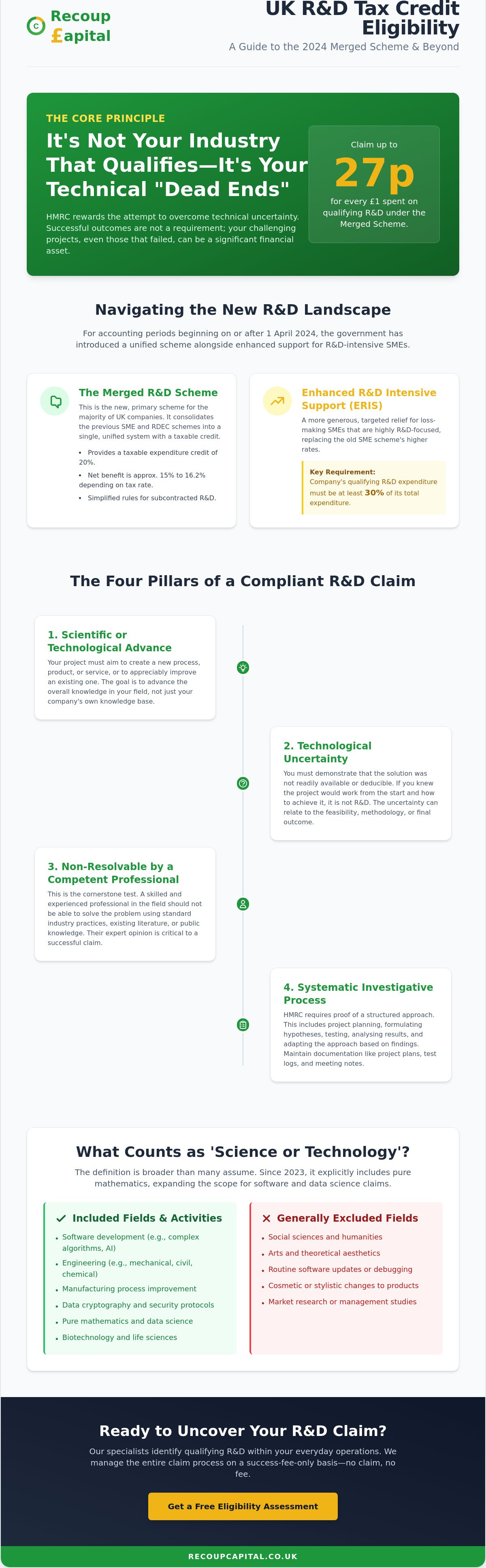
HMRC doesn't grant tax relief for "business as usual" activities. To successfully navigate the R&D tax credit eligibility criteria UK, your project must be built upon four distinct pillars of evidence. These aren't just suggestions; they're the structural requirements that separate a compliant claim from one that triggers an enquiry. By understanding these pillars, you can transform your technical challenges into a strategic financial asset.
- Pillar 1: Seeking a Scientific or Technological Advance. Your project must aim to increase the overall knowledge or capability in your field, not just within your own company.
- Pillar 2: Encountering Technological Uncertainty. You must prove that the solution wasn't readily available or obvious. If you knew it would work from day one, it isn't R&D.
- Pillar 3: Non-Resolvable by a Competent Professional. You need to demonstrate that a skilled person in your industry couldn't simply "google" the answer or use standard practices to fix the problem.
- Pillar 4: Systematic Investigative Process. HMRC expects to see a methodical approach. This involves testing, analysing results, and refining your hypothesis until a solution is found or the project is abandoned.
To ensure your records align with these standards, it's helpful to consult HMRC's R&D Guidelines. These internal manuals provide the granular detail our specialists use to defend your claim. If you're still questioning if your specific hurdles count, you might find clarity by exploring why other businesses choose to claim despite initial doubts.
Defining the "Appreciable Improvement"
An "appreciable improvement" means your project has made a process, material, or device significantly better than what currently exists. In construction, this might involve developing a bespoke cladding system that exceeds standard fire safety ratings by 40%. In engineering, it could be a 15% reduction in energy consumption for a manufacturing line. Routine maintenance or cosmetic upgrades never count. You must show that the improvement required a genuine technical leap that wasn't previously achievable with standard industry tools.
Identifying Technological Uncertainties
Technological uncertainty exists when you don't know if a result is achievable, or how to achieve it in practice. A "dead end" is often the best evidence of this. If your team spent three weeks testing a software integration that ultimately failed, those costs are still eligible. "System uncertainty" is also a vital concept. Even if you're using well-known components, the way they interact in a new, complex system can create qualifying R&D. You must prove that the specific "how-to" was not in the public domain at the time of your project.
The Merged Scheme: How Eligibility Changed for 2026
The transition to a unified system has fundamentally altered the way businesses approach their claims. For accounting periods beginning on or after 1 April 2024, the separate SME and RDEC paths have been combined into a single Merged Scheme. This new framework offers a 20% gross credit on qualifying expenditure, providing a streamlined route to secure money for reinvestment. Whilst the core definition of innovation remains consistent, the R&D tax credit eligibility criteria UK now place a much heavier emphasis on who controls the project and where the technical "intent" originates. This shift was designed to simplify the process, but it requires a more precise understanding of your contractual relationships to ensure you don't miss out on your entitlement.
HMRC's introduction of the mandatory Additional Information Form (AIF) is the most visible change in the 2026 landscape. Every claim must now be accompanied by this digital submission before the Corporation Tax return is filed. It's no longer enough to provide a high-level summary; you must provide detailed technical descriptions for your largest projects, including the specific names of the senior professionals who led the work. This digital-first approach allows HMRC's risk-assessment software to flag inconsistencies instantly, making professional accuracy more vital than ever before.
Who Claims: Client or Subcontractor?
The 2024 rule changes significantly clarified the "contracted out" R&D rules. Eligibility now generally sits with the company that "intended" the R&D to take place. If your business identifies a technical uncertainty and hires a third party to help solve it, you are typically the party eligible to claim. Conversely, if you are a subcontractor performing routine work and you encounter a problem that you decide to solve through your own innovation, you might find your ability to claim restricted. Structuring your commercial agreements to reflect this "intent" is a critical step in Claiming R&D Tax Credits successfully. It's often the wording of the contract, rather than the work itself, that determines which entity receives the financial benefit.
R&D Intensive SME Criteria
While the Merged Scheme covers the majority of UK businesses, the Enhanced R&D Intensive Support (ERIS) scheme provides a more generous alternative for loss-making SMEs. To qualify for ERIS in 2026, your qualifying R&D expenditure must be at least 30% of your total business expenditure. This threshold was lowered from 40% on 1 April 2024, opening the door for approximately 20,000 SMEs to access higher rates of relief. If you meet this intensity ratio, you can receive a payable credit of up to 27% of your qualifying costs. This is particularly valuable for tech startups and biotech firms where high research costs often precede any significant revenue. Calculating this ratio correctly is the first step in determining whether you're leaving thousands of pounds on the table.
The Ultimate R&D Eligibility Checklist
Determining whether your innovation fits the R&D tax credit eligibility criteria UK is often the most daunting part of the process. To simplify this, we've developed a practical checklist that mirrors the internal scrutiny applied by HMRC inspectors. If you can answer "yes" to these five fundamental questions, your business is likely sitting on unclaimed capital ready for reinvestment.
- Is your company a UK Limited Company currently liable for Corporation Tax?
- Did you attempt to create a completely new product or achieve an appreciable improvement in an existing process?
- Was there a specific technical challenge that your lead developers or engineers couldn't solve using standard industry knowledge?
- Did you pay for specialists, such as software devs, chemical engineers, or data scientists, to tackle these problems?
- Can you produce evidence of a systematic "trial and error" phase, such as testing logs, failed prototypes, or iteration records?
If these points resonate with your recent projects, you're already halfway to a successful claim. It's about documenting the "how" and the "why" of your technical journey. When you can demonstrate that your team spent time overcoming hurdles that would stump a competent professional, you meet the core requirements for relief.
Qualifying Expenditure Checklist
Identifying the right costs is essential for maximising your claim value. Since the 2023 and 2024 updates, the scope of what you can include has widened to reflect modern business practices. You can now claim for:
- Staff costs: This includes gross salaries, Class 1 National Insurance, and pension contributions for employees directly involved in R&D.
- Cloud computing and data: A vital addition for 2026, covering cloud storage and software licences used specifically for your R&D projects.
- Consumables: Materials, water, and energy that are transformed or used up during the investigative process.
For a deeper dive into these categories, our guide on R&D tax credits explained offers a granular breakdown of claimable expenditure. Ensuring every pound is accounted for can significantly increase your final credit.
The "Non-Eligible" Red Flags
HMRC's AI-driven compliance checks in 2026 are specifically tuned to catch "innovation-washing." Routine activities don't qualify, even if they're complex or expensive to execute. Common red flags include:
- Simple bug fixing, security patches, or routine maintenance in software development.
- Integrating open-source code without making a significant technical advance to the code itself.
- Market research, cosmetic enhancements, or purely commercial innovations that don't solve a technical uncertainty.
- Minor modifications to a product that don't improve its functional performance or technical capability.
If your project falls into these traps, it won't meet the R&D tax credit eligibility criteria UK. Ready to see if your work truly qualifies? Speak with an expert partner to verify your eligibility today.
Maximising Your Claim with Recoup Capital
Recoup Capital doesn't just process paperwork; we act as a protective guide through the complexities of tax law. Many directors in sectors like construction or food tech don't realise they meet the R&D tax credit eligibility criteria UK because their innovation is woven into daily problem-solving. Whether it's developing a new preservative-free shelf-life solution or engineering a bespoke foundation for unstable ground, these are technical advances. We specialise in identifying these "hidden" claims that generalist accountants often overlook. Our goal is to transform your technical hurdles into money for reinvestment.
Our partnership is built on a success-based fee model. This means there's no initial cost or financial risk for your business. We only succeed when you do. From the first technical interview with your "competent professionals" to the final submission and any potential HMRC enquiry defence, we provide end-to-end support. You can explore exactly why other businesses choose to claim with us to understand the seamless, expert experience we promise to provide.
A Holistic Approach to Tax Relief
We believe in looking at the bigger picture of your corporate finance. Often, a project that qualifies for R&D also opens doors to other forms of financial recovery. For example, commercial property renovations might qualify for Capital Allowances, whilst clearing a brownfield site for a new facility could trigger Land Remediation Relief. Our team of chartered tax accountants ensures that every claim is fully compliant with the latest HMRC standards. This multi-layered approach protects your business whilst maximising your total return.
Next Steps: Your Free 15-Minute Consultation
Getting started is simple and low-friction. During your initial 15-minute consultation, we'll quickly determine if your work aligns with the R&D tax credit eligibility criteria UK. We'll guide you on how to organise your technical documentation and financial records to ensure a smooth submission process. Choosing the right R&D Tax Credit Specialists UK is about finding a partner who understands your technical journey as well as the tax law. We're ready to help your business thrive by securing the capital you've earned through innovation.
Ready to Transform Your Technical Hurdles into Capital?
The landscape of UK innovation funding has shifted. With the Merged Scheme and the 30% intensity threshold for ERIS now firmly in place, mastering the R&D tax credit eligibility criteria UK is a strategic necessity for growth-minded limited companies. Your team has already encountered the technical "dead ends" and rigorous testing phases that HMRC seeks to reward. Now, you simply need to bridge the gap between those technical achievements and a compliant financial claim that stands up to 2026 scrutiny.
Recoup Capital acts as your proactive guide through this complex transition. Our specialist chartered tax accountants possess a proven track record in demanding sectors like Construction and Engineering, ensuring your claim is both robust and accurately valued. Because we operate on a success-based fee model, you can explore your entitlement without any upfront financial risk. We focus on demonstrating value through results to help your business thrive.
Don't leave your hard-earned money for reinvestment on the table. Book your FREE 15-minute R&D eligibility consultation today and discover how seamless financial recovery can be. Today's adviser is ready to become your partner for tomorrow's success.
Frequently Asked Questions
Can I claim R&D tax credits if my project failed?
Yes, you can absolutely claim for projects that did not reach a successful conclusion. HMRC rewards the attempt to overcome technical uncertainty, regardless of the commercial outcome. In fact, a project that ended in a "dead end" often provides the most robust evidence that the R&D tax credit eligibility criteria UK were met, as it proves the solution was not obvious to a competent professional.
Does a small limited company qualify for the Merged Scheme?
Most small limited companies now fall under the Merged Scheme for accounting periods beginning on or after 1 April 2024. This unified system provides a 20% gross credit on qualifying expenditure. If your business is loss-making and your R&D spend exceeds 30% of your total expenditure, you may instead qualify for the more generous Enhanced R&D Intensive Support (ERIS) scheme.
What is the minimum spend required to make an R&D claim worthwhile?
There is no statutory minimum spend required to submit a claim. Whilst any amount of qualifying expenditure can technically be processed, most companies find the process most viable when spend exceeds £10,000. This ensures the resulting money for reinvestment significantly outweighs the administrative time required to prepare the mandatory technical reports and Additional Information Forms.
How far back can I claim R&D tax credits in the UK?
You can claim for R&D tax relief up to two years after the end of the relevant accounting period. This effectively gives you a three-year window to look back at previous innovation. For example, a company with a year-end of 31 December 2024 has until 31 December 2026 to submit their claim, ensuring you don't miss out on historical financial recovery.
Are software development and AI projects eligible for R&D relief?
Software and AI projects are highly eligible if they push beyond routine coding and resolve specific technical uncertainties. The 2023 expansion to include pure mathematics and cloud computing costs has made the R&D tax credit eligibility criteria UK even more favourable for tech firms. To qualify, your project must involve more than just using standard APIs or fixing common bugs.
What happens if HMRC opens an enquiry into my R&D claim?
An enquiry is a formal request for further evidence regarding your technical advances and costs. HMRC now uses AI-driven screening to flag claims that appear inconsistent with industry benchmarks. If an enquiry is opened, we provide full defence support, using our specialist knowledge to explain your technical journey in a way that satisfies HMRC's compliance standards.
Can I claim for subcontractors under the new 2026 rules?
You can claim for subcontractor costs, but the 2024 "contracted out" rules mean the party who "intended" the R&D to take place usually holds the eligibility. If you identify a technical problem and hire a third party to solve it, you are generally the claimant. It's vital to have clear contracts that reflect this intent to ensure your claim is protected.
How long does it take for HMRC to process an R&D tax credit payment?
HMRC aims to process 95% of payable tax credit claims within 40 days of submission. Whilst most claims are handled within this window, the process can take longer if the Additional Information Form (AIF) is incomplete or if an enquiry is opened. Providing high-quality, contemporaneous documentation from the start is the best way to ensure a seamless and rapid payment.