
UK Construction Companies and Financial Distress: Myth-Busting the Path to Recovery in 2026

What if the mounting pressure on your balance sheet isn't a sign of terminal decline, but simply a mountain of unrecovered capital waiting to be reclaimed? For many uk construction companies financial distress feels like an inescapable trap, especially following the 4.3% rise in industry insolvencies reported by the Insolvency Service in late 2024. It's a heavy burden to carry whilst you're juggling persistent wage inflation and aggressive HMRC demands. You likely feel that these external pressures are narrowing your path to survival, turning what should be a productive 2026 into a desperate fight for liquidity.
We're here to show you that financial distress is frequently a symptom of trapped cash rather than a lack of viability. This article promises to reveal how you can transform your outlook by identifying early warning signs and unlocking hidden capital that's rightfully yours. We'll outline a strategic approach to debt restructuring and tax recovery that turns your current liabilities into money for reinvestment, ensuring your firm doesn't just survive but thrives.
Key Takeaways
- Challenge the misconception that insolvency is inevitable by identifying the true drivers behind the current landscape of uk construction companies financial distress.
- Uncover "secret" lifelines like Land Remediation Relief and R&D tax credits to transform stranded capital into vital money for reinvestment.
- Move from reactive survival to proactive recovery by learning how to negotiate with creditors from a position of professional strength.
- Understand why significant financial distress is often a symptom of unrecovered expenditure rather than a sign of poor management or a lack of work.
- Discover how a seamless 15-minute consultation can provide the clarity needed to navigate complex regulations and secure your firm's future.
The Current Landscape of UK Construction Companies and Financial Distress
Is the sector facing a genuine collapse, or is it simply recalibrating after years of volatility? The reality for uk construction companies financial distress in 2026 is complex. Recent data from the Red Flag Alert report indicates that over 47,000 construction firms entered the first quarter of the year in "significant" financial distress. This represents a 6.4% increase compared to the same period in 2025, suggesting that the tailwinds of previous economic shocks are still being felt across the site. Understanding this landscape requires looking past the headlines to see where the pressure is actually mounting.
While the broader UK construction industry overview shows a sector that contributes billions to the GDP, certain sub-sectors are struggling more than others. Specialised design and electrical installation firms are currently the most vulnerable. These trades often operate at the start or end of a project lifecycle, making them highly susceptible to cash flow gaps. They carry heavy upfront costs for high-specification materials and specialised labour, meaning a single late payment from a main contractor can trigger a liquidity crisis. This "supply chain squeeze" has become a regional flashpoint, with firms in the North West and West Midlands reporting a 14% higher rate of insolvency filings than those in the South East, largely due to a slower rollout of local infrastructure spending.
Macroeconomic Pressures Shaping the Sector in 2026
The legacy of fixed-price contracts signed during the 2024 period continues to haunt the industry. With material inflation hovering stubbornly around 4.2% for key components like structural steel and timber, contracts that seemed profitable two years ago are now operating at a loss. Site margins are being further eroded by the rise in the National Living Wage to £12.21 per hour, which has increased the direct labour cost for SMEs by an average of 7.8% since last year. Many firms are also dealing with a "Budget Hangover" from the previous Autumn Statement. Despite a healthy pipeline of available projects, client confidence remains subdued, leading to longer procurement cycles and a "wait and see" approach that starves contractors of necessary working capital. Exploring corporate finance options has become a vital survival strategy for those looking to bridge these gaps.
HMRC and the Crackdown on Unpaid Tax
The days of lenient Time to Pay (TTP) arrangements appear to be over. HMRC has shifted its behaviour significantly in 2026, adopting a more aggressive stance on collecting unpaid VAT and PAYE. In previous years, a contractor might have used unpaid tax as an informal overdraft to manage cash flow through the winter months. Today, "holding your breath" until the final quarter often leads to a winding-up petition rather than a negotiation. Proactive engagement is now the only viable path for firms facing uk construction companies financial distress. According to current Insolvency Service metrics, "significant distress" is defined as a business having a County Court Judgment (CCJ) of less than £5,000 or demonstrating a consistent decline in working capital and retained profits over two consecutive quarters.
Myth vs Reality: Why Financial Distress Doesn't Always Mean Insolvency
The stigma surrounding uk construction companies financial distress often suggests that a balance sheet in the red is a definitive death sentence. It isn't. Many directors believe that once they hit significant distress, the only logical conclusion is liquidation. This is a dangerous misconception that ignores the survival strategies used by industry leaders. In reality, distress is often a cyclical phase rather than a terminal state. Even the UK's largest contractors, including those with turnovers exceeding £500 million, frequently manage periods of high debt and low liquidity. They don't fold; they restructure and adapt. Another common myth is that distress results solely from poor leadership or a lack of work. This view ignores the reality of fixed-price contracts signed in 2022 being delivered in a 2024 economy where material costs rose by over 15% in specific categories. Finally, there's the belief that a general accountant has already identified every possible tax saving. Generalists are excellent at compliance, but they often lack the forensic focus required to identify complex relief opportunities that specialists uncover.Distinguishing Between Cash Flow Issues and Terminal Failure
Identifying the tipping point between manageable strain and critical failure requires looking beyond the immediate bank balance. A 2024 analysis of the financial health of the construction sector highlights that many "zombie" firms survive for years on thin margins before a single bad debt triggers a collapse. Whilst working capital ratios are standard metrics, they can be misleading in high-inflation environments. High inflation often inflates asset values on paper whilst cash remains trapped in unpaid retentions. Directors must account for contingent liabilities, such as long-term warranties or pending litigation, to see the true picture of their business health. If these liabilities outweigh the realistic recovery of work-in-progress, the uk construction companies financial distress moves from significant to critical. Recognising this early allows for a strategic pivot rather than a forced closure.The Role of R&D as a Strategic Recovery Tool
Innovation isn't just for tech firms. Construction companies constantly solve technical uncertainties on-site, yet many overlook these activities as eligible for tax relief. When a firm faces a cash crunch, a retrospective claim can be a vital lifeline. By reviewing the last two completed accounting periods, businesses often find significant "money for reinvestment" hidden in their previous project expenditure. Understanding how R&D tax credits explained by specialists can change a balance sheet is a foundational recovery step. These claims provide an immediate cash injection that can be used to settle HMRC arrears or bridge the gap until the next stage payment arrives. It's a proactive way to transform a complex tax process into a strategic business tool. If you're concerned about your current cash position, a quick review of your innovation spend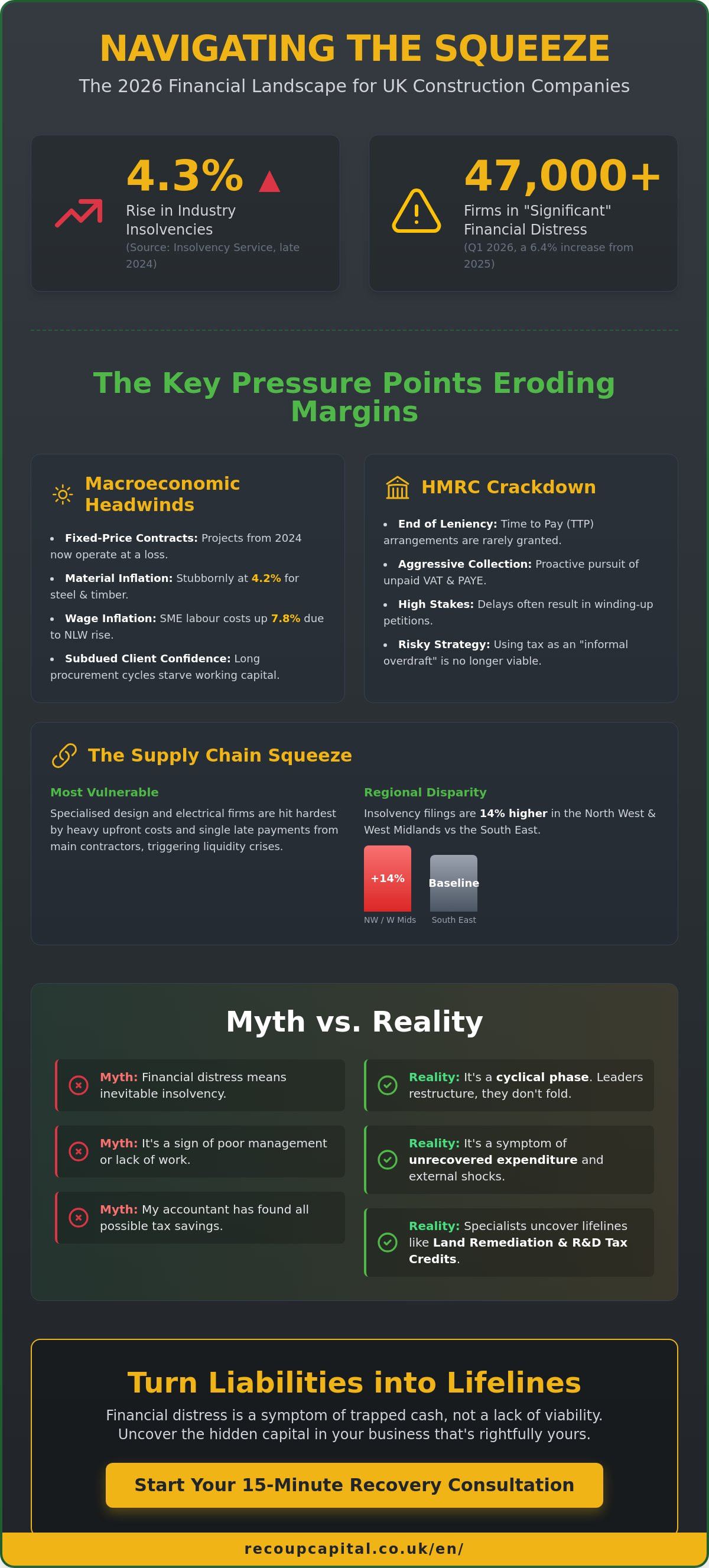
Unlocking Hidden Cash Flow: The Construction Industry's "Secret" Lifelines
Many uk construction companies financial distress stems from capital being trapped in places directors don't think to look. We call this "stranded capital." It's money already spent on commercial property or derelict land that hasn't been properly optimised for tax purposes. In 2026, liquidity is your most valuable asset. Finding these hidden lifelines can be the difference between a forced restructuring and a successful recovery.
Capital Allowances: The Underutilised Asset
Standard accounting practices often overlook embedded fixtures. Items like air conditioning, lift systems, and specialist cabling are frequently bundled into general construction costs. This is a missed opportunity. Forensic surveying identifies these specific assets, allowing you to claim significant relief. Under the "Full Expensing" rules, which remain a cornerstone of business investment in 2026, your firm can deduct 100% of the cost of qualifying plant and machinery from your profits. For a deeper look at what qualifies, see our guide on Capital Allowances for Commercial Property. This isn't just a tax break; it's immediate cash for reinvestment.
Land Remediation Relief for Distressed Developers
Derelict or contaminated sites are often seen as liabilities, but they hold significant potential for tax efficiency. Land Remediation Relief allows companies to claim up to 150% of the costs associated with cleaning up land. This includes tackling asbestos, radon, or even long-term infestations like Japanese Knotweed. If you're working on a site that's been derelict for a long period, you might be eligible for a substantial boost to your balance sheet. You can check the specific Land Remediation eligibility criteria to see if your current project qualifies. Transforming a "problem site" into a tax-efficient opportunity is a proactive way to combat uk construction companies financial distress.
The real power comes from the synergy between these claims. It's about looking at a project through a forensic lens. For example, a mid-sized contractor we partnered with recently faced a £210,000 budget gap on a technical design project in Birmingham involving unstable ground conditions. By combining R&D tax credits for their innovative foundation solutions with a forensic capital allowances audit, they recovered over £185,000. This six-figure sum didn't just fill a hole; it funded their next three tenders. We don't just process paperwork. We find the money you've already earned so you can focus on building the future.
Strategic Debt Restructuring and Corporate Finance for Construction
Tax recovery often provides the initial lifeline, yet long-term resilience requires a deeper look at the balance sheet. When uk construction companies financial distress moves from a temporary cash flow hiccup to a structural deficit, fundamental restructuring becomes the priority. We act as the "Expert Friend," positioning your firm as a viable partner rather than a liability. This shift allows you to negotiate with creditors from a position of strength, backed by hard data and a clear path to solvency.
Distinguishing between "Death Spiral" debt and strategic growth capital is vital for survival in 2026. High-interest, short-term loans often mask underlying issues, leading to a terminal decline. In contrast, strategic capital focuses on mid-market corporate transactions that facilitate growth even whilst under pressure. By restructuring existing liabilities, firms can unlock capital for new projects, turning a period of distress into a window for market consolidation.
Refinancing the Supply Chain
Maintaining site momentum depends on liquidity. Asset-based lending (ABL) allows you to leverage machinery or property to bridge the gap between project milestones. Invoice discounting remains a powerful tool here, converting unpaid certificates into immediate working capital. Our team provides Corporate Finance expertise to assist with valuation and negotiation, ensuring you secure terms that support rather than stifle your recovery.
Managing HMRC Negotiations in 2026
HMRC's approach to the construction sector has tightened since the 2024 reforms. You'll need a structured recovery plan before you even think about approaching them for a Time to Pay (TTP) arrangement. We use your tax credit forecasts as tangible collateral, proving your ability to settle arrears through future innovation-based inflows. Because our success-based fees only apply when we deliver results, your remaining cash reserves stay protected throughout the entire negotiation process.
A proactive stance prevents the 4,370 insolvencies seen in the sector during 2023 from becoming your reality. Secure your firm's future by speaking with a specialist. Book your free 15-minute consultation today.
Navigating the Recovery: How Recoup Capital Partners with Distressed Firms
Surviving the economic pressures of 2026 requires more than a standard service provider. For uk construction companies financial distress isn't just a balance sheet issue; it's a threat to decades of hard work and professional reputation. Recoup Capital operates on a philosophy that moves beyond the traditional adviser role. We act as a partner, sharing the burden of recovery whilst identifying hidden capital that most generalist firms overlook.
Our engagement starts with a free 15-minute consultation. This low-friction entry point allows stressed directors to explore recovery options without financial commitment or high-pressure sales tactics. We focus on demonstrating value through immediate, actionable insights. In a sector where thousands of firms face insolvency annually, every minute of expert guidance counts. We provide a clear perspective when the path ahead feels cluttered by debt and regulatory complexity.
General accountants often lack the technical depth required to identify complex R&D or land remediation opportunities within a construction project. Choosing the right R&D Tax Credit Specialists UK ensures that technical assessment and forensic accounting are handled by experts who understand HMRC's evolving 2026 standards. We don't just file papers; we build a robust, compliant case for your business survival. Our specialists identify innovation in everyday problem-solving, from bespoke engineering solutions to site-specific environmental challenges.
The Seamless Recovery Process
The journey from instability to growth involves a rigorous end-to-end technical assessment. Our team manages everything from forensic accounting to direct HMRC liaison, ensuring your claim is defensible and accurate. We operate on a success-based fee model. This aligns our interests directly with yours; we only succeed if we secure the capital you need. This "money for reinvestment" serves as a strategic lifeline, allowing you to settle pressing debts, retain skilled staff, or pivot toward more profitable, innovative contracts. It's about turning past expenditure into future liquidity.
Taking the First Step Toward Stability
Preparation is the key to a rapid capital recovery audit. Gather your project records, payroll data, and subcontractor invoices; our team handles the heavy lifting of identifying qualifying expenditure. There's a significant psychological benefit to having a proactive guide through uk construction companies financial distress. Knowing that specialists are managing the technical complexities of tax law allows you to focus on core site operations. We're here to turn a daunting government process into a clear opportunity for growth. Today’s adviser, tomorrow’s partner; let's secure your firm's future together.
Securing Your Firm’s Legacy Beyond 2026
Navigating the complexities of uk construction companies financial distress requires more than just grit; it demands a strategic shift toward capital recovery. Whilst the market remains volatile, many firms are sitting on untapped lifelines that can prevent insolvency. By identifying qualifying R&D expenditure or unclaimed Capital Allowances, businesses can transform their balance sheets. Our specialist team of Chartered Tax Accountants and forensic surveyors has a proven track record in the construction sector, ensuring you don't leave vital funds on the table. We've seen how targeted financial recovery can turn a struggling site into a profitable enterprise.
We believe in demonstrating value through results. That's why we operate on success-based fees; we only win when you recover capital. It's time to move from surviving to thriving by leveraging the expertise of a partner who understands the construction sector's unique financial architecture. Your path to recovery starts with a simple, no-pressure conversation about your business's future. Today's adviser is ready to become your partner for the 2026 recovery and beyond.
Book your FREE 15-minute consultation today to uncover your hidden capital
Let's build a stronger financial foundation for your business together.
Frequently Asked Questions
What are the first signs of financial distress in a UK construction company?
The first signs of uk construction companies financial distress include missed payments to subcontractors and a sudden reliance on credit to cover weekly payroll. In 2023, the construction sector recorded 4,370 insolvencies, the highest of any UK industry. You should watch for recurring County Court Judgments (CCJs) or frequent requests for HMRC 'Time to Pay' arrangements. These red flags suggest your cash flow is no longer sufficient to meet your immediate liabilities.
Can R&D tax credits be used to pay off HMRC debt or VAT arrears?
You can use R&D tax credits to settle HMRC debt or VAT arrears through a process called offsetting. If your company owes £25,000 in VAT but is owed a £40,000 R&D credit, HMRC will automatically clear the debt and pay you the £15,000 difference. It's a highly effective way to clear historical tax burdens without using your company's limited liquid cash. This process provides immediate relief for your balance sheet.
Is my construction firm too small to benefit from corporate finance advisory?
No construction firm is too small to benefit from professional financial advice. Small and medium enterprises (SMEs) make up 99% of the UK construction industry and often have the most to gain from tax incentives. Whether your turnover is £500,000 or £5 million, identifying unclaimed capital allowances can provide the essential money for reinvestment that helps your business thrive. We focus on demonstrating value through results rather than delivering a traditional pitch.
What is the difference between significant and critical financial distress?
Significant distress is defined by CCJs totalling less than £5,000, while critical distress involves winding-up petitions or CCJs exceeding £5,000. Data from late 2023 showed that 47,477 construction businesses were in significant financial trouble. Whilst significant distress is a warning, critical distress often precedes formal insolvency. Catching these issues early allows for a more seamless transition back to stability through strategic debt restructuring and professional tax recovery services.
How long does a typical R&D or Capital Allowance recovery take to reach our bank account?
A typical R&D claim usually reaches your bank account within 28 to 40 days of submission to HMRC. Capital Allowance recoveries take slightly longer because they require more detailed forensic accounting and amendments to previous tax returns. You'll generally see these funds within 3 to 6 months. We focus on making the process as brisk and efficient as possible to ensure your financial recovery isn't delayed by unnecessary administrative friction.
Will claiming tax credits increase the likelihood of an HMRC inquiry?
Claiming tax credits doesn't automatically trigger an inquiry if your technical reports are accurate and professionally prepared. HMRC recently added 300 specialist inspectors to their R&D team to target non-compliant claims. We act as your protective guide, ensuring every pound of your claim is backed by rigorous evidence. This transparency reduces the risk of inquiry and helps maintain a positive relationship with the tax authorities while securing the money you're owed.
Do I need to be in profit to claim Land Remediation Relief or R&D credits?
You don't need to be in profit to benefit from Land Remediation Relief or R&D tax credits. Loss-making companies can surrender their tax losses in exchange for a cash payment from HMRC. For Land Remediation, this credit is worth 16% of the qualifying expenditure. It's a vital lifeline for firms dealing with uk construction companies financial distress, providing a cash injection when the business needs it most to fund future innovation.
How does Recoup Capital’s success-based fee model work for a company with no spare cash?
Our success-based model means we don't charge any upfront fees or hidden costs. We only take a pre-agreed percentage once your claim is successfully paid by HMRC. This approach removes the financial barrier for firms with no spare cash. We prefer to demonstrate our value through results. It's a low-risk partnership designed to help you innovate and grow without adding to your existing financial pressure or impacting your daily operational cash flow.