
The Impact of Mergers on R&D Tax Claims: Navigating the 2026 Landscape

Could your next corporate acquisition actually devalue your most innovative assets? While a strategic merger is often the catalyst for rapid growth, the impact of mergers on R&D tax claims can be surprisingly complex under the 2026 HMRC framework. You've likely spent years building a robust pipeline of innovation; the last thing you want is to see that value diluted because of a change in corporate structure or a misunderstanding of the "Merged Scheme" rules. It's a common concern for forward-thinking directors who want to ensure their technical advancements are recognised as strategic financial assets rather than administrative burdens.
We understand that the intersection of M&A activity and tax legislation often feels like a moving target. This guide will show you exactly how to safeguard your innovation incentives and ensure your transaction value remains intact. We'll examine the critical differences between corporate consolidation and the HMRC Merged Scheme; we'll also outline how to handle contracted-out work and maintain eligibility for Enhanced R&D Intensive Support (ERIS) to ensure your claims remain compliant and lucrative as you scale. By the end, you'll have a clear roadmap for protecting your R&D assets through every stage of the deal.
Key Takeaways
- Distinguish between corporate M&A and the HMRC Merged Scheme to ensure your innovation funding remains secure throughout 2026.
- Navigate the impact of mergers on R&D tax claims by correctly identifying which entity retains the right to claim for contracted-out expenditure under the new rules.
- Protect your transaction value by treating R&D tax credits as a critical due diligence priority that can reveal hidden innovation in sectors like construction and engineering.
- Establish a unified technical narrative and standardised data collection processes to streamline your post-acquisition CT600 filings and ensure total compliance.
- Understand the strategic advantage of partnering with specialists who act as protective guides, transforming complex regulatory shifts into approachable growth opportunities.
Navigating the Dual Impact of Mergers on R&D Tax Claims in 2026
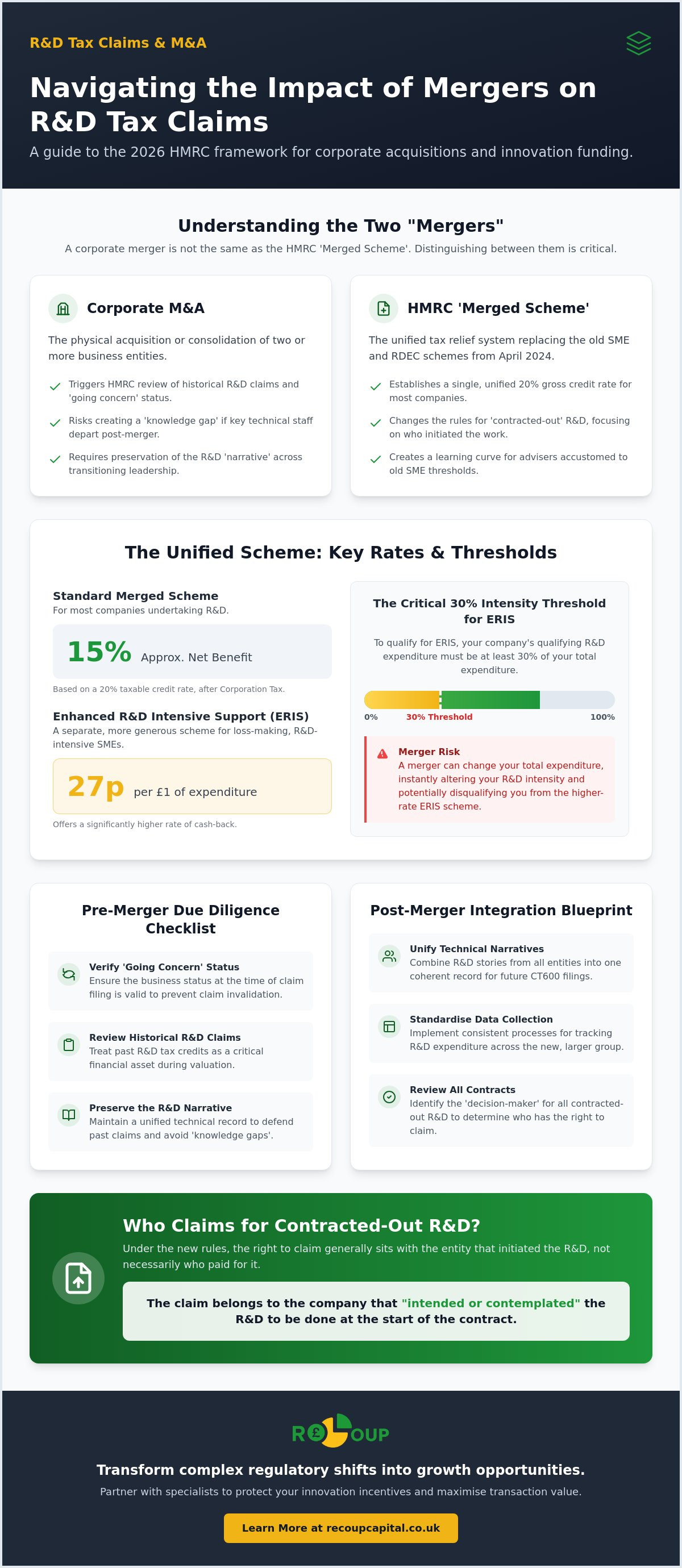
The year 2026 represents a unique crossroads for UK innovation. For many limited companies, the challenge isn't just managing the technicalities of a business acquisition; it's also adapting to a radically simplified, yet more rigorous, regulatory framework. Understanding the impact of mergers on R&D tax claims requires a clear distinction between two very different concepts: the physical merger of two corporate entities and the HMRC "Merged Scheme" for tax relief.
The HMRC Merged Scheme is the unified R&D expenditure credit system that replaced the separate SME and RDEC pathways for accounting periods beginning on or after 1 April 2024. While the terminology might suggest it's designed for business consolidations, it actually refers to the merger of the tax rules themselves. However, when a corporate transaction occurs in this environment, these two "mergers" collide. Viewing your UK's R&D tax incentive as a strategic asset rather than a mere post-tax bonus is essential for protecting your balance sheet during a sale or purchase. This perspective is a core component of modern corporate finance, where tax assets are treated with the same scrutiny as physical machinery or intellectual property.
Corporate M&A: When Two Innovative Cultures Collide
Acquisitions often trigger an immediate HMRC review of historical R&D claims. When a company changes hands, the "going concern" status of the entity becomes a focal point; if a business isn't considered a going concern at the time a claim is made, the credit may be invalidated. It's also vital to preserve the R&D "narrative" whilst leadership teams transition. Loss of technical staff during a merger can lead to a "knowledge gap" that makes defending past claims difficult. We've seen that maintaining a unified technical record is the best way to safeguard these assets during a transition.
The HMRC Merged Scheme: A Unified Regulatory Landscape
The transition from the old dual-system approach to the single Merged Scheme has created a learning curve for many corporate finance advisers. By 2026, the majority of UK businesses will be filing their returns under this unified 20% gross credit rate. This shift often confuses advisers who are used to the old SME thresholds. The impact of mergers on R&D tax claims is particularly sharp when it comes to "contracted-out" R&D. Under the new rules, the decision of which company claims the credit depends on who "intended" the R&D to take place at the start of the contract. This makes post-transaction contract reviews a mandatory step for any newly formed group.
The HMRC Merged Scheme: Preserving Value in the New Regulatory Era
The transition to a unified system has redefined how businesses calculate their innovation incentives. Under the merged scheme, companies receive a 20% taxable credit; this typically results in a net benefit of approximately 15% after Corporation Tax is applied. For loss-making, R&D-intensive SMEs, the Enhanced R&D Intensive Support (ERIS) remains a vital separate pathway. To qualify for this more generous relief, your company's qualifying expenditure must meet a 30% intensity threshold. This distinction is crucial because a corporate merger can instantly change your company's R&D intensity, potentially moving you from the 27p-per-£1 benefit of ERIS back into the standard merged scheme. Understanding the impact of mergers on R&D tax claims is no longer just a tax task; it's a fundamental part of maintaining your firm's valuation.
Navigating these rules requires a deep dive into HMRC's official guidance. The complexity of these regulations often surprises generalist advisers, particularly when assessing how a newly formed group should structure its future innovation projects to remain compliant and profitable.
Contracted-Out R&D: Who Claims Post-Merger?
One of the most significant shifts in the 2026 landscape is the hierarchy of claiming for contracted-out work. The right to claim now generally sits with the "decision-maker" who intended the R&D to take place at the start of the contract. If your business is acquired, your existing contracts with subsidiaries or third parties must be reviewed immediately. Restructuring your corporate group can inadvertently shift the "intended" status of a project from one entity to another; this could result in a lost claim if the contract language doesn't reflect the new reality. Ensuring that your group structure aligns with these rules is a core part of having R&D tax credits explained in a way that actually protects your bottom line.
Overseas Expenditure Restrictions in 2026
The merged scheme places a heavy emphasis on UK-based innovation. Most expenditure on subcontracted R&D or externally provided workers must now be performed within the UK to qualify for relief. Whilst there are limited exceptions for geographical, environmental, or legal necessities, globalised teams must be careful. If a merger brings an offshore development centre into your group, you may find that those specific costs are no longer eligible. Strategic planning is essential here. You might need to relocate specific R&D activities back to the UK to maximise your recovery and ensure the impact of mergers on R&D tax claims remains positive for your overall transaction value.
Due Diligence and Valuation: R&D as a Transactional Asset
In the 2026 M&A market, R&D tax credits have moved from a footnote in the tax pack to a high-risk due diligence item. Buyers are no longer satisfied with a summary figure; they want to see the granular technical evidence. The impact of mergers on R&D tax claims is often felt most acutely here, where a poorly documented claim can trigger a price chip or a significant indemnity. For many Tax Strategies for Growth-Oriented Businesses, the focus is on quantifying the risk of historical HMRC enquiries. If the target company hasn't maintained a robust technical narrative, the buyer may assume a worst-case scenario for potential clawbacks, directly affecting the final sale price.
We often find "hidden" innovation in sectors like construction and engineering. These businesses frequently overlook eligible activities, such as developing bespoke structural solutions or overcoming ground condition challenges, because they view them as standard operational problem-solving. A thorough due diligence process should include forensic surveying to identify these missed opportunities. This doesn't just uncover R&D; it also highlights potential capital allowances related to the physical assets and infrastructure involved in these projects, ensuring no capital is left on the table during the transaction.
Valuation Impacts: Boosting the Multiplier
A robust history of successful claims does more than just provide a cash injection; it fundamentally enhances the EBITDA of a target company. When you can demonstrate a consistent, compliant recovery of innovation costs, you're proving the efficiency of your technical operations. Transaction models in 2026 now frequently include future R&D tax credit forecasts as a core component of the valuation. You can Discover why claiming R&D tax credits is vital for growth by looking at how these credits act as a non-dilutive funding source that strengthens your balance sheet before a sale, making the business far more attractive to potential investors.
The "Digital Footprint" of Compliance
By 2026, HMRC's digital capabilities have evolved significantly. The use of advanced AI to flag inconsistencies amongst M&A filings means your technical reports must perfectly align with the corporate narrative of the merger. If your technical descriptions don't match the strategic goals described in the transaction documents, you're inviting scrutiny. The impact of mergers on R&D tax claims is often a matter of narrative consistency. Having Learn more about R&D tax credits explained through the lens of compliance ensures that your digital footprint remains clean, protecting you from automated red flags during a sensitive corporate transition.
Post-Transaction Integration: Aligning R&D Processes for Compliance
Once the ink has dried on a deal, the practical impact of mergers on R&D tax claims moves from the boardroom to the technical departments. Successfully integrating two innovative cultures requires more than just merging payroll; it demands a total standardisation of how R&D data is collected and documented. If your newly acquired business units continue to operate in silos, you risk submitting inconsistent technical narratives that don't stand up to scrutiny. Inconsistent record-keeping amongst subsidiaries is the #1 trigger for an HMRC enquiry. To mitigate this risk, many groups find success in appointing a central R&D specialist to oversee the entire merged portfolio, ensuring that every project meets the same rigorous evidentiary standards across the board.
Establishing a unified technical narrative for future CT600 filings is vital for maintaining the long-term value of your innovation assets. This isn't merely an administrative task; it's a strategic move to protect your balance sheet. By creating a single, high-quality standard for project descriptions and cost allocations, you present a transparent and professional image to the authorities. If you're currently managing an integration, you can optimise your R&D tax credit process by implementing these standardised protocols early in the transition phase.
Synchronising Accounting Periods and CT600s
Acquisitions frequently trigger "short period" tax returns as the new group aligns its financial year-ends. Managing R&D claims during these truncated periods requires precision, particularly when pro-rating staff costs and consumables. It's easy to lose track of qualifying expenditure during a year-end shift, but these timing nuances are exactly what HMRC's automated systems look for. Understanding HMRC R&D Tax Claim Transparency and AI: Navigating the New Compliance Era is essential here, as it explains how the digital-first approach to compliance affects companies undergoing structural changes.
Identifying Overlap in Innovative Projects
Mergers often reveal that both entities were working on similar technological challenges. Consolidating these duplicate projects isn't just about efficiency; it's about clarifying the "scientific or technological uncertainty" that makes the work eligible for relief. You must ensure that the combined technical report clearly defines where the baseline of industry knowledge sat for both teams and how their combined efforts pushed beyond it. Training new staff on the importance of contemporaneous record-keeping is a fundamental step in this process. When technical teams understand that their daily logs are actually strategic financial documents, the quality of your future claims improves significantly. This alignment ensures the impact of mergers on R&D tax claims remains a driver of growth rather than a compliance headache.
Maximising Innovation Value: Why Specialist Guidance is Essential
Relying on a generalist accountant during a complex corporate transition is a gamble that few innovative firms can afford. Whilst a generalist is excellent for standard compliance, they often lack the forensic depth required to navigate the rigorous 2026 HMRC landscape. Recoup Capital acts as a proactive and protective guide through these complexities; we ensure that every technical nuance is captured and every risk is mitigated. By blending specialist tax knowledge with corporate finance expertise, we transform your tax claims into strategic business tools that enhance your overall transaction value. This specialised focus is what prevents the dilution of your innovation assets during a high-stakes merger.
The impact of mergers on R&D tax claims is often multifaceted, requiring a steady hand to manage. Our success-based fee structure is designed specifically to preserve your transaction capital, ensuring that our interests are perfectly aligned with your recovery goals. This partnership-oriented approach moves far beyond the traditional service provider model; it's a commitment to long-term collaboration that safeguards your innovation through every stage of the business lifecycle. We believe in demonstrating value through results rather than delivery of a traditional pitch, which is why our track record in the corporate finance space is so vital for merged entities.
Beyond R&D: A Holistic View of Tax Relief
A merger is the perfect time to audit your entire tax relief strategy. Beyond R&D, your newly acquired entities might qualify for land remediation relief if they occupy sites with historical contamination or structural issues. Additionally, integrating Patent Box benefits can significantly lower your corporation tax to just 10% on profits derived from patented inventions. You can Explore our corporate finance advisory services to see how these various reliefs can be woven into a single, high-impact financial strategy that maximises the utility of your capital and improves your post-merger cash flow.
Securing the Future of Your Innovation
Ensuring ongoing compliance in 2026 and beyond requires a proactive stance. The regulatory environment will only become more rigorous, making a long-term partnership with a specialist essential for your peace of mind. We offer a no-cost technical assessment of your merged entity to identify immediate opportunities and potential risks. This discovery phase is entirely low-friction and evidence-based, allowing you to see the value we provide before making any commitments. If you're ready to protect your innovative arm and understand the full impact of mergers on R&D tax claims, you should Speak to our specialists about your post-merger R&D strategy today.
Future-Proofing Your Innovation Strategy
Navigating the 2026 landscape requires more than just technical aptitude; it demands a strategic alignment of your corporate structure with the latest HMRC regulations. By clearly distinguishing between business consolidations and the HMRC Merged Scheme, you can ensure that your innovation funding remains a robust asset rather than a compliance liability. The impact of mergers on R&D tax claims is profound, yet with standardised record-keeping and forensic due diligence, these transitions become clear opportunities for significant capital recovery and enhanced business valuation.
Our team of Chartered tax accountants and technical specialists brings deep expertise in mid-market corporate finance transactions to every collaboration. We act as your proactive guide, ensuring your technical narratives are bulletproof whilst our success-based fee structure keeps your transaction capital secure. Don't leave your innovation incentives to chance during a complex merger. You can secure your innovation assets with a specialist R&D assessment today. We're ready to help you transform your technical advancements into powerful, long-term drivers for your business's next chapter of growth.
Frequently Asked Questions
Does a merger automatically trigger an HMRC R&D enquiry?
No, a merger doesn't automatically trigger an enquiry, but it significantly elevates your risk profile in the eyes of HMRC. Structural changes often prompt automated systems to cross-reference historical filings with new corporate data. This is why the impact of mergers on R&D tax claims usually involves a higher degree of technical scrutiny. You should ensure that all technical reports are robust and consistently documented before the transaction completes to avoid red flags.
Can we still claim R&D tax credits if the target company is loss-making?
Yes, you can still claim credits if the target is loss-making. In fact, these entities often benefit most from the "above-the-line" credit or the Enhanced R&D Intensive Support (ERIS) scheme. If the loss-making company spends at least 30% of its total expenditure on qualifying R&D, it can receive a cash benefit of up to 27p for every £1 spent. This makes loss-making innovative firms highly attractive as transactional assets.
How does the HMRC Merged Scheme affect SME intensity status post-acquisition?
A merger can immediately alter your intensity status because the 30% threshold is calculated at the group level. If an R&D-intensive SME is acquired by a larger, less innovative group, the combined expenditure might push the innovative arm below the required percentage. This shift would move the company from the generous ERIS rates into the standard 20% merged scheme credit. It's a critical calculation to perform during the pre-deal valuation phase.
Who owns the R&D tax credit after a business is sold?
The legal entity that incurred the qualifying expenditure generally owns the credit, but the actual benefit is often decided by the Sale and Purchase Agreement (SPA). Buyers and sellers must negotiate who receives the value of historical claims or pending credits. The impact of mergers on R&D tax claims often hinges on these contractual details; they ensure the financial benefit of past innovation is correctly attributed to the right party.
Can R&D tax credits be used to offset Capital Gains Tax from a merger?
R&D tax credits cannot be used to directly offset Capital Gains Tax (CGT) arising from a merger. These credits are specifically designed to reduce Corporation Tax liabilities or provide a payable cash credit for loss-making firms. Whilst they improve your overall cash position and balance sheet strength, they operate within the Corporation Tax framework rather than the capital gains regime. It's best to view them as a strategic tool for operational funding.
What happens to R&D claims if our accounting period changes after a merger?
You will likely need to file "short period" returns to align your financial year with the new parent company. This requires a precise pro-rata allocation of R&D costs, including staff time and consumables, for the truncated period. Accuracy is vital here; HMRC's 2026 compliance tools are particularly sensitive to inconsistencies during these transitional accounting periods. Failing to align these correctly can lead to delayed payments or formal enquiries.
Is overseas R&D expenditure still claimable amongst merged UK groups in 2026?
Overseas expenditure is largely restricted under the 2026 rules, even for large merged groups. Most R&D activities must be performed within the UK to qualify for the 20% credit. There are very narrow exceptions for work that cannot be done in the UK due to geographical or legal requirements. If your merger brings in offshore development centres, you must carefully audit these costs to ensure they aren't inadvertently included in your UK claim.
How do we value an R&D tax credit claim during the due diligence process?
Valuation is achieved through a rigorous audit of the target's technical documentation and qualifying costs. We look for the "scientific or technological uncertainty" in their projects and verify that the evidence supports the figures claimed. If the documentation is weak, the claim is often valued lower or treated as a potential liability. Conversely, a well-documented claim history acts as a strategic asset that can significantly boost the company's EBITDA and final sale price.