
R&D Tax Relief: The 2026 Guide to Maximising Innovation Funding for UK Companies

What if the technical failures that cost your business £50,000 last year were actually your most valuable assets for 2026? Most UK directors agree that keeping pace with HMRC's 1 April 2024 merged scheme feels like a full-time job they didn't sign up for. It's natural to feel hesitant when the 2023-24 tax year saw HMRC intensify its scrutiny of r&d tax relief claims to combat an estimated £1.1 billion in error and fraud. You want to innovate, but you don't want to invite an audit or waste weeks on paperwork that might lead nowhere.
We're here to change that narrative. This guide shows you how to navigate the 2026 landscape, identify genuine innovation within your technical challenges, and transform those efforts into vital cash for reinvestment. We'll explore the latest legislative shifts, provide a framework for identifying future qualifying projects, and show you how to build a compliant claim that stands up to the strictest professional standards.
Key Takeaways
- Learn how to transform technical hurdles into strategic reinvestment capital by utilising the dual benefits of reduced Corporation Tax or payable cash credits.
- Master the HMRC definition of a "technological advance" to correctly identify innovation that moves the needle for your entire industry, not just your firm.
- Navigate the 2026 regulatory shift toward the Merged Scheme and ERIS to ensure your business remains compliant whilst maximising its r&d tax relief claim.
- Uncover the full spectrum of qualifying expenditure, from staffing and consumables to the vital 2026 categories of cloud computing and data costs.
- Understand the value of a specialist partnership in mitigating the risks of generalist accounting, ensuring your claim is both robust and fully optimised.
Understanding R&D Tax Relief in the 2026 UK Landscape
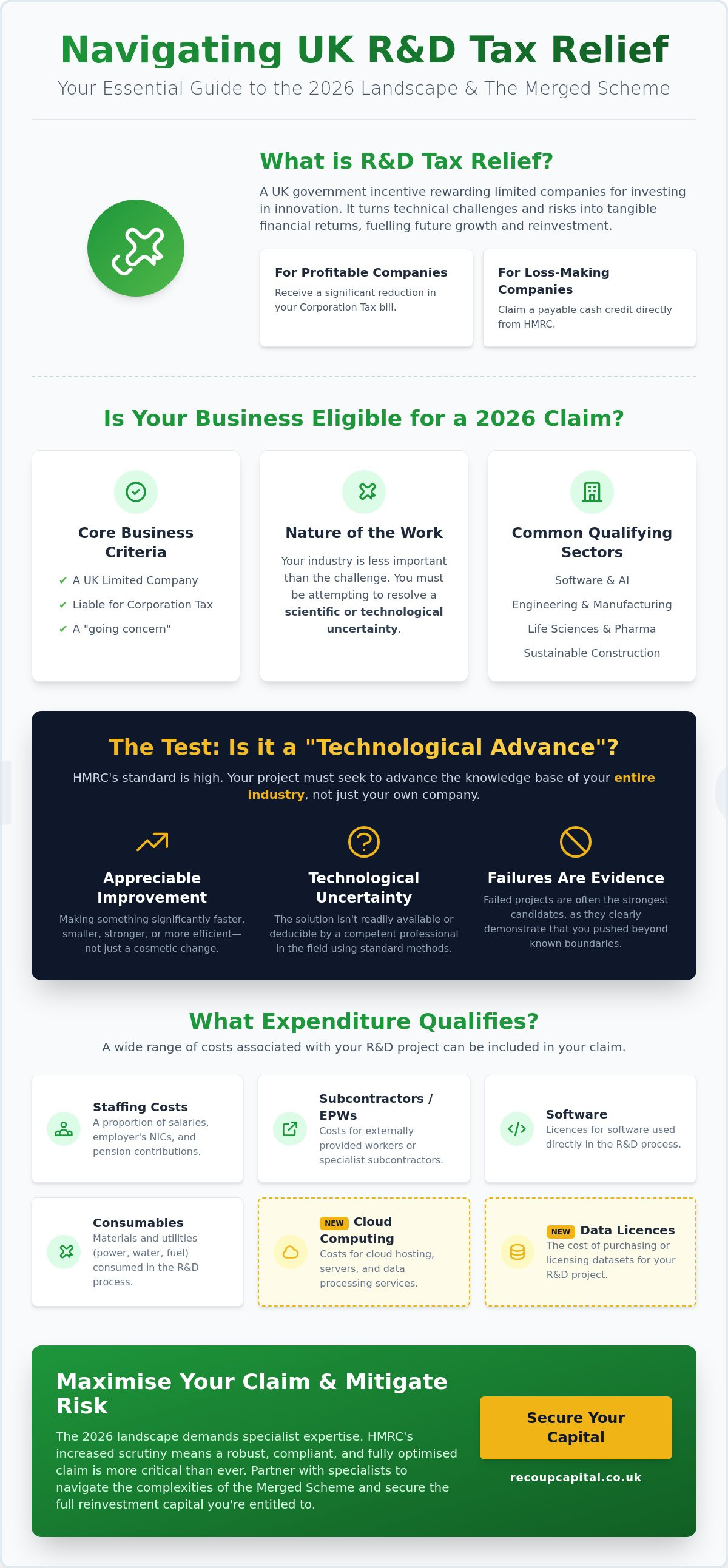
Innovation isn't just a buzzword; it's the engine of the British economy. At its heart, r&d tax relief is a government-backed incentive designed to reward UK limited companies for taking technical risks. Whether you're developing a new software algorithm or engineering a more efficient construction material, the scheme ensures that your investment doesn't go unrecognised. It's a strategic tool that turns technical challenges into financial opportunities.
The reward manifests in two primary ways. Profitable companies see a direct reduction in their Corporation Tax liability; meanwhile, for loss-making firms, the incentive transforms into a payable cash credit. We view this as more than a simple refund. It's essential money for reinvestment that fuels your next breakthrough and keeps your momentum high. It's about helping your business thrive by recovering costs that would otherwise be lost to the bottom line.
As we move through 2026, the environment has shifted. HMRC has introduced stricter transparency requirements to eliminate error and fraud, following the 2024 implementation of the merged R&D scheme. Claims now require more robust technical documentation and a mandatory digital-first approach to submission. We act as your protective guide through these complexities, ensuring your claim is both maximised and fully compliant with the latest standards.
The Core Purpose of the Incentive
The UK government maintains this support because innovation drives national productivity. While other tax reliefs have been phased out, R&D remains a priority to help the UK reach its target of spending 2.4% of GDP on research and development. Looking at the history of R&D tax relief, the scheme has evolved to bridge the "funding gap" for high-risk projects that private lenders might avoid. HMRC's 2023 statistics showed that the scheme supported over £44 billion in R&D expenditure, proving its role in keeping British sectors globally competitive.
Who Can Claim? Eligibility Criteria for 2026
Is your business eligible? The criteria are straightforward but strict. You must be a UK limited company liable for Corporation Tax. Crucially, your business must be a "going concern" when the claim is made. Your specific industry matters far less than the nature of your work. If you're attempting to resolve a scientific or technical uncertainty, you're likely eligible. Eligibility spans various activities:
- Software development and AI integration
- Engineering and manufacturing processes
- Life sciences and pharmaceuticals
- Sustainable construction and material science
To see how these rules apply to your specific situation, a FREE 15 minute consultation can provide the clarity you need. We're Today’s adviser, tomorrow’s partner, and we're ready to help you secure the capital you deserve.
The Science of Qualification: Defining a Technological Advance
Innovation isn't just a corporate buzzword; it's a strict legal benchmark. To secure r&d tax relief, your work must aim to create an "advance in science or technology." This means your project must seek to increase the overall knowledge base of your entire industry, not just your company's internal capabilities. If a solution already exists in a competitor's product but remains a trade secret, your attempt to replicate or surpass it through original research still qualifies as an advance. It's about pushing the boundaries of what's currently possible within your sector.
HMRC looks for an "appreciable improvement" in existing products, services, or processes. This isn't about minor cosmetic changes or routine updates that any developer could perform. It's about making something significantly faster, smaller, or more efficient through technical ingenuity. A "competent professional" plays a vital role in this process. This is an individual with relevant qualifications and years of experience who can testify that the challenge wasn't solvable by a seasoned pro using standard industry practices. Their expert judgment helps transform technical struggles into money for reinvestment.
Identifying Scientific or Technological Uncertainty
Uncertainty exists when the outcome of a project isn't deducible by a professional in the field. If you can't find the answer in a manual or through basic troubleshooting, you've likely hit a qualifying hurdle. Interestingly, failed projects are often the strongest candidates for a claim. Technical "dead ends" provide the clearest evidence that a project pushed beyond known boundaries. To satisfy HMRC auditors, you must document your trial and error process, showing exactly why the standard approach failed and how you attempted to resolve the technical gap. This documentation turns a "failed" investment into a successful claim.
The Boundaries of a Project
Determining the timeline of a project is essential for accurate cost allocation. R&D activity begins the moment you identify the technical challenge and start searching for a solution. It doesn't start at the initial brainstorming phase, but rather when the scientific work or technical research begins. The project ends when the uncertainty is resolved or the project is abandoned.
- Start Point: Technical specifications are defined and active research into the uncertainty begins.
- End Point: A working prototype is finalised or the technical challenge is deemed insurmountable.
- Exclusions: Routine commercial development, such as aesthetic design or standard software debugging, falls outside these boundaries.
Navigating the Merged R&D Scheme and ERIS Requirements
By 2026, the landscape of r&d tax relief has settled into a two-path system. The transition period is over. Most UK businesses now operate under the unified Merged Scheme, which replaced the separate SME and RDEC paths for accounting periods beginning on or after 1 April 2024. This evolution simplifies the framework but requires a more disciplined approach to documentation. It's no longer just about company size; it's about how you structure your innovation and where the financial risk sits.
The Merged Scheme: A Unified Approach
The Merged Scheme adopts the "above the line" credit model previously reserved for large corporations. You receive a gross credit of 20% on qualifying expenditure. Because this credit is taxable, the net benefit for most companies sits at approximately 15% after the 25% Corporation Tax rate is applied. This accounting treatment improves your EBITDA, making your balance sheet more attractive to potential investors or lenders.
Subcontracting rules have changed significantly. The right to claim now generally sits with the "decision maker" who directs the R&D activity and bears the financial risk. If you hire a contractor to solve a specific technical problem you've identified, you are typically the claimant. This prevents the double-claiming issues that occasionally surfaced under the old rules. Consistency is your best defence. HMRC now uses sophisticated data matching to compare your R&D claims against previous years and industry benchmarks. Maintaining a seamless record of your projects ensures your claim remains robust during an enquiry.
Enhanced Support for R&D Intensive Firms
Loss-making SMEs that invest heavily in innovation can access a more generous lifeline through Enhanced R&D Intensive Support (ERIS). This scheme is specifically designed for pre-revenue tech and life science firms where research is the primary business activity. To qualify, you must meet the "intensity condition." This requires your qualifying R&D expenditure to be at least 30% of your total relevant expenditure for the period. This threshold was reduced from 40% in the Autumn Statement 2023, opening the door for thousands more businesses to claim higher rates of r&d tax relief.
For those who qualify, the 14.5% credit rate provides a net benefit of up to £26.97 for every £100 spent. This is a significant uplift compared to the standard Merged Scheme. You can calculate your intensity ratio by following these steps:
- Identify your total qualifying R&D expenditure, including any connected party payments.
- Calculate your total relevant expenditure, which includes almost all costs that appear in your P&L, with some specific exclusions like capital expenditure.
- Divide the R&D figure by the total expenditure. If the result is 0.30 or higher, you meet the threshold.
We view these credits as vital money for reinvestment. They allow you to hire more engineers, purchase better equipment, and accelerate your time-to-market. If you're unsure which path your business falls into, understanding the nuances of R&D tax credits is the first step toward securing your firm's financial future.
Identifying Qualifying Expenditure: Beyond the Laboratory
Many directors mistakenly believe R&D tax relief is reserved for scientists in white coats. HMRC's definition actually covers a broad spectrum of technical problem-solving across the UK's commercial landscape. For 2026 claims, identifying every pound of eligible spend is the difference between a modest rebate and a transformative injection of capital for reinvestment.
The primary categories of qualifying costs include:
- Staffing Costs: Salaries, employer NI, and pension contributions for those directly involved in R&D.
- Subcontractors: Payments made to third parties for specific R&D tasks, generally restricted to 65% of the invoice value.
- Consumables: Materials, items, or utilities transformed or used up during the R&D process.
- Cloud Computing and Data Costs: A vital category since the April 2023 legislative shift. This includes data licences and cloud storage used specifically for qualifying projects.
Software licences, heat, light, and power are also eligible, provided they're correctly apportioned. If your engineering team uses high-performance computing that spikes your energy bill, that portion of the utility cost belongs in your claim. Similarly, Externally Provided Workers (EPWs) follow the 65% restriction rule, reflecting the provider's profit margin and administrative overheads.
Sector Spotlight: Construction and Engineering
Bespoke engineering solutions for challenging sites frequently qualify for r&d tax relief. Innovation often hides in the development of modular building systems or the creation of sustainable materials that reduce a project's carbon footprint. These advancements often overlap with land remediation efforts on brownfield sites, where technical uncertainty is high. If you're solving a problem that doesn't have a "book" answer, you're likely innovating. You can start the process by claiming R&D tax credits for these technical breakthroughs.
Staffing Costs: The Largest Claim Component
Staffing usually represents 70% or more of a successful claim. Accurate apportionment is essential. You must track the time directors, engineers, and project managers spend overcoming technical uncertainties. This includes gross salary, employer Class 1 NICs, and pension contributions. For 2026, HMRC expects contemporaneous record-keeping. Using digital logs or project management software to track R&D hours ensures your claim stands up to scrutiny. Proactive documentation prevents the stress of retrospective estimation and secures your funding faster.
Optimising Your Claim: The Value of Specialist Partnership
Generalist accountants are vital for day-to-day compliance, but they often struggle with the technical nuances of r&d tax relief. They tend to either under-claim by missing eligible activities or over-claim by failing to provide robust technical justifications. Both scenarios create friction. Under-claiming leaves thousands of pounds in the government's pockets, whilst over-claiming invites unnecessary scrutiny from HMRC. Statistics suggest that specialist intervention can increase claim values by up to 30% compared to generalist filings.
Recoup Capital bridges this gap through a dual-lens methodology. We combine deep technical assessments with forensic accounting. Most business owners overlook eligible projects because they view them as "just doing the job." If your team is overcoming technical uncertainties or improving a process where the solution wasn't obvious from the start, it's likely R&D. We identify these hidden pockets of innovation that generalists simply don't have the industry background to spot. Whether it's a bespoke software integration or a material science breakthrough in manufacturing, we translate your hard work into a compliant financial asset.
Risk Mitigation and Compliance
In the 2026 tax landscape, the Additional Information Form (AIF) is a non-negotiable component of every submission. It requires granular detail on the scientific or technological advances sought and the specific uncertainties involved. Our specialists act as a "firewall" against inaccuracies, ensuring every claim is backed by evidence that stands up to HMRC enquiries. You can learn more about the specific criteria in our guide to R&D Tax Credits Explained. This rigorous approach protects our clients from the 15% to 30% penalty rates often associated with "careless" errors in generalist filings.
Turning Relief into Reinvestment
We view r&d tax relief as a strategic engine for growth rather than a simple refund. For instance, a recent engineering client used a £112,000 credit to fund two new specialist hires, accelerating their product roadmap by six months. Another manufacturing firm utilised their relief to purchase advanced CNC machinery, increasing their production capacity by 25%. This aligns with our "Today’s adviser, tomorrow’s partner" philosophy. We help you plan your innovation pipeline for the next three years, ensuring you're constantly capturing value. Discover how these funds can transform your bottom line by reading Why Claim R&D Tax Credits. We don't just process paperwork; we build the financial foundation for your next breakthrough.
Turn Your Technical Challenges Into Strategic Capital
The 2026 UK innovation landscape is complex, but it presents a massive opportunity for businesses ready to adapt. Navigating the merged scheme and stricter ERIS requirements is no longer optional; it's essential for protecting your cash flow. By looking beyond the laboratory to identify qualifying expenditure in everyday problem-solving, you can significantly increase the value of your r&d tax relief claim. It's about turning technical uncertainty into a tangible financial asset for your business.
Since 2019, Recoup Capital has facilitated significant capital for UK innovators, acting as today's adviser and tomorrow's partner. Our expert team of chartered tax accountants and technical specialists handles the heavy lifting, ensuring your submission is both robust and optimised. We operate on a success-based fee structure, which means our interests are perfectly aligned with your growth. You don't have to face HMRC's evolving regulations alone. Let's transform your qualifying activities into money for reinvestment.
Book your FREE 15-minute R&D consultation with Recoup Capital to discover how much capital you could be reinvesting into your next big breakthrough. We're ready to help your business thrive.
Frequently Asked Questions
Can I claim R&D tax relief if my project was a failure?
Yes, you can claim relief even if your project ended in failure or was eventually abandoned. HMRC rewards the attempt to resolve scientific or technical uncertainties, not just the final commercial outcome. In fact, roughly 80% of successful claims involve some level of technical trial and error. If your team spent time and capital trying to achieve a technical breakthrough that proved impossible, those costs remain eligible as money for reinvestment.
What is the deadline for submitting an R&D tax credit claim in 2026?
The deadline for submitting a claim is exactly two years after the end of the accounting period in which the costs were incurred. For instance, if your company's financial year ends on 31 December 2024, you must submit your 2026 claim by 31 December 2026. Missing this 24 month window means you permanently lose the opportunity to recover that capital. We recommend starting the documentation process at least 6 months before the deadline to ensure accuracy.
How long does it take for HMRC to process an R&D tax credit payment?
HMRC aims to process 80% of claims within 28 to 40 days of receipt. While complex cases or those selected for random spot checks can take longer, most UK SMEs receive their payment or tax credit notification within this six week window. This speed makes the relief a reliable source of liquidity for businesses looking to fund their next phase of innovation without waiting for traditional bank loans or external investment.
Can I claim for R&D work that was performed by subcontractors?
You can claim for work performed by subcontractors, though you typically only include 65% of the relevant costs in your calculation. Under the merged R&D scheme effective for accounting periods starting after 1 April 2024, the rules for contracted out R&D ensure the decision maker usually claims the relief. This ensures that the company taking the financial risk and driving the innovation receives the primary benefit from the government's incentive.
Is my software development project eligible for R&D tax relief?
Software projects are eligible if they seek to achieve a technical advancement by resolving uncertainties in computer science. This doesn't include standard website builds or using existing tools in a routine way. Instead, it applies to projects like creating new algorithms or improving data processing speeds by 30% or more. If your developers are pushing the boundaries of what's currently possible in your field, you likely have a valid claim for r&d tax relief.
What happens if HMRC decides to open an enquiry into my R&D claim?
If HMRC opens an enquiry, they will issue a formal letter requesting additional evidence to support your technical narrative and cost breakdowns. This isn't a reason to panic; roughly 5% of claims undergo some form of compliance check annually. You'll need to provide detailed documentation of your technical challenges and the specific staff hours involved. Having a partner to manage this correspondence ensures the enquiry is resolved quickly whilst you focus on r&d tax relief benefits.
Do I need to be a profitable company to benefit from R&D tax relief?
You don't need to be profitable to benefit from this scheme. Loss-making SMEs can surrender their R&D losses to HMRC in exchange for a payable cash credit. For R&D intensive companies, this credit is worth 14.5% of the surrenderable loss, providing a vital cash injection for startups that are still in the pre-revenue phase. This mechanism transforms a complex tax process into an approachable opportunity for business innovation and growth regardless of your current tax position.
Can I claim R&D tax relief and capital allowances on the same project?
You can claim both, but you must categorise your spending correctly between revenue expenditure and capital expenditure. R&D tax relief covers day to day operational costs like staff salaries and consumables; Research and Development Allowances (RDAs) provide 100% first year relief on capital assets like machinery or laboratory equipment. Using both ensures you maximise your total tax savings, potentially covering 100% of your innovation related investment across different tax schedules and asset classes.