
Corporate R&D Tax Relief: A Strategic Guide for UK Businesses in 2026

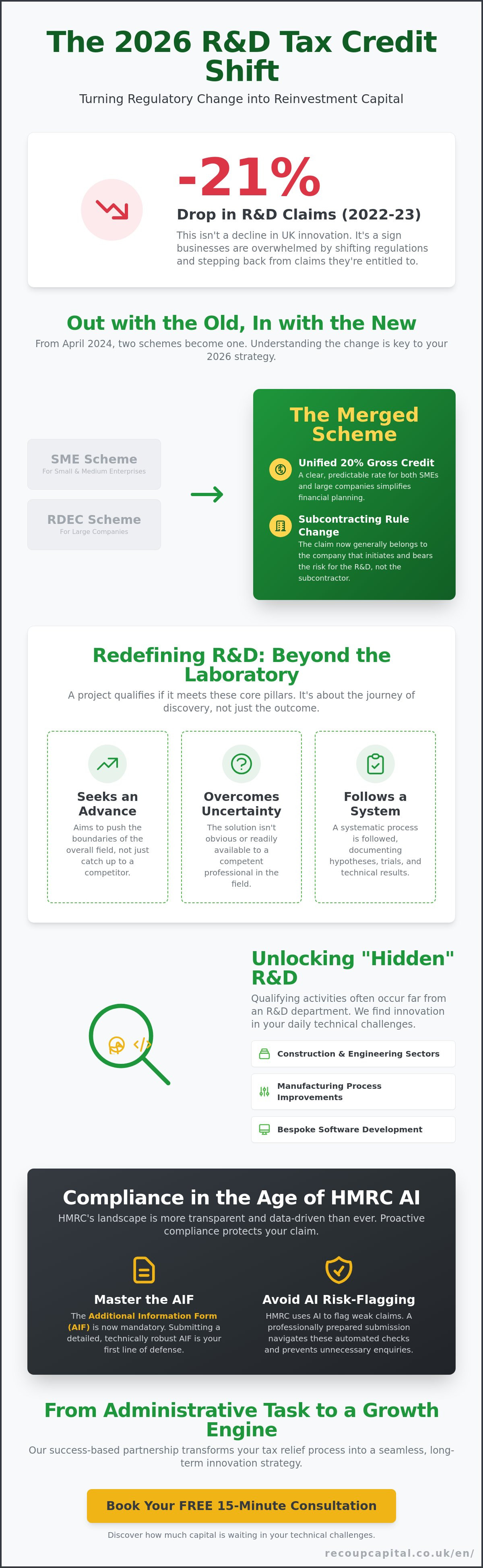
Did you know that HMRC reported a 21% drop in the total number of R&D tax credit claims for the 2022-23 period? This shift doesn't mean UK innovation is slowing down. It's a clear sign that many businesses are stepping back from claims they're entitled to because they feel overwhelmed by shifting regulations. If you're feeling uncertain about how the Merged Scheme affects your corporate rd strategy in 2026, you aren't alone. It's frustrating to see potential funding left on the table simply because the compliance process feels like a minefield, especially in sectors like construction where innovation isn't always obvious.
We're here to help you move forward with confidence. You'll discover how to successfully identify qualifying innovation and secure the maximum tax relief available for your business. This guide transforms a complex government process into a strategic opportunity to unlock money for reinvestment. We'll provide a clear framework for identifying qualifying expenditure and outline a compliant claim process that protects your business from unnecessary enquiries. Let's turn your technical challenges into a reliable source of growth capital.
Key Takeaways
- Learn how to identify qualifying innovation within your daily operations, moving beyond the laboratory to recognise the scientific and technological advances that drive growth.
- Understand the nuances of the Merged Scheme and ERIS to ensure your corporate rd strategy aligns with the 2026 regulatory environment for maximum relief.
- Uncover "hidden" R&D opportunities in sectors like construction and engineering, challenging common myths to unlock significant capital for reinvestment.
- Navigate HMRC’s increasingly transparent landscape by mastering the Additional Information Form (AIF) and protecting your claim against AI-driven risk flagging.
- Discover how a success-based partnership can transform your tax relief process from a mere administrative task into a seamless, long-term engine for business innovation.
Defining Corporate R&D: Beyond the Laboratory in 2026
Many UK directors still picture white coats and test tubes when they hear the term research and development. In 2026, the reality of corporate rd is far broader. It's a potent Corporation Tax incentive designed to reward UK limited companies for taking technical risks. This isn't a grant you apply for upfront; it's a strategic mechanism to recover costs already spent on innovation. We view these credits as "money for reinvestment." It's capital that flows directly back into your cash flow, allowing you to hire new talent or upgrade your infrastructure. The UK R&D tax incentive has evolved significantly since its introduction in 2000, and it remains a cornerstone of British industrial strategy for driving growth.
R&D occurs whenever your company seeks an advance in science or technology. This doesn't mean you have to discover a new element. It means you're looking for a way to do something that wasn't previously possible. We often describe this through the lens of "Scientific or Technological Uncertainty." In plain English, it's that specific moment your lead engineer or developer says, "We don't actually know if this will work." If the solution isn't obvious to a seasoned pro, you're likely in R&D territory. It's about the journey of discovery, even if the project eventually fails.
The Core Pillars of a Qualifying Project
To qualify for corporate rd relief, your project must seek an advance in the overall field, not just within your own business. You aren't simply catching up to a competitor; you're pushing the boundaries of what's possible in your sector. You must overcome uncertainties that a competent professional cannot readily resolve. If a quick search or a standard industry textbook provides the answer, it won't qualify. Finally, HMRC expects to see a systematic study. You need to show you've documented your hypotheses, your trials, and your technical breakthroughs throughout the process.
Why General Accountants Often Miss R&D Opportunities
Standard bookkeeping is excellent for day-to-day compliance, but it rarely identifies the technical nuances of innovation. General accountants look at invoices and balance sheets; we look at the sweat, the failed prototypes, and the technical hurdles your team faced. There's a significant risk of under-claiming when a firm only looks at the obvious R&D departments. In reality, qualifying costs often hide in manufacturing, software development, or complex engineering roles. If you're unsure if your work counts, our guide on R&D tax credits explained highlights how we perform forensic identification to find every penny you're owed.
Today’s adviser, tomorrow’s partner. If you want to see how much capital is waiting in your technical challenges, book a FREE 15 minute consultation with our team today.
Navigating the Merged R&D Scheme and ERIS
The regulatory framework for corporate rd tax relief underwent its most significant transformation on 1 April 2024. For businesses operating in 2026, the old distinctions between the SME scheme and RDEC are historical footnotes. HMRC replaced them with a single, unified Merged Scheme. This change aimed to simplify the process, yet it introduced nuanced rules regarding who can actually claim for contracted work. Understanding these shifts is vital for protecting your innovation budget. The 2026 landscape is defined by a more rigorous compliance environment where the "intent" of the research takes centre stage.
Key Features of the Merged Scheme
The Merged Scheme operates with a 20% gross credit rate. This provides a clear, predictable figure for your financial planning, though the net benefit depends on your current corporation tax rate. One major shift involves subcontracting. Previously, SMEs could often claim for work they were contracted to do; now, the right to claim generally sits with the company that "intended and initiated" the R&D. If your firm is the one driving the innovation and taking the financial risk, the claim belongs to you. This change has impacted thousands of firms in the construction and engineering sectors who previously relied on sub-contractor status for their claims.
- Unified Rate: A 20% gross credit applies to both large companies and most SMEs.
- Subcontracting ownership: The "customer" usually claims, provided they intended for R&D to take place at the start of the contract.
- Subsidised expenditure: Rules are now more restrictive; if a project is subsidised by a grant or another company, it may limit the qualifying expenditure under the merged rules.
Managing these overlaps between group companies requires careful documentation. If you're unsure where your project sits, it's worth checking how these credits are explained in the context of your specific contracts.
Enhanced Support for R&D Intensive Companies
Loss-making innovators haven't been left behind. The Enhanced R&D Intensive Support (ERIS) provides a lifeline for companies where R&D makes up at least 30% of total expenditure. This threshold was lowered from 40% in the 2023 Autumn Statement, opening the door for approximately 5,000 more UK businesses to access higher relief. For these intensive firms, the benefit remains more generous, offering a 14.5% surrender rate for losses rather than the standard merged rate. This distinction is critical for tech start-ups and life science firms that are pre-revenue but heavy on innovation.
To qualify for ERIS in 2026, your "R&D intensity" is calculated by dividing your qualifying R&D expenditure by your total relevant expenditure. This calculation must be precise. For a life sciences firm spending £300,000 on corporate rd out of a total £900,000 budget, the 33% intensity ensures they hit the threshold for the higher payable credit. This cash injection is often the difference between reaching the next stage of clinical trials or stalling. It's money for reinvestment that keeps the UK's most ambitious companies competitive on a global scale.
Strategic Sector Analysis: Where is Your Innovation Hidden?
A common misconception persists amongst UK business leaders that R&D tax credits are the exclusive domain of pharmaceutical giants and software developers. This narrow view ignores the reality of corporate rd in the modern economy. Innovation isn't just about discovery; it's about the practical resolution of technical uncertainty in any field. Recent HMRC data indicates that the manufacturing and construction sectors accounted for 22% and 7% of total claims respectively, proving that the scope for recovery is far broader than many realise. If you're solving a problem where the solution wasn't immediately obvious to a competent professional, you're likely innovating.
Innovation in Construction and Engineering
Construction firms often perform qualifying work without labelling it as such. Developing new materials to meet the 2025 Future Homes Standard requires significant experimentation with thermal efficiency and carbon capture technology. If your team is designing bespoke engineering solutions to overcome complex site constraints or ground stability issues, you're likely eligible for a claim. This work frequently intersects with Land remediation tax relief. When you're innovating ways to treat contaminated soil or remove asbestos from a site more efficiently, these dual claims can provide a significant injection of money for reinvestment. We've seen firms successfully claim for the development of modular construction techniques that reduce on-site waste by 20% whilst improving structural integrity.
Food Technology and Manufacturing Advances
The food and beverage sector is a hotbed for technical advancement where corporate rd is frequently overlooked. Process innovation is just as valuable as product development. We see significant claims arising from several key areas:
- Extending shelf life through novel chemical or physical preservation processes that don't compromise the nutritional integrity of the product.
- Automating production lines to reduce waste whilst simultaneously increasing throughput by integrating custom sensors or AI-driven sorting.
- Developing unique textures or nutritional profiles in plant-based products to mimic traditional meat or dairy products.
If your manufacturing facility has invested in bespoke machinery or modified existing lines to handle new materials, those costs represent eligible expenditure. It's about the "how" as much as the "what." Improving a production process to save 10% on energy costs is a technical achievement that HMRC recognises. We act as your expert friend to identify these hidden pockets of value, ensuring that every pound spent on overcoming these hurdles is accounted for in your claim. This proactive approach transforms a complex tax process into a seamless opportunity for growth.
Compliance in the Age of HMRC Transparency and AI
HMRC's digital transformation has fundamentally changed the landscape for every corporate rd claim. The mandatory Additional Information Form (AIF), which became a requirement in August 2023, now demands granular detail for every project submitted. It's no longer enough to provide a high-level summary of your activities. HMRC uses sophisticated AI algorithms to scan these submissions for "template" language or phrases that lack specific technical depth. If your narrative looks like it was generated by a generic bot or copied from a previous year, it'll likely trigger an automated red flag.
Every claim must now be endorsed by a named "Competent Professional" within your business. This individual must have the technical expertise to explain exactly why a project constitutes an advance in science or technology. Transparency is your primary defence. By providing clear, dated evidence of technical uncertainties and the specific steps taken to overcome them, you build a robust case that satisfies HMRC's increasingly curious inspectors. It's about demonstrating the reality of your innovation through facts rather than marketing speak.
Preparing for an HMRC R&D Inquiry
Vague technical descriptions are the quickest route to a formal enquiry. In 2024, HMRC significantly expanded its compliance teams to scrutinise claims with greater intensity. Common red flags include unallocated staff costs and failing to define exactly where a technical uncertainty ended. Real-time record keeping is essential for success. You shouldn't try to reconstruct project hours 18 months after the work finished; instead, track technical hurdles as they happen. For a deeper dive into these technological shifts, see our guide on HMRC R&D Tax Claim Transparency and AI.
The Role of Specialist R&D Consultants
The rise of "claim mills" has led to a surge in rejected applications and HMRC penalties. These high-volume firms often overlook the nuances of corporate rd eligibility, leaving businesses exposed. Professional consultants provide a vital layer of protection by ensuring your technical narrative stands up to rigorous testing. They don't just process paperwork; they act as a long-term partner to ensure your money for reinvestment is secure. Discover the benefits of Claiming R&D Tax Credits with specialists to protect your business from unnecessary risk.
Don't leave your compliance to chance. Book a FREE 15 minute consultation to ensure your claim is robust enough to withstand HMRC scrutiny.
Optimising Your Claim: The Recoup Capital Partnership
Securing corporate rd tax relief shouldn't feel like a one-off transaction. In the evolving regulatory climate of 2026, businesses need more than a simple filing service; they require a strategic ally. Our approach moves beyond traditional consultancy by embedding ourselves into your long-term growth strategy. We transform the complex HMRC requirements into a streamlined, risk-free opportunity for capital injection.
The "Seamless Experience" we promise is built on technical precision. It begins with a forensic audit of your qualifying activities, where our experts identify eligible costs that internal teams often overlook. We handle everything from the initial technical report to the final HMRC submission. Because our fee structure is success-based, our goals are perfectly aligned with yours. We only succeed when you secure the funding your innovation deserves.
Viewing these credits as "money for reinvestment" is vital for 2026 business resilience. Rather than treating a claim as a retrospective rebate, forward-thinking UK firms use these funds to bridge the gap between initial R&D and market readiness. This capital often provides the necessary liquidity to hire specialist talent or invest in advanced machinery without diluting equity. In a market where 62% of SMEs cite cash flow as their primary barrier to growth, these credits represent a critical non-dilutive funding source.
Today’s Adviser, Tomorrow’s Partner
We protect your business by maintaining 100% compliance in an era of increased HMRC scrutiny. We provide peace of mind by ensuring every claim is robust and defensible. Beyond corporate rd tax credits, our team offers access to broader financial strategies, including Corporate Finance Advisory and capital allowance expertise. This holistic view ensures you aren't leaving money on the table across any area of your tax profile. We act as the expert guide, helping you navigate the complexities of the tax code whilst you focus on running your business.
Your Next Steps to Financial Recovery
The path to unlocking your hidden capital starts with a low-friction entry point. Our FREE 15-minute consultation is designed to establish your eligibility without any high-pressure sales pitches. We prefer to let our results speak for themselves. To make this initial conversation as productive as possible, it helps to have a high-level overview of your recent expenditure ready. Focus on three core areas:
- Payroll: Staff costs for those directly involved in technical problem-solving or project management.
- Subcontractors: Payments to external specialists or agencies who contributed to your technical projects.
- Consumables: Costs for materials, light, and power used specifically during the R&D process.
Don't let valuable capital sit unclaimed while your competitors innovate. Take the first step toward securing your firm's financial future and book your free consultation today.
Secure Your Innovation Funding for 2026
Navigating the 2026 landscape for corporate rd tax relief requires a shift from reactive filing to proactive strategy. Success now depends on mastering the merged scheme's complexities and ensuring your documentation withstands HMRC's AI-enhanced transparency protocols. By identifying hidden innovation within your specific sector, you'll transform everyday problem-solving into essential money for reinvestment.
Recoup Capital acts as your expert guide through these technical hurdles. Our team of chartered tax accountants and forensic specialists provides national UK coverage, backed by a proven track record of facilitating significant capital for our clients. Because we operate on a success-based fee structure, we're fully committed to your business's financial recovery without any upfront risk. It's about more than just paperwork; it's about building a partnership that fuels your future growth.
Take the first step toward reclaiming your expenditure today. Book your FREE 15-minute consultation with our R&D specialists and let's see how much your innovation is actually worth. We're ready to help your business thrive.
Frequently Asked Questions
What is the "corporate rd" merged scheme introduced in 2024?
The merged scheme combines the previous SME and RDEC pathways into a single unified system for all accounting periods starting on or after 1 April 2024. This "corporate rd" framework provides a 20% gross credit rate, which simplifies the process for businesses of all sizes. It's designed to offer more consistency across the UK innovation landscape while still providing specific protections for loss-making, R&D-intensive SMEs.
Can my company claim R&D tax credits if we are making a loss?
Yes, loss-making companies can still access vital capital by surrendering their R&D losses for a payable cash credit. Under the current rules, most firms receive a net credit of 15% after the notional tax rate is applied. If your R&D expenditure accounts for 30% or more of your total spending, you may qualify as an R&D-intensive SME, allowing you to claim a higher 14.5% surrender rate.
How far back can I look to claim corporate R&D tax relief?
You can typically claim for your two most recent completed accounting periods. For a UK business with a financial year ending on 31 December 2024, the deadline to submit or amend a claim for the 2022 period would be 31 December 2024. This 24-month window is a strict deadline, so it's essential to organise your technical data and expenditure records well before the cut-off date.
What costs are eligible for R&D tax credits in 2026?
Eligible expenditure includes staff salaries, employer Class 1 NICs, and pension contributions for those directly working on the project. You can also claim for consumables like water, fuel, and materials used in the R&D process. Since 1 April 2023, the government expanded the scope to include cloud computing and data licence costs, provided these resources are used to resolve a specific technological uncertainty.
Do I need to submit an Additional Information Form (AIF) for my claim?
Yes, any claim submitted on or after 8 August 2023 must be supported by a digital Additional Information Form (AIF) before you file your CT600 tax return. This form requires a detailed breakdown of costs and specific technical descriptions for each project included in your "corporate rd" application. If you fail to submit this digital form in advance, HMRC will automatically remove the R&D claim from your tax return.
How long does it take for HMRC to process an R&D tax credit claim?
HMRC currently aims to process 80% of all R&D tax credit claims within 40 days of receipt. While many businesses see their money for reinvestment arrive within this six-week window, more complex claims or those selected for compliance checks can take 6 months or longer to resolve. We focus on submitting high-quality, robust documentation to help ensure your claim moves through the system as a seamless experience.
Is my construction project eligible for corporate R&D relief?
Construction projects are eligible if they involve solving a technical problem that doesn't have a standard industry solution, such as developing a new modular building technique or engineering a foundation for a unique soil type. Simply following existing building regulations or using standard materials won't qualify. You must demonstrate that the project sought a scientific or technological advance that wasn't readily deducible by a competent professional.
What happens if HMRC opens an enquiry into my R&D claim?
If HMRC opens an enquiry, they'll send a formal notice requesting further evidence to justify your technical projects and the associated costs. This process usually lasts between 3 and 9 months and requires a precise, evidence-based response to satisfy the inspector's queries. We act as your proactive partner during this time, handling all technical correspondence and defending the integrity of your claim to secure your funding.