
R&D Tax Credits for Startups UK: A Strategic Guide for 2026

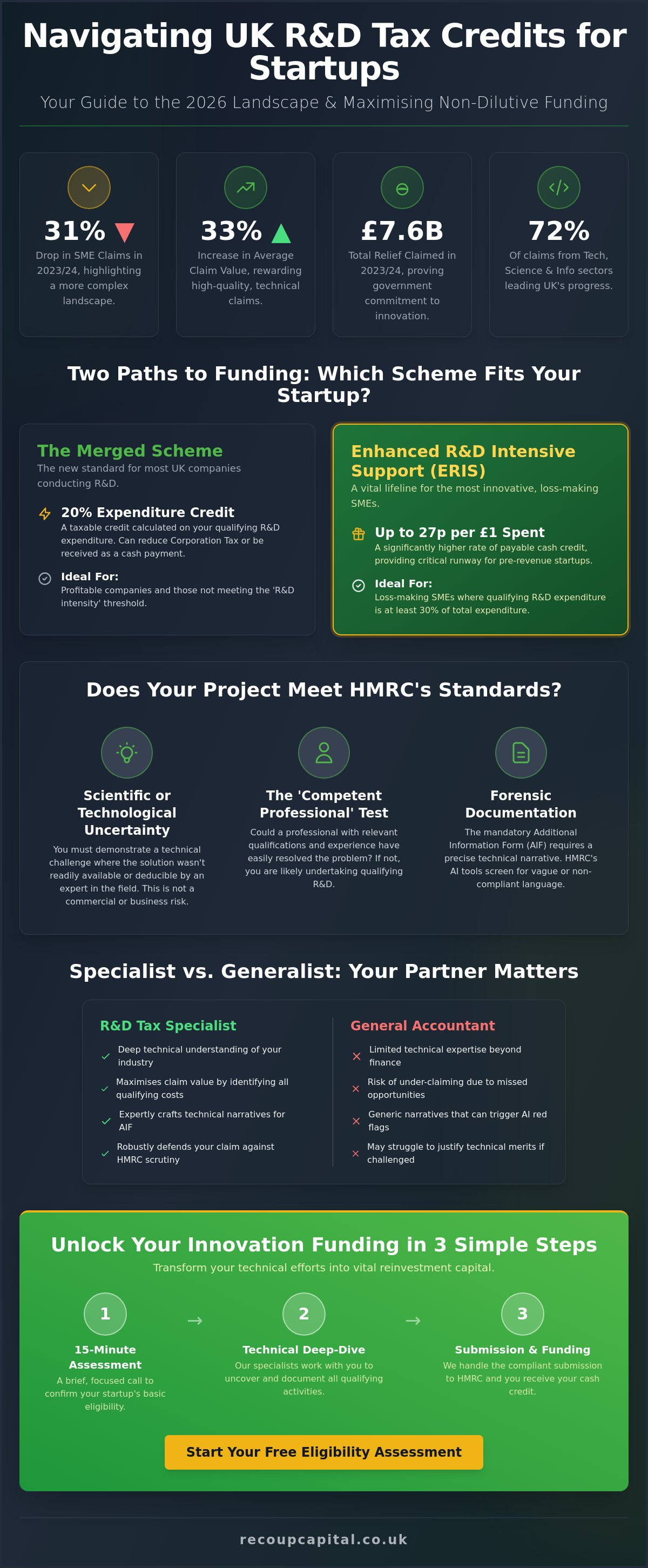
Did you know that the number of SME claims dropped by 31% in the 2023/24 tax year? This sharp decline isn't because British innovation has stalled, but because the regulatory landscape has become a complex minefield. Scaling a business is difficult enough without the added fear of HMRC enquiries or the pressure of managing cash flow whilst you grow. If you're feeling overwhelmed by the transition to the merged scheme, you aren't alone. Securing R&D tax credits for startups UK has shifted from a simple filing exercise to a strategic necessity that requires forensic precision.
We understand that your primary focus is growth, not paperwork. You deserve a clear path to the money for reinvestment your innovation has earned. This guide provides the clarity you need to navigate the 2026 landscape, ensuring you secure the maximum cash credit whilst maintaining 100% compliance with new AI transparency standards. We'll break down how to access the 20% expenditure credit and explain why the Enhanced R&D Intensive Support (ERIS) scheme could return up to 27p for every £1 spent on your most ambitious projects.
Key Takeaways
- Learn why R&D credits are the most significant source of non-dilutive funding to help your startup scale without sacrificing equity.
- Understand how to satisfy HMRC standards by identifying qualifying scientific or technological uncertainties through the lens of a 'Competent Professional'.
- Navigate the complexities of the 2026 landscape by determining whether your project qualifies for the Merged Scheme or the higher rates of R&D tax credits for startups UK via ERIS.
- Identify the critical difference between generalist accountants and technical specialists when defending your innovation against heightened HMRC scrutiny.
- Discover a seamless process for transforming technical effort into money for reinvestment through a focused, 15-minute eligibility assessment.
The Strategic Importance of R&D Tax Credits for UK Startups in 2026
In 2026, the UK R&D Tax Credit Scheme remains the most powerful tool for founders to de-risk innovation. It isn't just a reward for success; it's a government incentive designed to support companies tackling scientific or technological uncertainties. When your engineers struggle to make a software architecture scale or your chemists fail to stabilise a new compound, you're doing R&D. For many, R&D tax credits for startups UK represent the largest source of non-dilutive funding available. Unlike venture capital, this capital doesn't require you to surrender a single percentage of equity.
The 2026 fiscal landscape has redefined how founders view these incentives. We've moved beyond the era where credits were seen as a simple tax refund. Today, they are a strategic reinvestment tool. By treating R&D tax credits for startups UK as a predictable line item in your financial planning, you can budget for more ambitious research cycles. This creates a "fail fast" innovation culture amongst early-stage firms, where the financial sting of an unsuccessful experiment is softened by the prospect of financial recovery. This safety net allows you to push boundaries that competitors might find too risky to explore.
Cash Flow vs. Tax Reduction: Which Benefits Your Startup?
Startups generally face a choice: reduce their Corporation Tax bill or receive a payable cash credit. Whilst profitable companies might prefer the former to protect their bottom line, loss-making startups prioritising rapid growth almost always opt for the cash. This immediate injection of liquidity allows you to hire your next lead developer or invest in new laboratory equipment months earlier than planned. A payable cash credit is a vital lifeline for pre-revenue startups that provides the essential runway needed to reach the next stage of commercialisation.
While R&D tax credits provide a significant boost to your company's finances, founders often need to manage their own personal liquidity as well. To explore a range of personal and homeowner loan products that can help bridge these gaps, visit I Need Cash.
The Role of Innovation in National Economic Growth
The UK government views innovation as the primary engine for economic expansion, aiming to reach ambitious R&D investment targets. By offering these incentives, they ensure the UK remains a competitive base for tech firms, even as global markets fluctuate. In the 2023/24 period, the total relief claimed reached £7.6 billion, demonstrating a massive commitment to supporting businesses that take technical risks. Understanding Why claim R&D tax credits is essential for founders who want to build long-term stability.
Maintaining a competitive edge in global tech markets whilst based in the UK requires a proactive approach to these incentives. With the average claim value increasing by 33% in the 2023/24 period, the focus has shifted toward high-quality, technically sound claims. This ensures that the "Information and Communication" and "Professional, Scientific and Technical" sectors, which account for 72% of all claims, continue to lead the nation's technological progress.
Defining Qualifying Expenditure: Does Your Startup Project Meet HMRC Standards?
HMRC doesn't just take your word for it. They use the 'Competent Professional' test to evaluate whether your project truly pushes the boundaries of science or technology. A competent professional is someone with relevant experience and qualifications who can confirm that the solution wasn't obvious to someone else in the field. To succeed with R&D tax credits for startups UK, you must prove you've faced 'Scientific or Technological Uncertainty'. This isn't just a business risk; it's a technical hurdle where the outcome couldn't be predicted at the start of the project.
Since the introduction of the mandatory Additional Information Form (AIF) in late 2023, HMRC has increasingly used AI-driven tools to screen technical narratives for red flags. This means your documentation must be forensic and technically precise. We often see founders struggle to identify R&D tax credits for startups UK in 'hidden' places like back-end software architecture or complex data processing pipelines. If you're unsure if your technical challenges qualify, a quick review of R&D tax credits explained can often reveal hidden opportunities in activities like prototype trialling or material substitution.
Eligible Costs: What Can You Actually Claim For?
You can claim for a variety of direct costs that contribute to your R&D efforts. Staffing is usually the largest component, covering gross salaries, Class 1 NICs, and pension contributions for those directly involved in the innovation. For 2026 tech startups, cloud computing costs and data license fees are now fully integrated into the qualifying expenditure list, which is a significant win for SaaS and AI businesses. When weighing up R&D Grants vs. Tax Credits, remember that tax relief can often cover these ongoing operational costs more flexibly than a restrictive grant might. Subcontracted R&D remains a complex area; the 2026 rules focus heavily on who makes the decision to innovate and who bears the ultimate financial risk.
The 'Advance' vs. 'Routine' Distinction
HMRC draws a firm line between genuine innovation and routine commercial work. Fixing standard software bugs or designing a beautiful user interface (UI) doesn't qualify as R&D because the underlying technology hasn't been advanced. To be eligible, you must demonstrate an 'appreciable improvement' over existing technology. This means going beyond what's already available in the public domain or through standard commercial tools. An appreciable improvement in software scalability occurs when a system’s architecture is fundamentally re-engineered to handle an order-of-magnitude increase in concurrent users or data throughput that was previously impossible using standard industry practices. If you're worried about your documentation surviving a compliance check, it's worth speaking with a specialist who understands the technical nuances of your industry.
Navigating the 2026 Compliance Landscape: Merged Schemes and ERIS
The 2026 landscape for R&D tax credits for startups UK is no longer defined by the old choice between SME and RDEC tracks. Instead, the Merged Scheme provides a unified framework for almost all companies, offering a gross expenditure credit of 20%. For a profitable startup paying corporation tax at 25%, this results in a net benefit of approximately 15%. Whilst this merger simplifies the rules, it has arrived alongside a significant increase in HMRC scrutiny. Some founders worry that "HMRC is too strict now," especially following the 26% decrease in the total number of claims during the 2023/24 period. However, this scrutiny isn't an obstacle if your documentation is forensic and transparent. Clear, evidence-based reporting is your best defence against enquiries. To understand how automated systems now vet your data, read our guide on HMRC R&D Tax Claim Transparency and AI.
Calculating the 2026 Benefit Rates
Whilst the 20% Merged Scheme is the standard, many early-stage firms qualify for more generous support. The Enhanced R&D Intensive Support (ERIS) scheme is a vital lifeline for loss-making, R&D-intensive SMEs. If your qualifying R&D expenditure is 30% or more of your total expenditure, you can receive a payable tax credit of up to 14.5%. This means your startup could receive up to 27p for every £1 spent on innovation. Accurate calculation of this 30% intensity threshold is critical. HMRC has become increasingly vigilant regarding how total expenditure is defined; even a minor miscalculation can trigger an enquiry that disrupts your daily operations. Successfully navigating these rates ensures you secure the maximum money for reinvestment without drawing unnecessary attention from tax inspectors.
The Digital Submission Mandate
Compliance in 2026 is digital-first. Every claim must be submitted via the Additional Information Form (AIF), which requires detailed technical narratives that map your activities directly to HMRC's guidelines. You don't just list costs; you must explain the technical uncertainty and the specific advance you've achieved. Crucially, you must now name a senior officer within your startup who takes responsibility for the claim's accuracy. This person is usually the CTO or CEO, and their involvement signals to HMRC that the claim has been internally vetted. Whilst this increased monitoring has slowed down processing times for some, the average claim value actually increased by 33% in the 2023/24 cycle. This suggests that high-quality, well-supported claims are being rewarded more than ever before.
Specialist Consultants vs. General Accountants: Choosing Your Partner
Choosing the right partner for R&D tax credits for startups UK is a decision that impacts your long-term relationship with HMRC. Most general accountants are excellent at managing your day-to-day books or filing VAT returns. However, they often lack the technical background required to identify the specific scientific or technological uncertainties we discussed earlier. This lack of depth frequently leads to a conservative approach. Generalists might leave significant money on the table simply because they don't recognise eligible technical activities as R&D. They might see "coding," whilst a specialist sees the resolution of a complex architectural bottleneck.
A specialist doesn't just look at your payroll; they speak the same language as your lead engineers and product managers. If your adviser can't explain the nuances of your software architecture or chemical processes to an HMRC inspector, your claim is at risk. Specialists provide a robust "enquiry defence" that generalists typically don't offer. This means they stand by your side if HMRC requests more detail, drawing on technical expertise to justify every pound claimed. For more detail on vetting a provider, see our guide on R&D Tax Credit Specialists UK: Choosing a Partner.
The Cost of Inaccuracy: Protecting Your Startup
The 2026 landscape is unforgiving to "R&D cowboys" who promise high returns without technical rigour. You can spot these providers by their lack of technical staff or their tendency to focus only on numbers rather than the science. Inaccurate claims don't just result in rejected credits; they can lead to significant financial penalties and a damaged reputation with HMRC. By claiming R&D tax credits using a proven, technically-led methodology, you protect your startup from these avoidable risks. It's about ensuring your innovation is documented in a way that survives the closest scrutiny.
Success-Based Fees: Aligning Incentives
Most specialists operate on a contingency-based model, meaning they only get paid when you successfully receive your credit. This "pay-on-results" structure is ideal for startups looking to protect limited cash reserves. It ensures your adviser is motivated to maximise your claim for R&D tax credits for startups UK whilst maintaining 100% compliance. This alignment of interests transforms the relationship from a simple service into a long-term collaboration. We believe in being today's adviser and tomorrow's partner, helping your business thrive through every research cycle. If you want to ensure your claim is handled with forensic precision, book a free 15-minute consultation with our team today.
Maximising Your Claim with Recoup Capital: A Seamless Process
Our approach begins with a simple, free 15-minute consultation designed to provide immediate clarity. There's no traditional sales pitch here; we prefer to demonstrate our value through a quick eligibility assessment that respects your time. Securing R&D tax credits for startups UK shouldn't be a source of stress, and our end-to-end process ensures minimal disruption to your daily operations. From the initial technical discovery to the final HMRC liaison, we handle the heavy lifting so you can focus on scaling your business. We act as a proactive guide, ensuring your claim is both maximised and fully compliant with the latest 2026 regulations.
We often find that innovation is hidden in plain sight, even in industries that don't consider themselves 'high-tech'. Whilst software is a common claimant, significant opportunities exist in sectors like construction, engineering, and food tech. Whether you're developing modular building techniques for better thermal efficiency or perfecting sustainable packaging in the food industry, we've the expertise to translate that technical effort into money for reinvestment. This commitment to finding every eligible pound across diverse sectors is why many founders believe Why Recoup Capital is the preferred choice for UK innovation.
The Technical Assessment Phase
During the Technical Assessment Phase, you'll meet with our team of chartered tax accountants and industry-specific specialists who understand your sector's unique hurdles. We don't just list your expenses; we build a robust technical narrative that pre-empts HMRC's questions before they're even asked. Our specialists possess the technical depth to justify your innovation, ensuring your claim is defended with professional authority. Recoup Capital organises your claim to be 'HMRC-ready' from day one, ensuring that your documentation meets the high transparency standards required in 2026.
Beyond R&D: A Holistic Financial Partnership
Our partnership doesn't have to end with a single claim. We take a holistic view of your financial health, identifying other valuable reliefs such as Capital Allowances or Land Remediation. If you're planning for future acquisitions or disposals, our corporate finance expertise provides the strategic oversight needed for long-term success. We aim to be your long-term partner, helping you navigate the complexities of corporate finance as your startup matures. Ready to secure the capital your startup deserves? Book your free 15-minute consultation today and discover the potential within your business.
Fuel Your Future Innovation Today
The 2026 fiscal landscape has fundamentally changed how businesses approach research and development. Securing R&D tax credits for startups UK is no longer a mere filing task; it's a strategic necessity for maintaining a competitive edge. By navigating the Merged Scheme with technical precision, you transform your research challenges into vital money for reinvestment.
Our expert team of chartered tax accountants and technical specialists brings a proven track record in high-scrutiny HMRC environments to every claim. We don't believe in aggressive sales pitches. We prefer to demonstrate our value through tangible results. With our success-based fees, we only win when you do, ensuring our interests are perfectly aligned with your long-term growth. Don't let complex regulations stifle your progress or leave your hard-earned capital on the table.
Book your FREE 15-minute R&D consultation to start your journey today. Your innovation deserves a partner who is truly invested in your future.
Frequently Asked Questions
Can a loss-making startup claim R&D tax credits in 2026?
Yes, loss-making startups can absolutely claim through either the Merged Scheme or the Enhanced R&D Intensive Support (ERIS) framework. Most early-stage firms choose to surrender their tax losses in exchange for a payable cash credit to support their immediate growth. In the 2026 landscape, this remains a vital source of non-dilutive funding that provides essential runway for pre-revenue businesses.
What is the R&D intensity threshold for startups to get the 27% rate?
The intensity threshold is currently set at 30%. To qualify for the more generous ERIS rate, which offers up to 27p for every £1 spent, your qualifying R&D expenditure must account for at least 30% of your total relevant expenditure. This lower threshold, which was reduced from 40% for accounting periods starting on or after 1 April 2024, allows more innovative startups to access higher levels of support.
How far back can my startup claim for R&D tax relief?
You can claim for your last two completed accounting periods. This generally gives you a window of up to two years from the end of the accounting period in which the expenditure occurred to submit your claim to HMRC. It's a valuable opportunity to recover money for reinvestment from innovation projects you've already completed.
Does subcontracting work to developers outside the UK affect my claim?
Yes, overseas expenditure is now significantly restricted under the rules introduced in April 2024. For your costs to qualify, the R&D activity must generally take place within the UK. There are very limited exceptions for specific geographical, environmental, or legal requirements that make UK-based research impossible, but standard software development performed abroad is typically excluded.
What happens if HMRC opens an enquiry into our R&D claim?
HMRC will pause the processing of your credit and request detailed technical narratives and financial evidence. They've increased compliance checks recently, which contributed to a 26% decrease in total claims during the 2023/24 cycle. If an enquiry is opened, having a specialist partner is essential to provide a robust defence and justify the technical uncertainties you've tackled.
Is software development always considered R&D for tax purposes?
No, routine software development like building standard websites or fixing common bugs doesn't qualify. To meet HMRC standards, your project must aim to achieve an appreciable improvement in overall knowledge or capability. This means your developers must be facing technical challenges that wouldn't be easily resolved by a competent professional working in the same field.
How long does it take for HMRC to process a startup R&D claim?
HMRC typically aims to process claims within 40 to 60 days. Whilst they strive to meet a 40-day target for 95% of all submissions, the increased scrutiny on claim quality and the vetting of Additional Information Forms can sometimes extend this timeline. Ensuring your claim is technically sound from day one is the best way to prevent unnecessary delays.
Can we claim R&D tax credits if we have received a grant?
Yes, you can still claim R&D tax credits for startups UK even if your project has been partially funded by a grant. The Merged Scheme has simplified how state aid interacts with tax relief, removing many of the restrictive barriers that previously forced grant-funded projects into less generous schemes. This ensures that startups taking multiple routes to funding aren't penalised for their proactivity.