
R&D Tax Credits for Food and Beverage Industry: The 2026 UK Guide

Why does the UK's largest manufacturing sector account for a mere 1% of all R&D tax relief claims? Many directors assume their work doesn't qualify, yet R&D tax credits for food and beverage industry players are often hidden in plain sight within shelf-life stability tests or sodium reduction trials. If you've ever struggled to make a plant-based protein mimic the texture of meat or redesigned a production line to resolve technical bottlenecks, you aren't just cooking; you're overcoming scientific uncertainties.
It's natural to feel hesitant about the process, especially with HMRC's increased scrutiny and the one in five claims that now face an in-depth enquiry. You want the cash injection to reinvest in new equipment without the headache of time-consuming documentation. This 2026 guide provides a clear framework to identify qualifying costs and secure the 20% expenditure credit your business deserves. We'll examine the latest merged RDEC rules and show you how to transform technical challenges into strategic financial assets that fuel your company's growth.
Key Takeaways
- Identify the crucial difference between routine recipe changes and the genuine scientific breakthroughs that qualify for R&D tax credits for food and beverage industry specialists.
- Gain clarity on the 2026 merged R&D scheme to ensure you are claiming at the correct rates whilst maintaining full HMRC compliance.
- Learn how to document your 'competent professionals' and technical uncertainties to meet the rigorous standards of the latest Additional Information Form (AIF).
- Uncover hidden claim opportunities in your production line, from shelf-life microbiology to the technical trials of sustainable packaging materials.
- Discover how to transform your successful tax relief claim into a strategic asset for future innovation and facility upgrades.
Understanding R&D Tax Credits in the UK Food and Beverage Sector
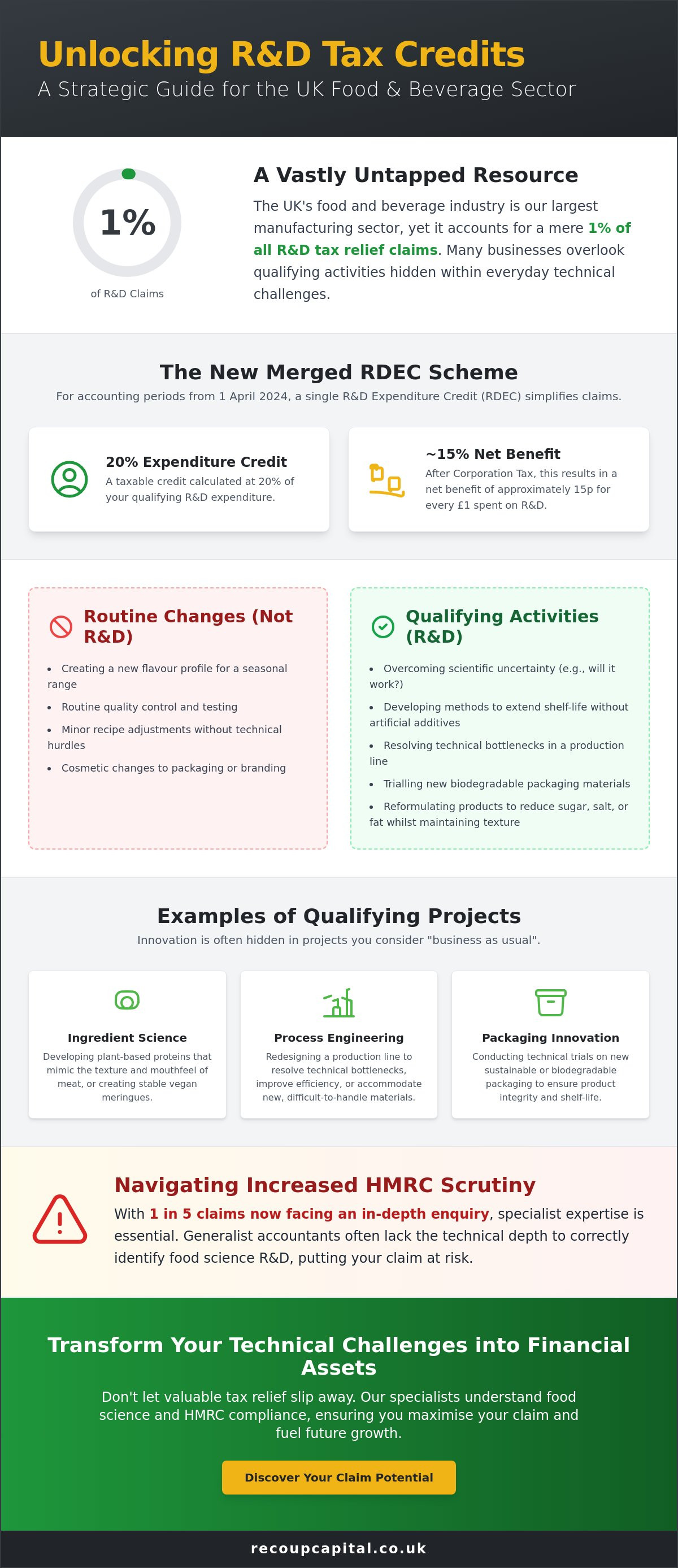
Only 1% of all UK R&D tax relief claims originate from the food and beverage sector. This is a staggering statistic considering the industry is worth over £100 billion and serves as the backbone of our national manufacturing. Many producers view themselves as makers rather than innovators, yet the technical hurdles faced daily in the factory often qualify for the UK R&D Tax Credit Scheme. If your team is resolving uncertainties in food chemistry or engineering, you're likely sitting on an unclaimed strategic asset.
For accounting periods starting on or after 1 April 2024, the landscape has shifted to a single merged R&D Expenditure Credit (RDEC). This provides a 20% taxable expenditure credit on qualifying costs. It's a vital lifeline. With raw material costs and energy prices remaining volatile, these credits act as a financial buffer. They allow businesses to maintain their margins whilst investing in future-proof technology. The standard rate results in a net benefit of approximately 15p for every £1 spent after corporation tax is considered. For loss-making companies, the Enhanced R&D Intensive Support (ERIS) can offer a payable credit of up to 27% if your research spend exceeds 30% of total expenditure.
The Economic Impact of Innovation for UK Producers
HMRC considers the food sector a priority for innovation support because it underpins national food security. We're seeing a clear shift from volume-led growth to value-led innovation across the British market. Producers aren't just trying to sell more; they're trying to produce more sustainably. Tax relief provides the essential capital needed to reinvest in biodegradable packaging or precision fermentation. These aren't just "nice-to-haves" anymore. They are requirements for a resilient business. By securing R&D tax credits for food and beverage industry projects, you turn your research costs into a reinvestment fund for new equipment and talent.
Why General Accountants Often Miss Food R&D
Most generalist accountants are excellent at bookkeeping, but they often lack the technical depth to spot food science. They might see a new product launch as a marketing expense rather than a series of technical trials. Qualifying R&D isn't about a new flavour profile; it's about the chemistry of emulsification or the microbiology of shelf-life extension. If your advisor doesn't understand these nuances, you're likely leaving five-figure sums on the table. Understanding why claim R&D tax credits through a specialist lens ensures that every technical trial is accounted for correctly. One in five claims now faces an in-depth enquiry, so having a partner who speaks the language of both food science and R&D tax credits for food and beverage industry regulations is no longer optional; it's a necessity for compliance.
Identifying Qualifying R&D Activities: Beyond Recipe Development
HMRC is clear on one point: a new flavour profile is not innovation. Whilst a delicious seasonal range might drive sales, it doesn't represent a scientific advancement in the eyes of the taxman. To successfully claim R&D tax credits for food and beverage industry activities, you must look past the aesthetics of the plate and into the molecular behaviour of your ingredients. We define R&D in this sector as the systematic resolution of technical challenges that are not readily deducible by a competent food scientist or technologist.
Scientific or technological uncertainty exists when your team cannot state at the outset whether a technical goal is achievable, or which route will lead to success. If you're experimenting with a new preservation method to replace artificial additives, you're likely facing microbial stability hurdles that require rigorous testing. This is a far cry from routine product development. Crucially, the "failed project" rule means that unsuccessful trials are often your most valuable evidence. If you spent six months trying to develop a vegan meringue that ultimately failed to hold its structure, those costs are still eligible. Failure is the ultimate proof that a technical uncertainty existed.
Technical Challenges in Food Chemistry
The push for healthier products often creates significant chemical instability. Reducing sugar, salt, or fat isn't as simple as changing a recipe; it alters the structural integrity and shelf-life of the product. Many UK producers are currently overcoming stability issues in plant-based dairy and meat alternatives, where mimicking the mouthfeel of animal proteins requires complex emulsification trials. If your team is working on clean-label solutions that involve shelf-life extension through natural fermentation or high-pressure processing, you are performing qualifying research. These activities represent genuine advancements in food science that go beyond standard industry practice.
Process and Manufacturing Innovation
Innovation often happens on the factory floor rather than in the lab. Scaling up a successful kitchen-bench recipe to a high-volume factory line frequently reveals technical bottlenecks that no one anticipated. You might need to develop bespoke machinery or modify existing software to automate complex assembly processes that were previously manual. Additionally, integrating sustainable packaging solutions often requires significant technical modifications to the fill-line to prevent moisture ingress or oxygen degradation. These engineering challenges are central to a robust claim. If you're unsure whether your recent trials meet these criteria, you can find more detail on how R&D tax credits explained for specific sectors can benefit your bottom line.
By focusing on the "how" and the "why" of your production struggles, you can build a narrative that satisfies HMRC's stricter 2026 standards. Don't overlook the technical sweat that goes into making a product commercially viable; those hours of troubleshooting are precisely what the government intends to reward.
Real-World Examples: Where Food Science Meets Tax Relief
Moving from technical definitions to the factory floor helps clarify what HMRC actually looks for in a claim. Innovation isn't restricted to high-tech laboratories; it happens in the heat of a production kitchen where a team struggles to make a gluten-free pastry that doesn't shatter upon contact. Claims for R&D tax credits for food and beverage industry players often hinge on these specific, documented technical iterations. If you've spent months testing hydrocolloids to replicate gluten's elasticity, you've moved beyond simple cooking into the realm of structural engineering.
The "Free-From" challenge is perhaps the most common source of hidden R&D. Replicating the texture and mouthfeel of traditional allergens requires solving the "protein network" problem. This involves testing various starches and binders to ensure a product remains commercially viable after freezing and reheating. Similarly, the move toward sustainable packaging creates significant technical hurdles. Transitioning to biodegradable films often ruins the barrier properties required for shelf stability. Trials to adjust moisture levels and oxygen transmission rates within these new materials are classic examples of qualifying R&D activity.
Shelf-life extension also provides fertile ground for tax relief. Using natural preservatives to replace synthetic additives in fresh produce isn't a straightforward swap. It often requires complex microbiology trials to ensure the natural alternatives can inhibit bacterial growth without altering the flavour profile. Furthermore, waste reduction projects are becoming a strategic priority. Converting manufacturing by-products, such as spent grain or fruit peels, into new, high-value nutritional ingredients involves enzymatic hydrolysis or complex extraction processes. These are scientific advancements that turn a waste stream into a secondary revenue source.
Case Study: The Plant-Based Revolution
Vegan cheese remains a technical minefield for many producers. Solving the "mouthfeel" problem requires protein restructuring trials to ensure the product doesn't feel like plastic or dissolve into oil. You might document dozens of iterations testing different plant proteins to achieve a specific melting point that mimics cheddar. These logs of failed attempts and slight adjustments form the backbone of a robust HMRC technical report. It's the evidence of this struggle that proves a technical uncertainty existed.
Innovation in Beverage Production
In the beverage world, the rise of "no-and-low" alcohol presents unique challenges. Developing a spirit that retains a complex botanical profile without the solvent properties of ethanol requires sophisticated distillation adjustments. Similarly, improving filtration in craft brewing to increase clarity without using chemical finings is a technical triumph. For a deeper dive into these categories, see how R&D tax credits explained for the manufacturing sector can unlock hidden capital. Every trial that fails to produce the right clarity or flavour is a step toward a successful claim for R&D tax credits for food and beverage industry innovation.
Navigating HMRC Compliance: The 2026 Standards for Food Claims
HMRC has moved the goalposts. The 2026 landscape for R&D tax credits for food and beverage industry claims is defined by the Additional Information Form (AIF). This mandatory digital submission requires a deep technical narrative before your claim is even processed. It isn't just a box-ticking exercise. It's a rigorous test of your project's scientific validity. You must clearly identify your "competent professionals," which in this sector often includes food technologists, chemical engineers, or senior chefs with specialized scientific backgrounds. Their expertise proves that the challenges you faced weren't solvable by a generalist in the field.
Precision in language is your best defence. HMRC's screening tools now flag "marketing-led" descriptions. Words like "innovative flavour," "unique recipe," or "artisan technique" are red flags that suggest routine development. Instead, focus your narrative on "molecular stability," "enzymatic reactions," or "viscosity trials." You also need a forensic breakdown of costs. This includes not just staff wages, but the raw ingredients wasted during failed production runs and the specific utility allocations for running test machinery. If you used £2,000 of specialized flour in a failed gluten-free trial, that cost must be documented as a consumable used in R&D.
The Role of Technical Documentation
Your recipe logs and trial feedback notes are your most valuable assets. They serve as the "lab notes" of the food industry. Whilst a balance sheet shows what you spent, these logs prove why you spent it on qualifying R&D. Recording the exact hours your team spent troubleshooting a technical bottleneck is vital for justifying staff costs. For a clearer understanding of how to align your internal processes with these expectations, review our guide on HMRC R&D Tax Claim Transparency. Robust documentation transforms a vulnerable claim into a secure financial asset.
Defending Your Claim Against Enquiries
Generic descriptions are the fastest way to trigger an HMRC technical audit. In the 2023/2024 period, the number of claims dropped by 26% as scrutiny intensified. If your claim reads like a product brochure, it will likely be rejected. A specialist consultant acts as a protective shield during these enquiries, translating your kitchen-floor struggles into the specific regulatory language HMRC requires. Forensic accounting helps identify "embedded" R&D costs, such as the proportion of staff overheads dedicated to testing new biodegradable packaging. If you want to ensure your documentation is airtight, you can start your compliance review with a specialist today to safeguard your claim against future scrutiny.
Maximising Your Claim with Recoup Capital’s Specialist Expertise
Securing R&D tax credits for food and beverage industry innovation is more than just a filing exercise; it's a strategic financial move. Our team doesn't just process paperwork. We act as a protective guide through the complexities of the 2026 regulatory landscape. By employing a success-based fee model, we ensure our goals are perfectly aligned with your business growth. We only succeed when you recover the capital you are entitled to, transforming what many see as a mere refund into a powerful strategic asset for your company.
The benefit of working with specialists lies in our ability to speak the "language" of food science. We understand the technical nuances of pH stability, microbial inhibition, and enzymatic reactions. This expertise allows us to identify qualifying activities that generalist accountants frequently overlook. Beyond research costs, we take a holistic view of your financial position. We often identify significant additional savings through Capital Allowances on food processing plant and machinery, ensuring that your heavy equipment investments are working as hard as possible for your bottom line.
A Holistic Approach to Food Sector Tax
Innovation rarely happens in a vacuum. If you are expanding your footprint, we can integrate your R&D claims with Land Remediation Relief for new factory developments on brownfield sites. This multi-layered approach ensures no stone is left unturned in your pursuit of capital utility. Our corporate finance specialists can then help you decide how to best reinvest these returns into business expansion or new product lines. When choosing a partner, it is vital to select R&D tax credit specialists UK producers can trust to handle both the technical discovery and the rigorous HMRC liaison process.
Your Next Steps to Capital Recovery
The journey to securing your R&D tax credits for food and beverage industry relief begins with a 15-minute discovery call. This time-limited, no-cost introductory offer allows us to identify "hidden" R&D without any upfront financial commitment from your side. We take the burden of documentation off your shoulders, organising your technical logs and recipe trials into a robust, enquiry-proof submission. We manage the entire process from initial assessment to final claim defence, providing you with the confidence to innovate whilst we secure the cash injection your business deserves. Book a consultation with our food sector specialists today to discover the true value of your technical challenges.
Transforming Technical Challenges Into Strategic Assets
The transition from traditional recipe development to complex food science represents a massive opportunity for UK producers to recover vital capital. By identifying the scientific uncertainties within your production line, you can turn technical struggles into a powerful reinvestment tool. Navigating the 2026 HMRC compliance landscape requires precision; generic claims are no longer enough to secure the relief your innovation deserves. It's time to treat your research costs as the strategic assets they truly are.
Our team of chartered tax accountants and industry specialists acts as a protective guide through the complexities of R&D tax credits for food and beverage industry claims. We employ a success-based fee model that aligns our goals with your growth, backed by a proven track record of defending HMRC enquiries. We don't just process paperwork; we build the technical narratives that protect your business and fuel your future expansion. Don't let your eligible expenditure go unclaimed whilst your competitors reinvest.
Start your food and beverage R&D claim assessment with Recoup Capital today. Your next breakthrough is already happening on the factory floor; let's ensure it's properly funded.
Frequently Asked Questions
What qualifies as R&D in the food and beverage industry?
Qualifying activities involve resolving technical challenges in areas like food chemistry, microbiology, or process engineering. It's about overcoming hurdles that a competent professional couldn't easily solve. This might include developing new methods for emulsification or improving the structural integrity of products during high-speed manufacturing trials.
Can we claim R&D tax credits for failed product trials?
Yes, failed trials are often the strongest evidence for a claim. HMRC views a project's failure as proof that a genuine technical uncertainty existed. If your team spent weeks trying to solve a stability issue and couldn't find a solution, those costs are still eligible for R&D tax credits for food and beverage industry claims.
Does a new recipe count as research and development?
A new recipe on its own rarely qualifies as R&D. HMRC distinguishes between "cooking" and "science." Whilst a new flavour is a commercial success, it only becomes R&D if you had to overcome a technical unknown to make that recipe work, such as managing complex ingredient interactions or ensuring shelf stability.
How much can a food business typically claim in R&D tax relief?
Most businesses claim a 20% taxable expenditure credit under the current merged scheme. This results in a net benefit of roughly 15p for every £1 of qualifying spend. For loss-making companies with high R&D intensity, the Enhanced R&D Intensive Support (ERIS) can provide a payable credit of up to 27%.
Is shelf-life testing considered a qualifying R&D activity?
Shelf-life testing qualifies if it's part of a project to resolve a technical uncertainty. If you're testing how new natural preservatives affect the microbiology of a product over time, it's likely eligible. Simple, routine testing of a standard product wouldn't qualify; there must be a scientific challenge involved.
How far back can we claim R&D tax credits for our food manufacturing?
You can generally claim for the previous two accounting periods. Claims must be submitted within two years of the end of the accounting period in which the activity happened. This makes it vital to review your past technical trials regularly to ensure you don't miss the deadline for capital recovery.
Do we need a laboratory to qualify for food science R&D credits?
You don't need a formal laboratory to qualify for these credits. Many of the most successful claims come from trials conducted in development kitchens or directly on the production line. As long as you're documenting the technical challenges and your systematic approach to solving them, the physical setting is secondary.
How has the 2026 merged R&D scheme affected food industry claims?
The 2026 landscape is defined by the merged RDEC-style scheme and the mandatory Additional Information Form (AIF). This has increased the need for robust technical narratives and precise cost breakdowns. Additionally, restrictions on overseas subcontracting mean that most R&D activities must now be UK-based to qualify for relief.