
R&D Tax Credits for Engineering Companies: The 2026 UK Guide to Maximising Innovation Relief

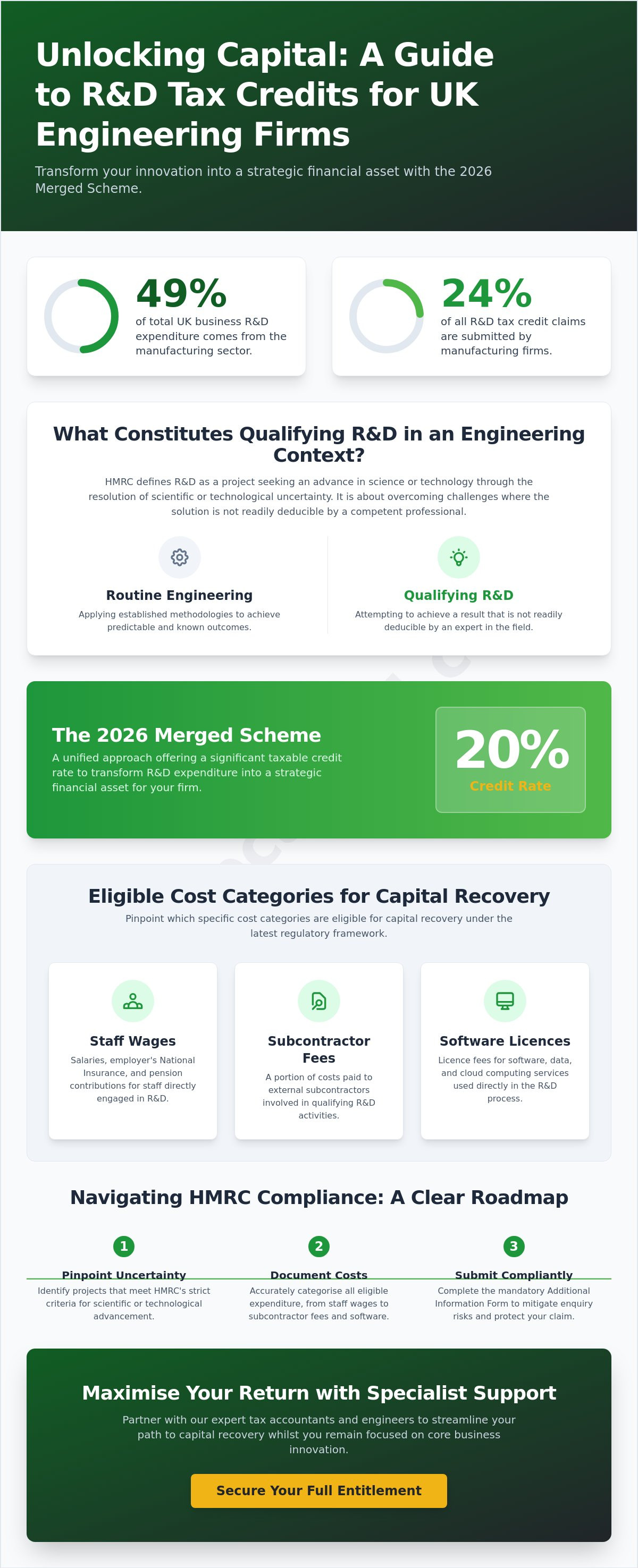
Did you know that the manufacturing sector accounts for 24% of all R&D tax credit claims in the UK? Despite this high volume, many firms still hesitate to apply because they view HMRC regulations as a complex minefield rather than a mechanism for growth. Securing R&D tax credits for engineering companies in 2026 requires more than just technical expertise; it demands a disciplined approach to documenting technical uncertainty as a core business function. Whether you are developing bespoke components or improving industrial processes, your innovation carries significant commercial value that often goes unclaimed.
You likely feel that the shift to the 2026 Merged Scheme, with its 20% credit rate, has added a fresh layer of uncertainty to an already time-consuming process. It is natural to worry about the risk of an enquiry whilst trying to recover the capital your firm has invested in research. This guide will show you how to identify qualifying activities accurately and navigate the latest HMRC requirements with total confidence. We will explore the mandatory Additional Information Form and outline a streamlined path to securing the relief you need to reinvest in your firm's future.
Key Takeaways
- Learn how to pinpoint "Technical Uncertainty" within your projects to ensure your activities meet the strict HMRC criteria for scientific or technological advancement.
- Understand the mechanics of the 2026 Merged Scheme and how R&D tax credits for engineering companies can transform qualifying expenditure into a strategic financial asset.
- Discover which specific cost categories, including staff wages, subcontractor fees, and software, are eligible for capital recovery under the latest regulatory framework.
- Gain a clear roadmap for navigating HMRC compliance and the mandatory Additional Information Form to mitigate the risk of enquiries and protect your claim.
- Explore how partnering with specialist tax accountants and engineers can streamline your path to capital recovery whilst you remain focused on core business innovation.
Fueling Innovation: The Strategic Value of R&D Tax Credits in British Engineering
Engineering is the engine room of the UK economy. In 2024, the manufacturing sector alone was responsible for 49% of total business R&D expenditure, demonstrating that innovation is woven into the very fabric of British industry. For 2026, R&D tax credits for engineering companies are far more than a simple fiscal rebate; they are a cornerstone of the UK’s industrial strategy. These credits empower firms to push boundaries, providing the financial breathing room required to tackle complex technical uncertainties. By actively participating in the UK's R&D tax incentive, businesses ensure that their commitment to progress is met with tangible financial support.
This relief acts as a vital bridge between high-risk technical exploration and commercial viability. It's a system designed to reward those who dare to improve existing systems or create entirely new solutions. When viewed through a strategic lens, these credits become a form of reinvestment capital that fuels the next generation of engineering excellence. It's not just about what you've done; it's about what the recovered capital allows you to do next. Reframing these returns as strategic assets shifts the focus from historical costs to future opportunities.
Why Engineering Firms Often Underclaim
A persistent myth suggests that R&D only occurs in sterile laboratories or high-tech software hubs. This couldn't be further from the truth. In reality, much of the innovation in the UK happens on the factory floor and in the design office. Many firms fall into the "innovation gap" because they view their daily problem-solving as "just part of the job." When identifying R&D tax credits for engineering companies, the focus should always be on the technical challenges overcome during the project. If your team is developing bespoke components, refining manufacturing processes, or integrating disparate systems, you're likely performing qualifying R&D. Failing to recognise these activities results in missing out on significant capital recovery every year. This oversight limits your firm's ability to compete on a global stage where innovation is the primary currency.
The Financial Impact: Turning Tax into Working Capital
Reframing tax relief as a strategic business tool changes how you approach growth. Instead of a passive refund, recovered funds become active working capital. You can use these assets for hiring specialised engineers, investing in state-of-the-art equipment, or funding the development of new prototypes. This influx of capital also enhances your position during competitive tendering, as it allows for more aggressive investment in advanced solutions. When you understand how R&D tax credits are explained as a reinvestment asset, you see that they provide a distinct advantage. It's a virtuous cycle. Innovation leads to capital recovery, which in turn funds further innovation, ensuring the long-term sustainability and resilience of your engineering firm.
Defining Eligibility: What Constitutes R&D in an Engineering Context?
Understanding the threshold for eligibility is often the biggest hurdle for technical teams. HMRC defines R&D as a project that seeks an advance in science or technology through the resolution of scientific or technological uncertainty. In the world of R&D tax credits for engineering companies, this doesn't mean you need to be inventing a new law of physics. It means you are attempting to achieve a result that isn't readily deducible by a competent professional in your field. If your project involves overcoming hurdles where the solution isn't obvious from the outset, you've likely crossed the line from routine work into qualifying innovation.
A project officially becomes an R&D project the moment you identify a technical gap that existing knowledge cannot bridge. This distinction is crucial. Routine engineering involves applying established methodologies to achieve predictable results. Qualifying R&D begins when those methodologies fail or prove insufficient for the specific requirements of a new contract. The Government Report on Engineering R&D Tax Credits highlights how sectors like robotics and autonomous systems are leading the way in these claims, but the same principles apply to traditional mechanical and civil engineering firms solving bespoke problems.
Identifying Technical Uncertainties in Engineering
Technical uncertainty exists when you don't know if a particular result is achievable, or how to achieve it in practice. This often surfaces when working with new materials or pushing structural integrity to its limits. If your team spent weeks in a "trial and error" loop to refine a design, that time represents a significant investment in resolving uncertainty. It's a common misconception that projects must be successful to qualify. In fact, "failed" projects are often the strongest evidence of R&D because they prove that a solution was not easily reachable. If you've encountered such challenges, claiming R&D tax credits could be the most effective way to recover those sunk costs.
Examples of Qualifying Engineering Activities
- Bespoke Manufacturing: Developing automated systems or unique tooling that hasn't been built before to meet specific production tolerances.
- Environmental Efficiency: Re-engineering existing mechanical systems to significantly reduce carbon output or energy consumption through novel cooling or propulsion methods.
- System Integration: Merging disparate technologies into a single, cohesive system where the interaction between components creates unpredictable technical conflicts.
These activities represent the "hard yards" of engineering. They require a level of experimentation and technical risk that the UK government is eager to support through fiscal incentives. By documenting these challenges as they happen, you create a robust foundation for a successful claim. It's about demonstrating that your firm is actively pushing the boundaries of what's possible within your specific niche.
Calculating Value: Qualifying Costs and the 2026 Merged Scheme
The financial landscape for innovation has shifted significantly. As of 2026, most firms now operate under the Merged R&D Expenditure Credit (RDEC) scheme. This unified system provides a taxable credit at a rate of 20% of qualifying expenditure. For loss-making SMEs with an R&D intensity of at least 30%, the Enhanced R&D Intensive Support (ERIS) remains a vital alternative, offering an additional 86% deduction and a payable credit of 14.5%. Understanding which category your firm falls into is the first step in turning technical challenges into a strategic business tool. It's about more than just numbers; it's about identifying every pound spent on resolving technical uncertainty.
Calculating the value of R&D tax credits for engineering companies requires a meticulous look at your project ledger. You can't simply claim for every expense. Instead, you must isolate the costs directly attributable to the R&D phase of a project. This includes consumables such as materials used for prototypes that are either scrapped or transformed during testing. Even overheads like heat, light, and power can be apportioned to the claim based on the percentage of time your facility was dedicated to R&D activities. If you're unsure how to partition these costs, claiming R&D tax credits with professional guidance ensures you don't leave capital on the table.
Staff Costs and Externally Provided Workers
Your people are your greatest R&D asset. You can claim for the proportion of gross salaries, employer National Insurance contributions, and pension contributions for staff directly engaged in R&D. This includes the engineers on the shop floor and the designers at their desks. If an engineer spends 60% of their time on a qualifying project, 60% of their total cost is eligible. The rules for subcontracted specialist services have also evolved under the Merged Scheme. Generally, the company that makes the decision to undertake the R&D and bears the financial risk is the one entitled to the relief. This makes clear contractual arrangements essential for long-term collaboration.
Software, Cloud Computing, and Data Costs
Modern engineering relies on digital precision. The 2026 rules explicitly allow for the inclusion of software licences used for R&D, such as CAD/CAM packages or bespoke simulation tools. Cloud computing and data costs are also qualifying expenditures, which is particularly beneficial for firms performing heavy computational modelling or finite element analysis. Distinguishing between general IT maintenance and R&D-specific digital tools is vital for compliance. These digital assets are fundamental to resolving technical uncertainties, and the tax system now reflects their importance in the modern engineering workflow. By capturing these costs accurately, you strengthen your firm's path to capital recovery.
Mitigating Risk: Ensuring Compliance and Navigating HMRC Enquiries
Fear of an HMRC enquiry is the primary reason many directors leave money on the table. It's understandable. The regulatory landscape has become more rigorous, particularly with the introduction of the mandatory Additional Information Form (AIF) in August 2023. However, an enquiry shouldn't be viewed as a threat if your claim is built on a foundation of "contemporaneous" evidence. This means documenting your technical challenges, test results, and iterations as they happen throughout the year. When you capture the reality of the engineering process in real-time, you prevent "innovation leakage". This is the loss of claimable value that occurs when details are forgotten or records are reconstructed months after the fact.
Building a robust claim for R&D tax credits for engineering companies is about transparency and technical accuracy. HMRC isn't looking for a polished marketing brochure; they want to see the "technical struggle". Working with specialist consultants ensures that your claim is protected by professionals who understand both the tax legislation and the engineering reality. This partnership-oriented approach transforms a potentially intimidating procedure into a secure opportunity for capital recovery. If you're concerned about the strength of your current documentation, you can book a diagnostic review to ensure your firm remains fully compliant.
Building a Robust Technical Report
The technical report is your opportunity to bridge the gap between complex engineering and tax law. You must translate dense engineering jargon into a narrative that an HMRC caseworker can follow. The core of this report shouldn't focus on the finished product but on the obstacles encountered. Why was the initial design insufficient? What were the specific technical uncertainties? By providing R&D tax credits explained through the lens of your specific technical hurdles, you demonstrate a clear "advance in technology". This narrative of struggle is what validates the investment of time and resources.
Common Pitfalls in Engineering R&D Claims
Many firms inadvertently trigger enquiries by failing to distinguish between routine work and innovation. Over-claiming for routine maintenance, minor bug fixes, or purely aesthetic changes is a common red flag. Similarly, poorly defined boundaries between the R&D phase and commercial production can lead to inaccuracies in the claim total. The danger often lies in relying on "generic" accountants who may lack the deep industry knowledge required for specialist tax relief. Engineering projects are unique. They require a specialist eye to ensure that every qualifying activity is captured whilst strictly adhering to HMRC’s evolving standards. Avoiding these pitfalls is essential for long-term financial stability and successful capital recovery.
Maximising Returns: How Recoup Capital Partners with Engineering Firms
Securing the full value of R&D tax credits for engineering companies shouldn't be a burden that pulls your lead designers away from their work. Recoup Capital operates on a success-based model, meaning our goals are perfectly aligned with your firm's growth. We don't just process paperwork; we act as a protective guide through the complexities of HMRC regulations. Our team is a strategic blend of chartered tax accountants and experienced engineers. This dual expertise is vital. It allows us to speak your technical language whilst ensuring every nuance is translated into a compliant financial narrative. We manage the entire lifecycle of the claim, from the initial technical audit through to the final submission.
The Recoup Capital Methodology
Our deep-dive technical interview process is designed to uncover innovation that often goes unnoticed in routine project logs. We don't expect your team to be tax experts. Instead, our engineers sit down with your technical leads to identify the specific uncertainties overcome during your latest projects. Once we've gathered the necessary evidence, we handle all direct liaison with HMRC. This reduces the administrative pressure on your staff and provides a robust layer of protection for your claim. Understanding why claim with Recoup Capital? comes down to this commitment to accuracy and our focus on long-term collaboration.
Beyond R&D: A Holistic Approach to Innovation Funding
Our support extends beyond a single tax relief scheme. We reframe your financial returns as strategic assets for future innovation. For example, many engineering firms overlook the potential of Capital Allowances on their specialised facilities and plant machinery. By taking a holistic view of your business, we help you identify multiple streams of capital recovery that others might miss. Our Corporate Finance advisory team can then help you structure these recovered funds to support your next major expansion or acquisition. This approach ensures that your firm isn't just recovering past costs but is actively building a war chest for the future.
Ready to explore your firm's potential for capital recovery? Book a no-cost introductory consultation to discover how we can transform your technical innovation into a powerful tool for business growth. We're here to ensure you secure every penny your innovation deserves.
Transforming Technical Challenges into Strategic Growth
The transition to the 2026 Merged Scheme represents a significant opportunity for firms to turn their daily problem-solving into a powerful financial tool. Success in this new landscape depends on your ability to identify genuine technical uncertainty and maintain the rigorous documentation HMRC now requires. By reframing your technical hurdles as strategic assets, you unlock a sustainable cycle of reinvestment that keeps your firm at the cutting edge of British industry. Navigating these complex regulations doesn't have to be a solo journey or a drain on your internal resources.
Recoup Capital provides the expert guidance needed to secure R&D tax credits for engineering companies with total confidence. Our national coverage across the UK ensures that wherever your facility is located, you have access to our specialist team of chartered tax accountants and engineers. We operate a success-based fee structure, prioritising your results and long-term collaboration over traditional sales tactics. It's time to reclaim the capital your innovation deserves and fuel the next phase of your business growth. We're ready to help you turn your technical struggles into commercial success.
Secure your engineering firm’s future with a compliant R&D claim consultation. Your next breakthrough is waiting for the investment it deserves, and we're here to help you find it.
Frequently Asked Questions
Can engineering firms claim R&D tax credits for failed projects?
Yes, you can absolutely claim for projects that didn't reach commercial fruition. HMRC defines R&D by the pursuit of a technical advance rather than the final result. In fact, a project's failure is often the most robust proof that a technical uncertainty existed and couldn't be easily resolved by a competent professional. These "failed" attempts represent a significant investment in innovation and are fully eligible for relief.
What is the 2026 Merged R&D Scheme and how does it affect engineering companies?
The 2026 Merged Scheme is a unified system that replaced the separate SME and RDEC pathways for accounting periods beginning on or after 1 April 2024. Most R&D tax credits for engineering companies now carry a gross credit rate of 20% of qualifying expenditure. This credit is taxable, providing a net benefit of approximately 15% to 16.2% depending on your firm's specific corporation tax rate. It simplifies the landscape but demands higher standards of documentation.
How far back can an engineering company claim R&D tax credits?
You have a two-year window to submit a claim for your innovation. This deadline is calculated from the end of the accounting period in which the R&D expenditure occurred. If your firm hasn't claimed previously, it's often possible to look back at the last two completed financial years to recover significant capital that can be reinvested into your current operations.
Do we need to be a "high-tech" firm to qualify for R&D tax relief?
No, innovation isn't reserved for laboratories or software houses. You don't need to be a "high-tech" firm; you simply need to be resolving a technical problem that doesn't have an off-the-shelf solution. Whether you're improving the load-bearing capacity of a unique structure or developing a more efficient hydraulic system for a client, your daily problem-solving likely qualifies as R&D.
Can we claim R&D tax credits if we were paid for the work by a client?
Under the current Merged Scheme rules, the right to claim generally sits with the company that initiates the R&D and takes the technical risk. If a client pays you to solve a specific technical problem they couldn't solve themselves, you may still be eligible to claim. Contractual wording is vital here. Ensuring your contracts correctly identify who is leading the R&D is essential for long-term collaboration and successful claims.
How long does it take for HMRC to process an engineering R&D claim?
HMRC typically aims to process R&D tax credits for engineering companies within 28 to 40 days of submission. However, this timeline depends on the quality of your documentation and whether HMRC requires further clarification. Providing a thorough technical report and a completed Additional Information Form is the best way to ensure your claim moves through the system without unnecessary delays.
What documentation does an engineering firm need to provide to HMRC?
Since August 2023, every claim must include a mandatory Additional Information Form (AIF) submitted before your tax return. You need to provide a detailed breakdown of qualifying costs alongside a technical narrative. This narrative must clearly explain the baseline technology, the desired advance, and the specific uncertainties your team worked to overcome. Maintaining contemporaneous records throughout the year makes this process much smoother.
Is there a minimum spend required to make an R&D tax credit claim?
There is no official minimum expenditure threshold for making an R&D claim. However, the administrative effort involved means very small claims might not always be commercially viable for every business. We recommend a diagnostic review to determine if the potential capital recovery justifies the time spent on documentation and compliance. Often, even modest projects can yield a surprising amount of working capital when every qualifying cost is captured.