
How to Amend a Previous R&D Tax Claim: A Guide to HMRC Compliance in 2026

Did you know that HMRC is currently investigating approximately 20% of all R&D tax relief claims? With the enquiry rate sitting at one in five, it's natural to feel a sense of apprehension about your previous filings. You might be worried that an accidental over-claim could trigger a penalty, or perhaps you've realised that you missed out on significant relief. Understanding how to amend a previous R&D tax claim is no longer just a clerical task; it's a vital part of your broader corporate finance strategy.
We understand that the transition to the merged scheme and the rigour of the mandatory Additional Information Form (AIF) can feel like a daunting administrative burden. This guide provides the precise steps and time limits you need to manage the statutory two-year amendment window with confidence. We'll walk you through the digital requirements for correcting submissions, ensuring your business remains compliant whilst maximising the tax relief you're rightfully owed to fuel your next phase of innovation.
Key Takeaways
- Master the two-year statutory window to ensure your amendments are submitted before the strict HMRC deadlines expire.
- Learn exactly how to amend a previous R&D tax claim using the mandatory digital Additional Information Form (AIF) to maintain full compliance.
- Identify overlooked qualifying expenditure to turn past under-claims into strategic assets for your business's future growth.
- Understand why proactive voluntary disclosure is the most effective way to mitigate penalties if you discover an error in a past submission.
- Discover how a forensic review can transform complex regulatory procedures into a streamlined opportunity for capital recovery.
Understanding the Statutory Time Limits for R&D Amendments
Time is the most critical factor when you are looking at capital recovery. The general rule is straightforward: your company has exactly two years from the end of the relevant accounting period to make changes to a Corporation Tax return. This timeframe is frequently misunderstood. Many directors confuse the statutory filing date, which is usually 12 months after the period ends, with the final amendment window. Knowing how to amend a previous R&D tax claim within this 24-month period is essential for securing funds that might otherwise be lost to the Exchequer.
The R&D tax credit scheme has undergone significant shifts recently. The 2023 and 2024 reforms merged schemes and introduced new digital requirements, making the 2026 compliance environment more rigid. If you miss the two-year cut-off, your options narrow significantly. HMRC typically views these deadlines as absolute, though some flexibility exists under specific regulatory provisions like Statement of Practice 5 (2001). This provision allows for late claims in very restricted scenarios, but it should never be your primary plan.
The Two-Year Rule Explained
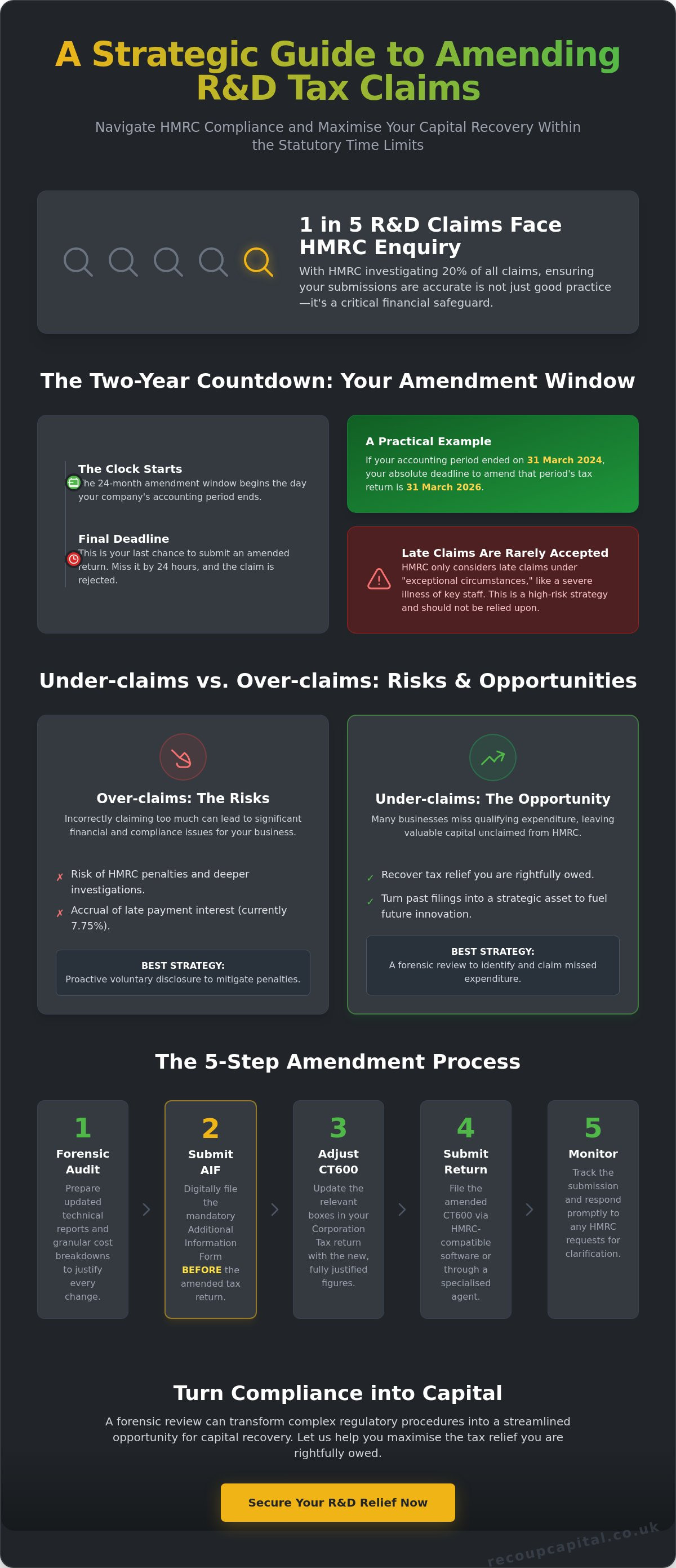
The clock starts ticking the moment your financial year concludes. For example, if your accounting period ended on 31 March 2024, your window to submit an amendment closes on 31 March 2026. This 24-month span applies regardless of whether you are correcting an over-claim to avoid the 7.75% late payment interest rate or identifying missed costs to claim a repayment. Short or long accounting periods can complicate this calculation. A period longer than 12 months is treated as two separate periods for tax purposes, each with its own specific deadline. Missing these dates by even 24 hours can result in a valid claim being rejected immediately by HMRC’s automated systems. You can find more detail on these timelines in our guide on R&D tax credits explained.
Exceptional Circumstances and Late Claims
HMRC rarely grants extensions for late submissions. To succeed with a late claim, you must demonstrate "exceptional circumstances" that prevented a timely filing. This isn't just about being busy or having a slow internal process. Valid excuses usually involve serious illness of key staff or the unforeseen destruction of records. Submitting a late disclosure via the R&D disclosure service is a high-risk strategy. It often invites deeper scrutiny, which is particularly sensitive given that HMRC now investigates around 20% of all claims. Whilst it's possible to appeal for a late entry under Statement of Practice 5 (2001), most UK limited companies should treat the two-year window as a hard limit to ensure long-term compliance.
The Step-by-Step Process: How to Amend Your CT600
Amending a claim is a rigorous compliance exercise. It's not a matter of simply swapping one figure for another. You must first conduct a forensic audit of your data. This involves preparing updated technical reports and granular cost breakdowns to justify every change. According to HMRC guidance on amending your tax return, you must follow a specific digital workflow to ensure your submission is recognised. If you are unsure how to amend a previous R&D tax claim, the process generally follows these stages:
- Prepare forensic technical justifications and cost spreadsheets.
- Submit the mandatory Additional Information Form (AIF) digitally.
- Adjust the figures in the relevant R&D boxes of the CT600 return.
- Submit the amended return via HMRC-compatible software or a specialised agent.
- Monitor for confirmation or requests for further clarification.
Success depends on precision. Every figure in your amended CT600 must be backed by a clear technical narrative. If you've missed out on relief previously, our team can help with claiming R&D tax credits for past periods to recover that lost capital.
Mandatory Digital Requirements: The AIF
The Additional Information Form (AIF) is the most critical hurdle in the 2026 compliance era. Your amendment is legally invalid without a prior digital AIF submission. This form must be completed and sent to HMRC before you file the amended CT600. A common pitfall is a lack of synchronisation. If the project costs in your AIF don't match the figures in your tax return exactly, it triggers an immediate red flag in HMRC's risk-profiling algorithms. You must include specific details when correcting previous project descriptions, ensuring the technical challenges are clearly defined.
Updating Your Technical Justification
Rewriting project narratives requires a delicate balance. You must maintain consistency with the original claim whilst clearly explaining why the figures have changed. This is your opportunity to identify "new" qualifying activities that were overlooked in the first instance. Perhaps a specific software trial or a prototype iteration wasn't fully documented. You must link these technical uncertainties directly to the revised financial figures. HMRC expects a high level of detail; vague descriptions are no longer sufficient to justify a revised claim value.
Under-claims vs Over-claims: Strategic Differences
Not all amendments are created equal. When considering how to amend a previous R&D tax claim, you must first determine if you are correcting an oversight or reclaiming missed capital. HMRC views these two scenarios through very different lenses. An under-claim represents a missed opportunity for your business to reinvest in its own growth. Conversely, an over-claim is a compliance risk that requires immediate, proactive management to protect your long-term relationship with the tax authorities.
HMRC distinguishes between errors that are "careless" and those that are "deliberate." Careless errors often stem from a lack of technical understanding or poor record-keeping, whilst deliberate errors involve a conscious effort to inflate figures. In the 2026 regulatory climate, where enquiry rates sit at 20%, the distinction is vital. A strategic forensic analysis of your previous tax and credit submissions can reveal hidden innovation costs that were previously ignored, turning a compliance check into a significant capital asset.
Maximising Missed R&D Expenditure
Many businesses inadvertently under-claim because they apply a narrow definition of qualifying activity. We frequently find that companies overlook subsidised R&D, staff bonuses, and complex utility apportionments that are legitimately eligible for relief. Identifying these costs can substantially boost your tax credit or refund. If you've realised your previous submission was too conservative, claiming R&D tax credits for missed expenditure is a precise way to recover that capital. You must document these newly discovered costs with the same transparency as a fresh claim, ensuring every penny is tied to a specific technical uncertainty.
Correcting Errors and Voluntary Disclosures
Waiting for an HMRC enquiry is the worst way to fix an over-claim. If you discover you've claimed too much, being proactive is the only way to mitigate potential penalties. As of January 2026, the late payment interest rate for Corporation Tax is 7.75%, which can quickly erode your cash reserves if an error is left unaddressed. You should use HMRC's R&D disclosure service to report inaccuracies voluntarily. This show of transparency often leads to lower penalties compared to errors discovered during a formal investigation. Partnering with a specialised R&D consultant to manage this disclosure ensures the technical corrections are robust and the financial impact is minimised through expert negotiation.
Protecting Your Business from HMRC Enquiries during Amendments
HMRC's approach to compliance has evolved. By 2026, the use of AI-driven risk-profiling algorithms means that any change to a previously settled tax return is likely to be flagged for review. When you are looking at how to amend a previous R&D tax claim, you must accept that the amendment itself acts as a signal to HMRC. It suggests that the original submission was either incomplete or inaccurate. To manage this risk, transparency is your best defence. You're not just correcting a number; you're re-establishing the credibility of your business's relationship with the tax authorities.
Every revised document must adhere to strict transparency standards. This starts with the Additional Information Form (AIF). You must ensure the "Senior Officer" or "Agent" details are not just accurate but credible. HMRC often looks for a named individual within the business who takes responsibility for the technical accuracy of the claim. A "Letter of Support" is another powerful tool. This document should explicitly explain why the amendment was necessary. Whether it was a change in accounting software that revealed missed costs or a retrospective technical audit, explaining the context helps de-risk the submission and prevents unnecessary friction.
Common Red Flags to Avoid
HMRC's automated systems look for specific inconsistencies. One of the biggest red flags is a drastic change in staffing costs without a corresponding evolution in the technical narrative. If your revised claim doubles the R&D intensity of your engineering team, you must explain exactly what new technical uncertainties they were resolving. Similarly, inconsistent project dates between the original and amended submissions suggest poor record-keeping. For a deeper look at how digital tools are shaping these reviews, read our article on HMRC R&D Tax Claim Transparency and AI.
Establishing a Robust Audit Trail
A successful amendment relies on contemporaneous evidence. This includes timesheets, project meeting notes, and prototype logs that were created at the time the work was performed. If your amendment involves identifying assets that qualify for capital allowances alongside R&D, a forensic surveying approach is essential. This ensures that the costs are correctly categorised and fully defensible. Navigating an HMRC enquiry is complex; professional representation is vital to ensure your responses are technically sound and delivered within the strict statutory deadlines. If you're concerned about a potential enquiry, our specialists can provide a comprehensive review of your revised figures to ensure they meet the highest compliance standards.
Why Partner with Recoup Capital for Your R&D Amendment?
The 2026 compliance landscape is unforgiving. With HMRC's heightened scrutiny and the complexities of the merged R&D scheme, you need a partner who views tax relief through a forensic lens. We don't just process paperwork; we provide a comprehensive technical and financial audit of your history. Our specialist chartered tax accountants understand exactly how to amend a previous R&D tax claim to ensure it stands up to the most rigorous enquiry. We take the weight of the administrative burden off your shoulders by managing the entire end-to-end process, from the digital Additional Information Form (AIF) to the final CT600 submission.
Our approach is built on a foundation of transparency and shared success. We operate a success-based fee model, which means our interests are perfectly aligned with yours. We only win when you successfully recover or protect your capital. This removes the financial risk of exploring an amendment and ensures you receive a high-value service focused on results rather than traditional sales pitches. We've built our reputation on helping UK businesses transform complex regulatory procedures into tangible opportunities for growth.
Beyond Paperwork: Strategic Capital Recovery
We believe in reframing your R&D refund as a strategic business asset rather than a simple one-off payment. This capital can be the catalyst for your next major breakthrough. Our forensic review often uncovers cross-over opportunities that generalist accountants might miss, such as qualifying expenditure for land remediation or the Patent Box. By looking at the bigger picture, we ensure your business isn't leaving money on the table. If you're still getting to grips with the basics of the current regulations, you can find more detail in our guide to R&D tax credits explained.
Your Long-Term Compliance Partner
Trust is earned through consistency and protection. Our commitment to high-quality, evidence-based submissions acts as a shield for our clients, reducing the likelihood of disruptive HMRC enquiries. We don't just aim for a quick win; we look to build long-term collaborations that support your innovation journey for years to come. Businesses across the UK trust our results-driven approach because we prioritise their bottom line and their peace of mind. If you're ready to secure your past claims and fuel your future, contact Recoup Capital for a no-cost introductory review of your previous claims. Let's ensure your business receives every penny of the support it deserves.
Securing Your Innovation's Future
The 2026 tax landscape demands a proactive approach to compliance and capital recovery. By mastering the two-year statutory window and the mandatory digital AIF requirements, you ensure your business remains on the right side of HMRC's evolving standards. Whether you're correcting a careless error or reclaiming overlooked expenditure, understanding how to amend a previous R&D tax claim is essential for protecting your bottom line. It's about turning historical technical challenges into strategic financial assets.
At Recoup Capital, we act as your protective guide through these regulatory complexities. Our expert team of chartered tax accountants provides national UK coverage and specialised sector knowledge to ensure every amendment is technically robust and fully defensible. We operate on a success-based fee structure, meaning we're fully invested in your results and long-term stability. Don't let valuable tax relief slip away or leave your business vulnerable to unnecessary scrutiny.
Request a forensic review of your previous R&D claims today to turn your historical innovation costs into strategic assets for future growth. We're ready to help you innovate with confidence and clarity.
Frequently Asked Questions
Can I amend an R&D claim if I have already received the tax credit payment?
Yes, you can still submit an amendment even after HMRC has processed your original payment. Receiving a tax credit doesn't close the statutory window for corrections. If you've discovered missed qualifying costs or technical errors, you can revise the figures to ensure your claim is both accurate and maximised for capital recovery.
What is the absolute deadline for amending a previous R&D tax claim in 2026?
The hard deadline is exactly two years from the end of the relevant accounting period. For instance, if your financial year ended on 31 March 2024, you must submit your amendment by midnight on 31 March 2026. Knowing how to amend a previous R&D tax claim before this date is vital, as HMRC rarely accepts late submissions without evidence of exceptional circumstances.
Do I need to submit a new Additional Information Form (AIF) for an amendment?
Yes, a fresh AIF is a mandatory digital requirement for every amendment. You cannot simply change the figures on your CT600; you must submit a new AIF that reflects the revised project details and costs first. HMRC’s systems are designed to cross-reference the AIF with your tax return, and failing to provide this updated digital form will result in your amendment being rejected.
Will amending my previous R&D claim trigger an HMRC enquiry?
Amending a claim can increase your risk profile, but it doesn't guarantee an enquiry. HMRC’s algorithms look for significant deviations from original submissions. However, by providing a transparent "Letter of Support" and ensuring your technical narratives are robust, you can mitigate these risks. Specialist representation is often the best way to manage this increased visibility whilst protecting your business.
Can I claim R&D tax relief for a project I forgot to include in my original return?
Yes, adding an entirely new project is a common reason for amending a return to address an under-claim. You'll need to prepare a full technical justification and cost breakdown for the new project, ensuring it meets the standard eligibility criteria. This is an effective way to recover capital that was inadvertently left on the table during your initial filing.
What happens if I realise I have over-claimed R&D tax credits by mistake?
You should act immediately by making a voluntary disclosure via HMRC's specialised R&D disclosure service. Reporting the error yourself demonstrates a commitment to compliance and typically results in significantly lower penalties than if HMRC discovers the discrepancy during an enquiry. It's a proactive step that protects your company's long-term reputation with the tax authorities.
How long does HMRC take to process an amended R&D tax claim?
Amended claims usually take longer to process than original submissions because they often trigger a manual review. Whilst standard claims might be settled in 40 days, an amendment can take between 60 and 90 days, or longer if HMRC requests further clarification. Maintaining an organised audit trail helps speed up this process by providing immediate answers to any technical queries.
Do I need my original accountant to handle the R&D tax claim amendment?
No, you're free to appoint a specialist firm to manage how to amend a previous R&D tax claim. Many businesses choose to work with R&D specialists for amendments because of the forensic technical knowledge required to justify changes to HMRC. A specialist can work alongside your existing accountant, focusing solely on the nuances of the R&D compliance framework whilst your main agent handles general tax affairs.