
R&D Tax Credit Specialists UK: Choosing a Partner for Compliant Innovation in 2026

Could your business withstand a retrospective HMRC enquiry into your last three years of innovation claims? With HMRC estimating that £1.1 billion was lost to error and fraud in R&D schemes during the 2023-24 financial year, the era of low-risk tax relief is over. Finding the right R&D tax credit specialists UK has become a strategic necessity rather than a simple clerical choice. You likely feel the pressure of the April 2024 merged scheme rules, where the line between eligible expenditure and a compliance red flag has never been thinner.
It's frustrating to see your technical team's time drained by complex documentation when they should be building your next product. This article outlines how to select an expert partner to maximise your claim value while maintaining total compliance with the latest 2026 standards. We'll explore the benchmarks of a robust claim process that turns tax relief into vital money for reinvestment. You'll learn how to secure a seamless experience that protects your business and fuels your future growth. By choosing today's adviser to be tomorrow's partner, you can stop worrying about HMRC and start focusing on your next breakthrough.
Key Takeaways
- Navigate the complexities of the 2026 Merged Scheme to ensure your business remains compliant while capturing every pound of eligible expenditure.
- Identify the critical "Dual-Expertise" model used by leading R&D tax credit specialists UK to accurately translate technical innovation into qualifying tax relief.
- Master a robust 5-point evaluation framework to distinguish high-value specialist partners from generalist accountants who may overlook technical nuances.
- Learn how to transform your tax refund into a strategic growth engine, providing essential money for reinvestment to fuel your next phase of innovation.
Navigating the UK’s Evolving R&D Tax Credit Landscape in 2026
R&D tax credit specialists UK act as the essential bridge between your technical innovation and the complex tax legislation governed by HMRC. They don't just process paperwork; they translate your engineering or scientific breakthroughs into a language that tax inspectors understand. In 2026, this role has become a cornerstone of corporate strategy. Following the full integration of the Merged Scheme on 1 April 2024, the boundary between the old SME and RDEC paths has vanished, creating a unified but more rigorous landscape for every claimant.
HMRC has significantly sharpened its focus on the definition of "innovation" to eliminate fraudulent or boundary-pushing claims. With the tax authority deploying over 300 additional compliance officers since 2023, the focus has shifted from high-volume submissions to high-quality, evidence-based claims. It's no longer enough to be "clever." You must prove that your project sought to resolve a specific scientific or technological uncertainty that wasn't readily deducible by a competent professional in the field. This shift ensures that tax relief remains a reward for genuine advancement rather than a loophole for standard business activities.
The Impact of Recent HMRC Policy Shifts
The introduction of the mandatory Additional Information Form (AIF) on 8 August 2023 fundamentally altered the documentation process. Specialists must now provide granular project breakdowns before the Corporation Tax return is even submitted. 2026 is the year of "compliance-first" consultancy, where the priority is building a robust technical narrative that satisfies non-technical inspectors. We focus on identifying the exact moment your team hit a technological dead end, as these uncertainties are the primary triggers for successful claims. Proving what didn't work is often as valuable as proving what did.
Why Generalist Support is No Longer Sufficient
Using standard accounting software to guess your R&D expenditure is a significant risk in this regulatory environment. Generalists often miss qualifying activities in sectors like construction or food technology, where innovation is frequently hidden in process improvements or material trials. A specialist protects your business from the reputational damage of an HMRC enquiry while ensuring you receive the maximum money for reinvestment. Our approach turns a complex government process into a seamless opportunity for growth. We aren't just processing a refund; we are acting as today’s adviser and tomorrow’s partner to help your business thrive.
- Risk Mitigation: Reducing the likelihood of "grey area" claims that trigger costly and time-consuming audits.
- Maximum Recovery: Identifying overlooked costs like software licences, consumable items, or specific utility power used during the R&D phase.
- Future-Proofing: Ensuring your internal record-keeping meets the 2026 standards for digital evidence and real-time project tracking.
By partnering with R&D tax credit specialists UK, you move beyond mere compliance. You gain a strategic ally who understands that every pound recovered is vital capital for your next breakthrough. If you're unsure if your recent projects qualify under the 2026 rules, we offer a FREE 15 minute consultation to provide clarity without the sales pitch.
What Defines a True R&D Tax Credit Specialist?
Identifying a genuine specialist requires looking beyond basic accounting qualifications. A high-performing team operates on a "Dual-Expertise" model, which merges the financial precision of chartered tax accountants with the boots-on-the-ground experience of sector-specific engineers and scientists. This combination is vital because HMRC doesn't just want to see your receipts; they want to understand the "why" behind your innovation. Without a specialist who speaks the language of your developers or site managers, significant portions of your eligible work might go unrecorded.
True R&D tax credit specialists UK apply forensic accounting techniques to isolate qualifying expenditure from your general business costs. They don't just look at top-line figures. Instead, they drill into the specific percentages of staff time, consumable items, and software licences directly tied to resolving technical uncertainties. This meticulous approach ensures that the claim is both maximised and fully defensible if HMRC requests more information. It's about turning a complex government process into a seamless opportunity for financial recovery.
Technical Firepower: Beyond the Balance Sheet
A specialist must grasp the specific "technological advancement" in your field, whether that's a breakthrough in sustainable construction materials or a novel algorithm in a software suite. They translate messy project logs and internal Slack conversations into professional, HMRC-ready technical reports. This expertise allows them to identify "indirectly qualifying" activities. For instance, testing phases or specific maintenance tasks often qualify for relief, yet these are missed by generalist firms in 30% of standard claims. This technical depth ensures no "money for reinvestment" is left on the table.
Chartered Tax Authority
The financial side of a claim is equally rigorous, especially since the legislative changes introduced in April 2024. You need qualified tax professionals who understand the nuances of the merged R&D scheme and how it interacts with other reliefs like the Patent Box or Capital Allowances. They ensure the CT600 is filed with absolute accuracy, following the latest ICAEW R&D technical resources to maintain professional standards.
Optimising a claim for a UK Limited Company requires a deep understanding of corporate structures. A specialist acts as a protective guide, ensuring your claim is robust while avoiding the "sales pitch" style of aggressive boutique firms. They focus on results, treating the process as a partnership rather than a one-off transaction. If you want to see how this expertise applies to your specific projects, a brief consultation can often uncover hidden value in your existing workflows.
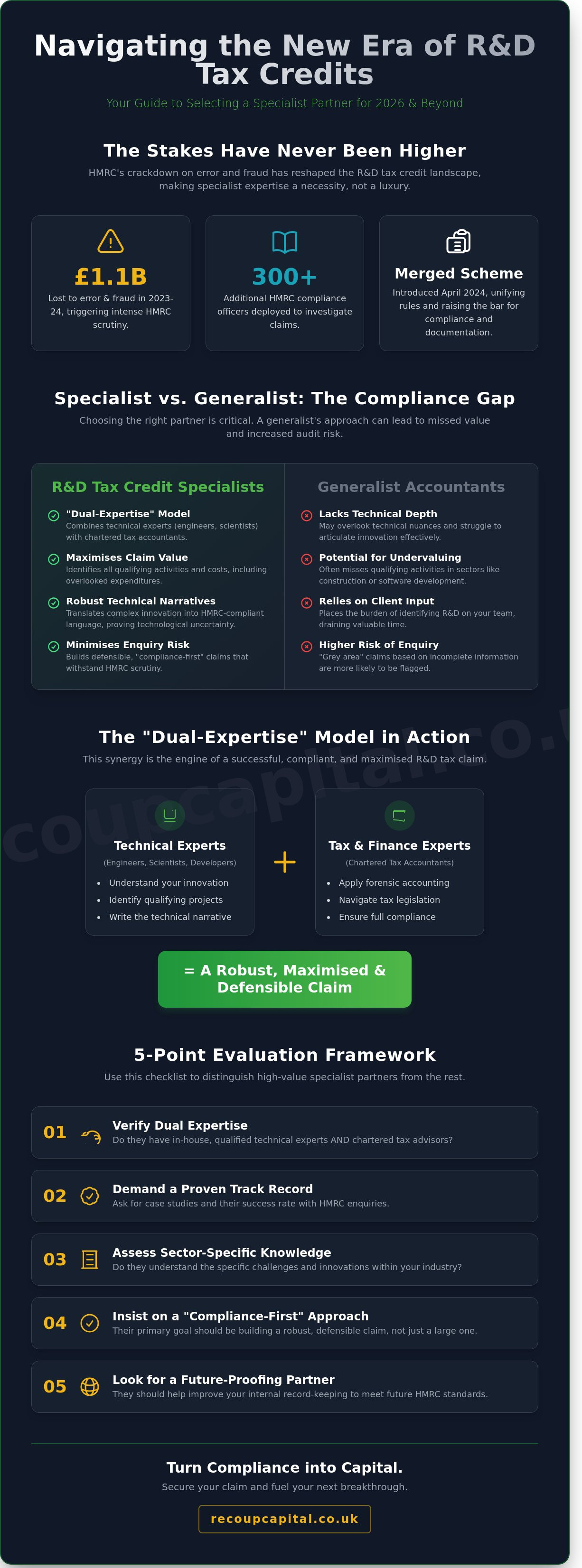
Specialist Consultants vs. Generalist Accountants: The Compliance Gap
Most generalist accountants treat R&D tax relief as a once-a-year compliance chore, often tacked onto the end of an annual audit. This reactive approach creates a dangerous compliance gap. While your accountant is excellent at balancing books, they often lack the engineering or software background to identify eligible activities in real-time. R&D tax credit specialists UK provide continuous monitoring throughout the financial year, capturing qualifying expenditure the moment it occurs rather than trying to reconstruct projects from twelve months ago.
This difference in expertise carries tangible financial risks. A lack of technical depth leads to under-claiming, where businesses miss out on thousands of pounds because they didn't realise a specific process improvement qualified as innovation. On the other end of the spectrum, over-claiming is a growing concern. HMRC can issue penalties of up to 100% for "deliberate and concealed" inaccuracies, alongside interest charges that erode your cash flow. A specialist's success-based fee model removes this anxiety; it ensures our interests are entirely aligned with yours, focusing on securing the maximum legitimate amount of money for reinvestment.
The Forensic Advantage in Technical Reporting
Generalist reports often fail HMRC’s "competent professional" test because they describe business outcomes rather than technical uncertainties. Specialists use forensic surveying to uncover hidden R&D in sectors like construction, where a 2024 project might involve bespoke structural work to meet new environmental standards. Forensic technical assessment is the process of isolating specific innovation costs from routine business operations. This precision ensures your claim is built on a foundation of evidence that standard accounting software simply cannot provide.
Managing the HMRC Relationship
A specialist serves as a vital buffer between your business and the tax office. If HMRC requests further information or launches a formal enquiry, we handle the technical defence on your behalf. Specialists with a consistent track record of clean submissions carry significantly more credibility with HMRC inspectors, which often results in smoother processing. This is why many firms choose R&D tax credit specialists UK to manage their submissions rather than relying on a generalist. This partnership-oriented approach provides the peace of mind that your claim is protected by experts who understand the nuances of the latest 2023 and 2024 legislative shifts. It isn't just about processing paperwork; it's about providing a seamless experience that allows you to innovate without fear of administrative friction.
How to Evaluate R&D Tax Credit Specialists: A 5-Point Framework
Selecting the right partner determines whether you receive a standard refund or a transformative cash injection for reinvestment. It's about finding a guide who understands the technicalities as well as the spreadsheets. To ensure you're working with the best R&D tax credit specialists UK has to offer, use this five-point framework to assess their capability and culture.
- Sector Experience: Does the specialist understand your specific industry nuances? A firm that handles architectural claims may not grasp the complexities of clinical trial phases or subsea engineering. They must understand where your "uncertainty" ends and your "innovation" begins.
- Technical Background: Look for a team that isn't just composed of accountants. You need staff who understand engineering or science. If they can't speak the language of your technical leads, they'll likely miss eligible costs hidden in your daily operations.
- Compliance Track Record: HMRC's 2024/25 crackdown on "boundary pushing" means compliance is everything. Ask for their success rate under the new merged scheme rules. A specialist should have a robust process for the mandatory Additional Information Form (AIF) introduced in August 2023.
- Fee Transparency: Avoid hidden costs or complex percentage tiers. A pure success-based model is often best. It aligns your interests with theirs, ensuring they're motivated to find every penny of eligible expenditure without charging you upfront.
- Long-term Partnership: The best R&D tax credit specialists UK provide more than just a one-off filing. They offer strategic advice on how to reinvest that capital to fuel further innovation, acting as a catalyst for your business growth.
Vetting Your Potential Partner
Don't be afraid to ask the hard questions during your initial chat. Ask them exactly how many of their claims have been challenged by HMRC in the last 12 months. A transparent firm will provide these figures and explain their defence process. Check for professional memberships like CIOT or ICAEW status to ensure they're bound by professional standards. The data collection process should feel seamless; if you're spending 20 hours on paperwork, your partner isn't doing the heavy lifting for you.
The Importance of UK-Based Expertise
UK tax law is nuanced and HMRC's behaviour changes rapidly. "R&D cowboys" often promise unrealistic returns but lack the technical backing to survive a formal enquiry. These entities often operate without qualified UK tax professionals, leaving your business at risk. True expertise comes from a partner who provides "Today’s adviser, tomorrow’s partner" support. This means having a UK-based expert who understands the 2024 legislative shifts and can stand by your claim if HMRC asks for more detail. They should project confidence, not just sales pressure.
Ready to see how much your innovation is worth? Book your FREE 15 minute consultation with our specialist team today.
Maximising Your Innovation Potential with Recoup Capital
Recoup Capital operates on a simple but powerful principle: we aren't just here to process paperwork; we're here to fuel your future growth. We view every successful claim as "money for reinvestment." This philosophy transforms a standard tax refund into a strategic growth engine for your business. Whether you're looking to hire new technical talent, upgrade your facility, or start a new product trial, the capital we recover provides the liquidity needed to move faster. For companies scaling their operations, Business Reimagined provides leadership development and talent initiatives, while those exploring international expansion can discover Reflechir Consultancy for expert financial optimization in the UAE. As R&D tax credit specialists UK, we've seen how a well-executed claim can provide the financial breathing room required to take calculated risks in a competitive market.
Our approach is built on deep sector expertise rather than a one-size-fits-all model. We've developed a specialised focus on industries where innovation is often hidden in plain sight, such as:
- Construction: Developing sustainable building materials or solving unique structural challenges on-site.
- Engineering: Creating bespoke components or improving manufacturing tolerances.
- Food Tech: Innovating with shelf-life stability, nutritional profiles, or waste reduction processes.
The process we've designed is entirely seamless. We handle the end-to-end journey, from the initial technical assessment where we identify qualifying activities to the final HMRC liaison. You won't have to spend hours deciphering tax legislation. We do the heavy lifting so you can stay focused on your core operations.
The Recoup Capital Difference: Expert Guidance
Our team brings together technical specialists and chartered tax accountants who work in tandem. This dual approach ensures your claim is technically accurate and financially optimised. We've consciously rejected the standard, high-pressure sales pitch. Instead, we focus on demonstrating value through forensic results. Our success-based fees ensure we're fully invested in the accuracy and value of your submission. If you don't see a benefit, we don't either. It's a partnership-first model that prioritises your long-term success over short-term gains.
Start Your Journey: The 15-Minute Consultation
Finding out if you're eligible shouldn't be a complex chore. We offer a free consultation that takes just 15 minutes to identify potential qualifying expenditure without any initial commitment. During this call, our R&D tax credit specialists UK will ask targeted questions to uncover hidden innovation within your daily tasks. Once we've established eligibility, we follow a structured path to organise your data and prepare a robust submission for HMRC. We aim to make the entire experience transparent and stress-free.
Book your free 15-minute R&D consultation with our specialists today and see how much capital your business could be reinvesting in its next big breakthrough.
Turning Technical Innovation Into Strategic Reinvestment
Navigating HMRC’s rigorous compliance standards in 2026 requires more than just basic accounting. You need a partner who understands the technical nuances of complex sectors like construction and engineering alongside the latest legislative shifts. By prioritising a specialist over a generalist, you bridge the compliance gap and turn potential risks into vital capital for your next project. It's about more than just paperwork; it's about protecting your firm's financial integrity while you focus on growth.
Recoup Capital acts as your protective guide through this landscape. Our team of chartered tax accountants and technical specialists operates on a success-based fee model, which means you face no upfront costs. We focus on demonstrating value through results, ensuring every claim is robust and fully compliant with the UK’s evolving tax laws. Working with proven R&D tax credit specialists UK ensures your business doesn't leave money on the table while maintaining a transparent relationship with the Revenue.
It's time to transform your innovation into tangible growth. Secure your business’s future with a free 15-minute R&D consultation and see how we can help your business thrive. We're ready to help you unlock the funding your hard work deserves.
Frequently Asked Questions
What is the current definition of R&D for UK tax purposes in 2026?
In 2026, HMRC defines R&D as any project that seeks an advance in science or technology by resolving scientific or technological uncertainty. This advance must not be readily deducible by a competent professional working in the field. Since the April 2024 reforms, this definition officially includes all activities involving datasets and cloud computing costs used specifically for qualifying research purposes.
Can I still claim R&D tax credits if my project failed or was cancelled?
You can claim for projects that were cancelled or failed, as the scheme rewards the attempt to innovate rather than the commercial success. HMRC's criteria focus on the technical challenges you tried to overcome. If you spent money attempting to resolve a scientific uncertainty, those costs remain eligible even if the final product never reached the market.
How long does it typically take to receive the R&D tax credit from HMRC?
You'll typically receive your payment or tax credit within 28 to 40 days of submitting your claim to HMRC. The tax authority currently aims to process 95% of SME payable credit claims within this 40-day window. Working with R&D tax credit specialists UK ensures your technical documentation is accurate, which prevents the administrative delays that often occur with incomplete submissions.
What is the difference between the SME scheme and the Merged R&D scheme?
The Merged R&D Scheme is the standard pathway for most companies for accounting periods starting on or after 1 April 2024, combining the old SME and RDEC rules. However, the R&D Intensive SME scheme still exists for loss-making businesses where R&D spend makes up at least 30% of total expenditure. This intensive pathway offers a higher net benefit of up to 27p for every £1 spent on innovation.
Are success-based fees for R&D specialists tax-deductible for my company?
Fees paid to specialists are deductible as a standard professional business expense, meaning they'll reduce your overall corporation tax liability. While these consultancy fees aren't qualifying R&D expenditures themselves, they're treated like any other accountancy or legal cost. This makes hiring an expert a tax-efficient way to secure money for reinvestment without increasing your net costs.
How far back can a specialist look to identify unclaimed R&D tax credits?
You can claim for the two previous completed accounting periods. If your financial year ends on 31 December, you have until 31 December 2026 to submit or amend a claim for the period that ended in 2024. Our team identifies every eligible pound from these prior years to ensure you don't miss out on significant capital that's already been spent.
What happens if HMRC decides to open an enquiry into my R&D claim?
HMRC will issue a formal letter requesting more information or evidence to support the technical and financial details of your claim. It's a standard check to ensure compliance with the 2024 legislative updates. We handle the entire response process for you, providing the technical narratives and cost breakdowns required to satisfy the inspector and protect your funding.
Do I need to be a profitable company to claim R&D tax relief?
You don't need to be profitable to benefit from the scheme. Loss-making SMEs can choose to surrender their tax losses in exchange for a direct cash payment from HMRC. This provides a vital cash injection for early-stage companies and start-ups that are investing heavily in new technology before they've reached a point of commercial profitability.