
How to Conduct a Patent Search: A Strategic Guide for UK Innovators in 2026

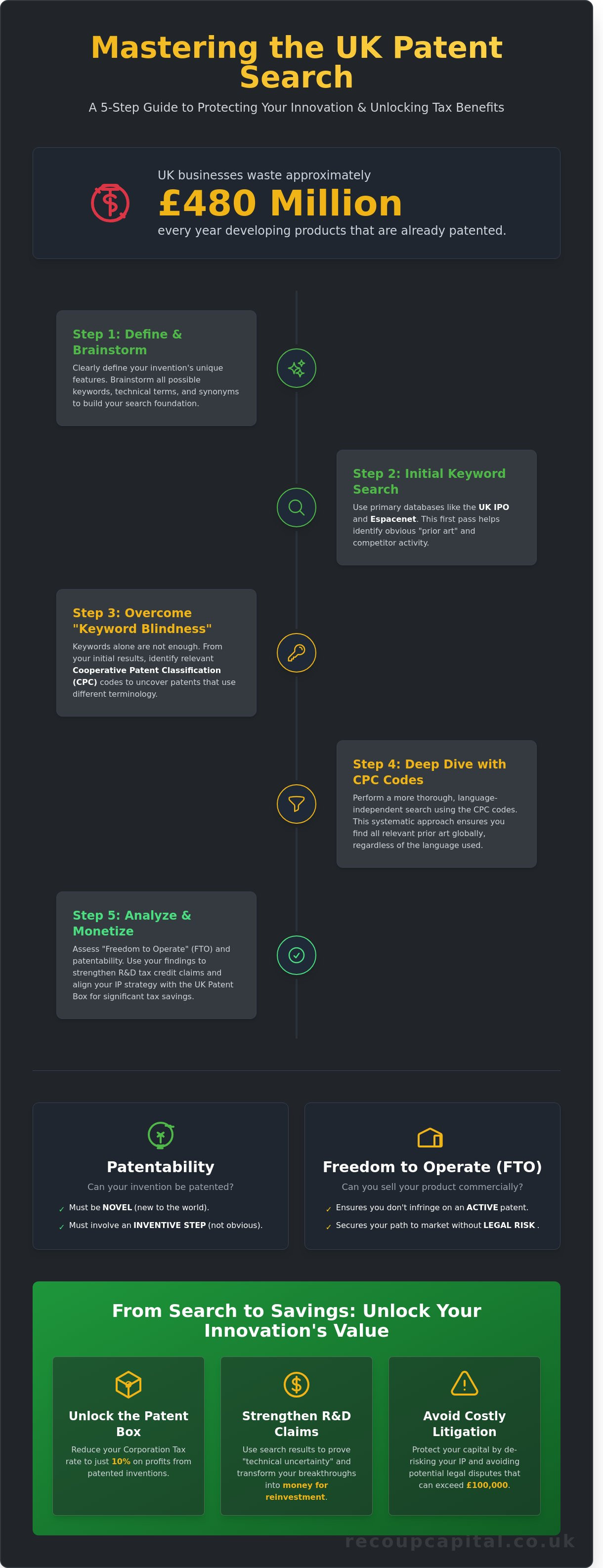
Did you know that UK businesses waste approximately £480 million every year developing products that have already been patented? It's a staggering figure from the UK Intellectual Property Office that highlights why so many innovators feel a genuine sense of dread when it's time to check the archives. You've likely shared that same hesitation; worrying if your "new" idea is actually someone else's property or feeling confused about which database holds the answers. It's common to feel stuck between the risk of a DIY patent search and the unknown costs of professional legal advice.
We believe that clarity shouldn't be a luxury for British businesses. This guide will help you master the essential steps of a patent search in 2026 to protect your intellectual property and prepare your business for significant tax incentives like the Patent Box. You'll gain a repeatable methodology and a clear list of tools to turn your innovation into money for reinvestment. We'll show you exactly how this search leads to HMRC-backed benefits that help your business thrive.
Key Takeaways
- Protect your investment by identifying "prior art" early, ensuring your innovation is viable before you commit significant development capital.
- Master a professional-grade patent search using UK IPO and Espacenet databases to navigate complex international technical landscapes with confidence.
- Avoid the trap of "keyword blindness" by utilising Cooperative Patent Classification (CPC) codes to uncover relevant protections that simple searches often miss.
- Secure a competitive advantage by aligning your intellectual property strategy with the UK Patent Box to reduce your Corporation Tax rate to 10%.
- Discover how to transform your technical breakthroughs into money for reinvestment by pairing patent success with lucrative R&D tax relief claims.
What is a Patent Search and Why is it Essential for UK Businesses?
Launching a new product in the UK market requires more than just a brilliant idea; it demands a clear path to commercialisation. A patent search is the systematic process of scanning global public databases to identify "prior art," which includes any existing evidence that your invention is already known or used. Think of it as a critical feasibility study. Before your business commits £50,000 or £500,000 to product development and manufacturing, you must ensure you aren't building on ground someone else already owns. It's about protecting your capital and ensuring your path to market remains unobstructed.
The stakes are high for British innovators. In 2022, the UK Intellectual Property Office (IPO) received over 19,000 patent applications, proving that the competitive landscape is crowded. Conducting a search early helps you avoid the high costs of patent infringement litigation in the UK courts, where legal fees for a High Court dispute can easily exceed £100,000. A patent search is a strategic tool for validating novelty and securing commercial freedom.
The Strategic Value of Early Discovery
Success isn't just about what you build, it's about knowing who else is building it. Early discovery allows you to map out competitors who are working in similar technological spaces, giving you a clear view of the market's direction. You can refine your innovation based on existing technical disclosures to ensure your work includes a unique "inventive step" that qualifies for protection. This documentation does more than just secure IP; it establishes a baseline for future R&D tax credits explained by clearly defining the technical challenges your team faced. When you prove you've tackled problems that aren't easily solved by existing technology, you strengthen your claim for money for reinvestment.
Patentability vs. Freedom to Operate
UK business owners often confuse two distinct concepts. First, you need to know if your invention can be patented, which requires it to be novel and involve an inventive step. Second, you must assess "Freedom to Operate" (FTO). This determines if you can sell your product without infringing on someone else’s active patent. You might have a patentable improvement on a machine, but if that machine is covered by a broader, active patent, you cannot sell your version without a licence. Understanding what a patent is and where its boundaries lie is essential for a robust corporate finance strategy. Investors look for businesses that have de-risked their intellectual property, ensuring that future growth isn't halted by a sudden injunction or a costly settlement.
- Avoid wasted expenditure: Stop projects that duplicate existing technology before costs spiral.
- Identify licensing opportunities: Find existing patents you can licence to accelerate your growth.
- Strengthen R&D claims: Use search results to prove the "technical uncertainty" required by HMRC.
By treating the patent search as a foundational step rather than an afterthought, you position your business as a proactive and informed player in the UK's innovation economy. It's the difference between a risky gamble and a calculated investment in your company's future.
Essential Tools for a Professional-Grade Patent Search
Securing your intellectual property starts with clarity. You need to know if your innovation is truly unique before committing significant capital to development. A professional patent search isn't just a legal hurdle; it's a strategic asset that protects your market position and informs your future expenditure on innovation. By identifying existing protections early, you avoid costly litigation and find "white space" for new growth.
Using the UK IPO Search Service
The Intellectual Property Office (IPO) provides the definitive UK patent search tool for domestic clearance. You can filter results by publication number, applicant name, or specific keywords to identify what your competitors are protecting. It's the primary resource for establishing "Freedom to Operate" within the British market. For those in the pharmaceutical or plant health sectors, the IPO database also tracks Supplementary Protection Certificates (SPCs). These can extend protection for up to five years after a patent expires, which is vital data for calculating your long-term ROI.
Espacenet: The Global Perspective
Local searches aren't enough for a comprehensive strategy. Espacenet offers access to over 150 million patent documents from across the globe, providing a window into international innovation. Its "Smart Search" function allows you to filter results by Cooperative Patent Classification (CPC) codes, which is far more precise than simple keyword matching. Even if you only intend to trade in the UK, checking global filings is essential. It prevents you from reinventing the wheel and helps you understand the "state of the art" required for claiming R&D tax relief later.
Google Patents and the Patents Journal
Google Patents simplifies the initial discovery phase. Its AI-driven indexing handles natural language queries, making it an excellent starting point for a preliminary patent search. It's fast, accessible, and links related documents seamlessly. Once you've moved past discovery, you should monitor the Patents Journal. Published every Wednesday by the IPO, this journal tracks the latest UK applications and granted rights. It ensures you're never blindsided by a competitor's new filing in your niche.
Success in business innovation relies on using the right data at the right time. Identifying these opportunities early can turn a simple idea into a significant source of money for reinvestment. If you're ready to see how your technical advances could translate into financial recovery, we offer a FREE 15 minute consultation to explore your options.
Common Pitfalls: Why a Simple Keyword Search Isn’t Enough
Thinking about a patent search as a quick Google task is a mistake that costs UK businesses thousands in wasted filing fees. Keyword blindness is the first hurdle. An engineer might describe an invention as a "rotary dampener," while a patent attorney in 2012 filed it as a "torque-limiting fluid coupling." If you only search for the former, you will miss the latter. This linguistic gap creates a false sense of security that can lead to expensive legal challenges later.
Don't ignore the past. A patent that expired in 1995 or 2005 cannot be enforced against you, but it remains a permanent part of the public record. It is still prior art. It can block your application just as effectively as a live patent. You must also look beyond official databases. Academic journals, trade show brochures from industry events, and even existing products on Amazon count as evidence of prior disclosure. While the UK patent search service is a vital starting point, it isn't the finish line. Your patent search must be exhaustive to withstand the rigorous scrutiny of both the Intellectual Property Office (IPO) and HMRC.
The "Prior Art" Trap
Prior art is any evidence that your invention was known to the world before your filing date. It's a broad net. A casual LinkedIn post or a detailed blog entry from six months ago can destroy your "novelty" requirement. Once information enters the public domain, you cannot "re-invent" it for a patent. This matters for more than just IP protection. Professional R&D tax credit specialists UK look for prior art during the claim process to ensure your project represents a genuine technological advance over existing knowledge.
Misinterpreting "Patent Pending" Status
A "patent pending" tag isn't a "keep out" sign; it's a warning of a moving target. Pending applications are vital to track because their claims can change during examination. You should monitor the Patents Journal for updates on status shifts that might impact your freedom to operate. Watch out for "submarine patents" too. These are applications that stay hidden for the standard 18-month secrecy period before publication, potentially emerging late in your development cycle to create significant legal friction and unexpected costs.
How to Perform a Patent Search: A 5-Step Methodology
A structured patent search ensures you don't waste capital on ideas that already exist. It’s a vital phase of due diligence that protects your investment and clarifies your path to market. Follow this five-step methodology to secure your competitive advantage.
- Step 1: Define your "Inventive Step." Break your invention down into its core technical components rather than searching for the product as a whole. If you've developed a new hydraulic valve, don't just search for "valves"; search for the specific pressure-release mechanism or the unique alloy composition that makes it innovative.
- Step 2: Identify relevant CPC codes. The Cooperative Patent Classification (CPC) system is a hierarchical structure used by over 45 patent offices globally. Finding the specific codes for your technology allows you to find similar inventions even if the inventors used different terminology to describe them.
- Step 3: Execute a broad keyword search. Use the UK IPO’s Ipsum service and Google Patents for an initial sweep. This phase is about filtering out the most obvious "prior art" and identifying the key players in your specific technical field.
- Step 4: Conduct a deep-dive on Espacenet. Managed by the European Patent Office, Espacenet contains more than 150 million patent documents. Use the CPC codes identified in Step 2 to perform a granular search that bypasses the limitations of simple keyword matching.
- Step 5: Document your findings in a "Search Report." This document serves as a record of your technical journey. It’s a vital piece of evidence that supports your technical narrative when claiming R&D tax credits through HMRC.
Defining Your Search Parameters
Precision is the difference between a successful search and a wasted afternoon. Start by brainstorming technical jargon and synonyms used in your industry; a "fastener" in one sector might be a "locking pin" in another. Use Boolean operators to refine your results. Using "AND" will narrow your search to documents containing both terms, while "NOT" helps exclude irrelevant hits like "software" when you are searching for mechanical hardware. Set geographic boundaries based on your commercial strategy, focusing heavily on the UK and any territories where you intend to manufacture.
Organising and Analysing the Results
Once you have gathered your data, create a "Patent Landscape" map. This visual representation reveals where competitors like Dyson or Rolls-Royce are most active and, more importantly, where they aren't. These gaps are known as "White Space," representing areas of technology where no patents currently exist and where your business can freely innovate. Linking these results to your internal R&D documentation ensures that every hour spent on research is accounted for during tax season. It transforms a legal requirement into a strategic asset for financial recovery.
Ready to turn your innovation into capital? Speak with our specialist team today to see how your patent journey supports a robust R&D tax claim.
From Search to Savings: Unlocking the Patent Box and R&D Tax Credits
A successful patent search does more than just clear the path for legal protection; it acts as the foundation for significant tax efficiencies. By securing a patent, your business gains access to the UK Patent Box regime. This incentive allows companies to apply a lower 10% rate of Corporation Tax to profits earned from its patented inventions. Compared to the main rate of 25% for profits over £250,000, this represents a substantial saving that can be diverted back into your core operations.
It's about more than just a lower tax bill. It's about building a sustainable cycle of innovation. When you align your intellectual property strategy with proactive tax planning, you create a dedicated stream of capital for future projects. This strategic approach ensures that your initial investment in a patent search pays dividends throughout the entire lifecycle of your product.
The Patent Box Advantage
To benefit from this 10% rate, you must hold a qualifying patent granted by the UK Intellectual Property Office or the European Patent Office. A rigorous search at the start ensures your application is robust enough to survive the full 20-year term without being overturned. Once granted, you'll need to "stream" your income, identifying exactly which profits come from the patented IP. This precision ensures you maximise your savings while staying fully compliant with HMRC requirements.
Maximising Innovation Incentives
Smart businesses don't choose between R&D tax credits and the Patent Box; they use both. While R&D relief covers the costs of development, the Patent Box rewards the commercial success of the result. When you submit a claim, HMRC looks for evidence that you've tackled a "technical uncertainty." A well-documented search report proves that a solution didn't already exist in the public domain. This justifies the "innovation" element of your why claim narrative, making your application significantly more persuasive.
Recoup Capital specialises in this intersection of IP and tax law. We help you transform complex technical data into money for reinvestment. We aren't here to deliver a traditional sales pitch. Instead, we focus on demonstrating value through results. Our team acts as a protective guide, helping you identify every qualifying expenditure and ensuring your documentation meets the highest professional standards. We believe in being today’s adviser and tomorrow’s partner, helping your business thrive in a competitive market.
Ready to see how your innovation can translate into capital? We offer a FREE 15 minute consultation to explore your eligibility and outline the potential for financial recovery. It's a seamless way to start your journey toward long-term growth.
Transforming Technical Diligence into Strategic Capital
A comprehensive patent search is the first step toward safeguarding your competitive advantage and ensuring your R&D investment isn't wasted on existing ideas. Beyond risk mitigation, this process establishes the technical baseline needed to access lucrative UK incentives like the Patent Box. These schemes don't just protect your work; they provide vital money for reinvestment that can accelerate your next phase of growth.
Navigating the intersection of intellectual property and tax legislation is complex, but you don't have to do it alone. Recoup Capital has facilitated over £100m in capital for UK innovators, providing the expertise needed to turn technical breakthroughs into financial success. Our specialist team of chartered tax accountants and technical experts manages the heavy lifting, working on a success-based fee structure where we only win when you do.
Today’s adviser, tomorrow’s partner; we're ready to help you unlock the full value of your innovation. Book your FREE 15-minute innovation consultation with Recoup Capital to see how much your business could recover. Your next breakthrough deserves the right financial backing.
Frequently Asked Questions
Can I do a patent search myself or do I need a lawyer?
You can certainly start a patent search yourself using free public databases like Espacenet or the UK Intellectual Property Office (IPO) digital search tools. These platforms allow you to identify obvious "prior art" and existing inventions that might conflict with your idea. However, a professional search by a patent attorney or specialist is recommended before filing a formal application. Experts use sophisticated Boolean search techniques and access private databases to catch obscure filings you might miss, reducing your risk of a rejected application.
Is a UK patent search valid for the rest of the world?
A UK-specific search only identifies patents registered within the United Kingdom and does not provide legal protection or a novelty guarantee in other jurisdictions. Patents are strictly territorial, meaning you must search global databases if you plan to export your product or service. Most innovators use the Patent Cooperation Treaty (PCT) search process, which covers 157 contracting states. This ensures your invention is truly unique on a global scale before you commit to expensive international filing fees.
How much does a professional patent search cost in 2026?
Professional fees for a comprehensive patent search in 2026 typically range between £600 and £1,800 depending on the technical complexity of your invention. These figures reflect current UK industry benchmarks for high-quality "freedom to operate" reports. While a basic search might sit at the lower end of that scale, complex biotech or software searches often require more billable hours from specialized attorneys. Investing in this early stage prevents you from wasting thousands of pounds on development for a product that you cannot legally own.
What happens if I find a patent that looks exactly like my idea?
Finding a matching patent isn't necessarily a dead end, but it does mean you need to pivot your strategy. You should first check if the patent is still "in force," as UK patents expire after 20 years and then enter the public domain for anyone to use. If the patent is active, you might consider reaching out to the owner for a licensing agreement. Alternatively, you can use the findings to "design around" the existing patent, creating a new iteration that solves the problem in a technologically distinct way.
How long does a comprehensive patent search usually take?
A professional patent search usually takes between 5 and 10 working days to complete and deliver a full report. This timeline allows the specialist to filter through thousands of documents and provide a detailed analysis of the most relevant results. If you are doing a DIY search, it can take several weeks of part-time research to feel confident in your findings. Speed is important, but accuracy is the priority to ensure your "IP journey" starts on a solid legal foundation.
Does a patent search guarantee that my application will be granted?
No search can provide a 100% guarantee that the IPO will grant your patent application. The search identifies "prior art" available at that moment, but there is always a small risk of "hidden" applications that have been filed but not yet published. The IPO examiner will conduct their own independent search once you file. However, a thorough search significantly increases your success rate by allowing you to draft your claims more precisely around existing inventions.
Can I claim R&D tax credits if my patent search shows my idea isn’t novel?
You can still claim R&D tax credits even if your invention doesn't qualify for a patent. HMRC's criteria for R&D tax relief focus on the resolution of scientific or technological uncertainty during the development process, rather than the final patentability of the product. If your team spent time and money trying to overcome technical challenges, those costs are often eligible for a claim. This provides vital money for reinvestment, helping your business thrive even if your original idea requires a technical pivot.
What is the difference between a patent search and a trademark search?
A patent search focuses on the technical function and novelty of an invention, while a trademark search looks for similar brand names, logos, and slogans. Patents protect how things work; trademarks protect your commercial identity in the marketplace. You might find that your invention is unique, but the name you've chosen for it is already registered by another company in a similar sector. Both searches are essential components of a robust intellectual property strategy to protect your business from different legal angles.