
Mastering the CT600: A How-To Guide for UK Limited Companies in 2026

Your annual ct600 filing shouldn't be viewed as a mere administrative burden; it's actually a strategic opportunity to reclaim vital capital for your business growth. It's perfectly natural to feel a sense of trepidation when faced with complex supplementary pages and the strict transparency standards set by HMRC. During the 2024/25 tax year, thousands of UK limited companies faced avoidable penalties or missed out on legitimate relief due to simple reporting oversights. We understand that you want to get it right the first time, ensuring your business remains compliant whilst protecting your bottom line.
This guide provides a clear roadmap to mastering your 2026 tax obligations with confidence. You'll learn how to accurately complete your return and integrate R&D tax credits or capital allowances to maximise your money for reinvestment. We'll explore the specific schedules you need and the best practices for demonstrating innovation to HMRC, transforming a daunting government process into a seamless experience for your team.
Key Takeaways
- Understand the latest 2026 digital filing requirements to ensure your business remains fully compliant with HMRC’s evolving transparency standards.
- Learn how to navigate the ct600 filing process using mandatory commercial software whilst integrating essential data from your statutory accounts and P&L statements.
- Discover the critical link between your tax return and the Mandatory Additional Information Form (AIF) to successfully claim R&D tax credits and capital allowances.
- Gain insight into how HMRC uses AI to cross-reference your data against industry benchmarks, helping you avoid common pitfalls and potential audits.
- Transform your compliance obligations into a strategic opportunity by identifying how specialist support can unlock significant capital for business reinvestment.
Understanding the CT600: Your Gateway to Corporate Tax Compliance
The ct600 is the formal document UK limited companies use to report income, claim reliefs, and calculate Corporation Tax. It functions as the definitive summary of your business's financial activity over a specific period. By 2026, HMRC has enhanced digital filing requirements to ensure greater transparency and data accuracy. This shift means your return isn't just a static report; it's a dynamic reflection of your company's financial integrity. Rather than viewing this as a simple administrative burden, smart directors see it as a chance to audit their own efficiency.
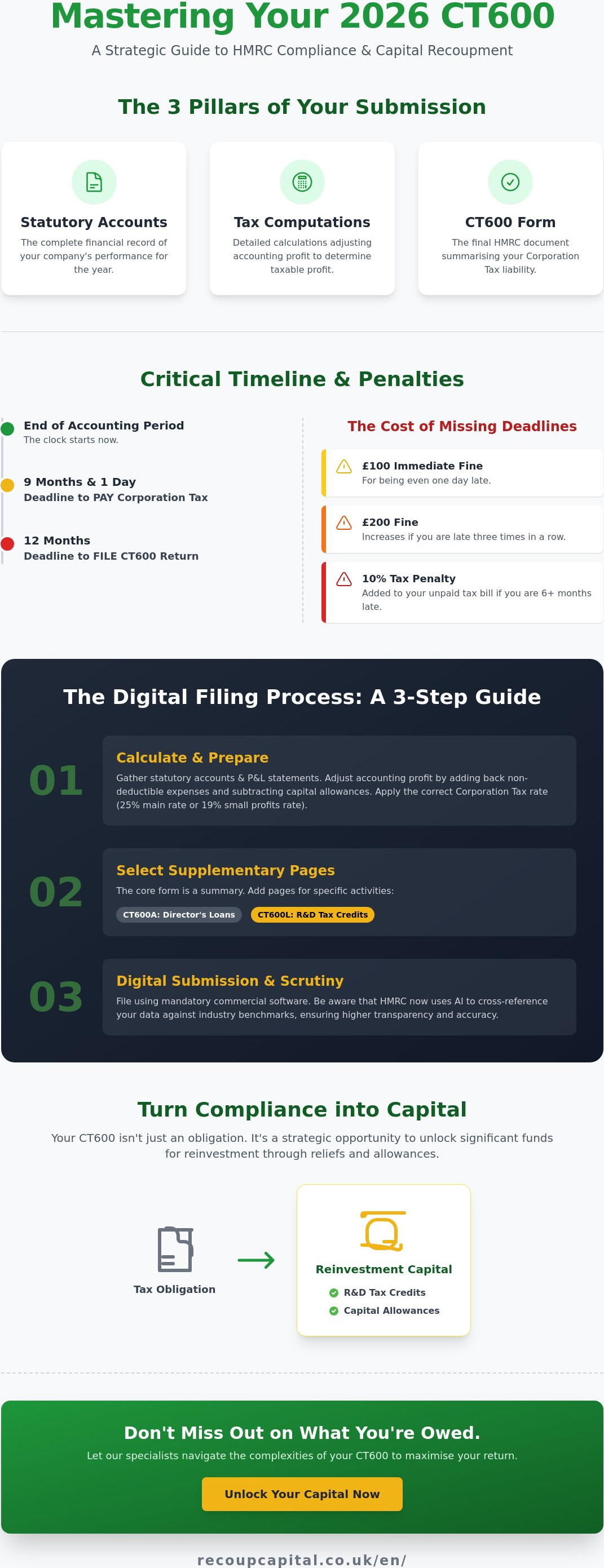
Understanding the UK corporation tax system is vital for every business owner. Your submission relies on three core pillars: your statutory annual accounts, detailed tax computations, and the final ct600 form itself. Whilst many see this as a mandatory liability, we view it as a strategic opportunity. Accurate filing allows you to identify overpayments and claim incentives, effectively turning a compliance hurdle into money for reinvestment that can fuel future innovation.
Who is Required to File a CT600?
Every active limited company must submit a return. This includes businesses that have operated at a loss or have no tax liability for the year. Even if your company is dormant, you must file if HMRC sends a Notice to Deliver. Your filing obligation is dictated by your Accounting Period (AP). This usually matches your financial year. If your accounts cover more than 12 months, you'll likely need to file two separate returns to cover the full duration. This ensures every pound of revenue is accounted for within the correct tax year.
Deadlines and Penalties: Staying on the Right Side of HMRC
Timing is everything when dealing with HMRC. You must pay your Corporation Tax within 9 months and 1 day after the end of your accounting period. However, you have 12 months from that same date to actually file the return. Missing these dates triggers automatic penalties that eat into your bottom line. A late return results in an immediate £100 fine. This increases to £200 if you're late three times in a row. If you're 6 months late, HMRC adds a 10% penalty to any unpaid tax. Maintaining precise records throughout the year ensures your filing is seamless and penalty-free.
How to Complete Your CT600: A Step-by-Step Filing Guide
Filing your ct600 is more than a compliance box-ticking exercise; it's a strategic review of your business's fiscal health. Before you begin the digital entry process, you must gather your essential data. This includes your statutory accounts, detailed Profit and Loss (P&L) statements, and comprehensive capital allowance reports. By 2026, HMRC mandates the use of commercial software for almost all limited company filings to streamline data processing and align with the Making Tax Digital initiative. You can consult the official government guidance to ensure your chosen software meets the current technical specifications.
Step 1: Company Information and Tax Calculation
Start by entering your 10-digit Unique Taxpayer Reference (UTR) and your registered office details with precision. Errors in these basic fields often lead to immediate submission failures. Once the identity data is set, you must calculate your taxable profits. This requires adjusting your accounting profit by adding back non-deductible expenses, such as client entertaining or certain legal costs, and subtracting capital allowances. For the 2026 financial year, ensure you apply the correct Corporation Tax rates. Most companies will navigate the 25% main rate, though those with profits under £50,000 may still benefit from the 19% small profits rate, provided they aren't part of a large associated group.
Step 2: Selecting Supplementary Pages
The core ct600 form acts as a summary, but specific business activities require additional "supplementary pages" to be valid. If your company has provided loans to directors or shareholders that remain unpaid nine months after the accounting period ends, you must complete page CT600A. For businesses driving innovation, page CT600L is the most critical addition. This is where you claim Research and Development (R&D) tax credits, turning your qualifying expenditure into vital cash flow. It's essential that the figures on these supplementary pages reconcile perfectly with the main tax calculation block to prevent HMRC's automated systems from flagging your return for a manual enquiry.
Step 3: Final Review and Submission
Before you commit to the final submission, perform a rigorous cross-reference of your data against your Research and Development Tax Checklist. This helps ensure that no eligible costs, such as software licences or consumable materials, have been omitted from your claim. The process concludes with a digital signature and the receipt of an HMRC confirmation message. The filing date is the date HMRC receives the return, not the date you post it. If you're looking to maximise your company's financial recovery, a quick review of R&D tax credits can help transform your tax return into a significant reinvestment opportunity.
Maximising Your Return: Integrating R&D and Capital Allowances
Your ct600 is far more than a simple tax bill; it's the primary engine for financial recovery. Since August 2023, HMRC has mandated the submission of an Additional Information Form (AIF) before you file your return. This digital link is critical. If the data on your AIF doesn't mirror the figures in your tax return, the system will automatically reject the claim. This integration ensures that the R&D tax relief you're entitled to is accurately reflected in the Box 650 series, transforming technical innovation into tangible cash flow.
Whilst many directors view the tax return as an annual chore, it's actually a strategic opportunity to reclaim money for reinvestment. By correctly recording "Enhanced Expenditure" and specific tax credits, you're not just complying with the law; you're securing the future of your business. It's about making sure every pound spent on innovation is recognised by the Exchequer.
Recording R&D Claims on the CT600L
The CT600L is the specialised supplementary page used to report R&D Tax Credits. Whether you're utilising the merged RDEC scheme or the relief for R&D-intensive SMEs, you must be meticulous. You'll record your qualifying expenditure in Box L166 and any payable credit in Box L175. A common pitfall is a minor discrepancy between the technical report and the ct600 figures. Even a £1 difference can trigger an HMRC enquiry, so precision is your best defence. If your company is loss-making, you can strategically carry-back these credits to the previous year or carry them forward to offset future liabilities, providing a seamless boost to your liquidity.
Leveraging Capital Allowances and Land Remediation Relief
Generalist accountants often miss the deep-level Capital Allowances hidden within commercial property. Beyond desks and computers, you can claim for "integral features" like electrical systems, cold water services, and even lifts. Under the "Full Expensing" rules made permanent in the 2023 Autumn Statement, you can claim a 100% first-year allowance on qualifying plant and machinery. This significantly lowers your final tax figure.
If your business has acquired or developed a site that was previously contaminated, you shouldn't overlook Land Remediation Relief. This allows for a 150% tax deduction on the costs of cleaning up the land. Forensic analysis of your property assets ensures these often-ignored figures are captured. It's a proactive way to turn a complex government process into a significant financial win for your company.
Navigating HMRC Compliance: The New AI and Transparency Standards
HMRC's approach to the ct600 has evolved into a digital-first, data-heavy operation. By 2026, the "Connect" system and advanced machine learning models will automatically cross-reference every line of your tax return against vast industry benchmarks. If your R&D expenditure deviates significantly from the 12% to 18% average seen in your specific SIC code, the AI triggers an immediate risk flag. This shift toward "Total Transparency" means you can't rely on vague estimates or rounded figures. You need a robust audit trail that includes dated project logs, specific payroll allocations, and granular evidence of technical uncertainties. You can learn more about how these digital tools impact your business in our guide on HMRC R&D Tax Claim Transparency and AI.
The Role of the Additional Information Form (AIF)
The AIF is no longer a secondary document; it's the gatekeeper for your entire 2026 filing. The AIF must be submitted via the HMRC portal before the ct600 is filed. If the tax office doesn't have this digital form on record when your return arrives, their system will automatically reject the claim without a manual review. Beyond timing, consistency is vital. Your technical narrative must mirror the financial figures in your tax return exactly. Discrepancies between the staff hours claimed in the narrative and the actual costs listed in the return are a primary cause for enquiry. We ensure these two documents speak the same language, protecting your company from unnecessary delays.
Avoiding "Red Flags" in Your Tax Return
HMRC's risk-profiling software looks for specific anomalies that suggest non-compliance. A sudden 50% spike in R&D spend compared to the previous year, or inconsistent industry classifications, often lead to a formal letter of enquiry. Using boilerplate descriptions is equally dangerous. HMRC inspectors now use their own AI tools to detect generic or templated text in supplementary documentation. They want to see the specific "why" and "how" of your innovation, not a copy-pasted definition of a software build or engineering project. To ensure your filing is airtight, a specialist review can identify these triggers early. We help you correct errors before they reach the taxman's desk, ensuring your business remains a partner in innovation rather than a target for an audit.
Ready to secure your claim with expert precision? Explore our R&D tax credits explained guide to see how we safeguard your technical data.
Beyond the Form: Transforming Compliance into Reinvestment Capital
Filing your annual ct600 shouldn't be viewed as a mere administrative hurdle or a drain on your resources. When approached with a strategic mindset, this mandatory filing becomes a powerful mechanism for unlocking liquidity. Recoup Capital operates on a success-based model, which means our incentives are perfectly aligned with your business goals. We don't just process paperwork; we hunt for overpaid tax and unclaimed incentives to fuel your future growth. This contingency-based approach ensures that you only pay for results, removing the financial risk often associated with high-level tax consultancy.
While a generalist accountant is essential for maintaining your day-to-day books, they often lack the granular technical knowledge required to navigate complex incentive schemes. Choosing R&D tax credit specialists allows your business to benefit from a forensic review of your operations. We frequently find "hidden" innovation in sectors like construction and engineering, where bespoke problem-solving is often dismissed as "just part of the job." By translating these technical challenges into qualifying expenditure, we turn your standard tax return into a significant source of reinvestment capital.
Why Specialist Guidance Wins
Specialist consultants provide a protective layer between your business and the tax authorities. With HMRC increasing its scrutiny of R&D claims by 20% in recent years, the precision of your technical report is more important than ever. Our team doesn't just calculate numbers; we build a robust, evidence-based narrative that justifies every penny claimed. For example, a mid-market civil engineering firm we recently assisted was able to recover £58,000 through a ct600 amendment after we identified qualifying activities in their sustainable drainage designs that their previous provider had overlooked.
- Forensic Analysis: We examine project logs and payroll data to capture costs that generalists typically miss.
- Risk Mitigation: Our specialists act as your first line of defence during any HMRC enquiries.
- Maximized Recovery: We ensure you utilize every available relief, from capital allowances to land remediation.
Your Innovation Roadmap for 2026
Moving from annual compliance to a long-term partnership allows you to organise your internal processes for maximum efficiency. Instead of a year-end scramble for receipts, we help you implement real-time data capture systems. This ensures that every hour of innovative labour is recorded as it happens, making your 2026 filing seamless and significantly more profitable. It's about shifting the perception of tax from a cost centre to a profit driver.
We invite you to take the first step with a FREE 15-minute consultation. This brief conversation allows us to gauge your eligibility and estimate potential recovery figures without any financial commitment from your side. Don't let your hard-earned capital sit in HMRC's accounts when it could be powering your next project. Today’s adviser is tomorrow’s partner; let’s start building that future together.
Turn Your Tax Compliance into Innovation Capital
Filing your company tax return shouldn't feel like a hurdle. It's actually a strategic moment to audit your innovation and secure the capital your business deserves. With HMRC's 2026 transparency standards and AI-driven compliance checks, precision in your ct600 is no longer optional. By correctly identifying R&D expenditure and capital allowances, you're not just ticking boxes; you're generating vital money for reinvestment.
Our team of chartered tax accountants and specialist surveyors has already facilitated over £100m in capital for UK businesses through meticulous claim preparation. We operate on a success-based fee structure, which means our goals are perfectly aligned with yours. As today’s adviser and tomorrow’s partner, we're here to act as your protective guide, ensuring every pound of eligible relief is captured and reinvested back into your company's future.
Ready to maximise your innovation capital? Book your FREE 15-minute consultation with our specialists today. Let's transform your tax obligations into a catalyst for sustainable growth.
Frequently Asked Questions
What is the deadline for filing a CT600 in 2026?
You must file your ct600 within 12 months of the end of your company's accounting period. For a financial year ending 31 December 2025, your filing deadline is 31 December 2026. Don't confuse this with the payment deadline, which is usually nine months and one day after your period ends. Missing the filing date by even 24 hours triggers an immediate £100 penalty from HMRC.
Can I file a CT600 on paper or must it be online?
You're required to file your ct600 online using HMRC-approved software or the Government Gateway. Paper filings are only permitted in very rare circumstances, such as when a company is in liquidation or if you have a specific religious exemption. You'll also need to submit your accounts and computations in iXBRL format. This digital process ensures your data is processed quickly, helping you access any potential tax refunds sooner.
How do I include an R&D tax credit claim on my CT600?
You include an R&D claim by completing the specific "Research and Development" section of the ct600 form, typically boxes 650 through 659. You'll enter your total qualifying expenditure to calculate either an enhanced deduction from your profits or a payable tax credit. It's a vital step that turns your innovative efforts into money for reinvestment. Ensure these figures align perfectly with your technical report to avoid processing delays.
What happens if I make a mistake on my Company Tax Return?
You can amend a mistake on your return within 12 months of the original filing deadline. Most businesses handle this through their accounting software or by submitting an amended return via the Government Gateway. Accuracy is essential because HMRC can apply penalties of up to 100% of the tax due if they find an error was deliberate. Correcting mistakes quickly shows you're proactive and helps maintain a positive relationship with the tax office.
Do I need to file a CT600 if my company made a loss?
Yes, you must still file a return if HMRC has issued a CT603 "Notice to Deliver," regardless of whether you made a profit or a loss. Filing a loss is actually a strategic advantage for your business. It allows you to formally record the deficit and carry it forward to offset against future profits or carry it back to claim a refund on tax paid in the previous 12 months.
What is the difference between a CT600 and a CT603?
The CT603 is the formal notice HMRC sends to tell you to file a return, whereas the ct600 is the actual tax return document you submit. You can think of the CT603 as the instruction and the ct600 as the completed task. HMRC typically sends the notice shortly after your accounting period ends. You've got to act on the notice within the legal timeframe to avoid the same penalties associated with late filing.
Is the Additional Information Form (AIF) mandatory for all R&D claims?
The Additional Information Form (AIF) is compulsory for every R&D claim submitted on or after 8 August 2023. You must submit this digital form before you send your ct600, or HMRC will automatically reject your claim. The form requires a detailed breakdown of costs and project descriptions. This process is designed to prevent fraud, so providing clear, concrete data is the best way to ensure your claim is successful.
How long should I keep records related to my CT600 filing?
You must keep all relevant business records for at least six years from the end of the accounting period. This includes all receipts, bank statements, and invoices that support the figures in your ct600. HMRC has the power to check these records at any point during this six-year window. Failing to keep adequate documentation can lead to a fine of up to £3,000, so it's best to stay organised from day one.