
Food Tech Innovation: Examples of Reinvestable R&D in the UK Food Sector

What if the technical hurdles you solved on your production line last month were actually worth tens of thousands of pounds in unclaimed tax relief? It's a common misconception; whilst the UK food and drink sector contributes over £33 billion to the national economy, thousands of firms miss out because they don't realise their factory floor innovations qualify. The rapid evolution of food tech means that your efforts to improve nutritional profiles or automate complex packaging lines often meet the strict criteria for HMRC R&D tax credits.
We know that balancing rising production costs whilst trying to meet 2030 sustainability targets feels like a delicate, often exhausting, balancing act. This guide will show you how to turn those technical challenges into significant money for reinvestment. We will identify qualifying projects for 2026 and explain how to secure the funding your business deserves without the usual administrative stress.
Key Takeaways
- Understand why 2026 is a pivotal year for the industry and how shifting consumer demands are creating new opportunities for technical growth.
- Explore the key pillars of food tech, from plant-based and lab-grown alternatives to the integration of AI and IoT on the factory floor.
- Debunk the "lab coat myth" by learning how to identify technical uncertainty and qualifying R&D activities within a standard production environment.
- Discover how to turn your technical innovations into significant money for reinvestment by navigating HMRC regulations with expert precision.
- Learn why a specialist technical assessment is essential to uncovering the full value of your claim whilst avoiding the common pitfalls of generic accounting.
Defining Food Tech Innovation in the UK Sector
Food tech is the strategic application of science and engineering to create efficiency across the entire food system. While many people confuse the term with basic kitchen gadgets, the reality is far more complex. It involves solving technical challenges in how we produce, preserve, and distribute what we eat. To understand the foundational principles, one might ask What is Food Technology? and discover a field rooted in the rigorous application of food science to commercial selection and distribution. For UK businesses, this translates to tangible R&D that drives bottom-line growth.
The year 2026 is set to be a pivotal moment for the UK food sector. By this date, several post-Brexit regulatory transitions will have concluded, and the 2030 net-zero interim targets will be just four years away. Consumer demands are shifting rapidly toward health-conscious, ultra-processed food alternatives. This creates a high-pressure environment where innovation isn't just an advantage; it's a necessity for survival. Businesses that don't adapt by 2026 risk falling behind more agile competitors who are already leveraging food tech to meet these new market standards.
It's vital to distinguish between "food science" and "food tech" within a commercial context. Food science is largely academic, focusing on the biological and chemical study of food components. Food tech is the commercial application of that knowledge. It's the engineering process that takes a laboratory discovery and scales it into a shelf-ready product. This distinction is critical for businesses looking to recover costs, as the UK government provides significant support for the latter. Through HMRC's R&D tax credit schemes, the government encourages companies to take technical risks. This isn't just a tax break; it's money for reinvestment that helps your business thrive in a competitive global market.
The Rise of Agri-FoodTech
We're witnessing a massive integration of AgTech with downstream food processing to create a leaner, more resilient supply chain. This synergy focuses on reducing waste and increasing throughput across the UK. Agri-FoodTech is the bridge between farm production and consumer delivery. By streamlining the path from the field to the fork, companies can significantly reduce their operational expenditure whilst improving product freshness.
Sustainability as a Technical Driver
Net-zero targets are forcing a wave of technical innovation across the industry. Manufacturers are currently struggling to balance "green" initiatives with the strict requirements of product safety and shelf-life. Solving this conflict often requires bespoke engineering solutions or new chemical formulations. As businesses expand their physical footprint to accommodate these new technologies, land remediation often becomes a factor for those developing on brownfield sites. Cleaning up contaminated land for new production facilities is a significant undertaking, yet it's a necessary step for a sustainable future.
Key Pillars of Food Tech: From Farm to Fork
The UK’s food tech landscape has evolved beyond simple recipe tweaks. It’s now a sophisticated arena where biology meets data science to solve global challenges. Innovation here isn't restricted to the laboratory; it extends across the entire value chain. Current breakthroughs often focus on supply chain transparency and waste reduction. British firms are increasingly using blockchain to create immutable records of food provenance. This ensures that a "locally sourced" label is backed by verifiable data. Simultaneously, sensor technology now monitors temperature and humidity in real-time during transit. This reduces the 9.5 million tonnes of food wasted annually in the UK. Many businesses are also finding value in circularity by converting manufacturing by-products into high-value ingredients. For example, turning spent brewery grain into protein-rich flour or extracting pectin from fruit peels isn't just sustainable; it’s a rigorous scientific process that often qualifies for financial recovery.Next-Generation Proteins and Ingredients
Replicating the fibrous texture and "snap" of animal protein remains a primary challenge for 70% of plant-based manufacturers. It's not just about flavour; it's about the molecular chemistry of mouthfeel. Many UK firms are currently experimenting with precision fermentation and mycelium-based scaffolds to mimic the marbling of beef. Alongside this, the industry faces pressure to reduce salt and sugar to meet HFSS (High Fat, Salt, Sugar) regulations without compromising shelf stability. If your team is tackling these technical uncertainties, you should read more about how R&D tax credits explained can help fund your next batch of trials.Smart Manufacturing and Automation
Food Processing 4.0 is transforming the factory floor from a manual environment into a data-driven hub. Implementing robotics in high-care zones, such as chilled ready-meal assembly, requires overcoming significant engineering hurdles related to hygiene and precision. UK manufacturers are now using machine learning algorithms to predict batch spoilage before it occurs. By analysing sensor data, these systems identify minute fluctuations in atmospheric pressure or temperature that could ruin a production run. This level of corporate rd represents a significant investment in bespoke software and hardware integration, often providing a perfect opportunity to claim back expenditure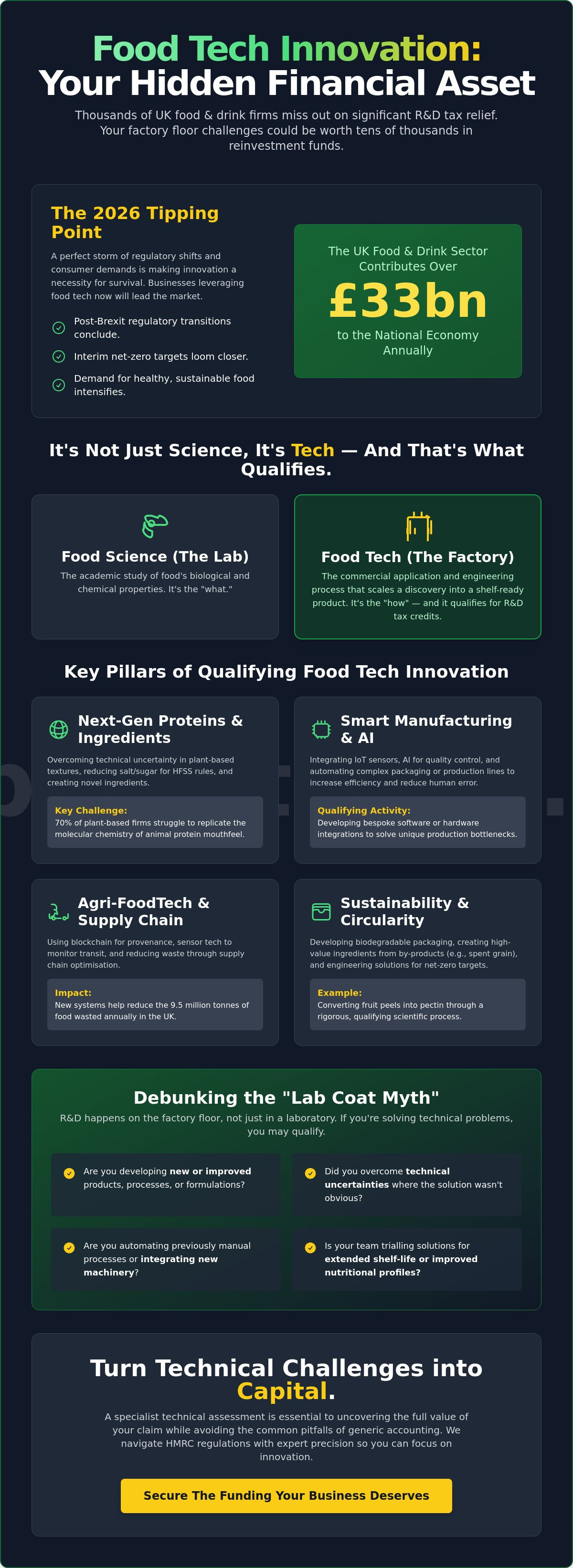
Identifying R&D in Food Tech: What Qualifies for Tax Relief?
The biggest hurdle many UK food businesses face isn't a lack of innovation, it's a lack of recognition. A pervasive misconception exists that research and development only happens in sterile laboratories where people wear white lab coats and peer into microscopes. In the world of food tech, the reality is far more practical. If your team is on the factory floor trying to stop a new gluten-free dough from sticking to the rollers, or experimenting with natural preservatives to extend shelf life without changing flavour, you're likely performing R&D.
HMRC defines R&D as a project that seeks to achieve an advance in science or technology through the resolution of scientific or technical uncertainty. This doesn't include "standard industry practice," which covers routine tweaks or using established recipes. To qualify, your team must be pushing beyond what's already known or publicly available in the industry. You're looking for a solution that isn't immediately obvious to a competent professional in the field.
Interestingly, failed projects often provide the most robust evidence for a claim. If you spent £40,000 on trials for a plant-based protein that ultimately failed to hold its structure during the extrusion process, that failure proves the technical uncertainty existed. It demonstrates that the answer wasn't easy to find, making the associated costs eligible for tax relief. We view these "failures" as vital stepping stones that generate money for reinvestment into your next successful breakthrough.
Resolving Technical Uncertainties
Technical challenges often arise when moving from a concept to a commercial reality. Scaling a recipe from a 5-litre kitchen pot to a 1,000-litre industrial vat isn't just a matter of multiplying ingredients; it involves complex changes in heat transfer, pH stability, and ingredient interaction. Similarly, developing sustainable packaging that maintains a barrier against oxygen and moisture involves significant trial and error. If the solution wasn't obvious to a competent professional, it is likely R&D.
Beyond the Kitchen: Qualifying Expenditure
When we help businesses identify qualifying costs, we look far beyond the R&D director's salary. Innovation is a collaborative effort that draws on various resources across your organisation. Qualifying expenditure typically includes:
- Staff costs: This includes a proportion of salaries, NI, and pension contributions for chefs, food scientists, and production engineers involved in testing.
- Consumables: The raw ingredients, water, and energy used specifically during the testing and trial phases that cannot be sold as a finished product.
- Software and Subscriptions: Costs for specialised design or modelling software used to simulate food processing environments.
Navigating these categories requires precision to ensure your claim stands up to HMRC scrutiny. Refer to our guide on R&D Tax Credit Specialists UK for compliance advice. We focus on transforming these complex technical details into a seamless financial recovery for your business.
Real-World Examples of Food Tech Innovation
UK food tech companies are solving complex biological and mechanical puzzles every day. These aren't just minor recipe tweaks; they're significant scientific advancements that qualify for R&D tax relief. One mid-sized producer successfully replaced synthetic nitrates in cured meats using celery-based extracts, extending shelf life by 14 days whilst maintaining the deep red colour consumers expect. This required extensive stability testing to ensure the product remained safe from botulism without traditional chemicals.
Water scarcity is another driver for innovation. A major vegetable processor in East Anglia recently reduced its water consumption by 42% by developing a proprietary closed-loop filtration system. This system recycled 1.2 million litres of wash-water annually, overcoming the technical challenge of removing soil and pathogens without affecting the vegetable's cellular structure.
The allergen-free market provides a fertile ground for food tech breakthroughs. Creating a gluten-free loaf that mimics the elasticity and crumb of wheat bread is a feat of molecular chemistry. Manufacturers are now using pea protein texturisation and novel enzyme blends to create plant-based alternatives that behave like traditional ingredients under high heat. Similarly, vertical farming firms in London are using tailored LED light spectrums to grow herbs with 95% less water than field-grown crops, effectively cutting out the 1,000-mile transport chain from southern Europe and reducing carbon emissions by 60% per kilogram of produce.
Sustainable Packaging Innovations
Moving away from single-use plastics involves overcoming massive technical barriers regarding barrier integrity. Compostable materials often fail to provide the oxygen and moisture resistance needed for a 12-day shelf life. Developing a bio-polymer that survives the rigours of a chilled supply chain without degrading prematurely is a classic R&D activity. If you're modifying your facility to house these new production lines, you might find overlaps with construction r&d tax relief for factory-specific structural improvements.
Process Automation and Robotics
Robotics are no longer limited to heavy lifting. Modern "soft-touch" grippers allow for the automated picking of delicate berries or the precise folding of puff pastry without bruising. Integrating AI for real-time quality control helps identify defects at speeds of 500 units per minute, far exceeding human capability. It's vital to document these projects carefully, as there are specific hmrc ai r&d claims challenges that require expert handling to ensure your automated systems are recognised as genuine innovation.
Innovation pays dividends for your bottom line and the planet. Discover how your technical challenges translate into money for reinvestment.
Maximising Your Food Tech R&D Claim with Recoup Capital
Generalist accountants often struggle to identify the specific scientific challenges that qualify for tax relief in the food sector. They might see a new product launch as a standard commercial exercise rather than a series of technical hurdles. This perspective often leads to missed opportunities. At Recoup Capital, we recognise that food tech innovation involves complex variables like microbial stability, rheological properties, and enzyme activity. These aren't just line items; they're the engine of your claim.
Our process starts with a deep technical assessment before we even look at your financial records. This ensures that every qualifying pound is captured from the outset. By leading with science, we build a claim that reflects the true scale of your experimentation. We transform your tax relief into strategic money for reinvestment, helping you bridge the financial gap between a successful prototype and a market-ready product.
HMRC's scrutiny of R&D claims has intensified, with compliance checks becoming more frequent across all sectors. We protect your business through robust, evidence-based technical reports that stand up to the most rigorous inspections. We don't just submit numbers; we provide the narrative that justifies them, significantly reducing the risk of time-consuming enquiries that could distract your team from their core work.
The Recoup Methodology: Expert Guidance
Our specialists speak the language of food science and corporate finance fluently. We don't rely on guesswork. We identify hidden costs in your supply chain, such as wasted raw materials during trial runs or bespoke software developed for production line automation. Whilst we maximise your claim, we maintain total compliance with the latest HMRC guidelines. Our team also offers corporate finance services to help you integrate this recovered capital into a long-term growth strategy that scales your operations effectively.
Partnering for Future Innovation
We operate under a "Today’s adviser, tomorrow’s partner" philosophy. This means we don't just show up once a year to process paperwork. We encourage a culture of innovation through regular R&D reviews, helping you track qualifying projects as they happen. This proactive approach ensures that your documentation is always ready and your food tech potential is never diluted by forgotten details. By turning tax credits into a predictable revenue stream, we empower you to take bolder risks in the development lab.
Turn Your Food Tech Breakthroughs into Working Capital
The UK food tech sector is a powerhouse of R&D, where solving technical uncertainties in shelf-life or sustainable packaging creates real commercial value. HMRC’s 2023 statistics reveal that the manufacturing sector, which encompasses much of the food industry, claimed over £1.4 billion in R&D tax relief, yet many businesses still overlook their eligibility. Your daily problem-solving isn't just part of the job; it's qualifying innovation that can be transformed into money for reinvestment. We help you identify these hidden costs and navigate the complexities of the tax system without the stress of a traditional sales pitch.
Recoup Capital provides a team of specialist tax accountants and industry experts who deliver HMRC-compliant technical reporting. Our success-based fee structure ensures our goals are perfectly aligned with your growth. We’ve streamlined the process to be seamless, allowing you to focus on your laboratory or production line whilst we handle the paperwork. It’s about more than a refund; it’s about securing the capital needed to stay competitive in a demanding market.
Start your journey toward financial recovery today. Claim your R&D tax credits with Recoup Capital and book your FREE 15 minute consultation. We’re ready to be today’s adviser and tomorrow’s partner for your business.
Frequently Asked Questions
What exactly is considered "food tech" for R&D tax purposes?
Food tech for R&D purposes involves applying science and engineering to overcome technical uncertainties in food production, processing, or preservation. It's not about standard recipe development; it's about solving problems where the solution isn't readily available. HMRC guidelines updated in April 2023 specify that this includes creating new textures, extending shelf life through chemical innovation, or developing bespoke machinery to reduce waste.
Can a small catering business claim R&D tax credits for new recipes?
New recipes rarely qualify for tax credits unless they involve a genuine scientific advancement or the resolution of a technical uncertainty. If your catering business is developing a gluten-free pastry that must maintain structural integrity under specific industrial heat conditions, you might have a claim. Standard culinary experimentation doesn't count, but 90% of successful food tech claims involve overcoming physical or chemical hurdles that a competent professional couldn't easily solve.
What are some examples of qualifying food tech projects?
Qualifying projects often focus on sustainability, nutrition, or manufacturing efficiency. Examples include developing plant-based protein alternatives with specific mouthfeel, creating biodegradable packaging that interacts with food enzymes, or engineering new fermentation processes. In 2022, UK firms claimed over £7.6 billion in R&D tax relief, with food manufacturing representing a growing portion of these technical innovations.
How much can a food tech company claim back through R&D tax relief?
For accounting periods starting after 1 April 2024, the merged R&D Expenditure Credit (RDEC) offers a taxable credit of 20% on qualifying expenditure. This results in a net benefit of approximately 15% to 16.2% for most companies. This capital provides vital money for reinvestment, allowing your business to fund its next phase of food tech innovation without relying on external debt or traditional bank loans.
What costs can I include in my food tech R&D claim?
You can include staff gross salaries, employer NI, and pension contributions for those directly involved in the project. Consumables used during the R&D process, such as ingredients for failed batches or specific heat and light costs, are also eligible. Since April 2023, data licence costs and cloud computing expenses related to your development are officially recognised as qualifying expenditures by HMRC.
Do I need a lab to be eligible for food tech tax credits?
You don't need a formal laboratory to qualify for R&D tax credits. Innovation often happens on the factory floor or in a test kitchen where technical trials take place. As long as you're documenting the systematic process of overcoming technical challenges, the physical location is secondary. Over 65% of our successful claims come from businesses that conduct their R&D within their standard production environments.
How far back can I claim for food tech innovation?
You can typically claim for your two previous completed accounting periods. This means if your financial year ends on 31 December, you have until 31 December 2024 to submit a claim for the period ending in 2022. This window is a strict statutory limit set by HMRC, so acting quickly ensures you don't lose out on capital that belongs back in your business.
What happens if my food tech project failed to reach the market?
You can still claim R&D tax credits even if your project was a commercial failure. HMRC rewards the attempt to innovate and the resolution of technical uncertainty, not the final sales figures. If you spent £40,000 trying to develop a shelf-stable probiotic drink but couldn't achieve the necessary bacterial stability, those costs remain eligible for relief. Failure is often the clearest proof that a technical uncertainty existed.