
R&D Meaning: A Comprehensive Guide for UK Limited Companies in 2026

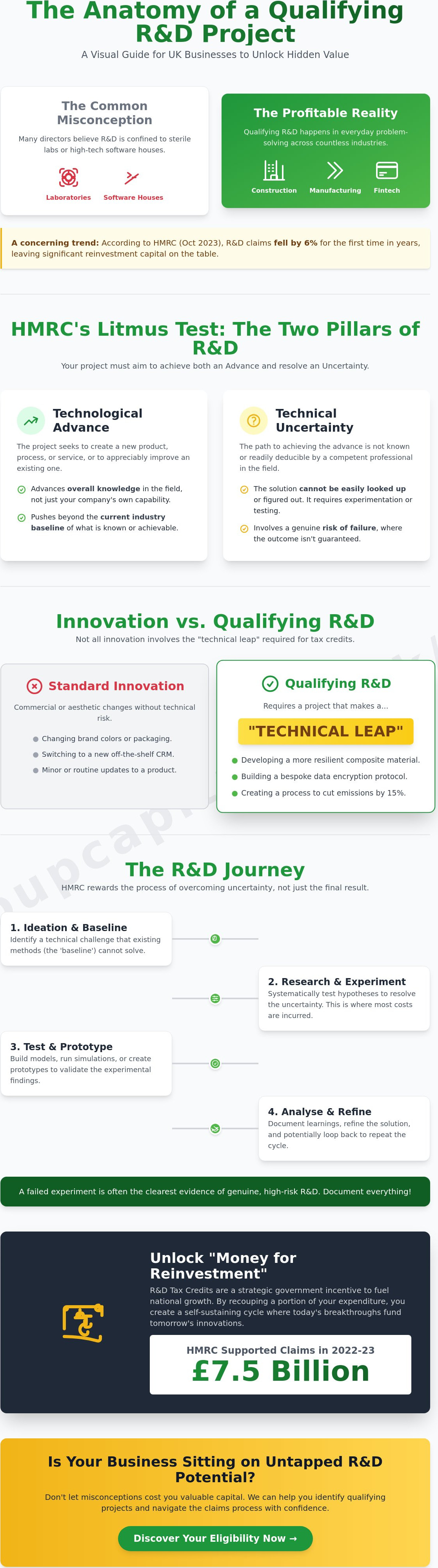
According to HMRC’s October 2023 report, the number of R&D tax credit claims fell by 6% for the first time in years, even though thousands of UK limited companies continue to solve complex technical problems every day. Most directors believe that the r and d meaning is strictly confined to sterile laboratories or high-tech software houses. It's a common misconception that leaves significant money for reinvestment sitting on the table. You might feel your business is simply "doing its job" rather than innovating, whilst worrying that a claim could trigger unwanted scrutiny.
We understand that the boundary between standard commercial activity and qualifying research often feels blurred. This guide provides a clear, actionable breakdown of the r and d meaning for tax purposes in 2026. You’ll learn how to identify hidden innovation within your existing projects and gain the confidence to explore the tax relief you've earned. We will examine the specific criteria used to define a technological uncertainty and show you how to turn your everyday problem-solving into a strategic financial asset.
Key Takeaways
- Understand the commercial r and d meaning to distinguish between standard business development and the pursuit of genuine scientific or technological advances.
- Learn how to navigate HMRC’s specific criteria by identifying technical uncertainties that push beyond the current industry baseline.
- Discover why innovation is not limited to laboratories and how to spot qualifying activities within your daily operations and unlikely sectors.
- Master the project lifecycle from ideation to testing to ensure your efforts are structured to maximise your potential for financial recovery.
- Explore how unlocking the value of your innovation provides a vital risk buffer, turning tax credits into essential capital for future reinvestment.
What is R&D? Defining Research and Development for UK Business
Understanding the r and d meaning starts with stripping away the jargon. For a UK limited company, Research and Development isn't confined to sterile laboratories or pharmaceutical giants. It's the purposeful pursuit of new knowledge or the creation of significantly improved products, processes, and services. Whether you're a construction firm developing a more resilient composite material or a fintech startup building a bespoke encryption protocol, you're engaging in R&D. It's about moving beyond what's currently achievable in your industry.
There's a vital distinction between academic research and commercial development. Whilst universities often seek knowledge for the sake of discovery, businesses focus on the practical application of that knowledge to gain a competitive edge. Broadly speaking, Research and development includes any activity that seeks to resolve a scientific or technical uncertainty. If your team is facing a problem where the solution isn't readily available or obvious to a competent professional in the field, you've likely found an R&D project.
The UK government prioritises these activities because they're the engine room of the economy. According to HMRC data released in late 2024, R&D tax relief supported over £7.5 billion in claims for the 2022-23 period. This isn't just a handout; it's a strategic incentive designed to drive national growth. At Recoup Capital, we view these incentives as "money for reinvestment." By recouping a portion of your expenditure, you create a self-sustaining cycle where today's breakthroughs fund tomorrow's innovations.
The Basic vs. Applied Research Distinction
Basic research involves acquiring new knowledge without a specific commercial application in mind. It's the "why" behind the science. Conversely, applied research focuses on solving specific, practical problems for commercial gain. Most UK limited companies spend their time in the "Development" phase. This means taking existing scientific principles and applying them to create something tangible, like a software platform that processes 30% more data than current industry standards or a manufacturing process that cuts carbon emissions by 15%.
Innovation vs. R&D: Why the Difference Matters
Every R&D project is an innovation, but not every innovation qualifies as R&D in the eyes of the taxman. Innovation can be aesthetic or administrative; changing your brand's colour palette or switching to a new CRM system is innovative, but it doesn't involve technical risk. R&D requires a "technical leap." If your project involves a high degree of uncertainty where the outcome isn't guaranteed, it likely qualifies. This inherent risk is exactly why R&D tax credits explained as a primary reward are so essential. They help mitigate the financial sting of projects that don't always go to plan, allowing your business to remain bold and proactive.
The Core Components of a Research and Development Project
Grasping the true r and d meaning requires looking past the finished product to the messy, iterative process that created it. You aren't just claiming for a "new idea". You're claiming for the resolution of technical uncertainty. This begins with identifying the "Baseline". This is the current level of scientific or technological knowledge available to a competent professional in your industry. If the solution is already common knowledge or easily accessible, it won't qualify for tax relief.
According to HMRC’s definition of R&D, your project must aim to achieve an advance in overall knowledge, not just your company's own internal capability. This is why documenting the "process" is more vital than the "result". HMRC values the journey. If you spent 250 hours testing a material that ultimately melted, those costs are often eligible. In the eyes of the taxman, a failed experiment is often the clearest evidence that a project was genuinely risky and innovative.
The R&D Cycle: A Four-Stage Framework
Most successful claims follow a logical progression. It's rarely a straight line from A to B. Instead, it's a cycle of testing and refinement that proves you're pushing boundaries.
- Stage 1: Ideation. You identify a technical challenge that existing methods or tools cannot solve.
- Stage 2: Feasibility. Your team conducts theoretical exploration and studies to see if a solution is even possible.
- Stage 3: Prototyping. This is where the bulk of the work happens. You build, trial, and often hit "dead ends" that require a complete rethink.
- Stage 4: Resolution. You either finalise the solution or reach a technical "no-go" point where the challenge remains unsolved.
Who Performs R&D? Roles Beyond the Scientist
R&D isn't confined to laboratories. It's a collaborative effort across your entire business. While software developers and engineers lead the way, project managers and shop-floor staff are equally vital. In 2025, data showed that 45% of technical uncertainties were first identified by staff working directly on the production line. They see the practical limitations of current technology first-hand.
When these individuals collaborate to overcome a hurdle, they're performing R&D. Understanding this broader r and d meaning helps ensure you don't leave money on the table. If you're curious about how your team's daily troubleshooting fits this criteria, exploring how these credits work can reveal significant opportunities for reinvestment. Every hour spent by your technical leads on these challenges contributes to your claim's value.
HMRC’s Specific R&D Meaning: Advance and Uncertainty
HMRC doesn't rely on a dictionary to define innovation. Instead, they use the Department for Business, Innovation and Skills (BIS) guidelines as their primary framework. This standard remains the benchmark for every claim processed in the UK. To qualify, your project must seek an advance in science or technology by resolving a technological uncertainty. This is a higher bar than simply being "new" to your business; it must be a challenge for the industry at large.
A common hurdle for many directors is the belief that "normal work" cannot be R&D. If your team is solving problems that haven't been solved before, it likely qualifies. The official HMRC definition of R&D relies heavily on the "competent professional" test. This means an expert in your field, such as a lead engineer or senior developer, must agree that the solution wasn't obvious. If your specialist had to conduct trials, build prototypes, or fail multiple times, you've moved past standard practice and should consider claiming R&D tax credits to recover those costs.
Seeking a Technological Advance
Proving an advance requires showing that your project aimed to create a new process or improve an existing one significantly. You aren't just looking for a change in appearance. HMRC requires an "appreciable" improvement, which generally means a measurable increase in performance, reliability, or efficiency that exceeds current industry standards. A Technological Advance is a jump in capability that wasn't previously available to the sector. This means the r and d meaning involves pushing the boundaries of what is possible within your specific industry, not just within your own office walls.
Resolving Technological Uncertainty
Uncertainty exists when the knowledge of whether something is scientifically possible or technologically feasible isn't publicly available. You might face "component uncertainty," where you don't know if a specific part will work, or "system uncertainty," where individual parts work but their integration creates new, complex problems. In 2026, documenting these hurdles is more critical than ever. Recent HMRC AI R&D claims challenges show that automated scrutiny is increasing, making it vital to record every failed iteration and technical dead end. If you can honestly say, "we don't know if this will work," you've found the strongest indicator of a qualifying project under the r and d meaning established by the tax office.
R&D in Practice: Industry-Specific Meaning and Examples
The "lab coat" myth persists, yet it's often far from the reality of British industry. In 2026, the r and d meaning encompasses any project where a company seeks to overcome a technical uncertainty that isn't readily resolvable by a competent professional. You don't need a dedicated research department to qualify. Instead, look at your daily operations. If your engineers or developers are spending time trial-testing solutions because the "standard practice" failed, you're likely innovating. Digital transformation has accelerated this shift. For SMEs in 2026, R&D isn't a separate silo; it's the iterative process of staying competitive. Spotting it requires a shift in perspective. If your team is asking "how can we make this work?" rather than "which manual do we follow?", you've found an R&D project.R&D in Construction and Engineering
Construction firms often overlook R&D because they view it as "just part of the job." However, creating bespoke materials to meet the UK's 2026 sustainability targets or solving unique ground-condition problems qualifies. For instance, if a project requires novel engineering to support a structure on unstable soil where traditional methods aren't viable, the costs associated with that design phase are eligible. You can explore these nuances further in our guide to Construction R&D Tax Relief.R&D in Software and Digital Technology
The digital landscape in 2026 is dominated by AI integration. It isn't enough to simply use an API; R&D occurs when you're pushing machine learning models beyond their standard parameters or integrating legacy systems that were never designed to communicate. If your team is building new algorithms to handle data throughput at a scale previously thought impossible, that's a clear advancement in the field. The r and d meaning here is found in the code that fails before it finally succeeds.R&D in Food Tech and Manufacturing
Food manufacturers face constant pressure to reformulate products. Reducing sugar or salt whilst maintaining a 12-month shelf life often requires significant experimentation. Similarly, adapting 20-year-old machinery to handle new, eco-friendly packaging materials involves technical hurdles that qualify as R&D. It's about the process of trial and error to achieve a result that isn't guaranteed from the start. Whether it's reducing waste by 15% through a new process or repurposing equipment for a novel function, these are claimable activities. Understanding these sector nuances is the first step toward reclaiming your investment. Don't leave your capital on the table. Book your free 15-minute consultationUnlocking Value: Why Understanding R&D Meaning Leads to Growth
Grasping the technical r and d meaning isn't just a glossary exercise for directors. It is the fundamental first step toward reclaiming significant capital that often sits hidden in your profit and loss statements. For UK limited companies, identifying these activities allows you to begin claiming R&D tax credits, a process that transforms technical challenges into tangible cash flow. This incentive acts as a vital risk buffer. By subsidising a portion of your development costs, the government encourages you to take the technical leaps that your competitors might avoid.
In 2026, the landscape of HMRC compliance is more rigorous than ever. Following the major structural changes to the scheme in April 2024, the tax office now requires granular evidence for every claim. Understanding the r and d meaning in this modern context ensures your business remains compliant whilst maximising its entitlement. To begin your own internal audit, look for "hidden" innovation in these areas:
- Internal software tools developed to solve unique logistics bottlenecks.
- Prototyping new materials to meet 2026 environmental sustainability standards.
- Iterative testing to improve the shelf-life or durability of a physical product.
- Scaling a manufacturing process that has never been performed at that volume before.
The Strategic Value of R&D Tax Relief
Successful claims provide vital money for reinvestment that can be channelled directly back into your most expensive assets: your staff and your equipment. Many firms find these credits more valuable than traditional grants. Grants are often restrictive, competitive, and require exhaustive applications before work even begins. In contrast, R&D tax relief is a statutory right for work you have already completed. It fosters an innovation-first culture within your team. When engineers and developers know that the financial risk of failure is mitigated by tax relief, they're more likely to pursue the "impossible" breakthroughs that lead to market leadership.
Starting Your Journey with Recoup Capital
We pride ourselves on being the expert friend to UK businesses. Our approach isn't about delivering a high-pressure sales pitch; it's about demonstrating value through results. We focus on your bottom line, ensuring that the complexities of the 2026 tax code don't stand in the way of your growth. Our process starts with a seamless 15-minute consultation. In this brief window, we can usually determine your eligibility and estimate the potential scale of your recovery without wasting your afternoon.
Our success-based fees ensure that our goals are perfectly aligned with your financial recovery. We handle the heavy lifting of the technical narrative and the Additional Information Form (AIF) requirements, letting you focus on running your business. Book your free 15-minute consultation today to see how much capital your innovation could unlock.
Transforming Your Innovation into Reinvestment Capital
Mastering the r and d meaning ensures your business doesn't leave vital capital on the table. HMRC's 2026 guidelines focus strictly on projects that resolve technical uncertainties or achieve a genuine scientific or technological advancement. Whether you're developing bespoke software in the tech sector or solving complex structural challenges on a construction site, these innovations represent significant money for reinvestment. Our specialist team of chartered tax accountants has a proven track record of securing results for UK companies across the engineering and technology landscapes. We operate on success-based fees, which means we only win when you do. It's about turning your past technical hurdles into your future growth engine. Don't let complex legislation stop you from claiming what your business has earned through its hard work and ingenuity.
We've facilitated significant capital for our clients by navigating the intricate details of tax law with professional clarity. Our approach is built on transparency and results rather than aggressive sales pitches. We act as your expert friend, handling the paperwork while you focus on what you do best. Let's explore how your recent projects align with current regulations to help your business thrive in an increasingly competitive market.
Discover if your innovation qualifies for a tax refund with a free 15-minute consultation
We're here to make the complex simple and the rewarding accessible. Today's adviser, tomorrow's partner.
Frequently Asked Questions
What is the simplest definition of R&D for a UK business?
The simplest definition of R&D for a UK business is a project that seeks to achieve an advance in science or technology by resolving a specific uncertainty. It isn't just about lab coats and test tubes; it's about any work where the solution wasn't immediately obvious to a competent professional. If your team had to experiment or iterate to overcome a technical hurdle, you've likely engaged in R&D.
Does our business need a laboratory to qualify for R&D tax credits?
No, your business doesn't need a laboratory or specialised research facility to qualify for tax relief. Innovation happens on construction sites, in commercial kitchens, and across digital workspaces every day. HMRC statistics from 2023 show that sectors like manufacturing and construction accounted for over 25% of all claims, proving that practical, "on-the-job" problem solving is just as valid as clinical research.
Can we claim R&D if our project was a technical failure?
Yes, technical failure is often the strongest evidence that a project meets the r and d meaning for tax purposes. HMRC recognises that if a solution was easy to find, it wouldn't involve the "uncertainty" required for a successful claim. If your team spent 6 months trying to develop a new composite material only to find it wasn't viable, those costs remain eligible for relief as money for reinvestment.
What are the four main criteria HMRC uses to define R&D?
HMRC evaluates R&D based on four specific pillars: the project must seek an advance in science or technology, involve a scientific or technological uncertainty, be performed by a competent professional, and not be easily deducible by another expert. These guidelines are set out in the Department for Science, Innovation and Technology (DSIT) 2023 regulations. We help you document these hurdles to transform your technical challenges into financial growth.
Is software development considered R&D under current UK rules?
Software development is one of the most common areas for R&D claims, provided it goes beyond standard coding or using existing libraries. If your developers are creating new algorithms or integrating legacy systems in a way that hasn't been done before, it likely qualifies. As of 1 April 2023, HMRC expanded eligible costs to include data licences and cloud computing expenses, making these claims even more valuable for tech firms.
How far back can a company go when identifying R&D projects for a claim?
You can typically claim for your two most recently completed accounting periods. This means if your current financial year ends on 31 December 2026, you can still submit a claim for the periods ending in 2025 and 2024. It's a strict two-year window from the end of the accounting period; acting quickly ensures you don't leave significant capital on the table that could thrive elsewhere in your business.
What is the difference between an R&D project and standard commercial work?
The core r and d meaning hinges on whether you're using existing knowledge or pushing technical boundaries. Standard commercial work involves using "off-the-shelf" solutions or established best practices to deliver a product. R&D starts when those standard methods fail. If your engineers have to invent a new process because the industry standard can't meet a specific performance requirement, that's where the R&D begins.
How much can a UK SME typically expect to receive from an R&D claim?
Under the merged R&D Expenditure Credit (RDEC) scheme introduced for accounting periods starting on or after 1 April 2024, the net benefit is approximately 15% to 16.2% of eligible expenditure. For a company spending £100,000 on qualifying staff and materials, this results in over £15,000 for reinvestment. R&D intensive SMEs, those spending 30% of total expenditure on R&D, may access a higher credit rate of 27%.