
How to Write an R&D Technical Narrative: A 2026 Compliance Guide

A successful R&D technical narrative isn't actually a success story; it's a meticulous map of technical uncertainty and the specific path your team took to resolve it. You've likely spent hours trying to figure out how to write an R&D technical narrative that doesn't just sound like your team's day-to-day work. It's frustrating when genuine innovation feels buried under the weight of HMRC’s latest compliance standards and the constant pressure of potential enquiries. We understand that separating commercial innovation from a true technical advance is often the most difficult part of the process.
In this guide, we'll help you master the art of documenting innovation to secure your tax credit claim whilst satisfying the 2026 legislative criteria. You'll learn how to navigate the single merged scheme and the 30% intensity threshold for SMEs with total confidence. We're providing a clear template for your project write-ups to ensure you maximise your claim value and turn that relief into vital money for reinvestment. Let's look at how to build a narrative that stands up to scrutiny and protects your business's future growth.
Key Takeaways
- Understand how the mandatory Additional Information Form (AIF) has transformed the qualitative narrative into the most critical component of your 2026 HMRC submission.
- Master how to write an R&D technical narrative by establishing a clear technical baseline and articulating the specific scientific uncertainties your team sought to overcome.
- Learn how to create a seamless link between your technical challenges and financial expenditure to ensure your claim value is fully supported and defensible.
- Apply a structured five-part framework to your project write-ups to ensure your documentation aligns perfectly with current legislative criteria and HMRC expectations.
- Discover why a professional "tax lens" review is essential for identifying red-flag phrasing that could otherwise trigger time-consuming compliance enquiries.
Understanding the Role of the Technical Narrative in 2026 HMRC Submissions
The technical narrative is the qualitative backbone of your R&D tax credit claim. While your spreadsheet tells HMRC how much you spent, the narrative explains exactly why that expenditure qualifies under the law. It's the primary piece of evidence that translates complex engineering or software development into the specific language of "scientific or technological advance" and "uncertainty." Without a precise narrative, your claim is just a collection of figures without a legal foundation. It must bridge the gap between technical reality and tax legislation; showing that your work wasn't just difficult, but technically uncertain according to the latest standards.
Since the introduction of the mandatory Additional Information Form (AIF), the stakes have changed. This digital submission must be completed before or at the same time as your Company Tax Return (CT600). It's no longer enough to have a generic project report sitting in a drawer. HMRC uses the AIF to pre-screen claims; if the narrative doesn't clearly articulate the technical challenges, the risk of a formal enquiry increases significantly. Learning how to write an R&D technical narrative that meets these digital-first standards is now a core requirement for any innovative UK business seeking to protect its claim.
The Shift Toward Digital-First Compliance
The 2026 compliance landscape is defined by the integration of the AIF within the wider CT600 process. HMRC now requires specific digital summaries for each project, and these summaries must map directly to the legislative criteria. Standard internal project reports often fail because they focus on commercial success rather than technical failure or uncertainty. Additionally, every narrative now requires a named "Senior Officer" within the company to sign off on the technical accuracy. This adds a layer of personal accountability, ensuring that the innovation described is a true reflection of the work performed and the costs incurred.
Why Your Narrative is the Key to Reinvestment
A robust, well-structured narrative does more than just satisfy a tax inspector; it accelerates the entire claim process. When your documentation is "HMRC-ready," it moves through the system with fewer friction points, meaning you receive your money for reinvestment much faster. In a climate where HMRC compliance checks have become standard practice, a narrative that proactively answers potential questions is your best defence. It protects the value of your claim and ensures that the financial recovery you've earned stays in your business to fuel future growth. By mastering how to write an R&D technical narrative, you turn a complex compliance task into a strategic advantage for your company's bottom line.
Defining 'Advance' and 'Uncertainty': The Core of Your Narrative
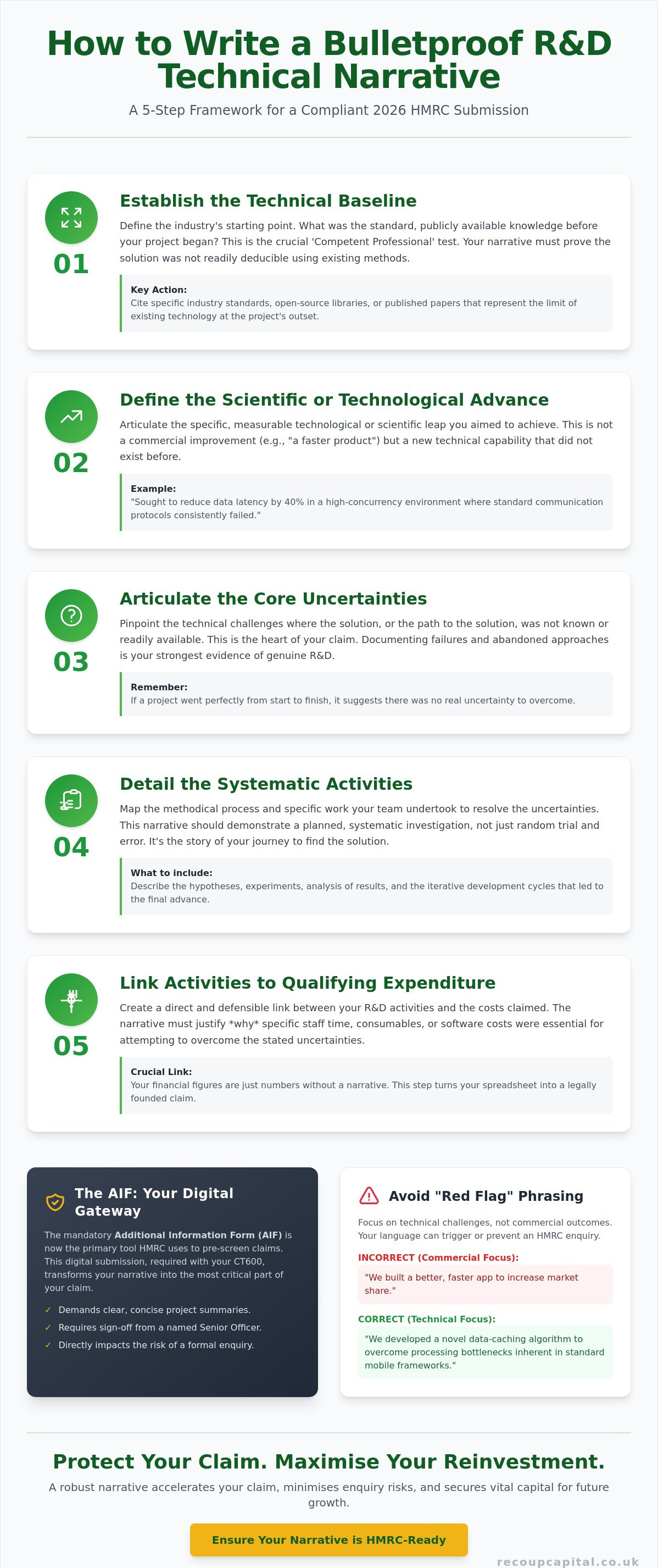
HMRC doesn't reward you for the complexity of your project; they reward you for the technical "delta" between the industry's starting point and your final achievement. To master how to write an R&D technical narrative, you must first define the baseline of existing knowledge. This is the "Competent Professional" test. If a skilled person in your field could have looked at the problem and solved it using standard, publicly available methods, it isn't R&D. Your narrative needs to prove that the solution was not readily deducible. It should demonstrate that even with your team's expertise, the path forward remained scientifically or technologically unclear.
The technical advance is the specific capability you sought that did not exist before you started. It isn't enough to say you built a better app or a faster engine. You must describe the specific technological improvement, such as reducing latency by 40% in a high-concurrency environment where standard protocols failed. This is why technical failure is often your best evidence. A project that went perfectly from start to finish rarely qualifies as R&D because it suggests there was no real uncertainty. Documenting the moments where things went wrong proves that you were operating at the edge of known technology.
The 'Baseline' vs. Your Innovation
Defining your baseline sets the stage for the entire claim. You should research and cite specific industry standards, open-source libraries, or white papers that represent the state of the art at the time. For example: "The industry baseline for this process relied on manual thermal regulation, which lacked the precision required for sub-zero chemical stability." By clearly stating where standard practice ends, you make it easy for an HMRC inspector to see where your R&D begins. If you're unsure if your starting point counts as a baseline, you can check our FAQs for more clarity on industry standards.
Documenting Technical Uncertainty and Failure
HMRC looks for unpredictability rather than just difficulty. A difficult task can be completed with enough time and money, but an uncertain task might never be solved. When claiming R&D tax credits, you must describe the dead ends, failed prototypes, and abandoned methodologies that occurred along the way. These "failures" are the qualitative proof that you faced genuine technical uncertainty. Don't shy away from explaining why a specific trial didn't work; it's this trial-and-error process that defines qualifying R&D activity. A robust narrative treats every failed iteration as a vital data point in the quest for a technical advance.
Bridging the Gap: Marrying Technical Innovation with Financial Expenditure
A common mistake in R&D submissions is treating the technical narrative and the financial spreadsheet as two unrelated documents. To satisfy HMRC's 2026 compliance standards, your narrative must act as the "connective tissue" that justifies every penny claimed. When considering how to write an R&D technical narrative, you must explicitly link specific technical uncertainties to the staff hours and resources consumed. If your narrative describes a breakthrough in thermal efficiency, your financial data should reflect the exact trial-and-error costs associated with that specific challenge. This level of granular cross-referencing makes it significantly harder for an inspector to challenge the validity of your expenditure.
Distinguishing between "Directly Contributed" and "Indirectly Contributing" activities is vital for a clean claim. Direct activities involve the actual resolution of technical uncertainty, such as coding a new algorithm or testing a prototype. Indirect activities, such as maintenance, security, or general administration, are generally excluded under the latest rules. Your narrative should focus heavily on the former. You must also justify consumable expenditure; if you used specific materials or power during technical trials, the narrative needs to explain why these were necessary to resolve the uncertainty and how they were transformed or "used up" during the process.
Staff Roles and Technical Contribution
HMRC requires a clear understanding of who did what. Your narrative should distinguish between a "Technical Lead," who defines the R&D strategy and navigates the uncertainties, and "Support Staff," who might perform testing or data collection under direction. It's essential to document the percentage of time each individual spent on R&D versus their routine commercial work. This distinction ensures your claim aligns with the R&D tax credits explained framework, which requires a rigorous allocation of qualifying time. Clear role descriptions prevent HMRC from assuming that staff costs were simply "guessed" or averaged across the department.
Subcontractors and External Expertise
Writing about outsourced work requires a careful balance. You must prove that your company directed the R&D and retained the technical risk, even if you didn't write every line of code yourself. Under the overseas expenditure rules effective from 1 April 2024, most costs for R&D conducted outside the UK are now excluded, making it even more important to document the UK-based direction of your projects. If your R&D involved significant physical asset modification or the creation of specialized machinery, you might also need to consider how these costs interact with capital allowances. A well-organised narrative ensures that your financial breakdown in the CT600 is fully supported by qualitative evidence, protecting your reinvestment capital from enquiry.
A Step-by-Step Framework for Drafting Project Write-Ups
HMRC's digital-first approach means brevity and precision are your best friends. You don't need to document every minor fix or routine update. Instead, identify the one to three projects that best represent your overall R&D effort for the year. These should be the projects where your team spent the most time wrestling with technical barriers. When considering how to write an R&D technical narrative, focus on technical verbs like "reconfigured," "tested," or "optimised." Avoid marketing "puffery" like "innovative" or "world-leading." HMRC wants to see the mechanics of your work, not a sales pitch. Ensure your narrative covers the exact dates of the accounting period in question; work performed outside these dates must be excluded to maintain compliance.
The 5-Part Project Structure
Structure each project using a consistent method to ensure no criteria are missed. First, define the Technical Objective; be specific about the goal, such as "achieving sub-10ms latency in a high-load environment." Second, establish the Baseline and Uncertainty by explaining why standard methods failed. Third, detail the Work Undertaken, focusing on the iterations and trials performed. Fourth, document the Resolution; even if the project failed, the outcome is vital evidence. Finally, articulate the Advance. This is the new technical capability your business now possesses that it didn't have before the project began.
Language and Tone: Layman vs. Specialist
Bridging the gap between a technical specialist and an HMRC inspector is a delicate balance. Use technical terminology where it's necessary for accuracy, but consider a "Glossary" technique for internal jargon. This prevents confusion and shows you've prepared your documentation with care. Always use British English spelling; words like "labour" and "programme" maintain a local compliance feel. By keeping the tone professional yet accessible, you make it easier for the inspector to approve your claim without asking for further clarification. If you want to ensure your documentation is robust enough to withstand scrutiny, you should understand why claim quality matters for your long-term relationship with HMRC.
Remember that the Claim Notification deadline is now just six months after your accounting period ends. This means your technical narratives should be drafted or at least outlined well before the final two-year filing deadline. Proactive documentation prevents the rush that often leads to poor wording and increased enquiry risk. By following this structured framework, you turn a potentially intimidating drafting process into a seamless part of your annual financial cycle.
Beyond the Draft: Why Professional Review Minimises Enquiry Risks
Even the most brilliant engineering teams can struggle to translate their technical breakthroughs into a format that satisfies a tax inspector. Understanding how to write an R&D technical narrative is only the first step. The real challenge lies in applying a forensic "tax lens" to your draft to ensure it doesn't inadvertently trigger a compliance check. Forensic tax specialists are trained to spot "red flag" phrases that suggest commercial activity rather than technical innovation. By refining your language, you move from simply filing a report to building a robust, enquiry-proof case for reinvestment. Learning how to write an R&D technical narrative that withstands this level of scrutiny is what separates a successful claim from a costly enquiry.
A partnership-led approach transforms this process from a stressful annual chore into a strategic advantage for your business. We don't just process paperwork; we help you identify the technical advances that fuel your growth. If you're unsure about the strength of your current documentation, a FREE 15 minute consultation can provide the clarity you need to move forward with confidence. We'll help you assess whether your narrative truly captures the technical uncertainties you've faced or if it leaves your business vulnerable to HMRC questioning.
The Risk of DIY Narratives
Writing your own narrative without expert oversight is a significant risk. One of the most common mistakes is over-claiming on commercial features like "improved user experience" instead of focusing on the underlying technical uncertainty. Inconsistent narratives are a primary cause of HMRC "Request for Information" (RFI) letters, which can delay your funding by months. You should also be aware of how modern tools impact your submission, as detailed in our guide on HMRC R&D Tax Claim Transparency and AI. A single poorly phrased sentence can lead to an enquiry that puts your entire claim at risk and drains your team's valuable time.
Recoup Capital: Your Partner in Compliant Innovation
Our success-based model means we're as invested in the accuracy of your narrative as you are. We only submit claims we're confident will stand up to scrutiny. Our team includes specialists who understand the nuances of construction R&D tax relief and complex engineering sectors. We bridge the gap between your technical reality and HMRC's strict criteria, ensuring your innovation is recognised and rewarded. We're here to help your business thrive by securing the capital it deserves. Today’s adviser, tomorrow’s partner.
Turning Technical Uncertainty into Strategic Reinvestment
Navigating the 2026 R&D landscape requires more than just technical expertise; it demands a forensic approach to documentation. By mastering the five-part framework and aligning your technical advances with financial data, you protect your claim from unnecessary HMRC enquiries. We've seen how the shift toward digital-first compliance via the Additional Information Form (AIF) makes the quality of your project write-ups more vital than ever before. Understanding how to write an R&D technical narrative is now a fundamental requirement for any business seeking to fuel its growth through tax relief.
You don't have to navigate these complexities alone. Our team of Chartered Tax Accountants and technical specialists understand the specific challenges within the construction, engineering, and tech sectors. We operate on a success-based fee model, ensuring our partnership is built on transparency and results. Book your FREE 15-minute consultation to review your R&D narrative and ensure your business gets the funding it deserves. Your innovation is the engine of your future success; let's make sure it's fully rewarded.
Frequently Asked Questions
How long should an R&D technical narrative be?
There is no fixed length, but HMRC's Additional Information Form (AIF) typically requires between 2,000 and 5,000 characters per project. You should focus on technical density rather than word count. A concise report that clearly articulates the baseline and uncertainty is far more effective than a lengthy document filled with commercial fluff. Aim to be as brief as possible whilst ensuring every legislative criterion is met.
Do I need to write a narrative for every single project?
No, you don't need to document every minor project, but you must cover a representative sample. HMRC usually requires details for at least three projects that account for a significant percentage of your qualifying expenditure. If you have fewer than three projects, you must describe all of them. This ensures the inspector understands the technical nature of your most substantial R&D investments and how they align with the 2026 rules.
What is the most common reason HMRC rejects a technical narrative?
The most common reason for rejection is failing to distinguish between "commercial difficulty" and "technical uncertainty." Many businesses focus on how hard it was to build a product rather than explaining why the solution wasn't readily deducible to a competent professional. If your narrative reads like a marketing brochure or a project management update, it's highly likely to trigger an enquiry or a claim rejection during the pre-screening phase.
Can I use AI to write my R&D technical narrative?
You can use AI as a drafting assistant, but it requires expert human oversight to ensure compliance. HMRC has increased scrutiny on AI-generated claims that lack specific technical depth or use generic phrasing. When considering how to write an R&D technical narrative, remember that AI often misses the nuances of scientific uncertainty. A specialist review is essential to ensure the final output aligns with the latest legislative standards and avoids red-flag terminology.
What is the difference between a technical report and the Additional Information Form (AIF)?
A technical report is your internal documentation, whereas the AIF is a mandatory digital summary submitted to HMRC. Since late 2023, the AIF has been the primary tool for pre-screening claims. While your internal report might contain hundreds of pages of data, the AIF requires you to condense that information into specific fields regarding technical advances and uncertainties to satisfy digital-first compliance checks before your CT600 is processed.
Should I include images or diagrams in my technical narrative?
You should keep your primary narrative text-based because the digital AIF portal has limited support for large attachments. While diagrams can help your internal understanding, the technical narrative must be strong enough to stand alone as a written explanation. If an inspector requests more detail during a formal enquiry, you can then provide supporting schematics or prototypes to illustrate the specific technical barriers you've already described in your text.
What happens if my R&D project was a total failure; can I still claim?
Yes, technical failure is actually one of the strongest indicators of qualifying R&D activity. HMRC rewards the attempt to resolve scientific or technological uncertainty, regardless of whether the project reached a successful commercial conclusion. Documenting your failed trials and abandoned prototypes provides qualitative proof that the solution was not "readily deducible." This is a core requirement for a successful claim and often makes for a more robust narrative than a perfect success story.
How far back can I go when writing narratives for a claim?
You can generally submit a claim for the two previous accounting periods. This means you must have your technical narratives and financial data prepared for projects that occurred within those specific windows. However, you must be mindful of the 2024 Claim Notification rule. If you're a first-time claimant, you must notify HMRC of your intent to claim within six months of the end of the accounting period to ensure your submission remains valid.