
Documentation Required for R&D Tax Claim: The 2026 Compliance Checklist

Did you know that the total number of R&D tax claims fell by 26% last year? This sharp decline isn't because British businesses stopped innovating; it's because the administrative bar for evidence has never been higher. You likely feel that gathering the documentation required for R&D tax claim submissions has become an exhausting retrospective exercise, especially with the strict requirements of the mandatory Additional Information Form. It's a common frustration, and the fear of an HMRC enquiry can make the entire process feel more like a liability than a reward.
We're here to change that perspective by turning your compliance burden into a streamlined strategy for growth. This 2026 checklist provides the definitive roadmap to making your claim audit-proof whilst ensuring you secure every penny of the relief you've earned. We will walk you through the exact technical narratives and financial records needed to transform your innovation into vital money for reinvestment, giving you total confidence in your submission. By following this guide, you can satisfy the latest HMRC regulations with minimum friction and focus on what you do best: building the future of your business.
Key Takeaways
- Understand the shift to mandatory digital forms and why the Additional Information Form (AIF) is now the non-negotiable cornerstone of every submission.
- Learn how to build a robust technical evidence trail that prioritises technological uncertainties and failed attempts to prove genuine innovation.
- Identify the specific financial records and PAYE data needed to satisfy the documentation required for R&D tax claim audits under 2026 regulations.
- Discover our two-step method for organising a dedicated "Innovation Folder" that seamlessly maps your technical breakthroughs to qualifying expenditure.
- Find out how a specialist partner can transform a complex compliance burden into a strategic opportunity to recover vital money for reinvestment.
The 2026 HMRC Compliance Landscape: Mandatory Digital Submissions
HMRC has fundamentally changed the way they scrutinise innovation. The days of submitting a loose technical report and hoping for the best are over. Since the 2024 reforms, the UK R&D tax incentive landscape has shifted toward a digital-first model where transparency is the primary currency. Every submission now demands a level of granularity that can feel overwhelming without a clear system. This change isn't just about red tape; it's about HMRC ensuring that every pound of money for reinvestment is backed by verifiable evidence. Consequently, the documentation required for R&D tax claim submissions must be more precise and structured than ever before.
The Additional Information Form (AIF) Requirements
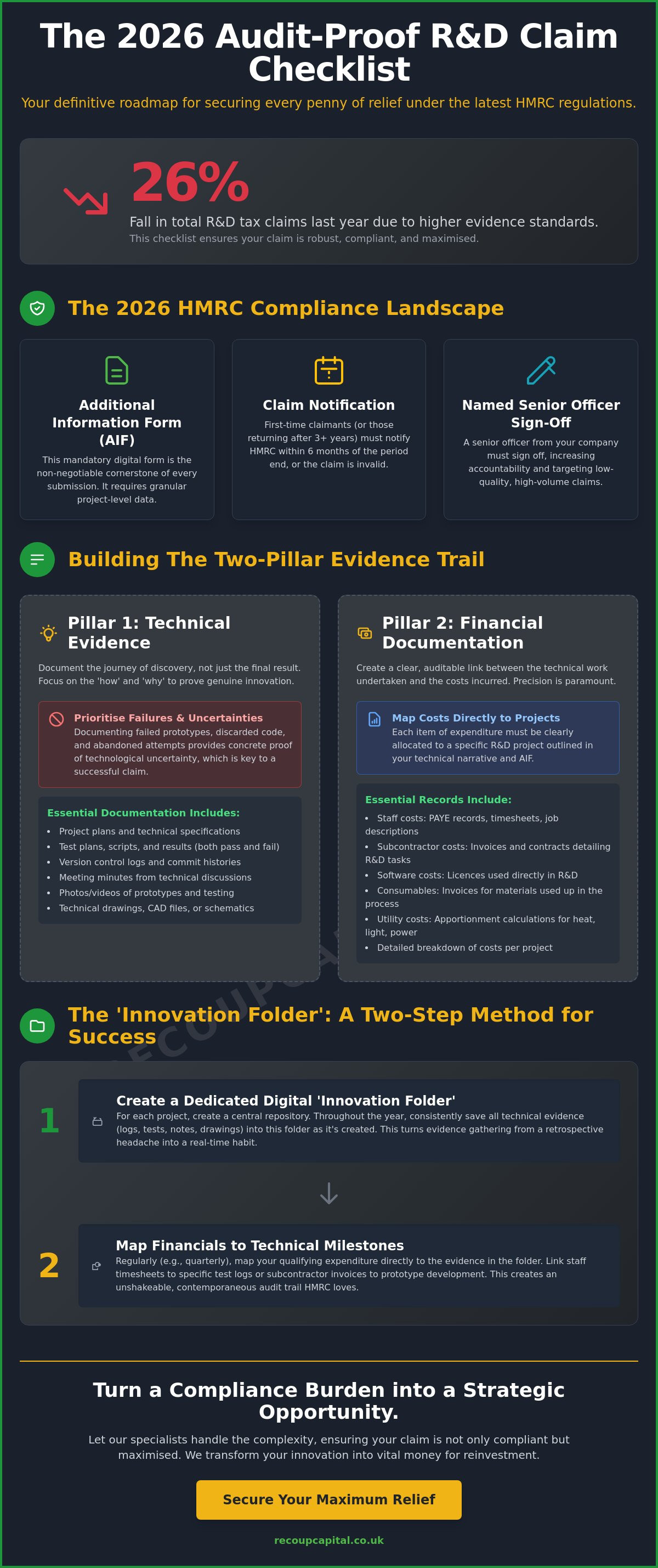
The AIF is now the non-negotiable entry point for any claim. You must provide project-level data including SIC codes, contact details for the main internal technical lead, and a breakdown of qualifying expenditure across specific categories. If your R&D projects span multiple accounting periods, you'll need to show how the costs and technical advances map across those timelines whilst remaining compliant with the merged scheme rules. The AIF acts as the mandatory digital bridge between technical reality and financial figures.
Claim Notification: Rules for New Claimants in 2026
If you're a first-time claimant, or if you haven't submitted a claim in the last three accounting years, you must submit a Claim Notification Form. This must be done within six months of the end of the accounting period you're claiming for. Missing this deadline is a common pitfall that can instantly invalidate your right to claim. You can find more about the basic eligibility in our guide to R&D tax credits explained.
Accountability is the new standard. HMRC now requires a named senior officer within your company to sign off on the submission, alongside the details of any agent who assisted. This move targets "faceless" claims and high-volume, low-quality providers who prioritise quantity over compliance. It's a protective measure designed to ensure that the person responsible for the business understands exactly what's being claimed in their name. This level of transparency builds trust with the tax office and helps to "audit-proof" your submission from the outset.
With the rise of AI-generated content, HMRC has become particularly sensitive to generic technical narratives. Whilst AI can assist in organising raw data, the documentation required for R&D tax claim success must reflect actual human expertise and the specific technological uncertainties encountered during your project. A generic, AI-spun narrative that lacks technical depth or human oversight is now a major red flag for an enquiry. HMRC's digital systems are increasingly adept at spotting patterns of non-human writing, making it essential that your technical evidence is as authentic as the innovation it describes.
Technical Evidence: Documenting the Scientific or Technological Advance
Your technical narrative should read like a story of discovery rather than a post-rationalised list of tasks. HMRC expects to see a clear evidence trail that illustrates the journey from a known baseline to a new technological advance. The specific documentation required for R&D tax claim success involves more than just a final summary; it requires a deep dive into the "how" and "why" of your innovation. By framing your work as a series of technical challenges, you demonstrate that the outcome wasn't a certainty, which is the heart of a successful claim.
Paradoxically, your failures are often more persuasive than your successes. If a project worked perfectly the first time, HMRC might argue the solution was readily deducible to any competent professional. By documenting failed prototypes, discarded code branches, or abandoned formulations, you provide concrete proof of technical uncertainty. This is supported by HMRC's official guidance, which emphasises that the process of overcoming these hurdles is what qualifies the work as R&D. Capturing these moments in real-time ensures your "innovation story" is authentic and robust.
Project Records and Iteration Logs
Capturing evidence whilst the work is in progress is the most effective way to protect your claim. For software engineering teams, this means preserving version control histories and commit logs. In construction or manufacturing, site logs and CAD revision histories serve as vital proof of iterative problem-solving. Even internal email trails can be powerful; they capture real-time expert debate and the troubleshooting steps taken when a project hit a technical brick wall. These contemporaneous records are far more valuable than a report written months after the project finished.
Evidence of Personnel and Expertise
You must demonstrate that the project was led by "competent professionals" with relevant industry experience. Keep a file of CVs and professional profiles for your key engineers or scientists. Their expertise is what defines the "technological baseline" of your industry; if they couldn't solve the problem easily, it's a strong indicator of a qualifying advance. This human element is becoming even more critical as HMRC looks closer at HMRC R&D Tax Claim Transparency and AI to ensure claims aren't being manufactured by algorithms. Authenticity is your best defence against an enquiry.
Organising this level of detail can be a significant administrative burden for a busy team. If you're unsure if your current logs meet the required standard, a brief chat with a specialist can help you identify any gaps in your technical evidence trail. We focus on the details so you can focus on the next big breakthrough for your business.
Financial Documentation: Tracking Qualifying Expenditure
Whilst technical narratives provide the context, your financial records provide the proof. HMRC operates on a hierarchy of evidence where the closer a cost is to the actual R&D activity, the more weight it carries. This means moving beyond a simple general ledger and into specific project-level allocations. The documentation required for R&D tax claim success must link every pound spent to a specific technological challenge. Without this granular mapping, even the most innovative projects can face significant pushback during an audit.
Staff costs remain the largest component of most claims. PAYE records and pension contributions are the "gold standard" here because they offer an undisputed trail of expenditure. For employees, you can claim for gross salaries, Class 1 NICs, and employer pension contributions. However, you can't include benefits in kind or dividends. It's vital to remember that only the time spent directly on R&D or in direct support of it qualifies. This distinction is where many businesses stumble, often over-claiming for administrative or general management time that doesn't meet the criteria.
Payroll and Time-Tracking Records
Robust timesheets are your best defence. They provide a clear method for apportioning staff time between R&D and business-as-usual activities. If a lead developer spends 60% of their month troubleshooting a new algorithm and 40% on routine maintenance, your records must reflect that split. This becomes even more complex when staff work on multiple innovative projects simultaneously. In these cases, a project-specific tracking system ensures you don't double-count hours whilst maximising your potential for claiming R&D tax credits across your entire portfolio.
Subcontractor and Third-Party Invoices
Managing third-party costs requires careful oversight of the "65% rule". Generally, you can only claim 65% of the qualifying costs paid to an unconnected subcontractor. The documentation required for R&D tax claim compliance must include contracts that explicitly state the R&D nature of the work. You'll also need to verify that these parties are truly "unconnected" to avoid different tax treatments. HMRC requires a clear audit trail from the invoice to the bank statement to ensure every transaction is legitimate and fully settled.
Software licences, consumables, and utility costs are also eligible, provided they're "consumed" or transformed during the R&D process. This includes items like chemicals used in a lab or the electricity powering a dedicated testing facility. For software, you must distinguish between licences used for general office tasks and those used specifically for R&D. By maintaining this level of detail, you transform your accounts from a basic record into a powerful strategic tool for financial recovery.
The R&D Audit Checklist: Organising Your Evidence for HMRC
Organising your evidence is about more than just storage; it's about creating a shield against HMRC enquiries. When a tax inspector reviews a submission, they look for a logical flow between the technical challenge described and the money spent. If your records are scattered across different departments, you risk creating inconsistencies that trigger a manual check. The documentation required for R&D tax claim success should be centralised, mapped, and ready for inspection long before you hit the submit button.
To ensure your claim is "ready-for-enquiry", follow this five-step preparation framework:
- Step 1: Centralise your "Innovation Folder". Collate all technical logs, meeting minutes, and financial spreadsheets into one secure location.
- Step 2: Map technical advances to expenditure. Every technical hurdle mentioned in your narrative must have a corresponding cost in your financial breakdown.
- Step 3: Review third-party contracts. Ensure your agreements with subcontractors explicitly mention the R&D nature of their work and define who owns the intellectual property.
- Step 4: Conduct an internal "Stress Test". Review your narrative against HMRC’s latest guidelines to ensure it focuses on technological uncertainty rather than commercial success.
- Step 5: Prepare for digital filing early. Ensure all digital signatures from senior officers and AIF fields are ready at least 30 days before your filing deadline to avoid a last-minute rush.
Audit-Proofing Your Narrative
HMRC has a keen eye for "marketing speak". If your narrative sounds like a sales pitch or a brochure, it's likely to be rejected. They're not interested in how your product will disrupt the market; they want to know why the underlying technology was difficult to build. You must cross-reference your technical claims with financial reality. For example, if you claim a project was highly innovative but your payroll records show only junior staff were involved, HMRC will question the validity of the advance. A specialist "Expert Review" can help identify these subtle gaps in your evidence trail before they become a problem.
Managing Retrospective Claims
You can make an R&D claim for accounting periods ending up to two years ago. Reconstructing the documentation required for R&D tax claim submissions for historical projects can be challenging, especially if key staff have moved on. Avoid "best-guess" estimates at all costs. Instead, use forensic accounting to piece together evidence from old email trails, project management software, and bank statements. Whilst the administrative burden of looking back can be high, the financial recovery is often the catalyst for future growth. If you're wondering if your past projects qualify, it's worth exploring why claim R&D tax credits to understand the strategic impact of this reinvestment capital.
The transition from raw data to an audit-proof submission requires a meticulous approach. If you're concerned that your current records might not stand up to HMRC scrutiny, you can book a free 15-minute consultation with our team. We’ll help you stress-test your evidence and ensure your claim is built on a solid foundation of compliant documentation.
Beyond the Paperwork: How Recoup Capital Maximises Your Claim
Managing the documentation required for R&D tax claim submissions shouldn't be a distraction from your core business. Whilst the 2026 compliance checklist seems daunting, it's actually an opportunity to formalise your innovation strategy. We don't just process paperwork; we act as a protective guide. Our team of specialist tax accountants speaks your industry jargon, whether you're developing high-frequency trading algorithms or sustainable construction materials. This deep understanding ensures that every technical nuance is captured and translated into the specific language HMRC expects.
Our success-based fee structure aligns our goals with yours. We only win when you recover capital for reinvestment. This approach removes the financial risk of exploring a claim and demonstrates our commitment to delivering value through results rather than a traditional sales pitch. We see ourselves as today’s adviser and tomorrow’s partner, helping you build a sustainable evidence trail that supports your business growth year after year. By focusing on the details of tax law, we allow you to focus on the future of your industry.
Specialist Consultancy vs General Accounting
Generalist bookkeeping is essential for day-to-day operations, but it often misses the subtle technical uncertainties that define a qualifying project. A generalist might see a simple invoice; we see a technological breakthrough. Through forensic surveying, we identify "hidden" qualifying costs that standard accounting methods frequently overlook. Choosing the right R&D Tax Credit Specialists UK can be the difference between a rejected submission and a significant cash injection for your business. We bridge the gap between your technical team and your finance department, ensuring nothing is left on the table.
Seamless Submission and HMRC Liaison
We handle the entire AIF and CT600 filing process from end to end. In this new era of AI-monitored compliance, our commitment to transparency is your greatest asset. We ensure that the documentation required for R&D tax claim success is authentic, human-led, and fully compliant with current regulations. If HMRC does raise an enquiry, we lead the liaison on your behalf, providing the technical depth needed to establish institutional credibility. Our goal is a seamless experience that delivers maximum relief with minimum friction.
Ready to transform your innovation into capital? You can book a FREE 15-minute consultation today to audit-proof your next claim. It's a low-pressure way to discover how we can help your business thrive whilst ensuring you remain on the right side of HMRC's evolving requirements.
Securing Your Innovation Strategy for 2026
The landscape of UK innovation has changed, but your ability to recover capital shouldn't be compromised by red tape. By mastering the mandatory Additional Information Form and maintaining contemporaneous logs, you transform a compliance hurdle into a strategic business tool. It's essential to remember that the documentation required for R&D tax claim success is ultimately about telling your innovation story with technical precision and financial clarity. You don't have to navigate these HMRC complexities alone.
Our team of chartered tax accountants and specialist surveyors brings a proven track record in the construction and engineering sectors to your corner. We operate on a success-based fee model, ensuring our interests are perfectly aligned with yours as we secure vital money for reinvestment. Book your FREE 15-minute R&D consultation today to audit-proof your submission and focus on your next breakthrough. Today’s adviser, tomorrow’s partner; we're here to help your business thrive and lead the way in your industry.
Frequently Asked Questions
What happens if I do not have timesheets for my R&D claim?
You can still submit a claim without formal timesheets, but you must be prepared for increased HMRC scrutiny. In the absence of automated logs, you'll need to provide a robust alternative methodology to justify staff allocations. This might include project meeting minutes, calendar entries, or version control commits. HMRC expects a reasonable and consistent approach to apportioning time, so the clearer your alternative evidence, the lower the risk of an enquiry.
Can I claim R&D tax credits for projects that failed?
Failed projects are fully eligible and often provide the best evidence of technical uncertainty. If you reached a technological dead end, it proves that the solution was not readily deducible to a competent professional. Documenting these failures through trial logs and abandoned prototypes is a powerful way to substantiate the innovation story within your claim. It shows you were pushing the boundaries of what was previously possible in your field.
How long do I need to keep my R&D documentation for HMRC?
You must retain all supporting evidence for at least six years after the end of the accounting period. This statutory requirement ensures you can respond to any retrospective HMRC compliance checks. Given the complexity of the documentation required for R&D tax claim audits, we recommend maintaining a digital archive of technical logs and financial records. This proactive organisation protects your business from the administrative burden of searching for old data years later.
Is a technical report still required under the 2026 rules?
A separate technical report is no longer a mandatory filing requirement, as the Additional Information Form (AIF) has replaced it. However, the technical details previously found in a report must now be digitised and entered directly into the AIF. Whilst the format has changed, the need for a detailed technical narrative remains. We still advise keeping a comprehensive internal report to serve as the evidence base for your digital submission.
What is the difference between a subcontractor and an EPW for documentation purposes?
The primary difference lies in control and supervision. Subcontractors are typically companies you hire to deliver a specific outcome, whilst Externally Provided Workers (EPWs) are individuals provided by a staff agency who work under your direct management. For documentation purposes, subcontractor claims usually require a 35% reduction in qualifying costs, whereas EPW documentation must clearly show the individual's role and the staff provider's invoices to satisfy HMRC’s specific rules.
Can I use AI to write my R&D technical descriptions?
You should treat AI as a supportive tool rather than a substitute for human expertise. HMRC's digital systems are increasingly sophisticated at identifying generic, AI-generated technical narratives that lack specific project depth. To ensure the documentation required for R&D tax claim approval is robust, every description must be reviewed by the competent professional who led the work. Authenticity and technical granularity are your best defences against a compliance check.
What are the penalties for submitting an inaccurate R&D claim?
Penalties are based on the nature of the error and the level of disclosure. If you've taken reasonable care but made a mistake, there's often no penalty. However, careless errors can result in fines of up to 30% of the tax lost, whilst deliberate inaccuracies can reach 100%. HMRC also considers whether you made a prompted or unprompted disclosure, making it vital to have an expert review your claim before submission.
How does the Claim Notification Form affect my documentation timeline?
The Claim Notification Form significantly accelerates your documentation timeline. Because you must notify HMRC within six months of your period end, you can't wait until the end of the two-year filing window to identify your R&D projects. You need to gather high-level technical and financial evidence early to ensure the notification is accurate. This proactive approach helps prevent the retrospective data-gathering panic that often leads to claims being missed or undervalued.