
Common R&D Tax Claim Mistakes: A 2026 Compliance Checklist for UK Firms

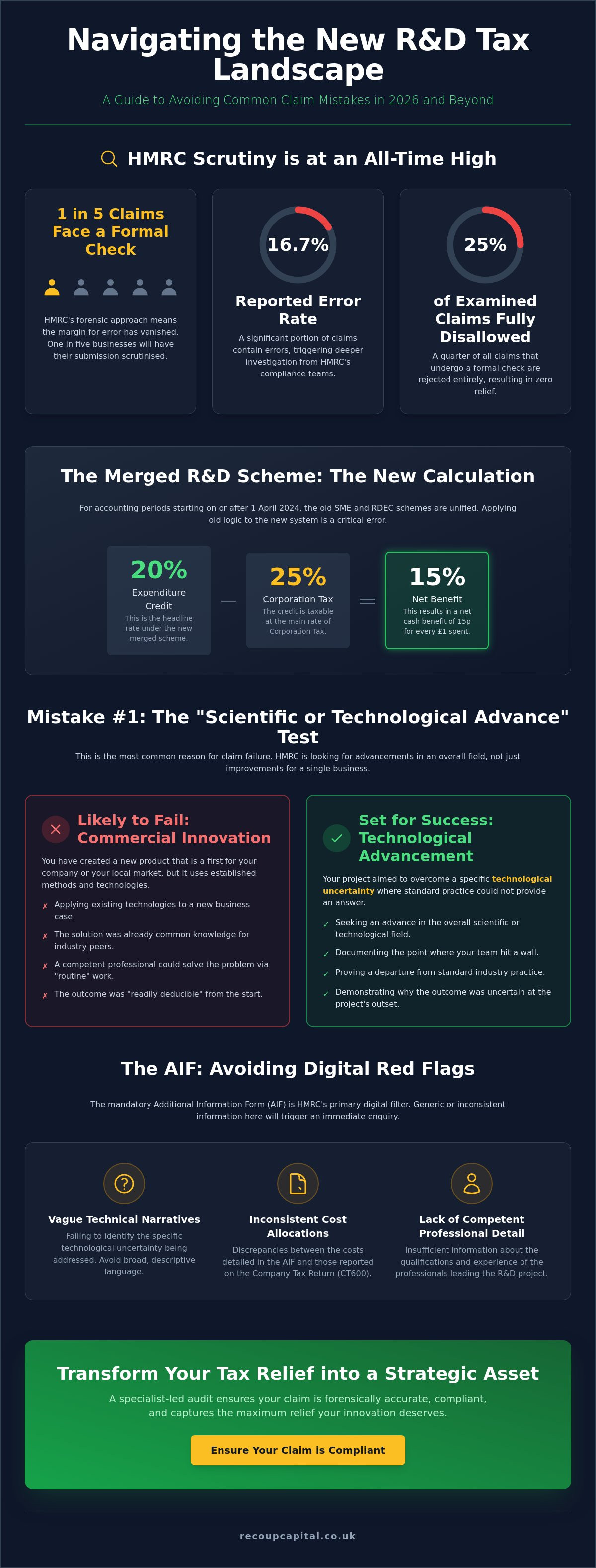
HMRC is now checking one in five R&D tax credit claims; with a reported error rate of 16.7%, a quarter of all examined submissions are being fully disallowed because of common R&D tax claim mistakes. You likely feel the mounting pressure of the 2026 regulatory landscape, especially as the distinction between routine problem-solving and genuine innovation becomes harder to define under the merged scheme rules. It's frustrating to invest time into a technical narrative only to face the anxiety of a potential enquiry or the sting of a rejected claim.
You deserve a process that treats your financial recovery as a strategic asset rather than a regulatory hurdle. This guide helps you identify these pitfalls and provides a forensic checklist to audit your submission, ensuring you meet every HMRC requirement whilst capturing the maximum relief your innovation deserves. We'll explore the mandatory Additional Information Form, precise cost allocation strategies, and the technical nuances that ensure your claim remains both compliant and highly rewarding.
Key Takeaways
- Understand how the transition to the merged R&D scheme in 2026 requires a shift from volume processing to forensic accuracy to satisfy HMRC compliance teams.
- Learn how to distinguish between commercial innovation and true technological advancement to avoid the most common R&D tax claim mistakes that trigger full claim rejections.
- Identify the specific risks of over-claiming director time and discover the qualifying indirect activities that often go overlooked by generalist accountants.
- Master the art of technical reporting by linking specific project costs directly to technological uncertainties rather than providing broad, descriptive narratives.
- Explore how a specialist-led audit can transform your tax relief into a strategic asset whilst ensuring your business remains protected by a success-based fee structure.
The Evolving HMRC Landscape: Why R&D Mistakes are Costlier in 2026
HMRC's approach to the UK's R&D tax incentive has undergone a radical transformation. We've moved beyond the era of volume processing where claims were often accepted at face value. Today, HMRC fraud teams employ forensic scrutiny on every submission. With one in five claims now facing a formal check, the margin for error has vanished. This stricter environment means that "good faith" is no longer a valid defence against penalties. If your technical narrative lacks precision, HMRC may view it as a failure of due diligence rather than a simple oversight. Errors that were overlooked three years ago now trigger immediate enquiries.
The mandatory Additional Information Form (AIF) acts as the primary filter for these enquiries. It's a digital gatekeeper designed to flag inconsistencies before a human inspector even opens your file. Relying on outdated templates or generic descriptions is one of the most common R&D tax claim mistakes we see in 2026. Key triggers for these digital filters include:
- Vague technical descriptions that fail to identify a specific technological uncertainty.
- Inconsistent cost allocations between the AIF and the Company Tax Return (CT600).
- A lack of detail regarding the "competent professional" leading the project.
Understanding the Merged Scheme Nuances
The transition to the merged R&D scheme, which unified the old SME and RDEC systems for accounting periods beginning on or after 1 April 2024, has created a significant hurdle. Under this framework, you're dealing with a taxable expenditure credit of 20%. This change isn't just about the numbers; it's about the methodology. Many businesses mistakenly apply old SME rules to new periods, leading to incorrect benefit calculations. If you're still using your 2023 claim logic, your current submission is likely obsolete. You must now account for the 25% main rate of corporation tax, which brings the net benefit to 15% for many firms. You can find more detail on how these R&D tax credits are explained within the current regulatory framework to ensure your calculations remain accurate.
The Digital Scrutiny Era
HMRC now utilises sophisticated digital tools to cross-reference technical descriptions against industry standards. They're looking for "routine" problem-solving disguised as innovation. If your documentation isn't contemporaneous, it won't hold up under pressure. A "wait and see" approach to record-keeping is a recipe for failure. You need real-time evidence that links specific costs to technological uncertainties as they happen. Success in 2026 requires more than just doing the work; it requires proving the work through a forensic, digital-first lens that treats your claim as a strategic financial asset.
Mistake #1: Failing the "Scientific or Technological Advance" Test
The most frequent error in UK submissions is the confusion between commercial innovation and technological advancement. Whilst your new product might be a commercial triumph that disrupts your local market, HMRC only cares about the underlying science or technology used to create it. If you've simply applied existing technologies to a new business case, your claim will likely fail. You must prove that your project sought an advance in the overall field, not just an improvement for your specific firm. This "Knowledge Gap" trap catches many off guard; it doesn't matter if the solution is new to your company if it's already common knowledge amongst industry peers.
HMRC inspectors frequently highlight common errors in R&D claims when businesses fail to prove a project sought a genuine advance. To avoid this, you must identify a specific technological uncertainty. This is the point where your team hit a wall and standard practice couldn't provide the answer. If a competent professional could have resolved the issue through "routine" problem-solving, it isn't R&D. You must document the departure from standard practice and why the outcome was not "readily deducible" from the outset. If you're unsure where your project sits on this spectrum, it's helpful to have R&D tax credits explained in the context of your specific industry baseline.
Defining Your "Competent Professional"
HMRC places significant weight on the opinion of your lead developer or engineer. Their CV is a critical part of your technical narrative. You need to demonstrate that this individual possesses the relevant qualifications and experience to be considered a "competent professional" in the field. Their role is to testify that the technical challenges faced were truly uncertain. If your lead engineer cannot explain why the solution wasn't found in a textbook or a public forum, the claim's credibility collapses. You must document the baseline of publicly available knowledge they consulted before beginning the R&D work.
The Software and Construction Pitfalls
Software and construction firms are particularly susceptible to these common R&D tax claim mistakes. In software, creating a "bespoke" platform or a sleek user interface is rarely R&D. The innovation must happen in the backend, such as developing new algorithms or improving data processing speeds in ways that haven't been done before. Similarly, in construction, managing a complex site or a difficult timeline is a project management success, not R&D. Genuine R&D in construction involves the development of new materials or innovative structural techniques that overcome a specific physical uncertainty. A project that is merely "difficult" will fail the eligibility test if it doesn't push the boundaries of current engineering knowledge.
Mistake #2: Forensic Failures in Cost Allocation and Staffing
Staffing costs typically represent the largest portion of any R&D submission, yet they remain a primary target for HMRC inspectors. One of the most common R&D tax claim mistakes is the "blanket allocation" of staff time, particularly regarding company directors. Claiming that a director spends 100% of their year on R&D is almost always a red flag. HMRC expects to see a realistic apportionment that accounts for administrative duties, business development, and general management. If you can't justify the split with robust evidence, you risk your entire claim being flagged for a compliance check.
Confusion also persists around consumables. If you've claimed for materials that were ultimately sold to customers or repurposed for non-R&D use, you've likely over-claimed. HMRC's list of common errors specifically highlights the miscalculation of materials and the failure to exclude costs for items that don't meet the "consumed or transformed" criteria. Accuracy here is vital to maintaining a clean compliance record and ensuring your claim withstands forensic scrutiny.
The Staffing Ratio Reality Check
Whilst HMRC doesn't strictly mandate timesheets for all staff, they do require a "reasonable and justifiable" estimate. Relying on guesswork at the end of the financial year is a dangerous strategy. You should also look beyond direct R&D work to identify Qualifying Indirect Activities (QIAs). These include essential maintenance, specific administrative tasks, and even certain training directly supporting the R&D project. However, you must handle pension contributions and bonuses with extreme care; only the qualifying portion of these costs can be included. Errors in these calculations are easily spotted during an audit.
Subcontractors and the Merged Scheme Rules
The 2026 landscape for subcontractors is complex. Under the merged scheme, the rules regarding "contracted out" research have tightened to prevent double-claiming. You must establish who actually owns the R&D and who is merely providing a service. If your firm is the one commissioning the work, you can typically claim for 65% of the relevant subcontractor costs. Failing to verify whether your subcontractor is also claiming for the same work is a recipe for an enquiry. It's essential to have clear contracts that define the R&D ownership from the outset to avoid these common R&D tax claim mistakes.
Balancing R&D with Capital Allowances
A significant gap often exists in how firms manage the overlap between different tax reliefs. If you capitalise your R&D expenditure on the balance sheet, it requires a different accounting treatment than immediate revenue expenditure. Many businesses "lose" qualifying costs because they don't recognise the natural overlap with capital allowances for commercial property. For instance, the infrastructure supporting a new laboratory might qualify for both incentives in different ways. Ensuring these costs aren't trapped in tax silos allows you to treat your returns as a strategic business tool. If you're unsure how to partition these costs, exploring our specialist advice on capital allowances can provide the forensic clarity needed to maximise your legitimate returns.
Mistake #3: Poor Documentation and Technical Reporting
Many firms treat the technical narrative as a marketing exercise. This is a critical error. HMRC doesn't want to hear about your company's history or how "revolutionary" your product is in a commercial sense. They want scientific precision. One of the most common R&D tax claim mistakes is providing a "wall of text" that lacks technical depth. If you can't link every pound spent directly to a specific technological uncertainty, your claim is vulnerable. In 2026, vague language is an invitation for an enquiry. HMRC inspectors are trained to spot marketing-led descriptions that gloss over the actual engineering challenges.
The shift toward digital-first compliance means your documentation must be forensic. It's no longer enough to state that a project was "complex" or "difficult." You must prove that the challenges faced were technological in nature and couldn't be solved by a competent professional using publicly available knowledge. When you fail to provide this depth, you're essentially telling HMRC that your project was routine. This lack of clarity is why the error rate remains high, with a quarter of all examined claims being fully disallowed.
The Anatomy of a Compliant Technical Report
A robust technical report acts as your first line of defence during a compliance check. It must follow a logical progression that demonstrates genuine innovation rather than simple business growth. To ensure your report meets the 2026 standards, follow these steps:
- Step 1: Define the baseline: State the scientific or technological knowledge that existed before you started. Use industry-standard terminology to show you understand the current limits of your field.
- Step 2: Articulate the uncertainty: Clearly define the specific roadblock. Why did standard practice fail? This is the heart of your claim.
- Step 3: Detail the systematic investigation: Document the trials, errors, and iterative testing. Don't hide your failures; they're the strongest proof that the outcome was uncertain.
- Step 4: Quantify the advance: Explain exactly how your work moved the needle. Even if the project failed to reach its commercial goal, the technological knowledge gained can still qualify as an advance.
Avoiding the "AIF" Red Flags
Since 8th August 2023, the mandatory Additional Information Form (AIF) has become the primary tool for HMRC's automated risk assessments. Small inconsistencies here trigger immediate flags. For example, if your project start dates in the AIF don't perfectly align with your CT600, you're likely to face a check. Similarly, the "Competent Professional" listed must have a verifiable industry footprint. HMRC's AI tools now cross-reference these names against professional platforms like LinkedIn. If their expertise doesn't match the project's technical demands, the claim's integrity is questioned. Finally, remember that the "Senior Officer" declaration carries legal weight. It's a formal confirmation of the claim's accuracy, and any inaccuracies can lead to significant penalties for the business.
If you're concerned that your current documentation won't withstand the scrutiny of a forensic HMRC audit, we can help you refine your narrative through our specialist R&D tax credits service. We focus on transforming complex technical data into a compliant, high-impact narrative that protects your bottom line.
The Specialist Solution: Auditing Your Claim for Long-Term Success
Navigating the 2026 tax landscape requires more than just accounting proficiency. It demands a deep understanding of the technical barriers your team has overcome. Whilst many generalist accountants are excellent at managing standard corporation tax, they often lack the engineering or scientific background necessary to bridge the compliance gap. This is where common R&D tax claim mistakes typically begin; if the person writing your technical narrative doesn't understand the science, HMRC certainly won't. A specialist audit ensures your claim is built on a foundation of technical truth rather than vague commercial descriptions.
Recoup Capital acts as a protective shield between your business and HMRC. We believe in demonstrating value through results. Our success-based fee structure ensures our interests are perfectly aligned with yours; we only succeed when you secure the legitimate relief your innovation deserves. By reframing these returns as strategic assets, you can reinvest in new equipment, hire specialised talent, or pivot toward even more ambitious technological advances. This transforms the process from a mere refund into a powerful tool for business growth.
Specialist vs. Generalist: The Compliance Gap
Technical expertise is as important as tax knowledge in the current climate. Specialists often identify "hidden" R&D in sectors like construction or food tech that generalists might overlook as routine business activity. For example, developing a new fermentation process or overcoming structural uncertainties on a brownfield site requires a level of technical justification that standard bookkeeping cannot provide. The peace of mind that comes from a robust, enquiry-ready submission is invaluable. You can move forward with confidence, knowing your claim is backed by a team that understands the forensic requirements of the merged scheme.
Next Steps for Your Business
Your first step should be a thorough internal health check of your current or planned claims. Review your technical narratives against the 2026 standards and ensure your cost allocations are defensible. You need to organise your records to reflect real-time activity, linking every developer hour and every consumable item to a specific technological roadblock. This level of preparation is the best defence against the common R&D tax claim mistakes that trigger HMRC enquiries.
Don't leave your capital recovery to chance. Speak to Recoup Capital today for a no-obligation review of your R&D potential. We'll help you audit your current approach and ensure your business is positioned for long-term success in an increasingly complex regulatory environment.
Secure Your Innovation Legacy in a Forensic Era
The transition to the merged R&D scheme has fundamentally shifted the burden of proof onto your business. Success in 2026 requires moving beyond simple bookkeeping to a forensic approach that links every pound spent to a genuine technological advance. By refining your technical narrative and ensuring your cost allocations are defensible, you transform your claim into a powerful strategic asset. Avoiding common R&D tax claim mistakes is the most effective way to safeguard your capital whilst maintaining a transparent relationship with HMRC.
You don't have to navigate these regulatory complexities alone. Our team of Chartered Tax Accountants and Technical Specialists has a proven track record with complex HMRC enquiries and operates on a success-based fee model. We act as your protective guide, ensuring your innovation is recognised and rewarded. Book your free R&D claim health check with our specialists today to ensure your next submission is both compliant and maximised. Your breakthroughs deserve a partner invested in your long-term success.
Frequently Asked Questions
What is the most common reason HMRC rejects an R&D claim?
The primary reason for rejection is failing the "scientific or technological advance" test by confusing commercial innovation with technological progress. Many firms submit claims for projects that resolve "routine" problems which a competent professional in the field could easily fix using existing knowledge. If your narrative doesn't clearly define a specific technological uncertainty that required a departure from standard practice, HMRC will likely disallow the submission.
Can I claim R&D tax credits if my project was a failure?
Yes, you can absolutely claim for unsuccessful projects as long as they sought a genuine technological advance. HMRC recognises that the systematic investigation of an uncertainty often leads to dead ends; in fact, a failed project often provides the strongest evidence that the outcome was not "readily deducible" at the start. The focus remains on the attempt to overcome technical hurdles rather than the commercial success of the end product.
How far back can I go to correct a mistake in a previous R&D claim?
You generally have up to two years from the end of the accounting period to which the claim relates to amend or submit a filing. If you've identified common R&D tax claim mistakes in a previous submission, such as incorrect cost apportionments or missing Qualifying Indirect Activities, you must act within this window. Once this two-year deadline passes, the opportunity to rectify the figures or recover under-claimed relief is usually lost.
Do I need to submit a technical report with every R&D claim in 2026?
Yes, providing a detailed technical narrative is now a digital requirement through the mandatory Additional Information Form (AIF). Since 8 August 2023, every claim must be accompanied by this form before the Company Tax Return is filed. While a separate technical report isn't strictly a legal requirement, the AIF demands the same level of granular detail regarding your project's uncertainties and systematic investigations to pass HMRC's initial filters.
What happens if HMRC discovers a mistake in my R&D submission?
HMRC's response depends on whether the error is deemed "careless" or "deliberate." If an enquiry uncovers inaccuracies, they may reduce the relief amount or demand a full repayment of the credit. In more serious cases, financial penalties can be applied, often ranging from 30% to 100% of the tax understated. This is why forensic accuracy in your initial submission is vital for protecting your business from long-term financial repercussions.
Is it a mistake to claim R&D tax credits and grants at the same time?
It isn't a mistake, but it requires careful navigation of the merged scheme rules to avoid double-counting. For accounting periods starting after 1 April 2024, the old restrictions regarding State Aid grants and the SME scheme have been simplified under the unified framework. However, you must still ensure that the specific expenditure covered by a grant isn't being claimed as a tax credit, as this remains a high-risk area for compliance checks.
How much detail does HMRC really need in the technical narrative?
HMRC requires enough technical depth to satisfy a "competent professional" that a genuine roadblock existed. You don't need to provide hundreds of pages of background; instead, focus on a concise explanation of the baseline technology, the specific uncertainty encountered, and the systematic trials used to overcome it. Vague, marketing-led language is a red flag that often leads to an enquiry, so stick to scientific and engineering terminology.
Can my regular accountant handle my R&D tax credit claim?
Whilst a regular accountant can technically submit the claim, they often lack the specialised technical background needed to identify every qualifying activity. Generalist accountants may struggle to bridge the gap between financial figures and complex engineering or scientific narratives. This lack of technical oversight is a leading cause of common R&D tax claim mistakes, making a specialist-led audit a safer route for ensuring both compliance and maximum legitimate relief.