
The Strategic Guide to Patents for UK Business Growth in 2026

What if you could legally slash your Corporation Tax bill by 60% simply by protecting the innovation you’ve already built? For many UK directors, the decision to file a patent feels like an expensive distraction from daily operations. You likely see the value in your intellectual property, yet the daunting complexity of IPO regulations and the fear of uncapped legal fees often stall progress. It’s a common frustration, especially when you’re trying to balance ambitious growth with the rising costs of doing business in 2026.
We believe your hard work deserves more than just a certificate on the wall. This guide will show you how to unlock the full commercial and tax potential of your ideas, transforming them into a strategic financial asset. You’ll learn how to determine if your invention is eligible and whether a patent or a trade secret is the right move for your specific goals. Most importantly, we’ll explain how to access the Patent Box, an HMRC incentive that can lower your tax rate to 10% on qualifying profits. From technical basics to securing money for reinvestment, this is your roadmap to turning ingenuity into long term success.
Key Takeaways
- Understand the 2026 legal standards for protecting UK inventions and the vital role of a comprehensive search before filing.
- Discover how to effectively balance immediate cash flow from R&D tax credits with the long-term commercial value of a granted patent.
- Learn how to qualify for a reduced 10% Corporation Tax rate on profits derived from your qualifying intellectual property.
- Identify the clear distinctions between "product" and "process" innovations to ensure your assets are correctly defined for maximum legal protection.
- See how partnering with specialist tax accountants can transform your technical innovations into significant money for reinvestment through expert claim management.
What is a Patent? Defining Your IP Asset in the UK
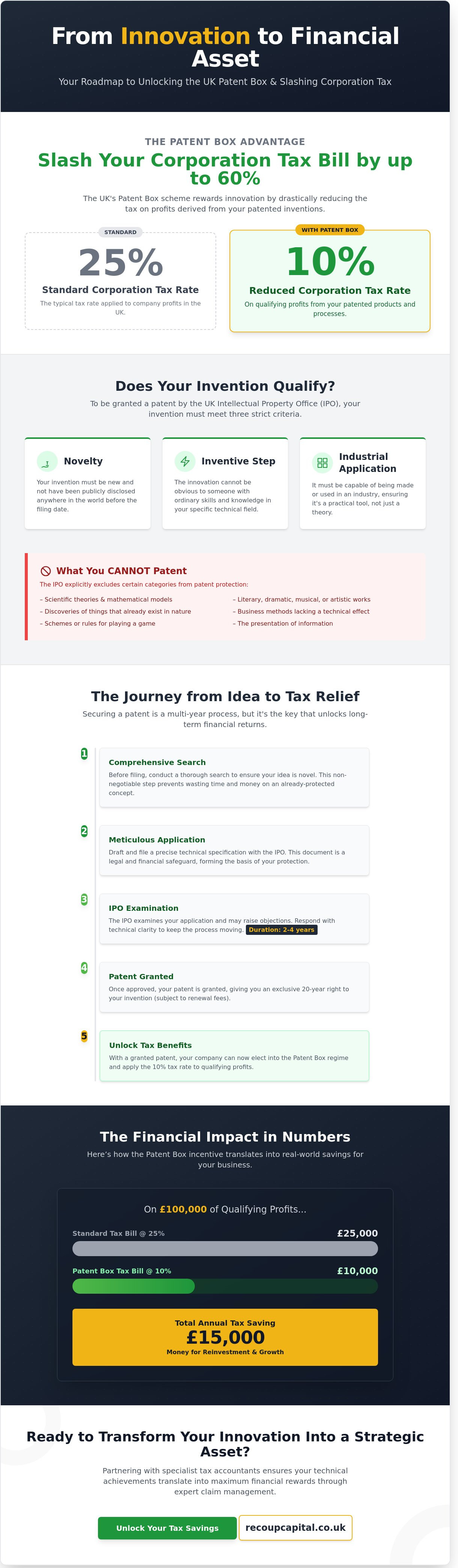
Innovation isn't just a buzzword; it's a tangible asset that can be quantified on a balance sheet. In the UK, a patent serves as a legal shield, granting you an exclusive 20-year right to stop others from making, using, or selling your invention. This protection applies to both physical products and specific industrial processes. While many business owners view this as a legal hurdle, we see it as "money for reinvestment." By securing your intellectual property through the UK Intellectual Property Office (IPO), you aren't just protecting an idea; you're creating a vehicle for significant tax efficiency. To understand the fundamental principles of What is a Patent?, one must view it as a strategic contract between your business and the state.
The Three Pillars of Patentability
For the IPO to grant protection, your invention must meet three strict criteria defined under the Patents Act 1977. First, it requires novelty. Your invention cannot have been publicly disclosed anywhere in the world before your filing date. Second, it must involve an inventive step. This means the solution shouldn't be obvious to a person with ordinary skills in your specific industry. Finally, industrial application is essential. The invention must be capable of being made or used in some kind of industry, ensuring it's a practical tool rather than a theoretical concept.
What You Cannot Patent: HMRC and IPO Restrictions
Not every breakthrough qualifies for protection. The IPO explicitly excludes certain categories, such as mathematical models, artistic works, and business methods that lack a technical character. If you're developing software, you must demonstrate a "technical effect" that solves a specific problem in a non-obvious way. There's also a vital distinction in tax law between a discovery and an invention. Finding something that already exists in nature is a discovery; creating a new process to extract or use it is an invention. Understanding these boundaries is the first step toward a successful R&D tax credit or Patent Box claim.
Securing a patent is a rigorous process, but it transforms your research and development costs into a protected commercial advantage. The UK government encourages this through specific tax incentives designed to reward companies that take the risk of developing new technology. Whether you've refined a manufacturing process or engineered a new hardware component, the patent is the key that unlocks these financial returns. It's about more than just legal protection; it's about building a foundation for sustainable growth and future innovation.
The UK Patent Landscape: Legal Requirements and 2026 Standards
The UK government's Innovation Strategy, published in 2021, sets a clear ambition for the country to become a global hub for technology and science by 2035. This drive creates a fertile environment for businesses, yet it brings a heightened level of scrutiny from HMRC. Transparency is now the baseline for any firm looking to benefit from tax incentives. If your business is IP-heavy, you can't afford to be vague about your assets. Accurate documentation is the bridge between a good idea and a successful tax claim. By 2026, we expect even tighter integration between digital filing systems and tax compliance, making early precision a vital commercial habit.
The Application Journey: From Search to Grant
Before you even file, a comprehensive search is non-negotiable. It prevents you from wasting thousands of pounds on an idea that's already been protected by someone else. When you're ready to proceed, the UK patent application process requires a meticulously drafted technical specification. This document isn't just a legal requirement; it's a financial safeguard. Precision here minimizes the risk of objections during the Intellectual Property Office (IPO) examination phase. Usually, it takes between two and four years from your initial filing to reach a final grant. You'll need to respond to IPO objections with technical clarity to keep the process moving toward that all-important grant date.
Maintaining Your Asset: Renewals and Enforcement
Your patent isn't a "set and forget" investment. Protection lasts up to 20 years, but only if you pay the annual renewal fees. In the UK, these start at £70 for the fifth year and scale up to £610 by year 20. Keeping these active is vital for maintaining your market share. Without active enforcement, your competitors will eventually erode your advantage. It's also worth considering how your IP portfolio integrates with your wider capital allowances strategy. Managing these assets together ensures you're extracting every penny of value from your innovation expenditure. This holistic approach transforms a legal cost into a strategic tool for reinvestment.
If you're unsure how your current IP portfolio positions you for future tax benefits, a quick 15-minute consultation can clarify your next steps and help you identify money for reinvestment.
Patent vs. R&D Tax Credits: Which Strategy Wins?
Choosing between these two incentives isn't about picking a winner. It's about timing. R&D tax credits offer an immediate injection of capital. This is money for reinvestment that lands in your bank account shortly after your tax filing. In contrast, a patent represents long-term equity. It’s an asset that sits on your balance sheet, protecting your market share for up to 20 years.
The R&D scheme supports the creation phase. It covers the costs of technical uncertainty and the trials that didn't work. Patents protect the final result. They secure the inventive step that gives you a competitive edge. Since the introduction of the Additional Information Form (AIF) in August 2023, HMRC compliance has become more rigorous. Businesses must now provide granular detail on their technical advancements. A patent filing serves as a powerful shield during this process. It offers external validation that your work meets a high bar of novelty.
Choosing the Right Incentive for Your Innovation
You should prioritise R&D tax credits explained by their ability to fund iterative improvements. If your team is refining existing software or enhancing manufacturing processes, R&D credits are your best bet. However, if you're seeking venture capital or debt restructuring, a formal patent is often non-negotiable. Investors want to see protected IP. If your invention is easily reverse-engineered, patenting is essential. If it relies on a proprietary process that can stay hidden, the trade secret alternative might save you the cost and public disclosure of a filing.
Synergy: How Patents Strengthen Your R&D Claim
Using a patent filing as evidence of technical advancement is a smart move for any UK firm. It provides HMRC with third-party validation from the Intellectual Property Office. When your technical narrative aligns with the standards in the Manual of Patent Practice, your claim's credibility increases. This alignment reduces the likelihood of an HMRC inquiry, which can be a time-consuming hurdle.
Most innovative firms find the greatest success by pursuing both simultaneously. This creates a seamless loop of funding and protection. You use the tax relief from your R&D expenditure to fund the legal costs of your patent applications. We recommend a success-based approach to managing these claims. This ensures you're not just processing paperwork but strategically building a more valuable, resilient business. Today’s adviser should be your tomorrow’s partner in navigating these complex UK regulations.
Commercialising IP: The Path to the 10% Patent Box Tax Rate
The Patent Box regime is a powerful fiscal tool designed to keep high-value innovation within the UK. It allows companies to apply a lower 10% Corporation Tax rate to profits earned from its patented inventions. This is a substantial saving when compared to the current 25% main rate for businesses with profits exceeding £250,000. It's a reward for the risks taken during the development phase and provides a clear incentive to keep intellectual property (IP) on British soil.
Eligibility is strict but rewarding. Your company must hold a qualifying patent granted by the UK Intellectual Property Office (IPO) or the European Patent Office (EPO). You can also qualify if you hold an exclusive licence to use a patent owned by someone else. The regime doesn't just apply to the sale of the patented item itself. It covers royalties, licensing fees, and even income from the sale of items that incorporate a patented component. This incentive works in perfect harmony with claiming R&D tax credits. While R&D credits support you during the costly trial-and-error phase, the Patent Box rewards you once those ideas become profitable.
Step-by-Step to Patent Box Election
Entering the regime requires a methodical approach to your accounting. First, you must identify all income streams derived from the patented invention. This isn't always straightforward if the patent only covers one part of a larger product. Second, you must apply the "Nexus fraction." This formula determines how much of the profit qualifies based on the proportion of R&D the company actually performed itself. It’s designed to prevent companies from simply buying IP to claim the tax break. Finally, you elect into the regime through your CT600 tax return. You have up to two years after the end of the relevant accounting period to make this election.
Maximising the Financial Return on Innovation
The Patent Box is a long-term strategic play rather than a one-off win. For established UK limited companies, it creates a sustainable cycle of innovation and reinvestment. When you integrate IP strategy into your corporate finance and valuation models, the impact is clear. A lower effective tax rate increases your net profit margins, which directly boosts your business valuation. This makes your company far more attractive to investors or potential buyers who value protected, tax-efficient revenue streams. We've seen businesses use these savings to fund their next generation of products, creating a self-sustaining engine for growth.
Calculating "relevant intellectual property profits" (RIPP) involves stripping away routine returns and marketing assets to find the true value of your innovation. It’s a complex process, but the 15% tax differential is too significant to ignore. We can help you determine if your portfolio is ready to deliver these savings.
Ready to see how much your IP could save you in tax? Book a free 15-minute consultation with our specialists today.
Maximising Innovation Rewards with Recoup Capital
Choosing between the Patent Box and R&D tax credits isn't a binary decision. It's a strategic one. Recoup Capital acts as a specialist partner for innovative UK firms, ensuring you don't just file paperwork but actually maximise your financial recovery. While generalist accountants handle your yearly books, our team consists of chartered tax accountants who live and breathe innovation incentives. This distinction is vital. Generalists often miss the technical nuances that lead to higher claim values or, worse, leave you exposed to HMRC inquiries. We conduct deep technical assessments to ensure every claim meets rigorous compliance standards, protecting your business while uncovering every eligible pound.
Our commitment is simple: we demonstrate value through results. We don't rely on aggressive sales pitches or empty promises. Instead, we focus on delivering tangible money for reinvestment that fuels your next phase of growth. By treating your tax relief as a strategic business tool rather than a mere refund, we help you build a sustainable cycle of innovation. We act as a protective guide, navigating the complexities of tax law so you can focus on what you do best.
Seamless Integration of IP and Tax Strategy
We look beyond the obvious to identify hidden opportunities in your technical expenditure. Many businesses overlook qualifying costs incurred during the development phase of a patent or the testing of advanced prototypes. Our specialists bridge the gap between your technical team and the finance department to capture these details accurately. Looking ahead, HMRC R&D tax claim transparency will become even more critical by 2026 as AI-driven auditing becomes the standard. Our success-based fee structure ensures our goals stay aligned with yours. You face no upfront risk, as we only receive a fee when your claim is successful. This creates a partnership built on transparency and shared success.
Start Your 15-Minute Consultation Today
Your journey begins with a free 15-minute consultation. This isn't a high-pressure sales call. It's a focused session where we determine your eligibility and estimate the potential value of your claim. To make the most of this time, have your technical data, project timelines, and details regarding your patent filing ready. We handle the heavy lifting of the technical report, transforming complex data into a compliant, high-value submission. Don't leave your hard-earned capital on the table. Turn your intellectual property into a strategic tax asset today. At Recoup Capital, we're proud to be today’s adviser, tomorrow’s partner.
Secure Your Competitive Edge in 2026
Securing a patent is no longer just about legal defense; it's a gateway to significant financial incentives. By leveraging the UK's 10% Patent Box tax rate, your business can retain more profit to fuel future breakthroughs. Navigating the intersection of R&D tax credits and intellectual property requires a precise approach to ensure every pound of expenditure is accounted for under current HMRC standards. This strategic alignment turns your technical milestones into vital capital for reinvestment.
Recoup Capital acts as your proactive guide through these legislative complexities. Our specialist team of chartered tax accountants and technical experts provides national coverage with a relentless focus on HMRC compliance. We operate on success-based fees, which means we only win when you do. We're here to handle the technical depth so you can focus on leading your industry.
Book Your FREE 15-Minute Consultation
Let's transform your innovation into a sustainable financial asset. Today's adviser, tomorrow's partner.
Frequently Asked Questions
What is a patent and how does it differ from a trademark?
A patent is a legal right granted by the Intellectual Property Office (IPO) that protects an invention, specifically how it works or what it does. In contrast, a trademark protects your brand identity, such as your business name or logo. While a patent lasts for up to 20 years, a trademark can be renewed indefinitely every 10 years. Securing a patent prevents others from making or selling your invention without permission.
Can I claim R&D tax credits if I already have a patent?
You can absolutely claim R&D tax credits even if you already hold a patent. These two incentives often work together to maximise your financial recovery. While R&D tax credits reward the process of innovation and overcoming technical uncertainties, the Patent Box rewards the commercialisation of that finished invention. If your patented product resulted from qualifying R&D expenditure, you could benefit from both schemes simultaneously, providing significant money for reinvestment.
How much does it cost to apply for a patent in the UK in 2026?
Applying for a patent through the Intellectual Property Office (IPO) involves specific statutory fees. Based on current 2024 government figures, the online application fee is £60, the search fee is £150, and the substantive examination fee is £100. This totals a minimum of £310. Most businesses invest between £2,000 and £5,000 in professional attorney fees to ensure their application is robust and legally sound before submission.
How long does a UK patent last and do I have to renew it?
A UK patent lasts for a maximum of 20 years from the date you first filed the application. To keep it in force, you must pay annual renewal fees starting from the fourth anniversary of your filing date. These fees increase each year, beginning at £70 for the fifth year and rising to £610 for the twentieth year. If you fail to pay these renewal fees, your legal protection will lapse.
What is the Patent Box and how does it reduce my Corporation Tax?
The Patent Box is a government scheme that lets companies apply a lower 10% rate of Corporation Tax to profits earned from patented inventions. This is a substantial reduction from the main Corporation Tax rate, which is 25% for companies with profits exceeding £250,000. To qualify, your company must hold an eligible patent and have performed development on the innovation. It’s a strategic tool for turning intellectual property into money for reinvestment.
Is software patentable in the UK under current HMRC rules?
Software is patentable in the UK provided it delivers a technical contribution or solves a technical problem in a novel way. While the IPO generally excludes computer programs as such, software that controls an industrial process or improves the internal operation of a computer often qualifies. HMRC follows the IPO’s lead; if the software is granted a patent, the associated profits can typically qualify for the 10% Patent Box tax rate.
What happens if my patent application is rejected by the IPO?
If the IPO rejects your application, you’ll receive an examination report detailing the specific reasons for the refusal. You usually have a window of several months to amend your claims or provide a counter-argument to the examiner’s objections. If these amendments don’t satisfy the requirements, your application will be formally refused. However, you can still claim R&D tax credits for the development costs even if the legal protection isn’t granted.
Do I need a patent to claim R&D tax relief for my business?
You don’t need a patent to claim R&D tax relief for your business. HMRC’s criteria focus on whether your project sought a technical advancement by overcoming scientific or technological uncertainty. Many successful claims involve failed projects or internal processes that are never protected by intellectual property. While a patent is a requirement for the Patent Box scheme, R&D tax credits are available to any UK company investing in innovation, regardless of their legal status.