
Contaminated Land Remediation: A Guide to Processes and Tax Relief in 2026

Could a patch of toxic soil actually be the key to unlocking your next major capital injection? While most developers see hazardous waste as a bottomless pit of unforeseen costs and project delays, savvy UK companies are turning these environmental burdens into significant tax advantages. Managing contaminated land remediation doesn't have to be a drain on your cash flow. It's a common frustration that high disposal fees and complex HMRC regulations often stall innovation before it even begins.
We're here to help you reclaim control. You'll discover the essential steps to clear your site safely and learn how to qualify for Land Remediation Relief, which allows companies to claim up to 150% tax relief on qualifying expenditure. This guide provides a clear roadmap of the remediation phases and the specific compliance standards required in 2026. By the end, you'll understand how to transform a liability into money for reinvestment, ensuring your project remains both compliant and profitable.
Key Takeaways
- Understand the legal requirements of the Environmental Protection Act 1990 and how a phased strategy ensures both planning success and tax compliance.
- Discover why modern, sustainable in-situ techniques are superseding traditional "dig and dump" methods for more efficient and eco-friendly site restoration.
- Learn how your limited company can claim a 150% tax deduction on qualifying expenditure, transforming remediation costs into significant capital for reinvestment.
- Master the end-to-end process of contaminated land remediation to mitigate environmental risks while maximizing your project's financial potential.
- Identify the specific evidence and rigorous documentation HMRC requires in 2026 to ensure your Land Remediation Relief claim is robust and successful.
What is Contaminated Land Remediation in the UK?
Land remediation is the active process of removing, treating, or neutralising pollutants within the ground or groundwater. It's about restoring safety and utility to a site that was previously unusable or dangerous. Under Part 2A of the Environmental Protection Act 1990, the UK government established a strict regime to identify and clean up land that poses a significant risk to human health or the environment. Understanding What is contaminated land? is the first step for any developer or landowner. It isn't just about ticking a box for compliance. It's a strategic move to protect the local ecosystem and prevent long-term legal liabilities that could stall your project's growth.
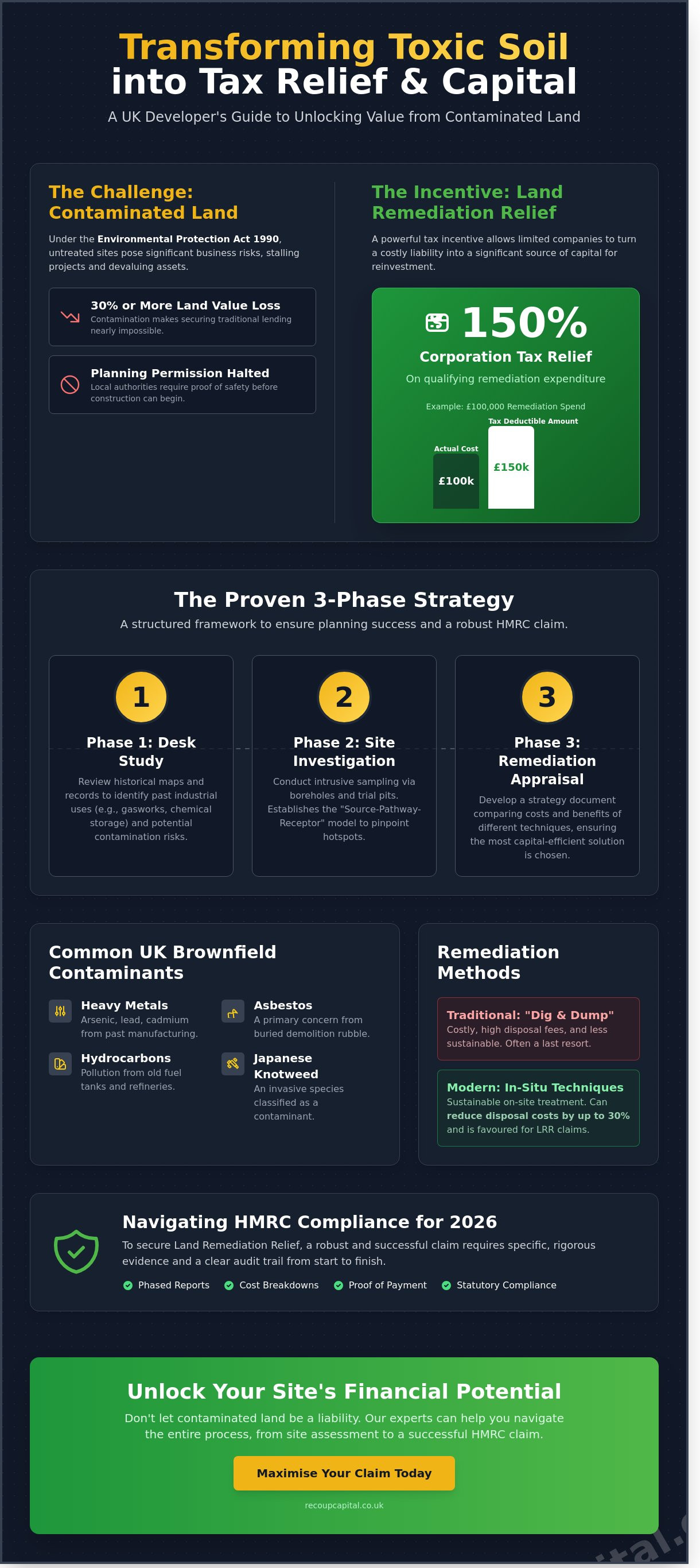
The business impact of untreated sites is substantial. Contamination can slash land value by 30% or more, often making it impossible to secure traditional lending. It frequently halts planning permissions, as local authorities require documented proof of safety before any construction begins. Investing in contaminated land remediation isn't just a hurdle; it's a way to unlock significant money for reinvestment by turning a liability into a high-value asset. This process ensures your project meets the requirements of lenders and insurers, helping your business thrive in a competitive development market.
Statutory Definitions: Contaminated vs. Derelict Land
HMRC defines a "Contaminated State" as land that causes, or has the potential to cause, relevant harm or the pollution of controlled waters. This definition is precise. It excludes land where substances are present only in their natural state, unless human activity has concentrated them or moved them. For your 2026 tax strategy, you must also distinguish this from derelict land. To qualify as derelict for tax relief purposes, a site must have been out of use since at least 1 April 1998. This distinction is vital. It determines the specific level of land remediation relief your business can claim against its Corporation Tax bill, turning a complex legislative requirement into a financial opportunity.
Common Contaminants Found on UK Brownfield Sites
UK development sites often face the "big three" legacy issues from our industrial past. First, heavy metals like arsenic, cadmium, and lead are common on land previously used for manufacturing or smelting. Second, hydrocarbons from old fuel tanks or refineries frequently pollute the soil and groundwater. Third, asbestos remains a primary concern, especially on sites with buried demolition rubble from the mid-20th century. Beyond these industrial pollutants, biological threats like Japanese Knotweed are officially classified as contaminants for tax purposes. This invasive species can grow through concrete and damage foundations, making its removal essential for structural integrity. Whether dealing with naturally occurring radon gas or man-made chemical spills, identifying these early ensures a seamless transition from a site survey to a successful claim.
The Phased Approach to Land Remediation Strategy
A haphazard approach to contaminated land remediation is a recipe for budget overruns and HMRC rejection. Success requires a structured, three-phase framework that satisfies both local planning authorities and tax inspectors. This isn't just about compliance; it's about creating a robust audit trail for your financial recovery. By following the Contaminated Land Statutory Guidance, developers can ensure their project meets the legal "suitable for use" standard while maximizing their tax position.
The process begins with Phase 1, a desk-based research exercise. We examine historical maps and trade directories to identify past land uses, such as 19th-century gasworks or mid-century chemical storage. Phase 2 moves into intrusive site investigation. This involves boreholes and trial pits to collect physical samples. Finally, Phase 3 delivers the Remediation Options Appraisal. This document weighs the costs and benefits of different techniques, ensuring the chosen path is the most efficient use of capital.
Site Investigation and Risk Assessment
Precision in the early stages prevents expensive mistakes later. We use soil and groundwater sampling to establish the "Source-Pathway-Receptor" model. This identifies the pollutant (source), how it moves (pathway), and who or what it harms (receptor). By pinpointing exact hotspots of hydrocarbons or heavy metals, you can avoid the "dig and dump" trap. Targeted data allows for surgical excavation, which can reduce waste disposal costs by up to 30% on complex sites. This level of detail is exactly what we look for when identifying money for reinvestment through tax relief claims.
Validation and Long-Term Monitoring
The Validation Report is the most critical document in your strategy. It's the final proof that the site is safe for its intended use, whether that's high-density housing or commercial units. For HMRC, this report serves as the primary evidence that the contaminated land remediation was necessary and successfully completed. Without it, claiming the 150% corporation tax relief becomes significantly harder.
Some sites require ongoing monitoring, especially if contaminants are capped or contained rather than removed. You might need to track groundwater quality or landfill gas levels for several years post-development. These ongoing costs are often overlooked but remain eligible for relief. If you're unsure if your current strategy meets these rigorous standards, it's worth booking a FREE 15 minute consultation to review your documentation. We act as your expert friend, ensuring your technical data translates into a successful financial outcome.
Effective Methods for Remediating Contaminated Sites
The era of simply hauling tainted earth to a landfill is ending. In 2026, developers face stricter ESG mandates and rising Landfill Tax rates, which hit £103.70 per tonne for the standard rate in 2024. This financial pressure has turned contaminated land remediation into a field of high-tech innovation rather than just earthmoving. Modern methods focus on treating soil where it lies, preserving the site's integrity while unlocking significant tax advantages. Selecting the right strategy isn't just an environmental choice; it's a calculated business decision that dictates your project's ultimate ROI.
In-Situ vs. Ex-Situ Techniques
Choosing between treating soil in place (in-situ) or moving it for processing (ex-situ) defines your project's rhythm. Bioremediation is a standout choice for organic pollutants like hydrocarbons. It uses naturally occurring microbes to break down contaminants, often reducing treatment costs by 30% compared to traditional disposal. Soil washing is another powerful tool for 2026 projects, using water-based processes to scrub pollutants from coarse-grained soil on-site. For more stubborn volatile compounds, thermal desorption applies heat to vaporise toxins, allowing clean soil to be reused immediately. This level of technical complexity is exactly what the HMRC Guidance on Land Remediation Relief seeks to reward. By opting for these advanced methods, companies can often qualify for the 150% tax deduction on qualifying expenditure, turning a site hazard into a source of reinvestment capital.
Containment and Capping Strategies
Sometimes, complete removal isn't the most efficient path for a developer's bottom line. When "dig and dump" costs exceed the project's contingency budget, containment becomes the primary strategy. This involves installing physical barriers or clean cover systems to break the pathway between the pollutant and the end-user. We're also seeing a significant rise in stabilisation and solidification techniques. This process uses chemical binders to lock contaminants within a solid, inert matrix, effectively preventing leaching into groundwater. While these methods require long-term monitoring, they often allow projects to proceed on sites that would otherwise be commercially unviable.
Balancing environmental impact with tight 2026 delivery schedules requires a partnership-led approach. While in-situ methods might take longer than a week of heavy excavation, the reduction in haulage costs and the boost to your land remediation claim often result in a much healthier financial outcome. It's about viewing the ground beneath your project not as a problem to be moved, but as an asset to be restored.
Financial Incentives: Land Remediation Relief (LRR) Explained
Land Remediation Relief (LRR) is one of the most effective ways for UK limited companies to reclaim costs associated with brownfield development. It offers a 150% tax deduction on qualifying expenditure. This means if your business spends £100,000 on contaminated land remediation, you can reduce your taxable profit by £150,000. It's a significant boost for the bottom line that turns an environmental liability into a fiscal asset.
You must meet specific criteria to qualify. The land must be located in the UK and held as a capital asset or stock by a limited company at the time the work is performed. Crucially, the "Polluter Pays" principle applies here. You cannot claim if you, or someone with a relevant connection to your company, caused the original contamination. HMRC expects you to be the solution to the problem, not the source of it.
Many construction firms already use R&D tax credits for technical innovation, but LRR is often left on the table. While R&D rewards breakthroughs in design or process, LRR focuses specifically on the physical restoration of the site. They're complementary tools. If your team develops a bespoke, innovative method to clean a site, you might find yourself eligible for both reliefs across different parts of the project budget.
Calculating Your Potential Tax Benefit
The financial impact depends on your current profitability. Profitable companies use the 150% deduction to directly offset Corporation Tax. For loss-making firms, the relief can be surrendered for a cash payment from HMRC, currently set at 16% of the qualifying expenditure. Qualifying costs include direct staff salaries, materials used in the process, and 100% of sub-contractor fees. Generalist accountants often overlook these claims because they view contaminated land remediation as a standard development cost. We see it as vital money for reinvestment.
Maximising Relief on Derelict Land
Ready to see how much capital is waiting in your site? Book a FREE 15 minute consultation to explore your eligibility.
Navigating HMRC Compliance for Remediation Claims
HMRC's scrutiny of tax relief claims has intensified significantly following the 2024 compliance updates. For 2026, a successful submission isn't just about showing a receipt; it's about proving a direct causal link between the pollutant and the extra costs incurred. You must demonstrate that the expenditure wouldn't have been necessary if the land weren't in a contaminated state. HMRC expects a high level of technical detail that many generalist accountants may overlook.
The standard for contaminated land remediation claims relies on a robust evidence chain. This starts with the Phase 1 Desk Study and Phase 2 Intrusive Investigation. These documents act as the baseline, identifying the "relevant harm" or "significant possibility of significant harm" required by legislation. Without these contemporaneous records, HMRC may argue that your cleanup efforts were part of standard site preparation rather than targeted remediation.
Evidence-Based Claim Preparation
Technical reports are the backbone of your justification. To secure the 150% tax relief, you must clearly apportion costs between "remediation" and "standard development." For example, if you're removing 500 tonnes of soil, you need to prove which portion was removed because of hazardous concentrations of lead or hydrocarbons, rather than just to create a level building platform.
- Phase 1 and 2 Reports: These must pre-date the start of works to prove the contamination was known.
- Remediation Strategy: A clear plan detailing how the identified risks were mitigated.
- Verification Reports: Final proof that the remediation was successful and the site is now fit for use.
- Invoices and Timesheets: Detailed breakdowns that separate plant hire and labour for remediation from general construction tasks.
Common mistakes often involve "double dipping" or claiming for capital expenditures that don't qualify. HMRC inquiries have risen by approximately 22% in the last two years, often triggered by vague descriptions like "site clearance" or "groundworks." Precise record-keeping during the cleanup phase ensures you don't leave money on the table or invite unnecessary audits.
Why Partner with a Specialist Consultant?
We don't believe in the traditional sales pitch. Instead, we focus on evidence-led tax recovery that protects your business from future risk. Navigating the 2009 Corporation Tax Act and subsequent HMRC manuals is a complex task. Recoup Capital acts as your expert friend, translating technical site data into a robust financial narrative. Our goal is to ensure a seamless and compliant process that withstands the most rigorous HMRC inspection.
By choosing a specialist, you move beyond guesswork. We identify qualifying contaminated land remediation costs that are often missed, such as professional fees, health and safety equipment, and specific employer's liability insurance. This isn't just about a refund; it's about securing capital for your next innovation.
Ready to see if your project qualifies for significant reinvestment capital? Book a free 15-minute consultation to assess your site eligibility and start your journey toward a successful claim.
Transforming Your Remediation Liabilities into Growth Capital
Navigating the technical and financial hurdles of contaminated land remediation doesn't have to be a drain on your project's bottom line. By following a structured phased approach and leveraging Land Remediation Relief, UK firms can offset up to 150% of their qualifying expenditure against Corporation Tax. It's a significant opportunity to recover capital that can be immediately reinvested into your next development or innovation project.
Success in these claims depends on precise technical documentation and strict HMRC compliance. Our specialist team of chartered tax accountants and technical surveyors has a proven track record of maximising claims for UK construction and engineering firms. We work on a success-based fee structure; we only win when you recover your capital. Don't leave your entitled relief on the table. Discover how much your land remediation is worth with a free consultation today. We're here to help your business thrive by turning complex tax legislation into a seamless financial advantage.
Frequently Asked Questions
What exactly is the definition of contaminated land for tax purposes?
For tax purposes, land is considered contaminated under the Corporation Tax Act 2009 if it's in such a state that relevant harm is being caused, or there's a serious possibility of such harm. This includes the presence of substances like asbestos, lead, or arsenic that pose risks to human health or the environment. To qualify for relief, the contamination must result from historical industrial activity or natural occurrences rather than your own company's actions.
Can my company claim Land Remediation Relief if we didn’t cause the pollution?
You can only claim Land Remediation Relief if your company was not responsible for the original pollution. HMRC guidelines strictly follow the "polluter pays" principle, meaning the person who caused the damage is ineligible for the tax break. This relief is specifically designed to incentivise developers and businesses to purchase and clean up brownfield sites they've inherited. It's a strategic way to unlock money for reinvestment while revitalising neglected areas of the UK.
How much can a limited company actually save through Land Remediation Relief?
A limited company can claim up to 150% tax relief on qualifying expenditure related to contaminated land remediation. For a profit-making company spending £100,000 on cleanup, this creates a £150,000 deduction from taxable profits. If your business is loss-making, you can surrender the loss for a cash credit worth 16% of the qualifying claim. This provides a significant capital injection to help your business thrive and continue its development goals without being hindered by cleanup costs.
What are the most cost-effective methods for contaminated land remediation?
Bioremediation and on-site soil washing are currently the most cost-effective methods for contaminated land remediation compared to traditional "dig and dump" strategies. With the standard rate of Landfill Tax reaching £103.70 per tonne in April 2024, moving waste off-site is increasingly expensive. On-site biological treatments use microbes to break down pollutants, while soil washing separates contaminants from clean aggregate. Both methods reduce disposal fees and can significantly lower your overall project expenditure.
Is Japanese Knotweed removal eligible for tax relief in the UK?
Japanese Knotweed removal is eligible for tax relief as long as your company didn't plant it or allow it to spread onto the site. HMRC recognises this invasive species as a form of biological contamination because it can cause structural damage to buildings and infrastructure. Whether you use chemical injections or full excavation, the costs associated with eradicating the plant from your site qualify for the 150% relief. It's a common claim for developers working on long-neglected UK sites.
How long do I have to submit a claim for land remediation tax relief?
You have up to two years from the end of the accounting period in which the expenditure occurred to submit your claim. This statutory window allows you to look back at previous projects and recover costs that you might have missed during the initial construction phase. If your company's year-end was 31 December 2023, you've got until 31 December 2025 to file. We recommend starting the process early to ensure all technical documentation is robust and ready for HMRC submission.
What happens if HMRC investigates my land remediation claim?
If HMRC investigates your claim, they'll usually open a compliance check to verify that the land meets the legal definition of contaminated. They'll request soil reports, invoices, or site surveys to confirm the expenditure was directly related to the remediation work. Having an expert partner like Recoup Capital ensures you're protected; we handle the technical queries and provide the evidence needed to satisfy the enquiry. It's a transparent process designed to confirm the validity of your financial recovery.
Can I claim relief on land that is derelict but not technically contaminated?
You can claim relief on derelict land provided it has been out of use since at least 1 April 1998. Derelict land is defined as land that cannot be brought into productive use without the removal of redundant buildings or structures. This extension to the relief scheme allows developers to recover costs for removing old foundations, reinforced concrete, or machinery bases. It's a valuable tool for transforming "dead" sites into profitable developments without the full burden of clearing historical structures.