
15 Essential Questions to Ask an R&D Tax Consultant in 2026

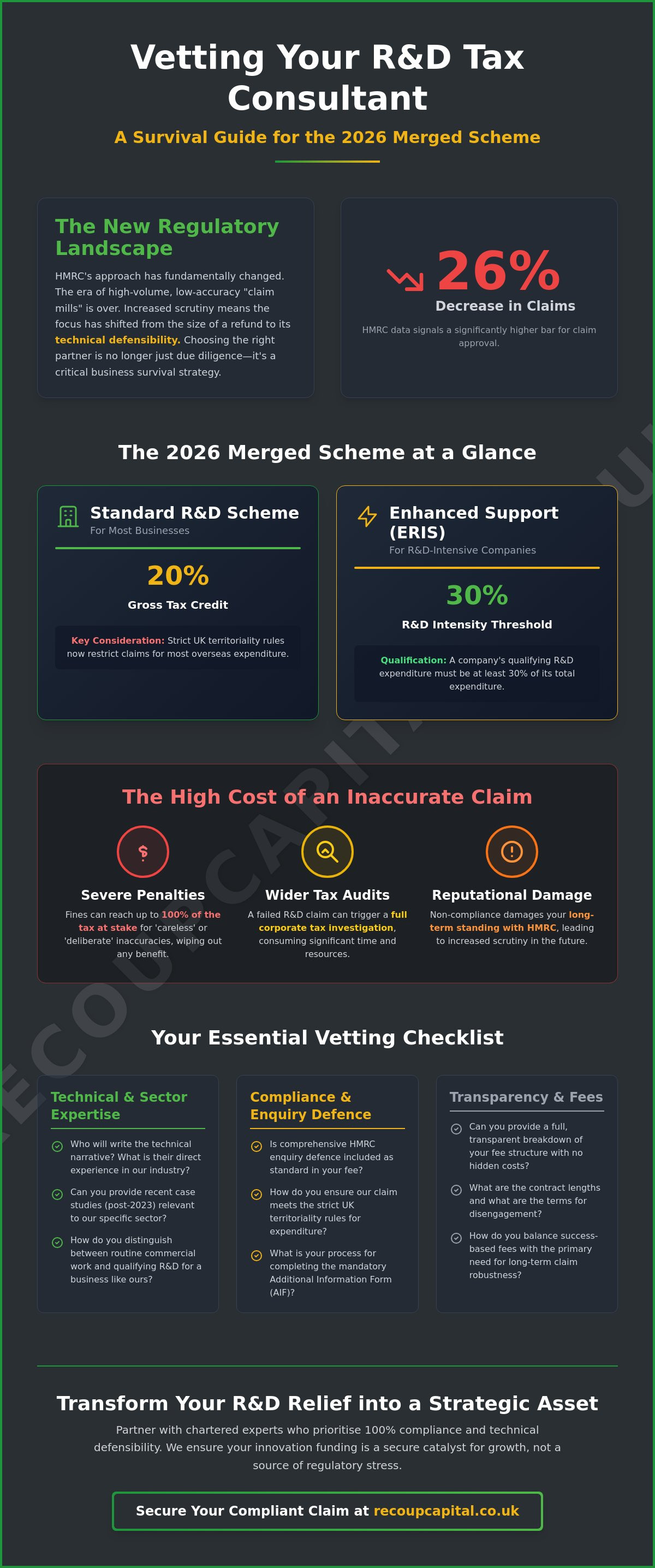
In the current regulatory climate, the most dangerous mistake a business can make is prioritising the size of a tax refund over its technical defensibility. With HMRC reporting a 26% decrease in total claims during the 2023-24 period, knowing the specific questions to ask an R&D tax consultant has become a matter of business survival rather than just simple due diligence. You likely feel the weight of the 2026 merged scheme rules and the anxiety that comes with increased HMRC scrutiny. It's frustrating to see your innovation potential stalled by complex territoriality restrictions or the looming threat of a compliance enquiry.
We believe that capital recovery should be a catalyst for growth, not a source of legal stress. This article provides a comprehensive vetting checklist to help you protect your business whilst maximising your innovation funding. We will walk you through the essential criteria for finding a long-term strategic partner who can ensure 100% compliance with the latest standards, from the 30% intensity threshold for ERIS to the 20% gross credit under the merged scheme. By the end, you'll have the tools to secure a robust claim that stands up to any professional challenge and functions as a genuine strategic asset.
Key Takeaways
- Understand why the shift in HMRC behaviour means choosing a quality partner is now about rigorous risk mitigation rather than just the size of the credit.
- Learn how to verify a specialist's sector-specific expertise to ensure your technical narrative meets the nuanced standards of the 2026 merged scheme.
- Use our comprehensive checklist of questions to ask an R&D tax consultant to ensure your provider offers robust enquiry defence as a standard inclusion.
- Identify potential hidden costs and predatory contract lengths by scrutinising fee structures and engagement terms before committing your business.
- Discover how to transform your tax relief into a strategic business asset through a transparent, results-oriented partnership rooted in chartered expertise.
Why Vetting Your R&D Tax Consultant is Critical in 2026
HMRC's stance on innovation incentives has undergone a fundamental transformation. The era of high-volume 'claim mills', providers who prioritised quantity over technical accuracy, has effectively ended. Recent HMRC data from September 2025 reveals a 26% decrease in the total number of claims; this is a clear signal that the bar for entry has been raised. In this environment, the questions to ask an R&D tax consultant must focus on their ability to navigate the 2026 merged scheme rules. These rules now apply a single 20% gross credit to most businesses whilst maintaining the Enhanced R&D Intensive Support (ERIS) for those meeting the 30% intensity threshold.
Accuracy is no longer optional. The introduction of the mandatory Additional Information Form (AIF) requires a level of technical detail that many general accountants simply aren't prepared to provide. Whilst your accountant is excellent at bookkeeping, they may lack the forensic engineering or scientific background required to defend a claim against a specialist HMRC inspector. You need a partner who takes full responsibility for the technical narrative. This ensures every project meets the strict UK territoriality rules that now restrict overseas expenditure, preventing your claim from being rejected before it's even reviewed.
The Cost of Inaccurate Claims in the New Regulatory Era
HMRC's toolkit for addressing non-compliance is extensive. Penalties for 'careless' or 'deliberate' inaccuracies can wipe out the value of a claim entirely, often reaching up to 100% of the tax at stake in severe cases. Beyond the immediate financial hit, an unsuccessful claim can trigger a wider corporate tax audit, damaging your reputation with the authorities for years. By consulting a UK R&D Tax Credit Overview, it becomes clear that the scheme is intended for genuine innovation; faking it is a high-risk strategy. A specialist protects your business by ensuring your technical documentation is bulletproof whilst maximising your innovation funding through legitimate, defensible channels.
Moving Beyond the 'Refund' Mentality
We view recovered capital as a strategic business asset, not just a one-off windfall. In a market crowded with unregulated advisors, professional authority is your best defence. Success-based fees are common, but they must be balanced with high-quality reporting that prioritises long-term stability over short-term gains. Identifying the right questions to ask an R&D tax consultant helps you separate those who simply process paperwork from those who act as a protective guide. This approach transforms complex regulatory procedures into approachable opportunities for business growth, ensuring your innovation is funded safely and sustainably.
Technical Expertise: Questions Regarding Sector Knowledge
Generalised advice is a liability in the 2026 tax environment. When compiling your list of questions to ask an R&D tax consultant, technical depth must be your top priority. A consultant who treats software development the same as civil engineering is unlikely to survive a modern HMRC enquiry. You need to know exactly how they define Research and Development within the context of your specific field. For instance, in construction, routine design and build work rarely qualifies, yet developing bespoke methods for ground stabilisation on contaminated land often does. Demand to see case studies from the last 12 months; this proves they are current with the merged scheme's nuances and didn't stop learning when the old SME rules were retired.
The technical narrative is the heartbeat of your submission. A common pitfall is allowing a salesperson to draft this document. Instead, ask whether a qualified specialist with a background in your specific industry will be lead-authoring the report. They must be intimately familiar with the latest HMRC 'Guidelines on the Meaning of R&D' (GFI) to ensure every claim is defensible. If you are unsure how your specific projects align with these shifting standards, you can explore how we categorise innovation across diverse sectors.
Verifying Industry-Specific Innovation
In complex sectors like food technology or engineering, the line between routine commercial work and qualifying R&D is often blurred. A specialist identifies 'uncertainties' that a generalist accountant might overlook, such as scaling a laboratory process to industrial production whilst maintaining chemical stability. By linking these activities directly to the R&D tax credit criteria, a consultant ensures that the technical narrative explains the 'how' and 'why' of the innovation, rather than just listing project costs. This level of detail is essential for the mandatory Additional Information Form (AIF) required in 2026.
The Qualifications of Your Dedicated Team
Don't be afraid to ask about the professional credentials of the individuals handling your file. The gold standard is a team that includes Chartered Tax Advisers (CTA) or Chartered Accountants working alongside technical experts. In sectors involving physical assets, the role of forensic surveying is also critical; it helps identify hidden R&D within property and infrastructure that a desk-based review would miss. This blend of technical engineering knowledge and forensic tax expertise ensures your claim is both maximised and compliant. We believe this partnership-oriented approach is the only way to transform complex regulatory procedures into a genuine opportunity for business growth.
HMRC Compliance and Enquiry Defence Checklist
HMRC's approach to compliance has shifted from occasional spot-checks to a sophisticated, data-led review process. In this climate, the most vital questions to ask an R&D tax consultant revolve around what happens after the claim is submitted. You must know if they will act as your lead representative or if they expect you to handle the technical heavy lifting alone. A specialist who treats the submission as the end of the process is a significant risk. Instead, look for a partner who provides a comprehensive enquiry defence service as a standard part of their engagement, ensuring you aren't left vulnerable to unexpected hourly fees if HMRC requests more detail.
Transparency is the new benchmark for success. Since the 2026 standards were introduced, HMRC has become particularly sensitive to AI-generated technical narratives that lack human expert oversight. Ask your consultant about their internal quality assurance process. Who is the final signatory on your Additional Information Form (AIF)? Do they carry Professional Indemnity insurance specifically tailored for R&D tax consultancy? These aren't just administrative hurdles; they are the pillars of a secure claim. A consultant's willingness to share their defence track record is a clear indicator of their professional authority and reliability.
Navigating the HMRC Enquiry Process
In 2026, a typical enquiry is no longer a simple exchange of letters. It often involves detailed technical interviews and requests for real-time project documentation. These reviews can last several months, and without expert guidance, the administrative burden on your team can be immense. A specialist with a history of defending claims without reducing the recovered capital is essential. To understand the current regulatory expectations, you can read our guide on HMRC R&D Tax Claim Transparency and AI.
The Importance of Direct HMRC Liaison
You should never feel like a middleman between your advisor and the tax authorities. A high-quality consultant acts as a protective shield, managing all correspondence and technical justifications directly with HMRC. This proactive liaison is crucial because it ensures that the nuances of your innovation are communicated in the specific language that tax inspectors expect. By choosing a partner who understands the intricacies of the manual review process, you protect your business from the stress of regulatory scrutiny and ensure your innovation funding remains a strategic asset for your future growth.
Transparency, Fees, and Engagement Terms
Commercial transparency is the bedrock of a healthy partnership. Amongst the most critical questions to ask an R&D tax consultant are those regarding the fine print of their engagement terms. You shouldn't have to worry about hidden 'onboarding' fees or surprise charges for technical reports. A professional specialist prioritises clarity, ensuring that you understand exactly what you are paying for and what you own at the end of the process. You should always retain ownership of the intellectual property within your reports and spreadsheets. This data is a record of your innovation; you shouldn't be held to ransom by a provider who refuses to share the forensic detail of your own claim.
Efficiency is equally vital. Ask how much of your team's time will be required to facilitate the process. A streamlined experience should only involve a few hours of technical interviews and data collection, leaving your internal experts free to focus on their core work. If a consultant suggests a process that takes weeks of your staff's time, it's a sign they lack the sector-specific expertise required to identify qualifying activities independently.
Understanding Success-Based Fees
Success-based models align the consultant's incentives with your own. You only pay when you recover capital, making it a low-risk way to access specialist advice. This model is particularly fair because it reflects the level of risk management and technical expertise provided. However, ensure this fee is all-inclusive. It should cover strategic advice and corporate finance reviews without adding unexpected costs for 'premium' reporting. Transparency here ensures that your recovered capital remains a high-impact asset for your business.
Contractual Clarity and Client Rights
Long-term tie-ins are a significant red flag in R&D contracts. You should have the freedom to leave after a single claim if the service doesn't meet your expectations. High-quality advisors rely on results to build long-term collaboration and innovation growth. Clear Service Level Agreements (SLAs) regarding submission timelines are also essential. These prevent your claim from sitting in a queue whilst the two-year statutory deadline approaches. By reframing these financial returns as strategic assets for reinvestment, you shift the narrative from a simple refund to a powerful tool for business expansion. If you are ready to move beyond traditional sales tactics, you can view our transparent approach to capital recovery.
The Recoup Capital Difference: Why Our Approach Wins
Finding the right specialist shouldn't feel like a gamble. When you consider the essential questions to ask an R&D tax consultant, the answers should lead you toward a partnership that values your innovation as a strategic asset. At Recoup Capital, we don't just process paperwork; we act as a protective guide through the complexities of the 2026 regulatory landscape. Our national reach allows us to provide expert guidance to companies across the UK, offering the stability of a large-scale firm without the 'boutique' risk of limited resources or narrow sector focus.
We operate on a success-based model. This means we only win when you recover strategic capital for your business. It's a relationship-first approach that ensures our goals are perfectly aligned with yours. Our team includes specialists with chartered expertise who understand the forensic detail of HMRC requirements, ensuring every technical narrative is robust and defensible. We also take a holistic view of your financial health, identifying opportunities for Capital Allowances and Land Remediation Relief that generalists often overlook.
A Partnership Focused on Your Bottom Line
Efficiency is at the heart of how we organise the end-to-end process. We aim to minimise your team's time investment whilst maximising the accuracy and value of your claim. Transparency is a non-negotiable standard for us; you will see every calculation and every technical justification before it reaches HMRC. Our deep Corporate Finance background gives us a unique advantage in accurately valuing your innovation and reframing your returns as tools for future growth. This ensures that the capital you recover becomes a catalyst for further innovation rather than just a line item on a balance sheet.
Next Steps: Your No-Cost R&D Assessment
Taking the first step toward securing your innovation funding is straightforward. Our initial assessment identifies qualifying projects without any financial commitment or pressure. To prepare for your first meeting with a Recoup Capital specialist, simply gather a brief overview of your recent technical challenges and any associated costs. This low-friction entry point allows us to demonstrate our value through results rather than a traditional pitch. For a deeper dive into selecting the right advisor, see our R&D Tax Credit Specialists UK Guide to ensure your business remains compliant and competitive in 2026.
Secure Your Innovation Funding for a Resilient Future
The landscape of R&D tax relief in 2026 demands a fundamental shift from high-volume processing to forensic, technical accuracy. You've seen how the merged scheme and the mandatory Additional Information Form have significantly increased the compliance burden on businesses. By using the right questions to ask an R&D tax consultant, you ensure your provider possesses the technical depth to defend your claim whilst treating recovered capital as a strategic asset for growth. Prioritising sector-specific knowledge and contractual transparency is no longer optional; it's the only way to mitigate the risk of a costly HMRC enquiry.
At Recoup Capital, our team of Chartered Tax Accountants specialises in navigating these complex regulatory shifts, particularly within the Construction and Engineering sectors. We operate on a success-based fee structure, meaning we only win when you recover the capital your innovation deserves. We're ready to act as your protective guide, transforming a potentially intimidating procedure into a streamlined opportunity for business expansion. Book your no-obligation R&D consultation with Recoup Capital today to secure your funding with confidence. Your next breakthrough deserves a partner who is as invested in your bottom line as you are.
Frequently Asked Questions
Do I really need a specialist if my accountant already handles my tax returns?
Whilst your accountant is vital for general compliance, a specialist provides the technical engineering and scientific expertise required to identify qualifying R&D activities. HMRC now requires a deep technical narrative that connects your work to specific scientific uncertainties. Most general accountants don't have the forensic surveying skills or the sector-specific background to draft these complex reports to the standard expected in 2026.
What happens if HMRC opens an enquiry into an R&D claim submitted by a consultant?
Your consultant should take the lead in managing the entire enquiry process. They act as a protective shield, handling all correspondence and providing the technical justifications HMRC requires. This is one of the most vital questions to ask an R&D tax consultant before signing a contract. You need a partner who includes full enquiry defence in their standard service rather than leaving you to face the tax authorities alone.
How much does an R&D tax consultant typically charge for their services?
The most common model is a success-based fee, where the consultant receives a percentage of the actual tax benefit recovered. This aligns their incentives with your own and ensures you aren't paying for a claim that doesn't succeed. You should always check for hidden costs like onboarding fees or report writing charges. A transparent provider will be clear about their fee structure from the very first meeting.
Can I switch R&D tax consultants if I am unhappy with my current provider?
You can certainly switch providers if your current contract allows for it. Many businesses move to a new specialist if they feel their current provider is too aggressive or lacks the technical depth required for the 2026 merged scheme. Before making the move, review your existing engagement letter for any notice periods or multi-year tie-in clauses that might affect your transition.
What is the 'Additional Information Form' (AIF) and why is it mandatory in 2026?
The AIF is a mandatory digital submission that provides HMRC with a detailed breakdown of your R&D projects and costs. It was introduced to improve transparency and combat inaccurate claims across the industry. In 2026, a claim is considered invalid if this form isn't submitted correctly. It requires a named senior officer from your company to sign off on the technical and financial details provided by your consultant.
How long does the R&D claim process take from start to finish?
The preparation phase usually takes between four and eight weeks, depending on the complexity of your projects. This involves technical interviews and gathering financial data to build a robust submission. Once submitted, HMRC typically aims to process claims within 28 days. However, if your claim is selected for a manual review or enquiry, this timeline can extend as the authorities conduct a more thorough investigation.
Are R&D tax credits still available for loss-making companies in 2026?
Yes, loss-making companies can still access significant funding through the merged scheme or Enhanced R&D Intensive Support (ERIS). If your R&D expenditure is at least 30% of your total expenditure, you may qualify for the ERIS rate, which offers a higher net benefit. For other loss-making firms, the merged scheme provides a 20% gross credit that can be surrendered for a cash payment, supporting your future innovation.
What are the biggest 'red flags' to look out for when hiring an R&D specialist?
Be wary of providers who use aggressive sales tactics or suggest that 'everything' qualifies as R&D. A lack of technical staff with industry-specific backgrounds is a major warning sign. If a consultant doesn't mention the AIF or seems unfamiliar with the 2026 merged scheme rules, they likely won't be able to protect your business during an enquiry. Always look for transparency regarding their defence track record and professional indemnity insurance.